 Add to Chrome
 Add to Firefox
 Add to Edge
FitAQA: A Benchmark of Fitness Action Quality Assessment for Multimodal Large Language Models
Aug 09, 2026
Fitness Action Quality Assessment (AQA) is important for intelligent sports training, yet the capabilities of Multimodal Large Language Models (MLLMs) in this setting remain underexplored. Existing benchmarks rely on action-specific annotation schemes and focus primarily on final assessment outputs, offering limited insight into how models assess exercise quality. We introduce FitAQA, a systematic benchmark for evaluating MLLMs in fitness AQA, containing 2,219 videos and 5,512 QA instances across 30 bodyweight exercises. In collaboration with experts in sports science, we develop a unified form error taxonomy that defines 38 recurring form errors within six complementary quality dimensions: alignment, symmetry, stability, coordination, tempo, and completeness. This taxonomy provides a shared assessment framework across different exercises. FitAQA further formulates three evaluation tasks: perception for recognizing relevant visual evidence, judgement for combining that evidence with domain knowledge to assess execution correctness, and temporal grounding for localizing form errors over time. Extensive evaluation shows that current MLLMs still struggle to assess exercise quality comprehensively and localize form errors precisely. Controlled experiments further indicate that visual perception is a key bottleneck, as judgement performance improves substantially when ground-truth perceptual evidence is provided. The dataset and evaluation code will be made publicly available.

ChartSync: A Benchmark for Visuo-Logical Cascading Chart Editing
Jul 11, 2026Generative image editing models struggle with structured statistical charts when data modifications require geometric synchronization. We formalize this task as Visuo-Logical Cascading Editing (VLCE). However, existing methods remain confined to localized text substitutions and struggle with dependency-aware cascading updates. To systematically evaluate this capability, we introduce ChartSync, an expert-validated benchmark constructed via a programmatic rendering pipeline that guarantees deterministic visuo-logical coupling for the ground truth. ChartSync comprises 870 triplets across 9 chart categories and 4 task types, including 235 geometry-coupled VLCE instances that specifically test cascading text-to-geometry synchronization. We further evaluate these instances via a two-tier framework combining objective visual metrics with a vision-language model judge paradigm to assess low-level fidelity alongside multimodal comprehension and reasoning. Evaluating 14 image editing models and one code-mediated pipeline reveals a nuanced capability gap: most open-source models suffer severe drops in geometric synchronization, while only two frontier proprietary models show emerging VLCE capability, with their residual errors mainly involving semantic isolation and background corruption. Our detailed error analysis deconstructs these failure paradigms to identify core meta-abilities for guiding future multimodal architectures. The ChartSync dataset and code are publicly released at https://github.com/kaka-yjk/ChartSyncCodebase.
ReportQA: QA-Based Radiology Report Evaluation
Jun 13, 2026Radiology report evaluation is essential for advancing automated report generation. Natural language generation metrics have limited clinical relevance. Clinical efficacy (CE) metrics evaluate important medical findings, but focus mainly on presence and cover only a limited set of entities. Due to heavy reliance on manual annotations, it is difficult for CE metrics to extend clinical entities or attributes. In clinical practice, radiology reports serve as a medium for information transfer. Clinicians use them to perform downstream diagnostic tasks without directly inspecting images. Based on this insight, we propose ReportQA, a clinical-related and flexible radiology report evaluation framework, supporting detailed quantitative analysis of radiology report generation systems. We first collect datasets covering multiple imaging modalities and anatomical regions. We then construct knowledge trees of clinical entities and attributes with radiologist guidance, and use large language models (LLMs) to extract structured information from raw reports. Next, we generate QA pairs from predefined templates and apply quality control through self-filtering and report-based filtering. During evaluation, the report is treated as context, and an LLM acts as a judge model to answer the QA pairs. Based on the resulting QA accuracy, we introduce QAScore metric. Compared with existing metrics, QAScore shows better alignment with radiologist judgments. Experiments on multiple state-of-the-art vision-language models reveal that current report-based inference paradigms struggle to learn fine-grained clinical representations and exhibit strong negative prior biases. In contrast, question-driven inference provides a more effective alternative. For reproducibility and extensibility, we release the knowledge trees, structured reports, and QA pairs, along with the pipeline code for QA construction and evaluation.
The 1st PortraitCraft Challenge: A CVPR 2026 Workshop Competition on Portrait Composition Understanding and Generation
Jun 09, 2026This paper presents an overview of the inaugural PortraitCraft Challenge, held as one of the official competitions at CVPR 2026. The challenge focuses on portrait composition understanding and generation, aiming to advance AI research in portrait aesthetics analysis and controllable image synthesis. Unlike existing datasets and tasks that primarily focus on global aesthetic scoring, PortraitCraft introduces a unified evaluation framework comprising two complementary tracks. Track 1 requires models to perform structured portrait composition understanding, and Track 2 requires models to generate portrait images from structured composition descriptions under explicit compositional constraints. To support the challenge, we constructed and publicly released a large-scale portrait composition dataset consisting of approximately 50,000 curated real portrait images, providing multi-level supervision. This report describes the challenge setup, evaluation protocols, dataset composition, and final results, along with an analysis of the technical characteristics of the submitted solutions. The PortraitCraft Challenge provides a standardized and reproducible platform for research on portrait composition understanding and generation, and is expected to foster further progress in the fields of portrait aesthetics and controllable image generation.
The Shape of Addition: Geometric Structures of Arithmetic in Large Language Models
May 29, 2026Large Language Models exhibit paradoxical fragility in fundamental arithmetic, implying a disconnect between internal computation and discrete output. By analyzing the residual stream geometry during multi-operand addition, we identify the Iso-Raw-Sum Trajectory (IRST), a geometric structure where representations are anchored by semantic digits and modulated by continuous carry fibers. We propose the Noisy Quantization Model to explain this geometry, framing arithmetic errors as Geometric Slippages caused by internal neural noise pushing a continuous, latent Carry Potential across quantization thresholds. This geometric framework further elucidates Probe Versatility, explaining how lightweight probes can disentangle coexisting latent signals (such as ground truth versus hallucination) from a single activation vector. Finally, we validate these insights through a geometric consistency check method that effectively detects and corrects these quantization failures during inference. Our code is available at https://github.com/RL-MIND/Shape-of-Addition.
InterMesh: Explicit Interaction-Aware End-to-End Multi-Person Human Mesh Recovery
May 06, 2026Humans constantly interact with their surroundings. Existing end-to-end multi-person human mesh recovery methods, typically based on the DETR framework, capture inter-human relationships through self-attention across all human queries. However, these approaches model interactions only implicitly and lack explicit reasoning about how humans interact with objects and with each other. In this paper, we propose InterMesh, a simple yet effective framework that explicitly incorporates human-environment interaction information into human mesh recovery pipeline. By leveraging a human-object interaction detector, InterMesh enriches query representations with structured interaction semantics, enabling more accurate pose and shape estimation. We design lightweight modules, Contextual Interaction Encoder and Interaction-Guided Refiner, to integrate these features into existing HMR architectures with minimal overhead. We validate our approach through extensive experiments on 3DPW, MuPoTS, CMU Panoptic, Hi4D, and CHI3D datasets, demonstrating remarkable improvements over state-of-the-art methods. Notably, InterMesh reduces MPJPE by 9.9% on CMU Panoptic and 8.2% on Hi4D, highlighting its effectiveness in scenarios with complex human-object and inter-human interactions.
Lost in the Hype: Revealing and Dissecting the Performance Degradation of Medical Multimodal Large Language Models in Image Classification
Apr 09, 2026The rise of multimodal large language models (MLLMs) has sparked an unprecedented wave of applications in the field of medical imaging analysis. However, as one of the earliest and most fundamental tasks integrated into this paradigm, medical image classification reveals a sobering reality: state-of-the-art medical MLLMs consistently underperform compared to traditional deep learning models, despite their overwhelming advantages in pre-training data and model parameters. This paradox prompts a critical rethinking: where exactly does the performance degradation originate? In this paper, we conduct extensive experiments on 14 open-source medical MLLMs across three representative image classification datasets. Moving beyond superficial performance benchmarking, we employ feature probing to track the information flow of visual features module-by-module and layer-by-layer throughout the entire MLLM pipeline, enabling explicit visualization of where and how classification signals are distorted, diluted, or overridden. As the first attempt to dissect classification performance degradation in medical MLLMs, our findings reveal four failure modes: 1) quality limitation in visual representation, 2) fidelity loss in connector projection, 3) comprehension deficit in LLM reasoning, and 4) misalignment of semantic mapping. Meanwhile, we introduce quantitative scores that characterize the healthiness of feature evolution, enabling principled comparisons across diverse MLLMs and datasets. Furthermore, we provide insightful discussions centered on the critical barriers that prevent current medical MLLMs from fulfilling their promised clinical potential. We hope that our work provokes rethinking within the community-highlighting that the road from high expectations to clinically deployable MLLMs remains long and winding.
MIPS: a Multimodal Infinite Polymer Sequence Pre-training Framework for Polymer Property Prediction
Jul 27, 2025Polymers, composed of repeating structural units called monomers, are fundamental materials in daily life and industry. Accurate property prediction for polymers is essential for their design, development, and application. However, existing modeling approaches, which typically represent polymers by the constituent monomers, struggle to capture the whole properties of polymer, since the properties change during the polymerization process. In this study, we propose a Multimodal Infinite Polymer Sequence (MIPS) pre-training framework, which represents polymers as infinite sequences of monomers and integrates both topological and spatial information for comprehensive modeling. From the topological perspective, we generalize message passing mechanism (MPM) and graph attention mechanism (GAM) to infinite polymer sequences. For MPM, we demonstrate that applying MPM to infinite polymer sequences is equivalent to applying MPM on the induced star-linking graph of monomers. For GAM, we propose to further replace global graph attention with localized graph attention (LGA). Moreover, we show the robustness of the "star linking" strategy through Repeat and Shift Invariance Test (RSIT). Despite its robustness, "star linking" strategy exhibits limitations when monomer side chains contain ring structures, a common characteristic of polymers, as it fails the Weisfeiler-Lehman~(WL) test. To overcome this issue, we propose backbone embedding to enhance the capability of MPM and LGA on infinite polymer sequences. From the spatial perspective, we extract 3D descriptors of repeating monomers to capture spatial information. Finally, we design a cross-modal fusion mechanism to unify the topological and spatial information. Experimental validation across eight diverse polymer property prediction tasks reveals that MIPS achieves state-of-the-art performance.
Enhancing Multi-task Learning Capability of Medical Generalist Foundation Model via Image-centric Multi-annotation Data
Apr 14, 2025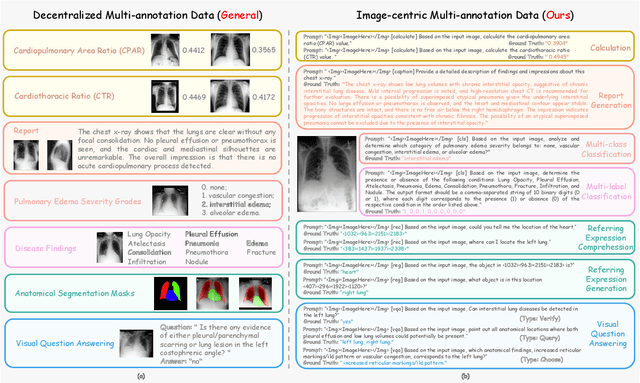
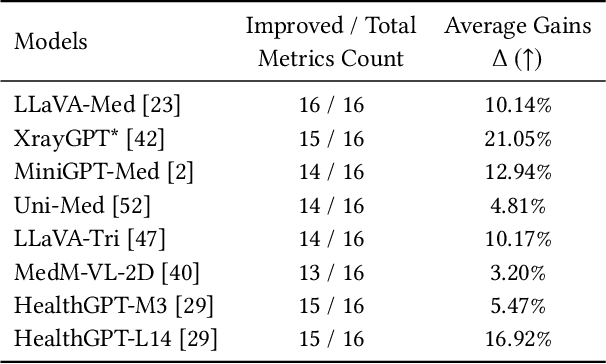
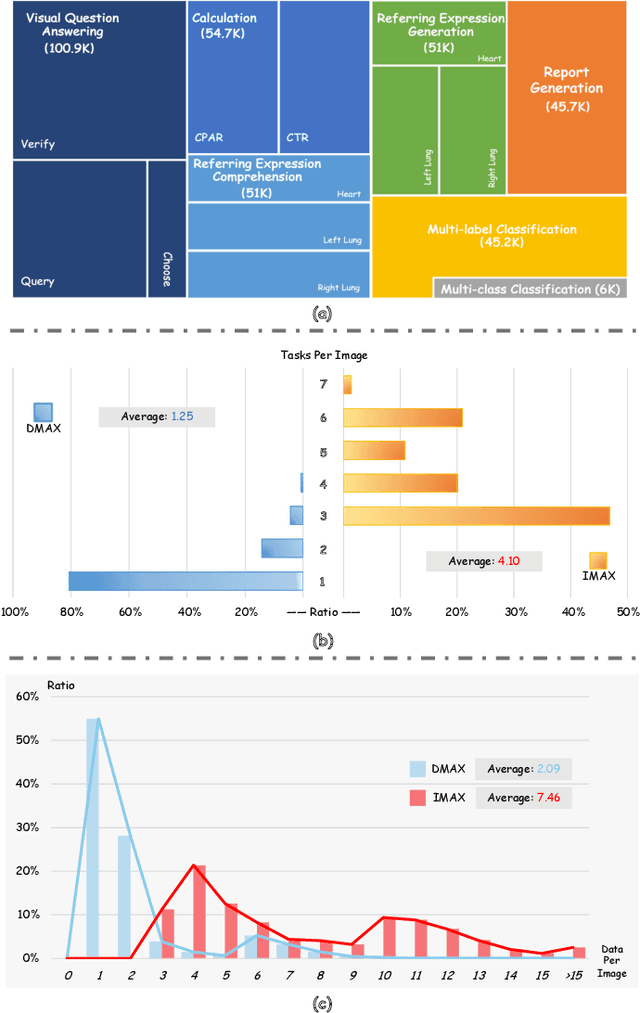

The emergence of medical generalist foundation models has revolutionized conventional task-specific model development paradigms, aiming to better handle multiple tasks through joint training on large-scale medical datasets. However, recent advances prioritize simple data scaling or architectural component enhancement, while neglecting to re-examine multi-task learning from a data-centric perspective. Critically, simply aggregating existing data resources leads to decentralized image-task alignment, which fails to cultivate comprehensive image understanding or align with clinical needs for multi-dimensional image interpretation. In this paper, we introduce the image-centric multi-annotation X-ray dataset (IMAX), the first attempt to enhance the multi-task learning capabilities of medical multi-modal large language models (MLLMs) from the data construction level. To be specific, IMAX is featured from the following attributes: 1) High-quality data curation. A comprehensive collection of more than 354K entries applicable to seven different medical tasks. 2) Image-centric dense annotation. Each X-ray image is associated with an average of 4.10 tasks and 7.46 training entries, ensuring multi-task representation richness per image. Compared to the general decentralized multi-annotation X-ray dataset (DMAX), IMAX consistently demonstrates significant multi-task average performance gains ranging from 3.20% to 21.05% across seven open-source state-of-the-art medical MLLMs. Moreover, we investigate differences in statistical patterns exhibited by IMAX and DMAX training processes, exploring potential correlations between optimization dynamics and multi-task performance. Finally, leveraging the core concept of IMAX data construction, we propose an optimized DMAX-based training strategy to alleviate the dilemma of obtaining high-quality IMAX data in practical scenarios.
MedM-VL: What Makes a Good Medical LVLM?
Apr 06, 2025Medical image analysis is a fundamental component. As deep learning progresses, the focus has shifted from single-task applications, such as classification and segmentation, to more complex multimodal tasks, including medical visual question answering and report generation. Traditional shallow and task-specific models are increasingly limited in addressing the complexity and scalability required in clinical practice. The emergence of large language models (LLMs) has driven the development of medical Large Vision-Language Models (LVLMs), offering a unified solution for diverse vision-language tasks. In this study, we investigate various architectural designs for medical LVLMs based on the widely adopted LLaVA framework, which follows an encoder-connector-LLM paradigm. We construct two distinct models targeting 2D and 3D modalities, respectively. These models are designed to support both general-purpose medical tasks and domain-specific fine-tuning, thereby serving as effective foundation models. To facilitate reproducibility and further research, we develop a modular and extensible codebase, MedM-VL, and release two LVLM variants: MedM-VL-2D for 2D medical image analysis and MedM-VL-CT-Chest for 3D CT-based applications. The code and models are available at: https://github.com/MSIIP/MedM-VL