 Add to Chrome
 Add to Firefox
 Add to Edge
FitAQA: A Benchmark of Fitness Action Quality Assessment for Multimodal Large Language Models
Aug 09, 2026
Fitness Action Quality Assessment (AQA) is important for intelligent sports training, yet the capabilities of Multimodal Large Language Models (MLLMs) in this setting remain underexplored. Existing benchmarks rely on action-specific annotation schemes and focus primarily on final assessment outputs, offering limited insight into how models assess exercise quality. We introduce FitAQA, a systematic benchmark for evaluating MLLMs in fitness AQA, containing 2,219 videos and 5,512 QA instances across 30 bodyweight exercises. In collaboration with experts in sports science, we develop a unified form error taxonomy that defines 38 recurring form errors within six complementary quality dimensions: alignment, symmetry, stability, coordination, tempo, and completeness. This taxonomy provides a shared assessment framework across different exercises. FitAQA further formulates three evaluation tasks: perception for recognizing relevant visual evidence, judgement for combining that evidence with domain knowledge to assess execution correctness, and temporal grounding for localizing form errors over time. Extensive evaluation shows that current MLLMs still struggle to assess exercise quality comprehensively and localize form errors precisely. Controlled experiments further indicate that visual perception is a key bottleneck, as judgement performance improves substantially when ground-truth perceptual evidence is provided. The dataset and evaluation code will be made publicly available.

InterMesh: Explicit Interaction-Aware End-to-End Multi-Person Human Mesh Recovery
May 06, 2026Humans constantly interact with their surroundings. Existing end-to-end multi-person human mesh recovery methods, typically based on the DETR framework, capture inter-human relationships through self-attention across all human queries. However, these approaches model interactions only implicitly and lack explicit reasoning about how humans interact with objects and with each other. In this paper, we propose InterMesh, a simple yet effective framework that explicitly incorporates human-environment interaction information into human mesh recovery pipeline. By leveraging a human-object interaction detector, InterMesh enriches query representations with structured interaction semantics, enabling more accurate pose and shape estimation. We design lightweight modules, Contextual Interaction Encoder and Interaction-Guided Refiner, to integrate these features into existing HMR architectures with minimal overhead. We validate our approach through extensive experiments on 3DPW, MuPoTS, CMU Panoptic, Hi4D, and CHI3D datasets, demonstrating remarkable improvements over state-of-the-art methods. Notably, InterMesh reduces MPJPE by 9.9% on CMU Panoptic and 8.2% on Hi4D, highlighting its effectiveness in scenarios with complex human-object and inter-human interactions.
BoxComm: Benchmarking Category-Aware Commentary Generation and Narration Rhythm in Boxing
Apr 06, 2026Recent multimodal large language models (MLLMs) have shown strong capabilities in general video understanding, driving growing interest in automatic sports commentary generation. However, existing benchmarks for this task focus exclusively on team sports such as soccer and basketball, leaving combat sports entirely unexplored. Notably, combat sports present distinct challenges: critical actions unfold within milliseconds with visually subtle yet semantically decisive differences, and professional commentary contains a substantially higher proportion of tactical analysis compared to team sports. In this paper, we present BoxComm, a large-scale dataset comprising 445 World Boxing Championship match videos with over 52K commentary sentences from professional broadcasts. We propose a structured commentary taxonomy that categorizes each sentence into play-by-play, tactical, or contextual, providing the first category-level annotation for sports commentary benchmarks. Building on this taxonomy, we introduce two novel and complementary evaluations tailored to sports commentary generation: (1) category-conditioned generation, which evaluates whether models can produce accurate commentary of a specified type given video context; and (2) commentary rhythm assessment, which measures whether freely generated commentary exhibits appropriate temporal pacing and type distribution over continuous video segments, capturing a dimension of commentary competence that prior benchmarks have not addressed. Experiments on multiple state-of-the-art MLLMs reveal that current models struggle on both evaluations. We further propose EIC-Gen, an improved baseline incorporating detected punch events to supply structured action cues, yielding consistent gains and highlighting the importance of perceiving fleeting and subtle events for combat sports commentary.
From Continuous sEMG Signals to Discrete Muscle State Tokens: A Robust and Interpretable Representation Framework
Feb 27, 2026Surface electromyography (sEMG) signals exhibit substantial inter-subject variability and are highly susceptible to noise, posing challenges for robust and interpretable decoding. To address these limitations, we propose a discrete representation of sEMG signals based on a physiology-informed tokenization framework. The method employs a sliding window aligned with the minimal muscle contraction cycle to isolate individual muscle activation events. From each window, ten time-frequency features, including root mean square (RMS) and median frequency (MDF), are extracted, and K-means clustering is applied to group segments into representative muscle-state tokens. We also introduce a large-scale benchmark dataset, ActionEMG-43, comprising 43 diverse actions and sEMG recordings from 16 major muscle groups across the body. Based on this dataset, we conduct extensive evaluations to assess the inter-subject consistency, representation capacity, and interpretability of the proposed sEMG tokens. Our results show that the token representation exhibits high inter-subject consistency (Cohen's Kappa = 0.82+-0.09), indicating that the learned tokens capture consistent and subject-independent muscle activation patterns. In action recognition tasks, models using sEMG tokens achieve Top-1 accuracies of 75.5% with ViT and 67.9% with SVM, outperforming raw-signal baselines (72.8% and 64.4%, respectively), despite a 96% reduction in input dimensionality. In movement quality assessment, the tokens intuitively reveal patterns of muscle underactivation and compensatory activation, offering interpretable insights into neuromuscular control. Together, these findings highlight the effectiveness of tokenized sEMG representations as a compact, generalizable, and physiologically meaningful feature space for applications in rehabilitation, human-machine interaction, and motor function analysis.
BoxMind: Closed-loop AI strategy optimization for elite boxing validated in the 2024 Olympics
Jan 16, 2026Competitive sports require sophisticated tactical analysis, yet combat disciplines like boxing remain underdeveloped in AI-driven analytics due to the complexity of action dynamics and the lack of structured tactical representations. To address this, we present BoxMind, a closed-loop AI expert system validated in elite boxing competition. By defining atomic punch events with precise temporal boundaries and spatial and technical attributes, we parse match footage into 18 hierarchical technical-tactical indicators. We then propose a graph-based predictive model that fuses these explicit technical-tactical profiles with learnable, time-variant latent embeddings to capture the dynamics of boxer matchups. Modeling match outcome as a differentiable function of technical-tactical indicators, we turn winning probability gradients into executable tactical adjustments. Experiments show that the outcome prediction model achieves state-of-the-art performance, with 69.8% accuracy on BoxerGraph test set and 87.5% on Olympic matches. Using this predictive model as a foundation, the system generates strategic recommendations that demonstrate proficiency comparable to human experts. BoxMind is validated through a closed-loop deployment during the 2024 Paris Olympics, directly contributing to the Chinese National Team's historic achievement of three gold and two silver medals. BoxMind establishes a replicable paradigm for transforming unstructured video data into strategic intelligence, bridging the gap between computer vision and decision support in competitive sports.
Towards Metric-Aware Multi-Person Mesh Recovery by Jointly Optimizing Human Crowd in Camera Space
Nov 17, 2025Multi-person human mesh recovery from a single image is a challenging task, hindered by the scarcity of in-the-wild training data. Prevailing in-the-wild human mesh pseudo-ground-truth (pGT) generation pipelines are single-person-centric, where each human is processed individually without joint optimization. This oversight leads to a lack of scene-level consistency, producing individuals with conflicting depths and scales within the same image. To address this, we introduce Depth-conditioned Translation Optimization (DTO), a novel optimization-based method that jointly refines the camera-space translations of all individuals in a crowd. By leveraging anthropometric priors on human height and depth cues from a monocular depth estimator, DTO solves for a scene-consistent placement of all subjects within a principled Maximum a posteriori (MAP) framework. Applying DTO to the 4D-Humans dataset, we construct DTO-Humans, a new large-scale pGT dataset of 0.56M high-quality, scene-consistent multi-person images, featuring dense crowds with an average of 4.8 persons per image. Furthermore, we propose Metric-Aware HMR, an end-to-end network that directly estimates human mesh and camera parameters in metric scale. This is enabled by a camera branch and a novel relative metric loss that enforces plausible relative scales. Extensive experiments demonstrate that our method achieves state-of-the-art performance on relative depth reasoning and human mesh recovery. Code and data will be released publicly.
Med-2E3: A 2D-Enhanced 3D Medical Multimodal Large Language Model
Nov 19, 2024

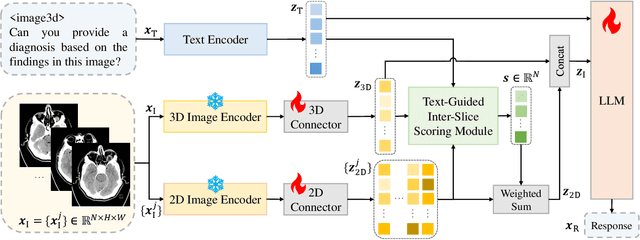

The analysis of 3D medical images is crucial for modern healthcare, yet traditional task-specific models are becoming increasingly inadequate due to limited generalizability across diverse clinical scenarios. Multimodal large language models (MLLMs) offer a promising solution to these challenges. However, existing MLLMs have limitations in fully leveraging the rich, hierarchical information embedded in 3D medical images. Inspired by clinical practice, where radiologists focus on both 3D spatial structure and 2D planar content, we propose Med-2E3, a novel MLLM for 3D medical image analysis that integrates 3D and 2D encoders. To aggregate 2D features more effectively, we design a Text-Guided Inter-Slice (TG-IS) scoring module, which scores the attention of each 2D slice based on slice contents and task instructions. To the best of our knowledge, Med-2E3 is the first MLLM to integrate both 3D and 2D features for 3D medical image analysis. Experiments on a large-scale, open-source 3D medical multimodal benchmark demonstrate that Med-2E3 exhibits task-specific attention distribution and significantly outperforms current state-of-the-art models, with a 14% improvement in report generation and a 5% gain in medical visual question answering (VQA), highlighting the model's potential in addressing complex multimodal clinical tasks. The code will be released upon acceptance.