 Add to Chrome
 Add to Firefox
 Add to Edge
Graphon Mean Field Games with A Representative Player: Analysis and Learning Algorithm
May 08, 2024
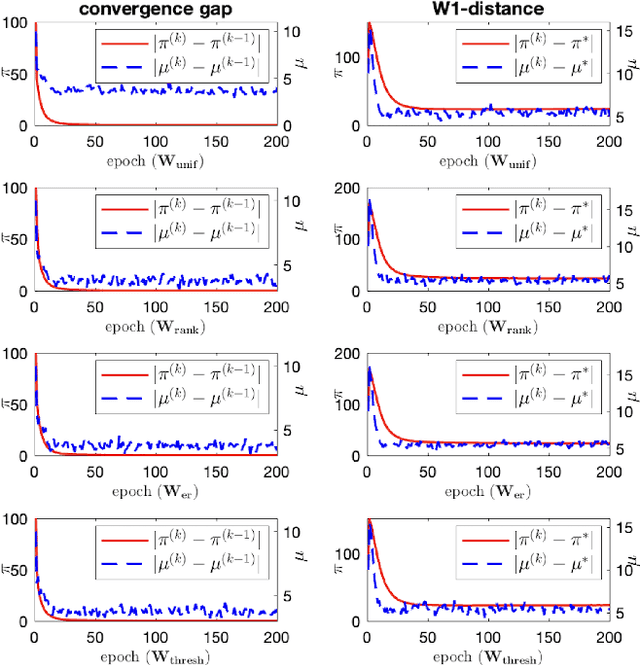
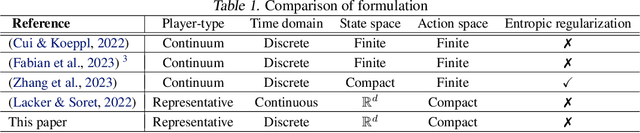
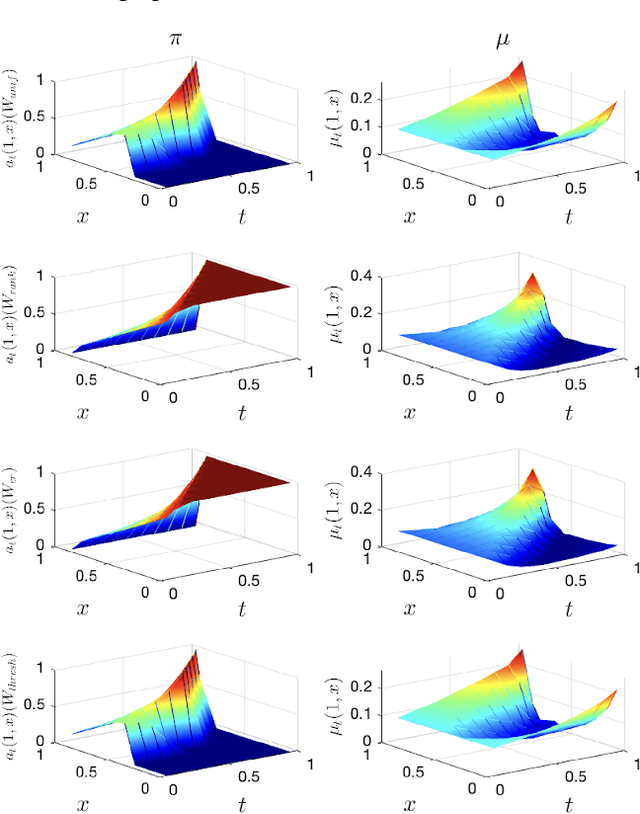
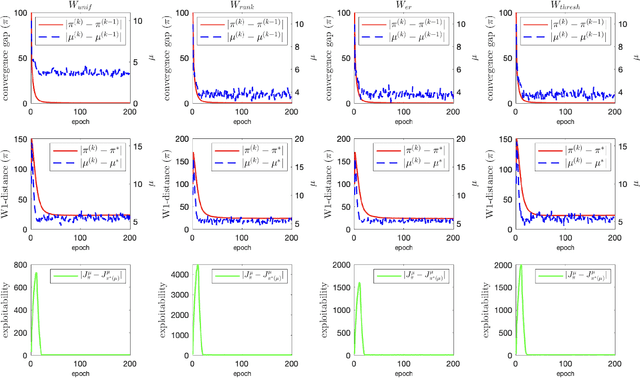
We propose a discrete-time graphon game formulation on continuous state and action spaces using a representative player to study stochastic games with heterogeneous interaction among agents. This formulation admits both philosophical and mathematical advantages, compared to a widely adopted formulation using a continuum of players. We prove the existence and uniqueness of the graphon equilibrium with mild assumptions, and show that this equilibrium can be used to construct an approximate solution for finite player game on networks, which is challenging to analyze and solve due to curse of dimensionality. An online oracle-free learning algorithm is developed to solve the equilibrium numerically, and sample complexity analysis is provided for its convergence.

A Single Online Agent Can Efficiently Learn Mean Field Games
May 05, 2024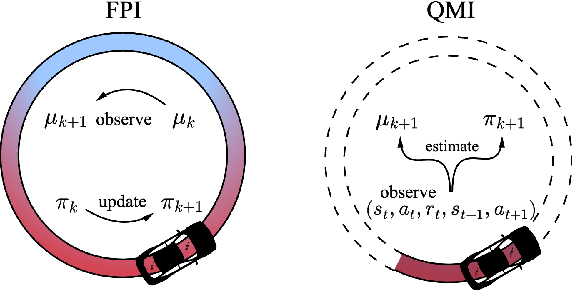
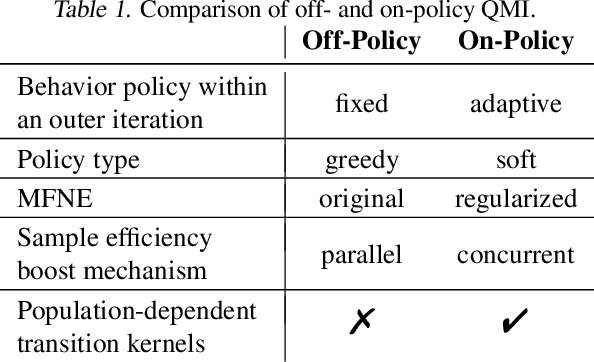
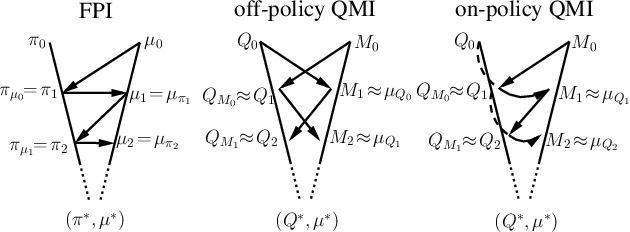
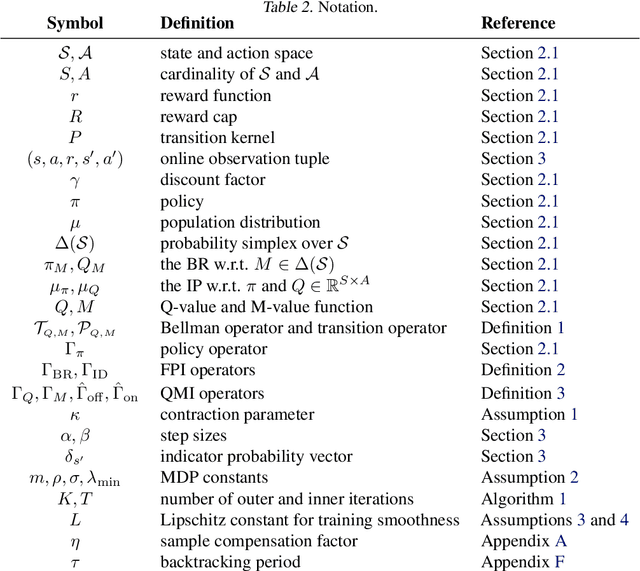
Mean field games (MFGs) are a promising framework for modeling the behavior of large-population systems. However, solving MFGs can be challenging due to the coupling of forward population evolution and backward agent dynamics. Typically, obtaining mean field Nash equilibria (MFNE) involves an iterative approach where the forward and backward processes are solved alternately, known as fixed-point iteration (FPI). This method requires fully observed population propagation and agent dynamics over the entire spatial domain, which could be impractical in some real-world scenarios. To overcome this limitation, this paper introduces a novel online single-agent model-free learning scheme, which enables a single agent to learn MFNE using online samples, without prior knowledge of the state-action space, reward function, or transition dynamics. Specifically, the agent updates its policy through the value function (Q), while simultaneously evaluating the mean field state (M), using the same batch of observations. We develop two variants of this learning scheme: off-policy and on-policy QM iteration. We prove that they efficiently approximate FPI, and a sample complexity guarantee is provided. The efficacy of our methods is confirmed by numerical experiments.
STT: Stateful Tracking with Transformers for Autonomous Driving
Apr 30, 2024Tracking objects in three-dimensional space is critical for autonomous driving. To ensure safety while driving, the tracker must be able to reliably track objects across frames and accurately estimate their states such as velocity and acceleration in the present. Existing works frequently focus on the association task while either neglecting the model performance on state estimation or deploying complex heuristics to predict the states. In this paper, we propose STT, a Stateful Tracking model built with Transformers, that can consistently track objects in the scenes while also predicting their states accurately. STT consumes rich appearance, geometry, and motion signals through long term history of detections and is jointly optimized for both data association and state estimation tasks. Since the standard tracking metrics like MOTA and MOTP do not capture the combined performance of the two tasks in the wider spectrum of object states, we extend them with new metrics called S-MOTA and MOTPS that address this limitation. STT achieves competitive real-time performance on the Waymo Open Dataset.
Debiased Collaborative Filtering with Kernel-Based Causal Balancing
Apr 30, 2024Debiased collaborative filtering aims to learn an unbiased prediction model by removing different biases in observational datasets. To solve this problem, one of the simple and effective methods is based on the propensity score, which adjusts the observational sample distribution to the target one by reweighting observed instances. Ideally, propensity scores should be learned with causal balancing constraints. However, existing methods usually ignore such constraints or implement them with unreasonable approximations, which may affect the accuracy of the learned propensity scores. To bridge this gap, in this paper, we first analyze the gaps between the causal balancing requirements and existing methods such as learning the propensity with cross-entropy loss or manually selecting functions to balance. Inspired by these gaps, we propose to approximate the balancing functions in reproducing kernel Hilbert space and demonstrate that, based on the universal property and representer theorem of kernel functions, the causal balancing constraints can be better satisfied. Meanwhile, we propose an algorithm that adaptively balances the kernel function and theoretically analyze the generalization error bound of our methods. We conduct extensive experiments to demonstrate the effectiveness of our methods, and to promote this research direction, we have released our project at https://github.com/haoxuanli-pku/ICLR24-Kernel-Balancing.
Implementation of Big AI Models for Wireless Networks with Collaborative Edge Computing
Apr 27, 2024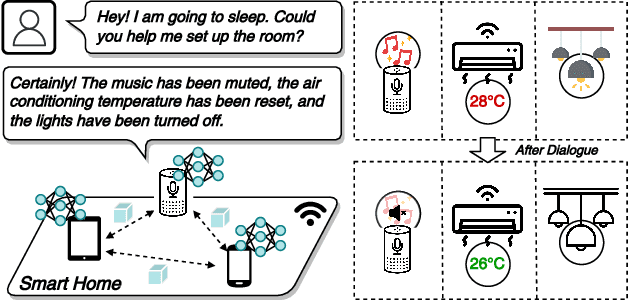
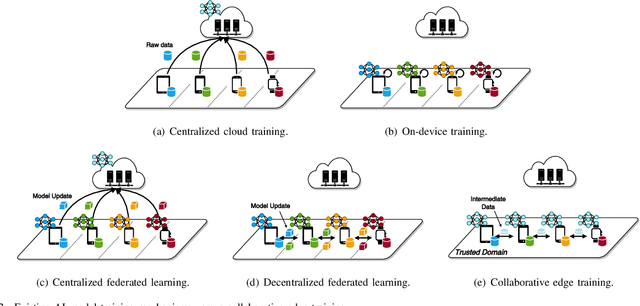
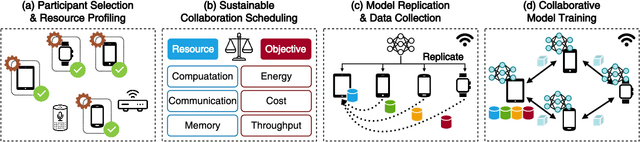

Big Artificial Intelligence (AI) models have emerged as a crucial element in various intelligent applications at the edge, such as voice assistants in smart homes and autonomous robotics in smart factories. Training big AI models, e.g., for personalized fine-tuning and continual model refinement, poses significant challenges to edge devices due to the inherent conflict between limited computing resources and intensive workload associated with training. Despite the constraints of on-device training, traditional approaches usually resort to aggregating training data and sending it to a remote cloud for centralized training. Nevertheless, this approach is neither sustainable, which strains long-range backhaul transmission and energy-consuming datacenters, nor safely private, which shares users' raw data with remote infrastructures. To address these challenges, we alternatively observe that prevalent edge environments usually contain a diverse collection of trusted edge devices with untapped idle resources, which can be leveraged for edge training acceleration. Motivated by this, in this article, we propose collaborative edge training, a novel training mechanism that orchestrates a group of trusted edge devices as a resource pool for expedited, sustainable big AI model training at the edge. As an initial step, we present a comprehensive framework for building collaborative edge training systems and analyze in-depth its merits and sustainable scheduling choices following its workflow. To further investigate the impact of its parallelism design, we empirically study a case of four typical parallelisms from the perspective of energy demand with realistic testbeds. Finally, we discuss open challenges for sustainable collaborative edge training to point to future directions of edge-centric big AI model training.
A Survey on the Memory Mechanism of Large Language Model based Agents
Apr 21, 2024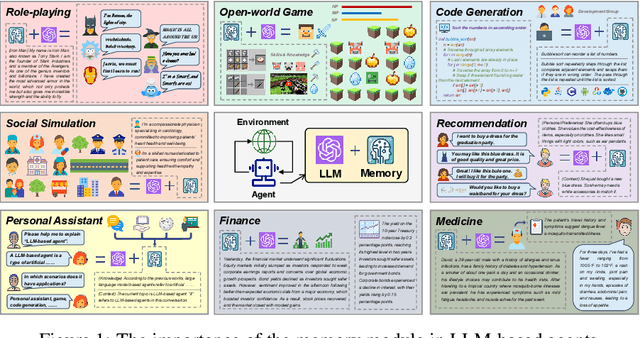


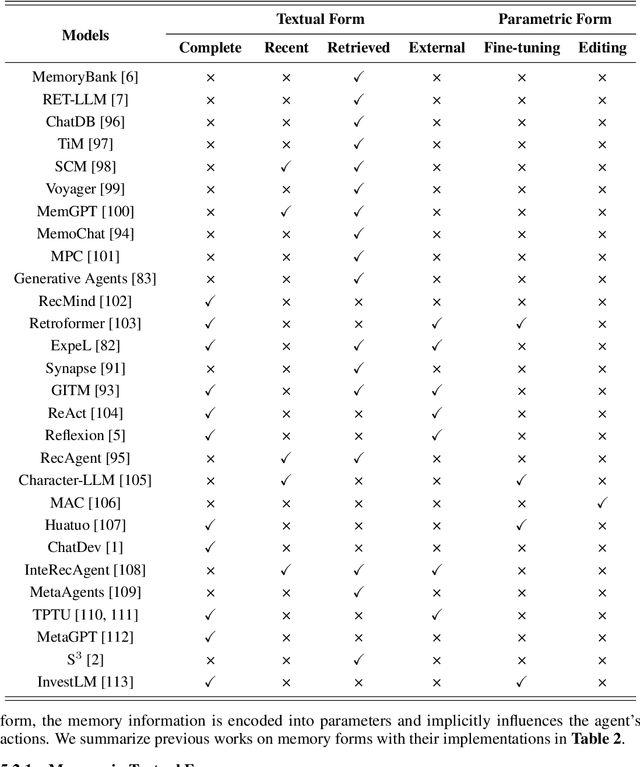
Large language model (LLM) based agents have recently attracted much attention from the research and industry communities. Compared with original LLMs, LLM-based agents are featured in their self-evolving capability, which is the basis for solving real-world problems that need long-term and complex agent-environment interactions. The key component to support agent-environment interactions is the memory of the agents. While previous studies have proposed many promising memory mechanisms, they are scattered in different papers, and there lacks a systematical review to summarize and compare these works from a holistic perspective, failing to abstract common and effective designing patterns for inspiring future studies. To bridge this gap, in this paper, we propose a comprehensive survey on the memory mechanism of LLM-based agents. In specific, we first discuss ''what is'' and ''why do we need'' the memory in LLM-based agents. Then, we systematically review previous studies on how to design and evaluate the memory module. In addition, we also present many agent applications, where the memory module plays an important role. At last, we analyze the limitations of existing work and show important future directions. To keep up with the latest advances in this field, we create a repository at \url{https://github.com/nuster1128/LLM_Agent_Memory_Survey}.
Single-temporal Supervised Remote Change Detection for Domain Generalization
Apr 19, 2024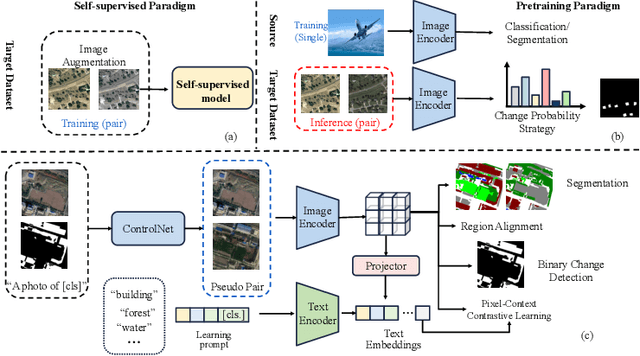
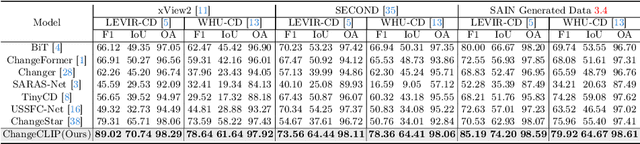
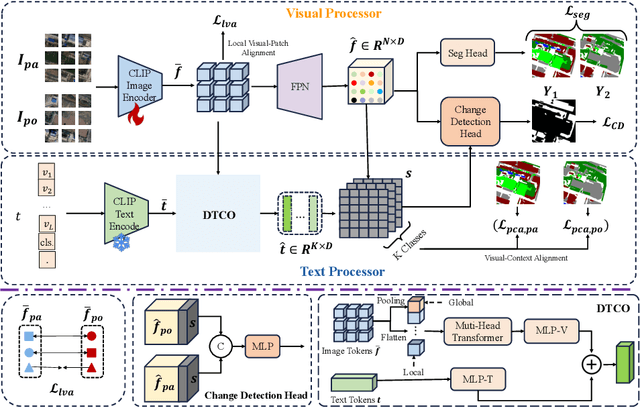
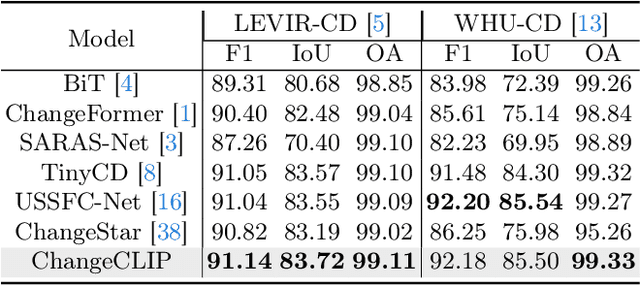
Change detection is widely applied in remote sensing image analysis. Existing methods require training models separately for each dataset, which leads to poor domain generalization. Moreover, these methods rely heavily on large amounts of high-quality pair-labelled data for training, which is expensive and impractical. In this paper, we propose a multimodal contrastive learning (ChangeCLIP) based on visual-language pre-training for change detection domain generalization. Additionally, we propose a dynamic context optimization for prompt learning. Meanwhile, to address the data dependency issue of existing methods, we introduce a single-temporal and controllable AI-generated training strategy (SAIN). This allows us to train the model using a large number of single-temporal images without image pairs in the real world, achieving excellent generalization. Extensive experiments on series of real change detection datasets validate the superiority and strong generalization of ChangeCLIP, outperforming state-of-the-art change detection methods. Code will be available.
Leveraging Fine-Grained Information and Noise Decoupling for Remote Sensing Change Detection
Apr 17, 2024Change detection aims to identify remote sense object changes by analyzing data between bitemporal image pairs. Due to the large temporal and spatial span of data collection in change detection image pairs, there are often a significant amount of task-specific and task-agnostic noise. Previous effort has focused excessively on denoising, with this goes a great deal of loss of fine-grained information. In this paper, we revisit the importance of fine-grained features in change detection and propose a series of operations for fine-grained information compensation and noise decoupling (FINO). First, the context is utilized to compensate for the fine-grained information in the feature space. Next, a shape-aware and a brightness-aware module are designed to improve the capacity for representation learning. The shape-aware module guides the backbone for more precise shape estimation, guiding the backbone network in extracting object shape features. The brightness-aware module learns a overall brightness estimation to improve the model's robustness to task-agnostic noise. Finally, a task-specific noise decoupling structure is designed as a way to improve the model's ability to separate noise interference from feature similarity. With these training schemes, our proposed method achieves new state-of-the-art (SOTA) results in multiple change detection benchmarks. The code will be made available.
Learn to Tour: Operator Design For Solution Feasibility Mapping in Pickup-and-delivery Traveling Salesman Problem
Apr 17, 2024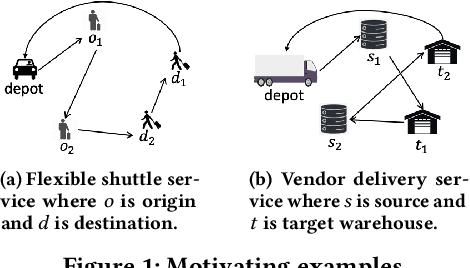
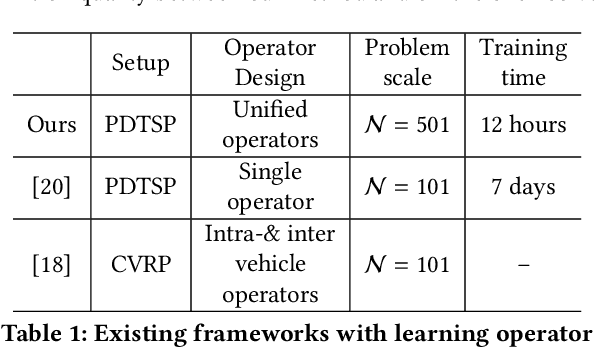
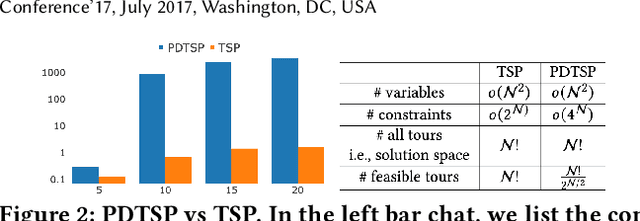
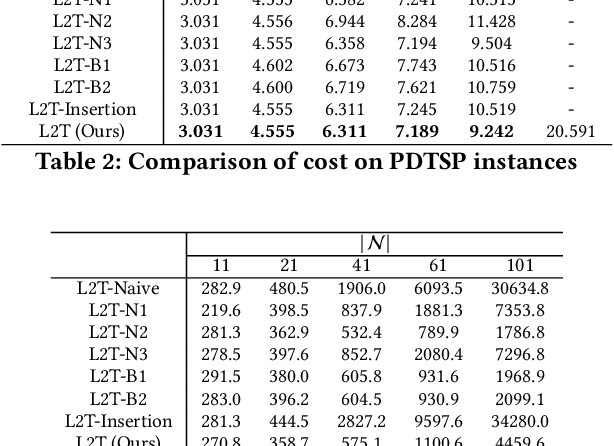
This paper aims to develop a learning method for a special class of traveling salesman problems (TSP), namely, the pickup-and-delivery TSP (PDTSP), which finds the shortest tour along a sequence of one-to-one pickup-and-delivery nodes. One-to-one here means that the transported people or goods are associated with designated pairs of pickup and delivery nodes, in contrast to that indistinguishable goods can be delivered to any nodes. In PDTSP, precedence constraints need to be satisfied that each pickup node must be visited before its corresponding delivery node. Classic operations research (OR) algorithms for PDTSP are difficult to scale to large-sized problems. Recently, reinforcement learning (RL) has been applied to TSPs. The basic idea is to explore and evaluate visiting sequences in a solution space. However, this approach could be less computationally efficient, as it has to potentially evaluate many infeasible solutions of which precedence constraints are violated. To restrict solution search within a feasible space, we utilize operators that always map one feasible solution to another, without spending time exploring the infeasible solution space. Such operators are evaluated and selected as policies to solve PDTSPs in an RL framework. We make a comparison of our method and baselines, including classic OR algorithms and existing learning methods. Results show that our approach can find tours shorter than baselines.
Cramer-Rao Bounds for Near-Field Sensing: A Generic Modular Architecture
Apr 11, 2024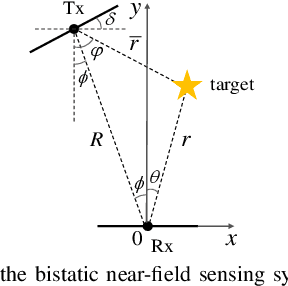
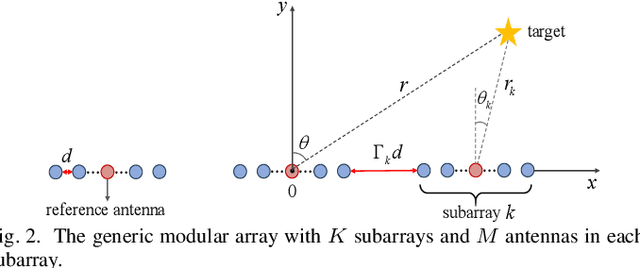
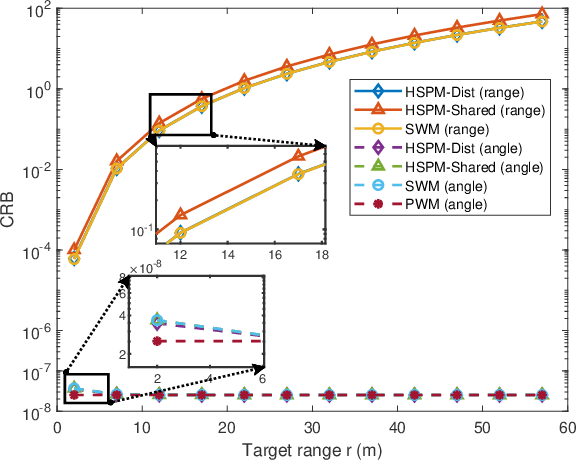
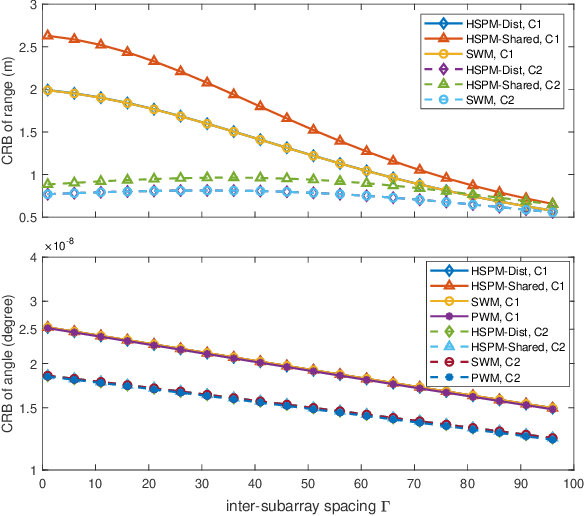
A generic modular array architecture is proposed, featuring uniform/non-uniform subarray layouts that allows for flexible deployment. The bistatic near-field sensing system is considered, where the target is located in the near-field of the whole modular array and the far-field of each subarray. Then, the closed-form expressions of Cramer-Rao bounds (CRBs) for range and angle estimations are derived based on the hybrid spherical and planar wave model (HSPM). Simulation results validate the accuracy of the derived closed-form CRBs and demonstrate that: i) The HSPM with varying angles of arrival (AoAs) between subarrays can reduce the CRB for range estimation compared to the traditional HSPM with shared AoA; and ii) The proposed generic modular architecture with subarrays positioned closer to the edges can significantly reduce the CRBs compared to the traditional modular architecture with uniform subarray layout, when the array aperture is fixed.