 Add to Chrome
 Add to Firefox
 Add to Edge
IFMTBench: A Comprehensive Benchmark for Multilingual Translation Instruction Following
May 27, 2026
Modern translation workflows demand more than semantic equivalence. Users routinely require models to preserve JSON or HTML schemas, honor curated glossaries, disambiguate with provided context, and match prescribed registers, often several at once. Conventional metrics such as BLEU and xCOMET capture semantic fidelity but provide little signal on constraint adherence, while general instruction following benchmarks ignore the cross-lingual nature of translation. We introduce \bench, a benchmark for multilingual translation instruction following covering seven languages, with 4,506 single-constraint and 2,838 multi-constraint items spanning six constraint dimensions and five compositional patterns with instructions issued in all seven languages. Constraints are split into a gating subset verified by deterministic checkers and a continuous subset scored by a rubric-based LLM judge, combined under a multiplicative rule that resists reward hacking. Evaluating 15 models reveals systematic gaps that prior protocols miss: Instruction following scales with size more sharply than translation quality, glossary and structured-format constraints dominate the difficulty gradient, and general instruction following rankings correlate only weakly with translation behavior. Our benchmark are available at https://github.com/Tencent-Hunyuan/Hy-MT2/tree/main/IFMTBench.

Hy-MT2: A Family of Fast, Efficient and Powerful Multilingual Translation Models in the Wild
May 21, 2026Hy-MT2 is a family of fast-thinking multilingual translation models designed for complex real-world scenarios. It includes three model sizes: 1.8B, 7B, and 30B-A3B (MoE), all of which support translation among 33 languages and effectively follow translation instructions in multiple languages. For on-device deployment, with AngelSlim 1.25-bit extreme quantization, the 1.8B model requires only 440 MB of storage and improves inference speed by 1.5x. Multi-dimensional evaluations show that Hy-MT2 delivers outstanding performance across general, real-world business, domain-specific, and instruction-following translation tasks. The 7B and 30B models outperform open-source models such as DeepSeek-V4-Pro and Kimi K2.6 in fast-thinking mode, while the lightweight 1.8B model also surpasses mainstream commercial APIs from providers such as Microsoft and Doubao overall.
Hunyuan-MT Technical Report
Sep 05, 2025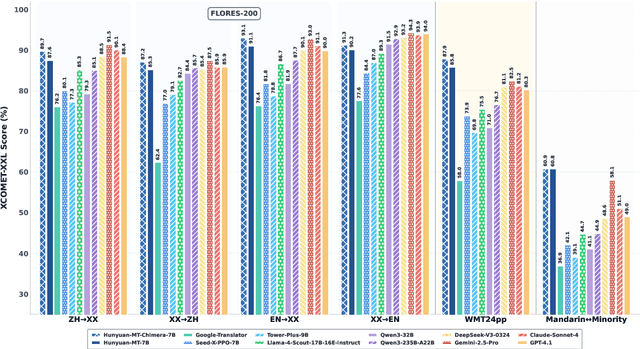
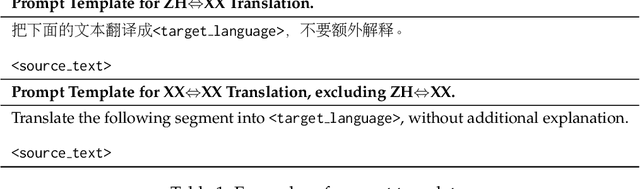
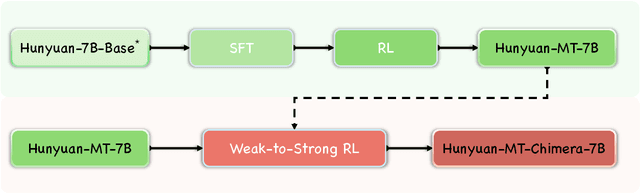
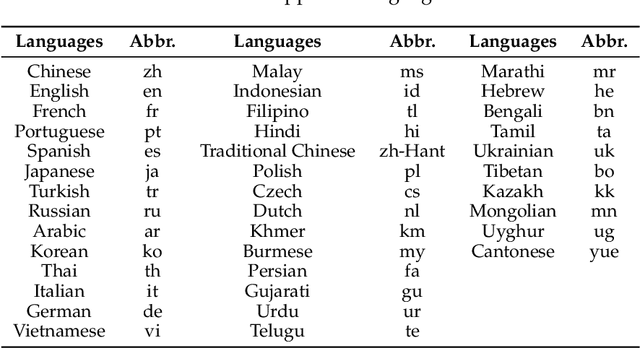
In this report, we introduce Hunyuan-MT-7B, our first open-source multilingual translation model, which supports bidirectional translation across 33 major languages and places a special emphasis on translation between Mandarin and several ethnic minority languages as well as dialects. Furthermore, to serve and address diverse translation scenarios and enhance model performance at test time, we introduce Hunyuan-MT-Chimera-7B, a translation model inspired by the slow thinking mode. This model integrates multiple outputs generated by the Hunyuan-MT-7B model under varying parameter settings, thereby achieving performance superior to that of conventional slow-thinking models based on Chain-of-Thought (CoT). The development of our models follows a holistic training process specifically engineered for multilingual translation, which begins with general and MT-oriented pre-training to build foundational capabilities, proceeds to Supervised Fine-Tuning (SFT) for task-specific adaptation, and culminates in advanced alignment through Reinforcement Learning (RL) and weak-to-strong RL. Through comprehensive experimentation, we demonstrate that both Hunyuan-MT-7B and Hunyuan-MT-Chimera-7B significantly outperform all translation-specific models of comparable parameter size and most of the SOTA large models, particularly on the task of translation between Mandarin and minority languages as well as dialects. In the WMT2025 shared task (General Machine Translation), our models demonstrate state-of-the-art performance, ranking first in 30 out of 31 language pairs. This result highlights the robustness of our models across a diverse linguistic spectrum, encompassing high-resource languages such as Chinese, English, and Japanese, as well as low-resource languages including Czech, Marathi, Estonian, and Icelandic.