 Add to Chrome
 Add to Firefox
 Add to Edge
When Denser Credit Is Not Enough: Evidence-Calibrated Policy Optimization for Long-Horizon LLM Agent Training
Jun 04, 2026
Long-horizon LLM agents require reinforcement learning methods that can assign credit to intermediate decisions under sparse and delayed rewards. Recent group-based methods such as GiGPO improve over GRPO by constructing step-level advantages at repeated anchor states. However, we show that such dense credit can be statistically unreliable: under limited rollouts, rare but lucky actions may receive overly large advantages, producing divergent anchor bias and late-stage training oscillation. We propose Evidence-Calibrated Policy Optimization (ECPO), a critic-free policy optimization algorithm that calibrates step-level credit before policy updates. ECPO combines Evidence-Calibrated Action Advantage, which groups rollouts by canonical actions and shrinks low-count estimates, with Variance-Gated Credit Weighting, which suppresses anchor states dominated by within-action noise. Experiments on ALFWorld and WebShop with Qwen2.5-1.5B/7B show that ECPO consistently outperforms strong baselines, improving GiGPO by +5.2/+7.3 success points on ALFWorld/WebShop with Qwen2.5-1.5B while adding only 0.1% additional advantage-computation overhead.

SIRI: Self-Internalizing Reinforcement Learning with Intrinsic Skills for LLM Agent Training
Jun 01, 2026Long-horizon LLM agents can benefit from reusable skills, yet existing skill-based methods often rely on external skill generators during training or persistent skill retrieval at inference, increasing engineering complexity, context length, and deployment latency. We propose Self-Internalizing Reinforcement learning with Intrinsic skills (SIRI), a three-phase framework that enables agents to discover, validate, and internalize skills without external skill generators or inference-time skill banks. SIRI first warms up the policy with GiGPO to acquire basic interaction ability and collect successful skill-free trajectories. It then performs self-skill mining, where the current policy summarizes compact skills from its own successful plain rollouts and validates them through paired skill-augmented and skill-free rollouts. Finally, SIRI distills only beneficial skill-guided action tokens into the plain policy using trajectory-level utility and action-level advantage. At inference, the agent runs with the original prompt only. On ALFWorld and WebShop with Qwen2.5-7B-Instruct, SIRI improves GiGPO from 0.908 to 0.930 on ALFWorld and from 0.728 to 0.813 on WebShop, outperforming prompt-based, RL-based, and memory-augmented baselines. Further analysis shows that our self-mining strategy can achieve performance comparable to distillation with closed-source large model. Our code is available at https://github.com/kirito618/SIRI.
Statistical Consistency and Generalization of Contrastive Representation Learning
May 04, 2026Contrastive representation learning (CRL) underpins many modern foundation models. Despite recent theoretical progress, existing analyses suffer from several key limitations: (i) the statistical consistency of CRL remains poorly understood; (ii) available generalization bounds deteriorate as the number of negative samples increases, contradicting the empirical benefits of large negative sets; and (iii) the retrieval performance of CRL has received limited theoretical attention. In this paper, we develop a unified statistical learning theory for CRL. For downstream tasks, we evaluate retrieval quality using an AUC-type population criterion and show that the contrastive loss is \emph{statistically consistent} with optimal ranking. We further establish a \emph{calibration-style inequality} that quantitatively relates excess contrastive risk to excess retrieval suboptimality. For upstream training, we study both supervised and self-supervised contrastive objectives and derive generalization bounds of order $O(1/m + 1/\sqrt{n})$ and $O(1/\sqrt{m} + 1/\sqrt{n})$, respectively, where $m$ denotes the number of negative samples and $n$ the number of anchor points. These bounds not only explain the empirical advantages of large negative sets but also reveal an explicit trade-off between $m$ and $n$. Extensive experiments on large-scale vision--language models corroborate our theoretical predictions.
Fight Poison with Poison: Enhancing Robustness in Few-shot Machine-Generated Text Detection with Adversarial Training
May 04, 2026Machine-generated text (MGT) detection is critical for regulating online information ecosystems, yet existing detectors often underperform in few-shot settings and remain vulnerable to adversarial, humanizing attacks. To build accurate and robust detectors under limited supervision, we adopt a threat-modeling perspective and study detector vulnerabilities from an attacker's viewpoint under an output-only black-box setting. Motivated by this perspective, we propose RAG-GuidEd Attacker Strengthens ConTrastive Few-shot Detector (REACT), an adversarial training framework that improves both few-shot detection performance and robustness against attacks. REACT couples a humanization-oriented attacker with a target detector: the attacker leverages retrieval-augmented generation (RAG) to craft highly human-like adversarial examples to evade detection, while the detector learns from these adversaries with a contrastive objective to stabilize few-shot representation learning and enhance robustness. We alternately update the attacker and the detector to enable their co-evolution. Experiments on 4 datasets with 4 shot sizes and 3 random seeds show that REACT improves average detection F1 by 4.95 points over 8 state-of-the-art (SOTA) detectors and reduces the average attack success rate (ASR) under 4 strong attacks by 3.66 percentage points.
MGTEVAL: An Interactive Platform for Systemtic Evaluation of Machine-Generated Text Detectors
Apr 28, 2026We present MGTEVAL, an extensible platform for systematic evaluation of Machine-Generated Text (MGT) detectors. Despite rapid progress in MGT detection, existing evaluations are often fragmented across datasets, preprocessing, attacks, and metrics, making results hard to compare and reproduce. MGTEVAL organizes the workflow into four components: Dataset Building, Dataset Attack, Detector Training, and Performance Evaluation. It supports constructing custom benchmarks by generating MGT with configurable LLMs, applying 12 text attacks to test sets, training detectors via a unified interface, and reporting effectiveness, robustness, and efficiency. The platform provides both command-line and Web-based interfaces for user-friendly experimentation without code rewriting.
Iron Sharpens Iron: Defending Against Attacks in Machine-Generated Text Detection with Adversarial Training
Feb 18, 2025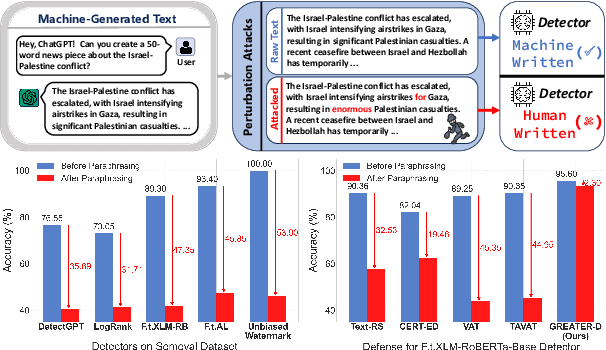
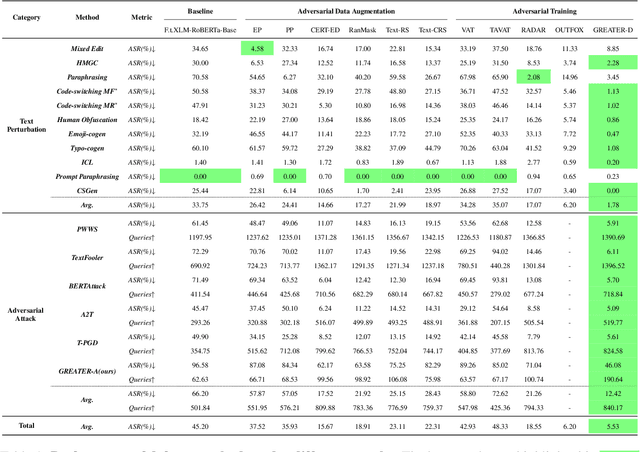
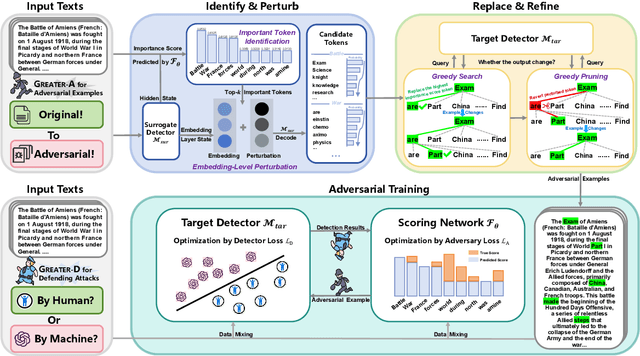
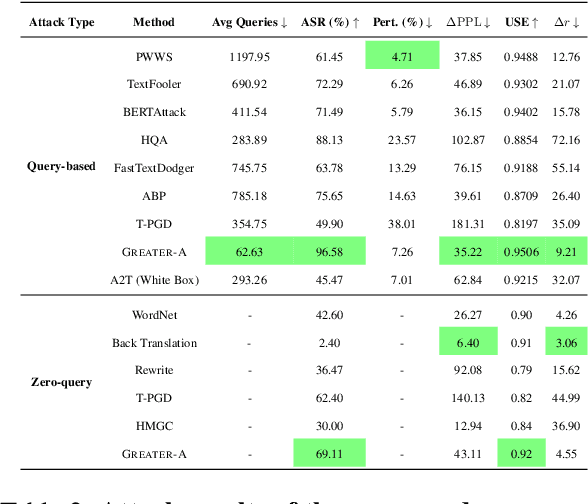
Machine-generated Text (MGT) detection is crucial for regulating and attributing online texts. While the existing MGT detectors achieve strong performance, they remain vulnerable to simple perturbations and adversarial attacks. To build an effective defense against malicious perturbations, we view MGT detection from a threat modeling perspective, that is, analyzing the model's vulnerability from an adversary's point of view and exploring effective mitigations. To this end, we introduce an adversarial framework for training a robust MGT detector, named GREedy Adversary PromoTed DefendER (GREATER). The GREATER consists of two key components: an adversary GREATER-A and a detector GREATER-D. The GREATER-D learns to defend against the adversarial attack from GREATER-A and generalizes the defense to other attacks. GREATER-A identifies and perturbs the critical tokens in embedding space, along with greedy search and pruning to generate stealthy and disruptive adversarial examples. Besides, we update the GREATER-A and GREATER-D synchronously, encouraging the GREATER-D to generalize its defense to different attacks and varying attack intensities. Our experimental results across 9 text perturbation strategies and 5 adversarial attacks show that our GREATER-D reduces the Attack Success Rate (ASR) by 10.61% compared with SOTA defense methods while our GREATER-A is demonstrated to be more effective and efficient than SOTA attack approaches.