 Add to Chrome
 Add to Firefox
 Add to Edge
Uni-COAL: A Unified Framework for Cross-Modality Synthesis and Super-Resolution of MR Images
Nov 14, 2023


Cross-modality synthesis (CMS), super-resolution (SR), and their combination (CMSR) have been extensively studied for magnetic resonance imaging (MRI). Their primary goals are to enhance the imaging quality by synthesizing the desired modality and reducing the slice thickness. Despite the promising synthetic results, these techniques are often tailored to specific tasks, thereby limiting their adaptability to complex clinical scenarios. Therefore, it is crucial to build a unified network that can handle various image synthesis tasks with arbitrary requirements of modality and resolution settings, so that the resources for training and deploying the models can be greatly reduced. However, none of the previous works is capable of performing CMS, SR, and CMSR using a unified network. Moreover, these MRI reconstruction methods often treat alias frequencies improperly, resulting in suboptimal detail restoration. In this paper, we propose a Unified Co-Modulated Alias-free framework (Uni-COAL) to accomplish the aforementioned tasks with a single network. The co-modulation design of the image-conditioned and stochastic attribute representations ensures the consistency between CMS and SR, while simultaneously accommodating arbitrary combinations of input/output modalities and thickness. The generator of Uni-COAL is also designed to be alias-free based on the Shannon-Nyquist signal processing framework, ensuring effective suppression of alias frequencies. Additionally, we leverage the semantic prior of Segment Anything Model (SAM) to guide Uni-COAL, ensuring a more authentic preservation of anatomical structures during synthesis. Experiments on three datasets demonstrate that Uni-COAL outperforms the alternatives in CMS, SR, and CMSR tasks for MR images, which highlights its generalizability to wide-range applications.

MeLo: Low-rank Adaptation is Better than Fine-tuning for Medical Image Diagnosis
Nov 14, 2023The common practice in developing computer-aided diagnosis (CAD) models based on transformer architectures usually involves fine-tuning from ImageNet pre-trained weights. However, with recent advances in large-scale pre-training and the practice of scaling laws, Vision Transformers (ViT) have become much larger and less accessible to medical imaging communities. Additionally, in real-world scenarios, the deployments of multiple CAD models can be troublesome due to problems such as limited storage space and time-consuming model switching. To address these challenges, we propose a new method MeLo (Medical image Low-rank adaptation), which enables the development of a single CAD model for multiple clinical tasks in a lightweight manner. It adopts low-rank adaptation instead of resource-demanding fine-tuning. By fixing the weight of ViT models and only adding small low-rank plug-ins, we achieve competitive results on various diagnosis tasks across different imaging modalities using only a few trainable parameters. Specifically, our proposed method achieves comparable performance to fully fine-tuned ViT models on four distinct medical imaging datasets using about 0.17% trainable parameters. Moreover, MeLo adds only about 0.5MB of storage space and allows for extremely fast model switching in deployment and inference. Our source code and pre-trained weights are available on our website (https://absterzhu.github.io/melo.github.io/).
3D Pose Estimation of Tomato Peduncle Nodes using Deep Keypoint Detection and Point Cloud
Nov 08, 2023Greenhouse production of fruits and vegetables in developed countries is challenged by labor 12 scarcity and high labor costs. Robots offer a good solution for sustainable and cost-effective 13 production. Acquiring accurate spatial information about relevant plant parts is vital for 14 successful robot operation. Robot perception in greenhouses is challenging due to variations in 15 plant appearance, viewpoints, and illumination. This paper proposes a keypoint-detection-based 16 method using data from an RGB-D camera to estimate the 3D pose of peduncle nodes, which 17 provides essential information to harvest the tomato bunches. 18 19 Specifically, this paper proposes a method that detects four anatomical landmarks in the color 20 image and then integrates 3D point-cloud information to determine the 3D pose. A 21 comprehensive evaluation was conducted in a commercial greenhouse to gain insight into the 22 performance of different parts of the method. The results showed: (1) high accuracy in object 23 detection, achieving an Average Precision (AP) of AP@0.5=0.96; (2) an average Percentage of 24 Detected Joints (PDJ) of the keypoints of PhDJ@0.2=94.31%; and (3) 3D pose estimation 25 accuracy with mean absolute errors (MAE) of 11.38o and 9.93o for the relative upper and lower 26 angles between the peduncle and main stem, respectively. Furthermore, the capability to handle 27 variations in viewpoint was investigated, demonstrating the method was robust to view changes. 28 However, canonical and higher views resulted in slightly higher performance compared to other 29 views. Although tomato was selected as a use case, the proposed method is also applicable to 30 other greenhouse crops like pepper.
Dissecting the Runtime Performance of the Training, Fine-tuning, and Inference of Large Language Models
Nov 07, 2023Large Language Models (LLMs) have seen great advance in both academia and industry, and their popularity results in numerous open-source frameworks and techniques in accelerating LLM pre-training, fine-tuning, and inference. Training and deploying LLMs are expensive as it requires considerable computing resources and memory, hence many efficient approaches have been developed for improving system pipelines as well as operators. However, the runtime performance can vary significantly across hardware and software stacks, which makes it difficult to choose the best configuration. In this work, we aim to benchmark the performance from both macro and micro perspectives. First, we benchmark the end-to-end performance of pre-training, fine-tuning, and serving LLMs in different sizes , i.e., 7, 13, and 70 billion parameters (7B, 13B, and 70B) on three 8-GPU platforms with and without individual optimization techniques, including ZeRO, quantization, recomputation, FlashAttention. Then, we dive deeper to provide a detailed runtime analysis of the sub-modules, including computing and communication operators in LLMs. For end users, our benchmark and findings help better understand different optimization techniques, training and inference frameworks, together with hardware platforms in choosing configurations for deploying LLMs. For researchers, our in-depth module-wise analyses discover potential opportunities for future work to further optimize the runtime performance of LLMs.
Disentangled Representation Learning with Large Language Models for Text-Attributed Graphs
Nov 06, 2023Text-attributed graphs (TAGs) are prevalent on the web and research over TAGs such as citation networks, e-commerce networks and social networks has attracted considerable attention in the web community. Recently, large language models (LLMs) have demonstrated exceptional capabilities across a wide range of tasks. However, the existing works focus on harnessing the potential of LLMs solely relying on prompts to convey graph structure information to LLMs, thus suffering from insufficient understanding of the complex structural relationships within TAGs. To address this problem, in this paper we present the Disentangled Graph-Text Learner (DGTL) model, which is able to enhance the reasoning and predicting capabilities of LLMs for TAGs. Our proposed DGTL model incorporates graph structure information through tailored disentangled graph neural network (GNN) layers, enabling LLMs to capture the intricate relationships hidden in text-attributed graphs from multiple structural factors. Furthermore, DGTL operates with frozen pre-trained LLMs, reducing computational costs and allowing much more flexibility in combining with different LLM models. Experimental evaluations demonstrate the effectiveness of the proposed DGTL model on achieving superior or comparable performance over state-of-the-art baselines. Additionally, we also demonstrate that our DGTL model can offer natural language explanations for predictions, thereby significantly enhancing model interpretability.
VideoDreamer: Customized Multi-Subject Text-to-Video Generation with Disen-Mix Finetuning
Nov 02, 2023Customized text-to-video generation aims to generate text-guided videos with customized user-given subjects, which has gained increasing attention recently. However, existing works are primarily limited to generating videos for a single subject, leaving the more challenging problem of customized multi-subject text-to-video generation largely unexplored. In this paper, we fill this gap and propose a novel VideoDreamer framework. VideoDreamer can generate temporally consistent text-guided videos that faithfully preserve the visual features of the given multiple subjects. Specifically, VideoDreamer leverages the pretrained Stable Diffusion with latent-code motion dynamics and temporal cross-frame attention as the base video generator. The video generator is further customized for the given multiple subjects by the proposed Disen-Mix Finetuning and Human-in-the-Loop Re-finetuning strategy, which can tackle the attribute binding problem of multi-subject generation. We also introduce MultiStudioBench, a benchmark for evaluating customized multi-subject text-to-video generation models. Extensive experiments demonstrate the remarkable ability of VideoDreamer to generate videos with new content such as new events and backgrounds, tailored to the customized multiple subjects. Our project page is available at https://videodreamer23.github.io/.
A Systematic Review for Transformer-based Long-term Series Forecasting
Oct 31, 2023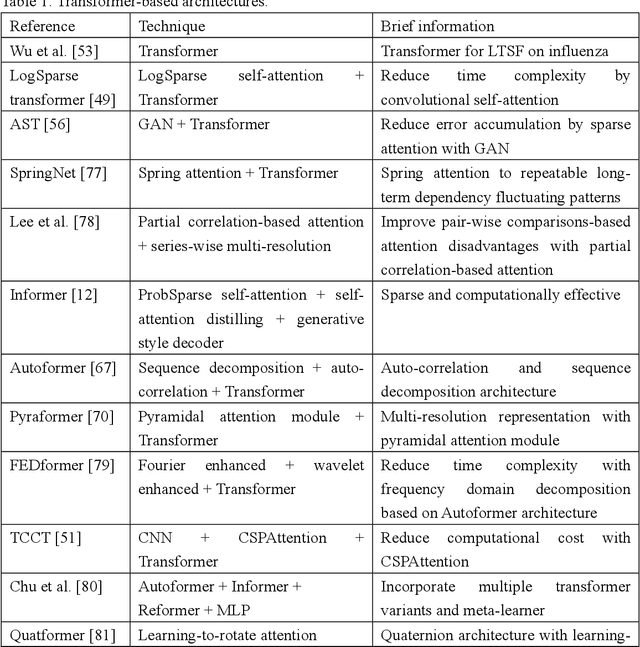
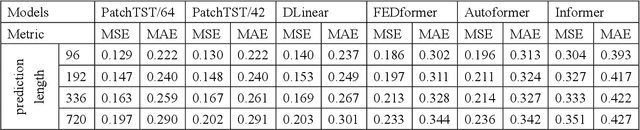

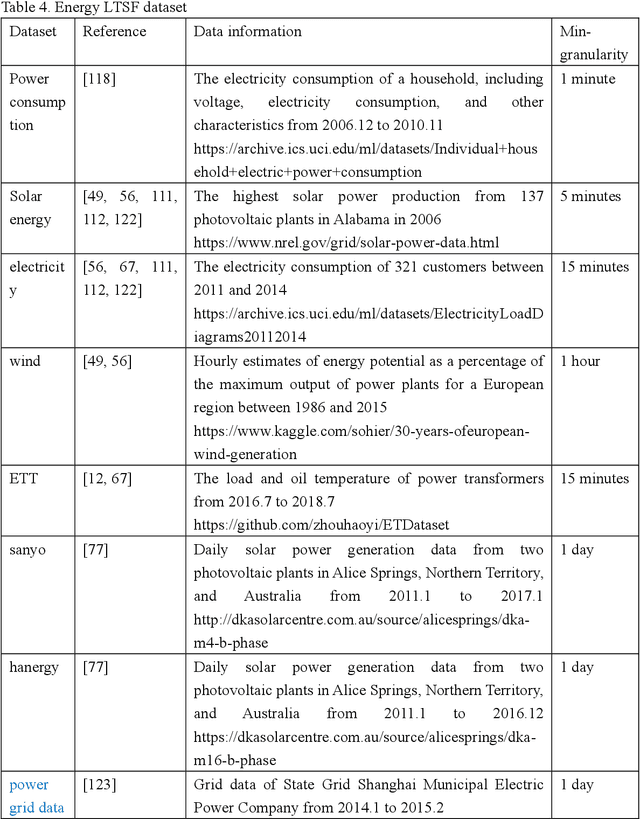
The emergence of deep learning has yielded noteworthy advancements in time series forecasting (TSF). Transformer architectures, in particular, have witnessed broad utilization and adoption in TSF tasks. Transformers have proven to be the most successful solution to extract the semantic correlations among the elements within a long sequence. Various variants have enabled transformer architecture to effectively handle long-term time series forecasting (LTSF) tasks. In this article, we first present a comprehensive overview of transformer architectures and their subsequent enhancements developed to address various LTSF tasks. Then, we summarize the publicly available LTSF datasets and relevant evaluation metrics. Furthermore, we provide valuable insights into the best practices and techniques for effectively training transformers in the context of time-series analysis. Lastly, we propose potential research directions in this rapidly evolving field.
Towards Generalized Multi-stage Clustering: Multi-view Self-distillation
Oct 29, 2023Existing multi-stage clustering methods independently learn the salient features from multiple views and then perform the clustering task. Particularly, multi-view clustering (MVC) has attracted a lot of attention in multi-view or multi-modal scenarios. MVC aims at exploring common semantics and pseudo-labels from multiple views and clustering in a self-supervised manner. However, limited by noisy data and inadequate feature learning, such a clustering paradigm generates overconfident pseudo-labels that mis-guide the model to produce inaccurate predictions. Therefore, it is desirable to have a method that can correct this pseudo-label mistraction in multi-stage clustering to avoid the bias accumulation. To alleviate the effect of overconfident pseudo-labels and improve the generalization ability of the model, this paper proposes a novel multi-stage deep MVC framework where multi-view self-distillation (DistilMVC) is introduced to distill dark knowledge of label distribution. Specifically, in the feature subspace at different hierarchies, we explore the common semantics of multiple views through contrastive learning and obtain pseudo-labels by maximizing the mutual information between views. Additionally, a teacher network is responsible for distilling pseudo-labels into dark knowledge, supervising the student network and improving its predictive capabilities to enhance the robustness. Extensive experiments on real-world multi-view datasets show that our method has better clustering performance than state-of-the-art methods.
Hierarchical Mutual Information Analysis: Towards Multi-view Clustering in The Wild
Oct 28, 2023Multi-view clustering (MVC) can explore common semantics from unsupervised views generated by different sources, and thus has been extensively used in applications of practical computer vision. Due to the spatio-temporal asynchronism, multi-view data often suffer from view missing and are unaligned in real-world applications, which makes it difficult to learn consistent representations. To address the above issues, this work proposes a deep MVC framework where data recovery and alignment are fused in a hierarchically consistent way to maximize the mutual information among different views and ensure the consistency of their latent spaces. More specifically, we first leverage dual prediction to fill in missing views while achieving the instance-level alignment, and then take the contrastive reconstruction to achieve the class-level alignment. To the best of our knowledge, this could be the first successful attempt to handle the missing and unaligned data problem separately with different learning paradigms. Extensive experiments on public datasets demonstrate that our method significantly outperforms state-of-the-art methods on multi-view clustering even in the cases of view missing and unalignment.
LLM4DyG: Can Large Language Models Solve Problems on Dynamic Graphs?
Oct 26, 2023In an era marked by the increasing adoption of Large Language Models (LLMs) for various tasks, there is a growing focus on exploring LLMs' capabilities in handling web data, particularly graph data. Dynamic graphs, which capture temporal network evolution patterns, are ubiquitous in real-world web data. Evaluating LLMs' competence in understanding spatial-temporal information on dynamic graphs is essential for their adoption in web applications, which remains unexplored in the literature. In this paper, we bridge the gap via proposing to evaluate LLMs' spatial-temporal understanding abilities on dynamic graphs, to the best of our knowledge, for the first time. Specifically, we propose the LLM4DyG benchmark, which includes nine specially designed tasks considering the capability evaluation of LLMs from both temporal and spatial dimensions. Then, we conduct extensive experiments to analyze the impacts of different data generators, data statistics, prompting techniques, and LLMs on the model performance. Finally, we propose Disentangled Spatial-Temporal Thoughts (DST2) for LLMs on dynamic graphs to enhance LLMs' spatial-temporal understanding abilities. Our main observations are: 1) LLMs have preliminary spatial-temporal understanding abilities on dynamic graphs, 2) Dynamic graph tasks show increasing difficulties for LLMs as the graph size and density increase, while not sensitive to the time span and data generation mechanism, 3) the proposed DST2 prompting method can help to improve LLMs' spatial-temporal understanding abilities on dynamic graphs for most tasks. The data and codes will be open-sourced at publication time.