 Add to Chrome
 Add to Firefox
 Add to Edge
Engram-E2VID: Reference-Based Event-to-Video Reconstruction via Generative Activation of Appearance Engrams
Aug 06, 2026
Reference-based event-to-video reconstruction aims to recover target RGB frames from a reference frame and the event stream captured over the reference-to-target interval. Although events provide fine-grained temporal cues, they encode sparse and asynchronous log-intensity changes rather than absolute appearance, making faithful reconstruction intrinsically challenging. The central challenge lies in associating event-derived target-time structures with relevant appearance information from the reference frame, especially under complex motion and long temporal intervals. In this work, we propose Engram-E2VID, a structure-guided framework that reconstructs target frames through the generative activation of appearance engrams. Specifically, the reference frame is encoded into token-space appearance engrams, while the event stream and reference context are transformed into a target-time motion-structure scaffold that captures motion boundaries and event-induced structural changes. Within a one-step diffusion backbone, scaffold-derived structural tokens progressively interact with and activate relevant appearance engrams across layers. This token-space association allows target structures to access reference appearance without relying on direct pixel-wise correspondence, while the diffusion prior complements uncertain or newly revealed regions. Across three benchmarks, Engram-E2VID improves PSNR by up to 3.29 dB and reduces LPIPS by up to 0.08 over the strongest same-input baseline, while degrading more slowly as the reconstruction interval increases.

Topological GCN for Improving Detection of Hip Landmarks from B-Mode Ultrasound Images
Aug 24, 2024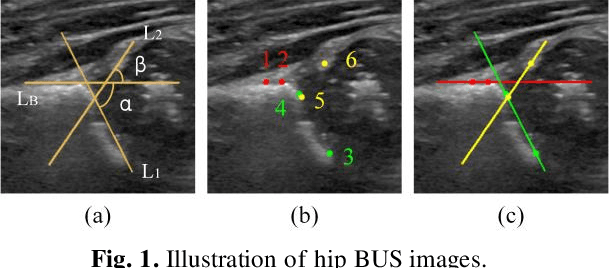
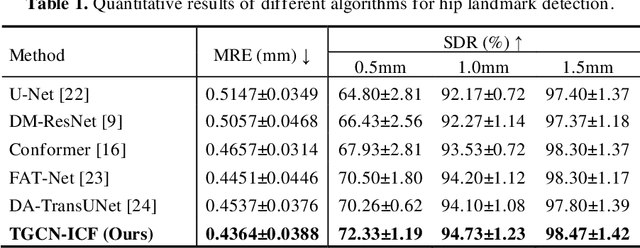
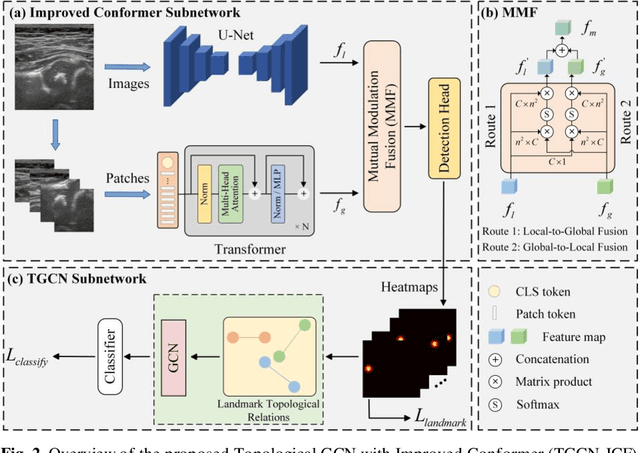
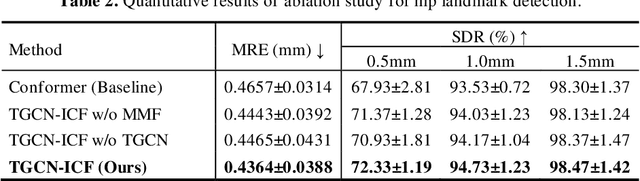
The B-mode ultrasound based computer-aided diagnosis (CAD) has demonstrated its effectiveness for diagnosis of Developmental Dysplasia of the Hip (DDH) in infants. However, due to effect of speckle noise in ultrasound im-ages, it is still a challenge task to accurately detect hip landmarks. In this work, we propose a novel hip landmark detection model by integrating the Topological GCN (TGCN) with an Improved Conformer (TGCN-ICF) into a unified frame-work to improve detection performance. The TGCN-ICF includes two subnet-works: an Improved Conformer (ICF) subnetwork to generate heatmaps and a TGCN subnetwork to additionally refine landmark detection. This TGCN can effectively improve detection accuracy with the guidance of class labels. Moreo-ver, a Mutual Modulation Fusion (MMF) module is developed for deeply ex-changing and fusing the features extracted from the U-Net and Transformer branches in ICF. The experimental results on the real DDH dataset demonstrate that the proposed TGCN-ICF outperforms all the compared algorithms.