 Add to Chrome
 Add to Firefox
 Add to Edge
Engram-E2VID: Reference-Based Event-to-Video Reconstruction via Generative Activation of Appearance Engrams
Aug 06, 2026
Reference-based event-to-video reconstruction aims to recover target RGB frames from a reference frame and the event stream captured over the reference-to-target interval. Although events provide fine-grained temporal cues, they encode sparse and asynchronous log-intensity changes rather than absolute appearance, making faithful reconstruction intrinsically challenging. The central challenge lies in associating event-derived target-time structures with relevant appearance information from the reference frame, especially under complex motion and long temporal intervals. In this work, we propose Engram-E2VID, a structure-guided framework that reconstructs target frames through the generative activation of appearance engrams. Specifically, the reference frame is encoded into token-space appearance engrams, while the event stream and reference context are transformed into a target-time motion-structure scaffold that captures motion boundaries and event-induced structural changes. Within a one-step diffusion backbone, scaffold-derived structural tokens progressively interact with and activate relevant appearance engrams across layers. This token-space association allows target structures to access reference appearance without relying on direct pixel-wise correspondence, while the diffusion prior complements uncertain or newly revealed regions. Across three benchmarks, Engram-E2VID improves PSNR by up to 3.29 dB and reduces LPIPS by up to 0.08 over the strongest same-input baseline, while degrading more slowly as the reconstruction interval increases.

Timing Recovery for Non-Orthogonal Multiple Access with Asynchronous Clock
Jul 10, 2024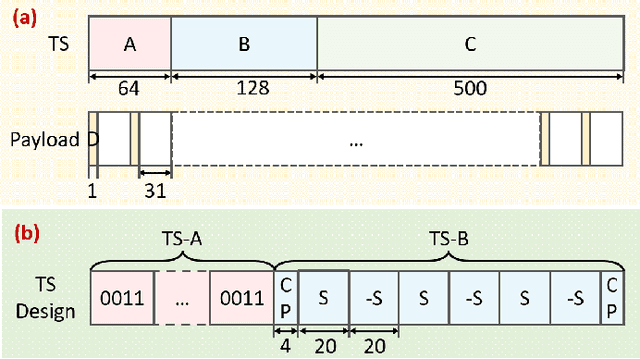
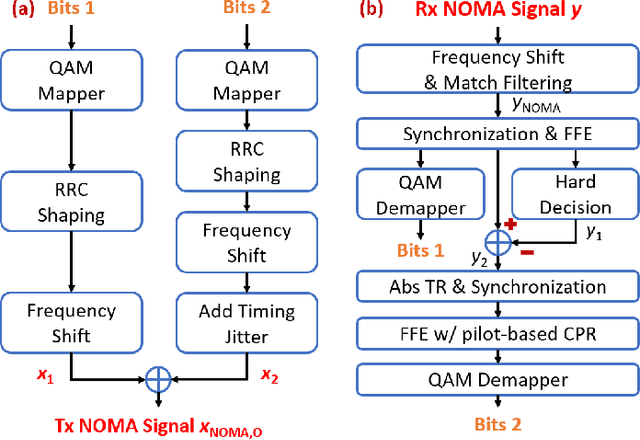
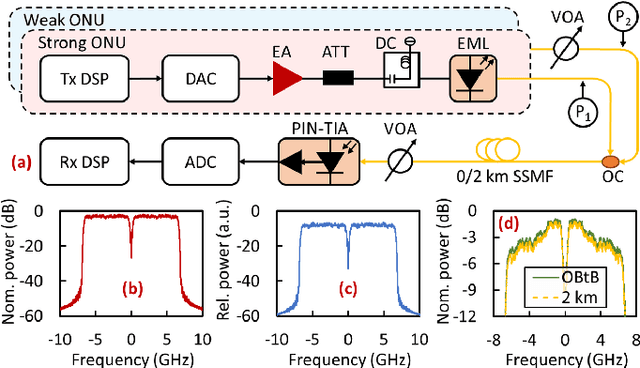
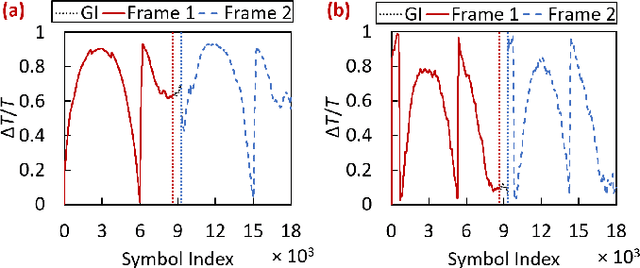
A passive optical network (PON) based on non-orthogonal multiple access (NOMA) meets low latency and high capacity. In the NOMA-PON, the asynchronous clock between the strong and weak optical network units (ONUs) causes the timing error and phase noise on the signal of the weak ONU. The theoretical derivation shows that the timing error and phase noise can be independently compensated. In this Letter, we propose a timing recovery (TR) algorithm based on an absolute timing error detector (Abs TED) and a pilot-based carrier phase recovery (CPR) to eliminate the timing error and phase noise separately. An experiment for 25G NOMA-PON is set up to verify the feasibility of the proposed algorithms. The weak ONU can achieve the 20% soft-decision forward error correction limit after compensating for timing error and phase noise. In conclusion, the proposed TR and the pilot-based CPR show great potential for the NOMA-PON.
Pilot-Based Key Distribution and Encryption for Secure Coherent Passive Optical Networks
Nov 05, 2023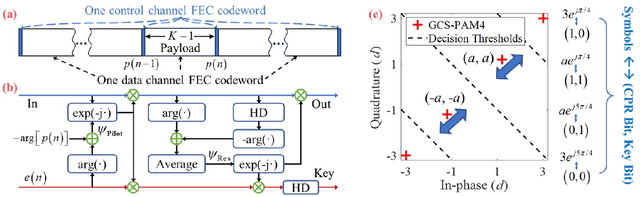
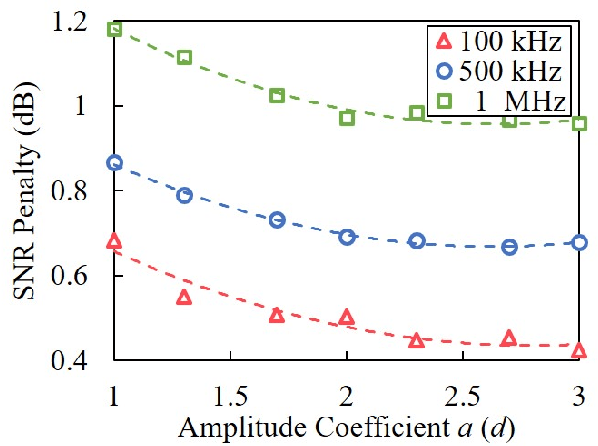
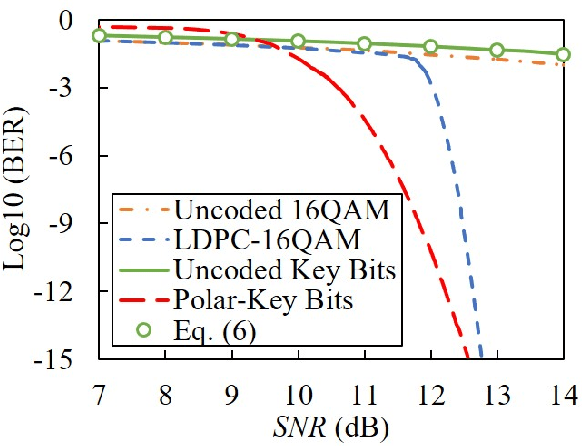
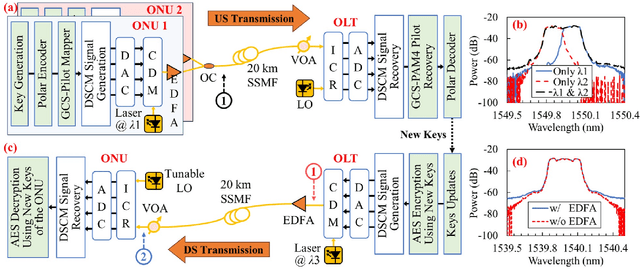
The security issues of passive optical networks (PONs) have always been a concern due to broadcast transmission. Physical-layer security enhancement for the coherent PON should be as significant as improving transmission performance. In this paper, we propose the advanced encryption standard (AES) algorithm and geometric constellation shaping four-level pulse amplitude modulation (GCS-PAM4) pilot-based key distribution for secure coherent PON. The first bit of the GCS-PAM4 pilot is used for the hardware-efficient carrier phase recovery (CPR), while the second bit is utilized for key distribution without occupying the additional overhead. The key bits are encoded by the polar code to ensure error-free distribution. Frequent key updates are permitted for every codeword to improve the security of coherent PON. The experimental results of the 200-Gbps secure coherent PON using digital subcarrier multiplexing show that the GCS-PAM4 pilot-based key distribution could be error-free at upstream transmission without occupying the additional overhead and the eavesdropping would be prevented by AES algorithm at downstream transmission. Moreover, there is almost no performance penalty on the CPR using the GCS-PAM4 pilot compared to the binary phase shift keying pilot.