 Add to Chrome
 Add to Firefox
 Add to Edge
MicroEvo: Knowledge-Guided LLM Sampling for Efficient Microarchitecture Design Space Exploration
Aug 06, 2026
Microarchitecture design space exploration suffers from expansive search spaces and expensive PPA evaluation, leaving only a small simulation budget for design decision-making. Existing methods perform blind search without considering microarchitectural dependencies and fail to learn from the iterative search effectively, leading to wasted evaluations and weak Pareto convergence. In this paper, we propose MicroEvo, a knowledge-guided framework that couples off-the-shelf LLMs with Monte Carlo Tree Search (MCTS) for multi-objective microarchitecture optimization. MicroEvo combines LLM-driven evolutionary operators, a Pareto-aware tree policy that balances Pareto contribution and diversity, an active knowledge accumulation mechanism that extracts and reuses optimization insights, and state-aware directives that adapt the search behavior online. Experiments show that MicroEvo improves Pareto-front quality by up to 36.2% over NSGA-II and achieves 10.6x higher search efficiency, and also demonstrates strong scalability to a complex industrial-scale core. The code repository is available at: https://github.com/GEAR-SEU/MicroEvo-ICCAD-26.

Bridging the Information Gap: Semantic Densification and Hindsight Distillation for Cold-Start Prediction
Jul 19, 2026New-user cold-start is a critical bottleneck for e-commerce platforms: predicting user lifetime value (LTV) and conversion rate (CVR) for users with sparse interaction history. Two prior directions -- LLM-based semantic augmentation and learning using privileged information (LUPI) -- each face a key limitation. First, LLM augmentation produces unstructured rationales that are noisy and hard to operationalize in production. Second, naive student-teacher distillation can be brittle due to an information gap between the privileged teacher and the sparse student; moreover, this gap is heterogeneous across users. We propose SemRaD, a Semantic Reasoning-aware Distillation framework addressing both limitations. First, a Structured Semantic Reasoning Pipeline replaces free-form rationales with a structured schema built via a discover-curate-audit workflow, producing per user a Densified Semantic Profile (consumed by the deployed student via a Semantic-Gated Encoder that focuses on the most informative dimensions) and a Hindsight Distillation Target reconciled from pre- and post-conversion reasoning (used only at training). Second, to bridge this gap and handle its heterogeneity, a Hindsight-Aware Distillation Network transfers privileged knowledge via the hindsight target, with Distillation Experts improving transfer under per-user variability. On a large-scale industrial dataset, SemRaD lifts +1.9% LTV (Gini) and +1.0% CVR (AUROC) over a production-grade base; a four-week online A/B at Keeta confirms +1.0% LTV / +0.43% CVR. SemRaD also matches the production system's LTV using only 9% of the training data while improving CVR by 0.8%.
From Uncertainty to Stability and Fidelity: Guiding Sparse-View 3D Gaussian Splatting with Fisher Information
Jun 18, 20263D Gaussian Splatting (3DGS) has emerged as a promising technique for novel view synthesis. However, 3DGS requires dense input views to achieve high-quality rendering. In sparse-view scenarios, 3DGS often prones to overfitting, resulting in noticeable artifacts and degraded rendering quality. Previous methods explore to address this issue by introducing additional priors (e.g. depth priors) or integrating regularization techniques (e.g. Dropout). However, these methods are often applied without principled guidance. In particular, prior-based augmentation typically samples novel viewpoints randomly, while Dropout-based regularization randomly removes Gaussians. The compounded randomness introduces uncertainty and instability, limiting the fidelity of novel view synthesis. In this paper, we propose a novel method for sparse-view 3DGS that incorporates Fisher Information to quantitatively guide the utilization of geometric priors and regularization. Specifically, our method comprises two key components: (1) Stereo augmentation with Fisher Information. By leveraging Fisher Information, we actively select most informative supporting views and use depth priors to curate reliable pseudo ground truths, which reduces randomness in augmentation and improves stability and rendering fidelity; (2) Uncertainty-aware regularization. We reduce the instability of Dropout-based regularization by using Fisher Information to quantitatively measure the uncertainty of each 3D Gaussian, and adaptively adjust the removal probability, leading to more stable and effective regularization. With these two components, our method effectively mitigates overfitting and improves the stability of optimization in sparse-view 3DGS, resulting in superior rendering fidelity. Extensive experiments show that our method achieves state-of-the-art performance in sparse-view novel view synthesis benchmarks.
DrivePTS: A Progressive Learning Framework with Textual and Structural Enhancement for Driving Scene Generation
Feb 26, 2026Synthesis of diverse driving scenes serves as a crucial data augmentation technique for validating the robustness and generalizability of autonomous driving systems. Current methods aggregate high-definition (HD) maps and 3D bounding boxes as geometric conditions in diffusion models for conditional scene generation. However, implicit inter-condition dependency causes generation failures when control conditions change independently. Additionally, these methods suffer from insufficient details in both semantic and structural aspects. Specifically, brief and view-invariant captions restrict semantic contexts, resulting in weak background modeling. Meanwhile, the standard denoising loss with uniform spatial weighting neglects foreground structural details, causing visual distortions and blurriness. To address these challenges, we propose DrivePTS, which incorporates three key innovations. Firstly, our framework adopts a progressive learning strategy to mitigate inter-dependency between geometric conditions, reinforced by an explicit mutual information constraint. Secondly, a Vision-Language Model is utilized to generate multi-view hierarchical descriptions across six semantic aspects, providing fine-grained textual guidance. Thirdly, a frequency-guided structure loss is introduced to strengthen the model's sensitivity to high-frequency elements, improving foreground structural fidelity. Extensive experiments demonstrate that our DrivePTS achieves state-of-the-art fidelity and controllability in generating diverse driving scenes. Notably, DrivePTS successfully generates rare scenes where prior methods fail, highlighting its strong generalization ability.
Drive-JEPA: Video JEPA Meets Multimodal Trajectory Distillation for End-to-End Driving
Jan 29, 2026End-to-end autonomous driving increasingly leverages self-supervised video pretraining to learn transferable planning representations. However, pretraining video world models for scene understanding has so far brought only limited improvements. This limitation is compounded by the inherent ambiguity of driving: each scene typically provides only a single human trajectory, making it difficult to learn multimodal behaviors. In this work, we propose Drive-JEPA, a framework that integrates Video Joint-Embedding Predictive Architecture (V-JEPA) with multimodal trajectory distillation for end-to-end driving. First, we adapt V-JEPA for end-to-end driving, pretraining a ViT encoder on large-scale driving videos to produce predictive representations aligned with trajectory planning. Second, we introduce a proposal-centric planner that distills diverse simulator-generated trajectories alongside human trajectories, with a momentum-aware selection mechanism to promote stable and safe behavior. When evaluated on NAVSIM, the V-JEPA representation combined with a simple transformer-based decoder outperforms prior methods by 3 PDMS in the perception-free setting. The complete Drive-JEPA framework achieves 93.3 PDMS on v1 and 87.8 EPDMS on v2, setting a new state-of-the-art.
GNNavigator: Towards Adaptive Training of Graph Neural Networks via Automatic Guideline Exploration
Apr 15, 2024Graph Neural Networks (GNNs) succeed significantly in many applications recently. However, balancing GNNs training runtime cost, memory consumption, and attainable accuracy for various applications is non-trivial. Previous training methodologies suffer from inferior adaptability and lack a unified training optimization solution. To address the problem, this work proposes GNNavigator, an adaptive GNN training configuration optimization framework. GNNavigator meets diverse GNN application requirements due to our unified software-hardware co-abstraction, proposed GNNs training performance model, and practical design space exploration solution. Experimental results show that GNNavigator can achieve up to 3.1x speedup and 44.9% peak memory reduction with comparable accuracy to state-of-the-art approaches.
Anything in Any Scene: Photorealistic Video Object Insertion
Jan 30, 2024Realistic video simulation has shown significant potential across diverse applications, from virtual reality to film production. This is particularly true for scenarios where capturing videos in real-world settings is either impractical or expensive. Existing approaches in video simulation often fail to accurately model the lighting environment, represent the object geometry, or achieve high levels of photorealism. In this paper, we propose Anything in Any Scene, a novel and generic framework for realistic video simulation that seamlessly inserts any object into an existing dynamic video with a strong emphasis on physical realism. Our proposed general framework encompasses three key processes: 1) integrating a realistic object into a given scene video with proper placement to ensure geometric realism; 2) estimating the sky and environmental lighting distribution and simulating realistic shadows to enhance the light realism; 3) employing a style transfer network that refines the final video output to maximize photorealism. We experimentally demonstrate that Anything in Any Scene framework produces simulated videos of great geometric realism, lighting realism, and photorealism. By significantly mitigating the challenges associated with video data generation, our framework offers an efficient and cost-effective solution for acquiring high-quality videos. Furthermore, its applications extend well beyond video data augmentation, showing promising potential in virtual reality, video editing, and various other video-centric applications. Please check our project website https://anythinginanyscene.github.io for access to our project code and more high-resolution video results.
Energy-efficient Integrated Sensing and Communication System and DNLFM Waveform
Sep 18, 2023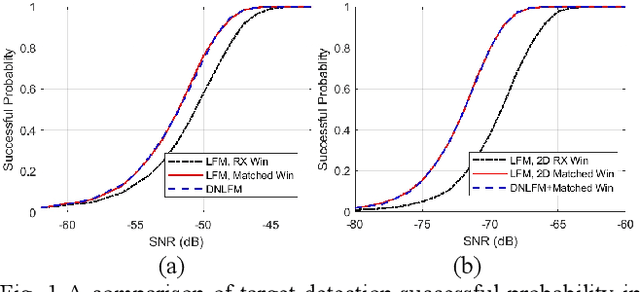
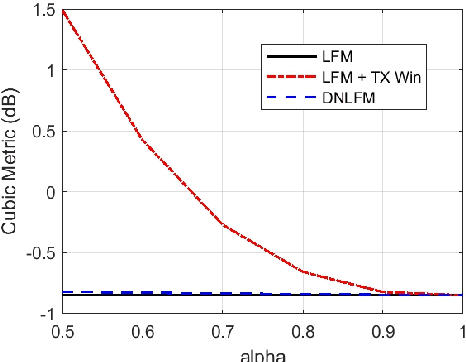
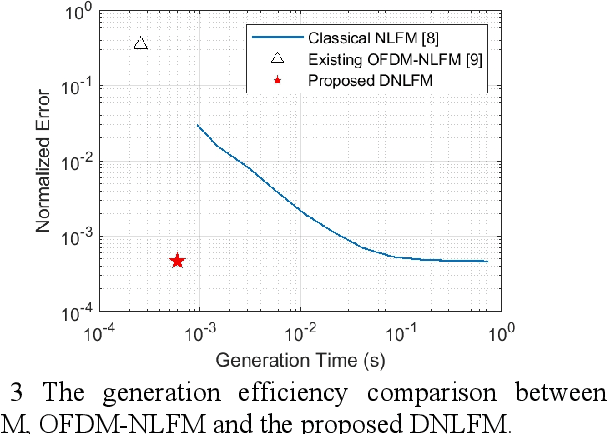
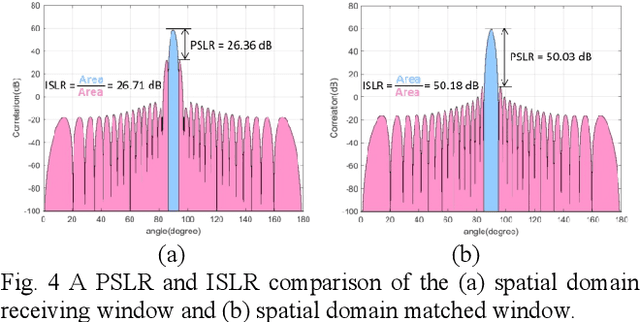
Integrated sensing and communication (ISAC) is a key enabler of 6G. Unlike communication radio links, the sensing signal requires to experience round trips from many scatters. Therefore, sensing is more power-sensitive and faces a severer multi-target interference. In this paper, the ISAC system employs dedicated sensing signals, which can be reused as the communication reference signal. This paper proposes to add time-frequency matched windows at both the transmitting and receiving sides, which avoids mismatch loss and increases energy efficiency. Discrete non-linear frequency modulation (DNLFM) is further proposed to achieve both time-domain constant modulus and frequency-domain arbitrary windowing weights. DNLFM uses very few Newton iterations and a simple geometrically-equivalent method to generate, which greatly reduces the complex numerical integral in the conventional method. Moreover, the spatial-domain matched window is proposed to achieve low sidelobes. The simulation results show that the proposed methods gain a higher energy efficiency than conventional methods.
Dynamic Structural Brain Network Construction by Hierarchical Prototype Embedding GCN using T1-MRI
May 17, 2023Constructing structural brain networks using T1-weighted magnetic resonance imaging (T1-MRI) presents a significant challenge due to the lack of direct regional connectivity information. Current methods with T1-MRI rely on predefined regions or isolated pretrained location modules to obtain atrophic regions, which neglects individual specificity. Besides, existing methods capture global structural context only on the whole-image-level, which weaken correlation between regions and the hierarchical distribution nature of brain connectivity.We hereby propose a novel dynamic structural brain network construction method based on T1-MRI, which can dynamically localize critical regions and constrain the hierarchical distribution among them for constructing dynamic structural brain network. Specifically, we first cluster spatially-correlated channel and generate several critical brain regions as prototypes. Further, we introduce a contrastive loss function to constrain the prototypes distribution, which embed the hierarchical brain semantic structure into the latent space. Self-attention and GCN are then used to dynamically construct hierarchical correlations of critical regions for brain network and explore the correlation, respectively. Our method is evaluated on ADNI-1 and ADNI-2 databases for mild cognitive impairment (MCI) conversion prediction, and acheive the state-of-the-art (SOTA) performance. Our source code is available at http://github.com/*******.
3DG-STFM: 3D Geometric Guided Student-Teacher Feature Matching
Jul 06, 2022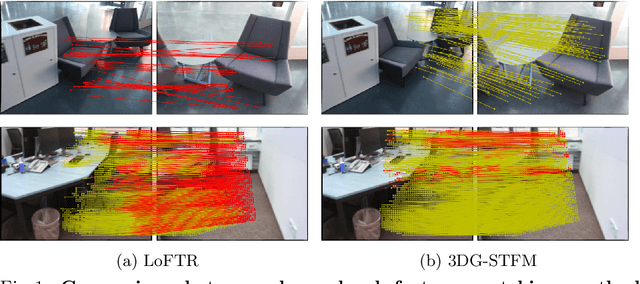
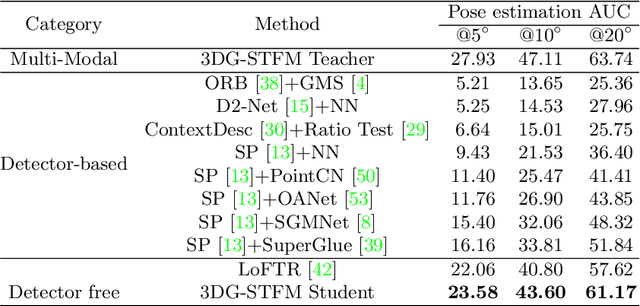
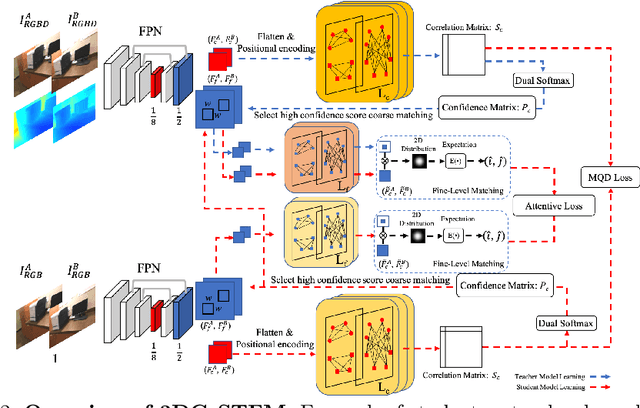
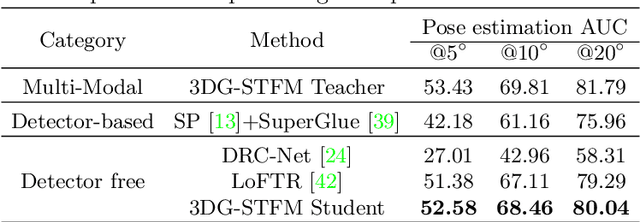
We tackle the essential task of finding dense visual correspondences between a pair of images. This is a challenging problem due to various factors such as poor texture, repetitive patterns, illumination variation, and motion blur in practical scenarios. In contrast to methods that use dense correspondence ground-truths as direct supervision for local feature matching training, we train 3DG-STFM: a multi-modal matching model (Teacher) to enforce the depth consistency under 3D dense correspondence supervision and transfer the knowledge to 2D unimodal matching model (Student). Both teacher and student models consist of two transformer-based matching modules that obtain dense correspondences in a coarse-to-fine manner. The teacher model guides the student model to learn RGB-induced depth information for the matching purpose on both coarse and fine branches. We also evaluate 3DG-STFM on a model compression task. To the best of our knowledge, 3DG-STFM is the first student-teacher learning method for the local feature matching task. The experiments show that our method outperforms state-of-the-art methods on indoor and outdoor camera pose estimations, and homography estimation problems. Code is available at: https://github.com/Ryan-prime/3DG-STFM.