 Add to Chrome
 Add to Firefox
 Add to Edge
Approximation and learning of anisotropic and mixed smooth functions by deep ReLU neural networks
May 29, 2026
This paper studies how efficiently deep ReLU neural networks can approximate and learn smooth functions. When the error is measured in $L^p([0,1]^d)$ norm and the approximator is a network with width $W$ and depth $L$, recent works have proven the supper approximation rate $\mathcal{O}((WL)^{-2s/d})$ for Besov space $\mathcal{B}^s_{q,r}([0,1]^d)$ under the Sobolev embedding condition $s/d>1/q-1/p$. In order to overcome the curse of dimensionality in this rate, we extent this result to anisotropic and mixed smooth function classes. We establish the approximation rate $\mathcal{O}((WL)^{-2\tilde{s}})$ for anisotropic Besov space $\mathcal{B}^{\boldsymbol{s}}_{q,r}([0,1]^d)$ with anisotropic smoothness $\boldsymbol{s}=(s_1,\dots,s_d)$ under the embedding condition $\tilde{s} > 1/q-1/p$, where the mean smoothness $\tilde{s} = (\sum_{i=1}^d s_i^{-1})^{-1}$. For mixed smooth Besov space $\mathcal{MB}^s_{q,r}([0,1]^d)$ with mixed smoothness $s>1/q-1/p$, we show that the approximation rate $\mathcal{O}((WL)^{-2s})$ holds up to logarithmic factors. Using these results, we also derive approximation bounds for the composition of anisotropic Besov functions. As an application, it is shown that deep ReLU neural networks can achieve minimax optimal rates up to logarithmic factors for a wide range of smooth function classes.

Neural Radiated-Noise Fields for Unmanned Underwater Vehicle Noise Spectrum Prediction in Three-Dimensional Scenes
May 29, 2026Radiated noise in unmanned underwater vehicles (UUVs) is an important indicator for characterizing acoustic signatures and evaluating platform performance. To address the strong dependence of traditional physics-based modeling and numerical simulation methods on target structural information and environmental boundary conditions, and their inability to achieve continuous spatial spectrum-response modeling in three-dimensional scenes, this paper proposes a neural radiated-noise field (NRNF). An NRNF represents the UUV radiated-noise spectrum as a continuous function of the three-dimensional UUV position, the three-dimensional hydrophone position, the UUV yaw angle, and the frequency, enabling query-based prediction at arbitrary spatial locations. The proposed method employs sinusoidal encoding for position and frequency, and introduces a learnable three-dimensional scene feature grid to explicitly represent environmental structure and propagation effects. A spectrum-prediction dataset is constructed from lake trials, and the proposed model is evaluated under three settings: horizontal extrapolation, depth extrapolation, and cross-run generalization. Results show that the NRNF achieves an average prediction error of 3.5 dB in the 50 to 5000 Hz band. Horizontal extrapolation is easiest, depth extrapolation is the most challenging, and cross-run generalization is of intermediate difficulty. Further ablation results demonstrate that the scene feature grid significantly improves the prediction stability and spatial generalization of the model.
Mitigating Object Hallucinations in Vision-Language Models through Region-Aware Attention Recalibration
May 24, 2026The generation of factually incorrect objects, commonly known as object hallucination, remains a persistent challenge in Large Vision-Language Models (LVLMs). Current approaches to address this issue - ranging from expensive data-driven fine-tuning and high-latency contrastive decoding to rigid attention head truncation - frequently compromise either computational efficiency or the continuity of the model's feature space. To overcome these limitations, we introduce a novel, training-free inference strategy that operates as a region-aware adaptive weighting mechanism to dynamically correct semantic drift without relying on abrupt heuristic truncations. By computing an outlier-resistant statistical midpoint across various attention heads, we establish a stable anchor for reliable visual representations. We then utilize the inter-head disagreement mapped across regions to dynamically determine intervention budgets, gently suppressing hallucination-inducing attention paths through a continuous penalty modulation. This recalibration process effectively rectifies visual-semantic misalignments while fully preserving generative fluency and language priors. Comprehensive evaluations on standard multimodal benchmarks, including CHAIR, POPE, and MME, reveal that our strategy substantially curtails both instance- and sentence-level hallucinations. The results demonstrate state-of-the-art performance against contemporary baselines, confirming our method's efficiency and algorithmic robustness. Our code will be public.
Unbounded Density Ratio Estimation and Its Application to Covariate Shift Adaptation
Mar 31, 2026This paper focuses on the problem of unbounded density ratio estimation -- an understudied yet critical challenge in statistical learning -- and its application to covariate shift adaptation. Much of the existing literature assumes that the density ratio is either uniformly bounded or unbounded but known exactly. These conditions are often violated in practice, creating a gap between theoretical guarantees and real-world applicability. In contrast, this work directly addresses unbounded density ratios and integrates them into importance weighting for effective covariate shift adaptation. We propose a three-step estimation method that leverages unlabeled data from both the source and target distributions: (1) estimating a relative density ratio; (2) applying a truncation operation to control its unboundedness; and (3) transforming the truncated estimate back into the standard density ratio. The estimated density ratio is then employed as importance weights for regression under covariate shift. We establish rigorous, non-asymptotic convergence guarantees for both the proposed density ratio estimator and the resulting regression function estimator, demonstrating optimal or near-optimal convergence rates. Our findings offer new theoretical insights into density ratio estimation and learning under covariate shift, extending classical learning theory to more practical and challenging scenarios.
Two-Stage Data Synthesization: A Statistics-Driven Restricted Trade-off between Privacy and Prediction
Feb 09, 2026Synthetic data have gained increasing attention across various domains, with a growing emphasis on their performance in downstream prediction tasks. However, most existing synthesis strategies focus on maintaining statistical information. Although some studies address prediction performance guarantees, their single-stage synthesis designs make it challenging to balance the privacy requirements that necessitate significant perturbations and the prediction performance that is sensitive to such perturbations. We propose a two-stage synthesis strategy. In the first stage, we introduce a synthesis-then-hybrid strategy, which involves a synthesis operation to generate pure synthetic data, followed by a hybrid operation that fuses the synthetic data with the original data. In the second stage, we present a kernel ridge regression (KRR)-based synthesis strategy, where a KRR model is first trained on the original data and then used to generate synthetic outputs based on the synthetic inputs produced in the first stage. By leveraging the theoretical strengths of KRR and the covariant distribution retention achieved in the first stage, our proposed two-stage synthesis strategy enables a statistics-driven restricted privacy--prediction trade-off and guarantee optimal prediction performance. We validate our approach and demonstrate its characteristics of being statistics-driven and restricted in achieving the privacy--prediction trade-off both theoretically and numerically. Additionally, we showcase its generalizability through applications to a marketing problem and five real-world datasets.
Efficient Low-Tubal-Rank Tensor Estimation via Alternating Preconditioned Gradient Descent
Dec 23, 2025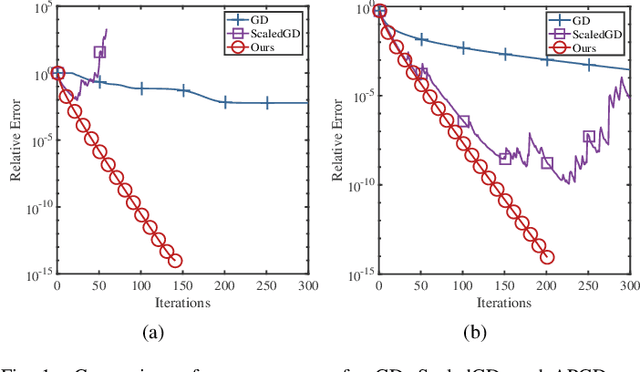
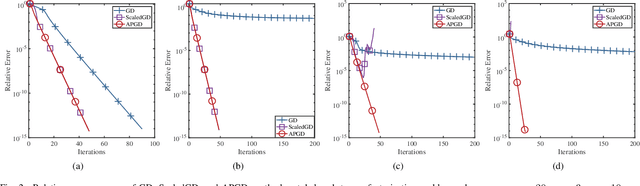
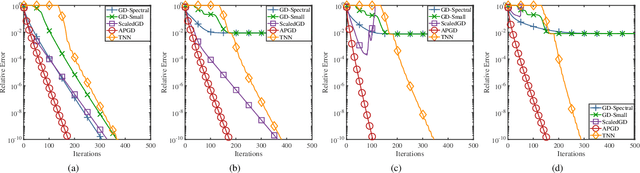
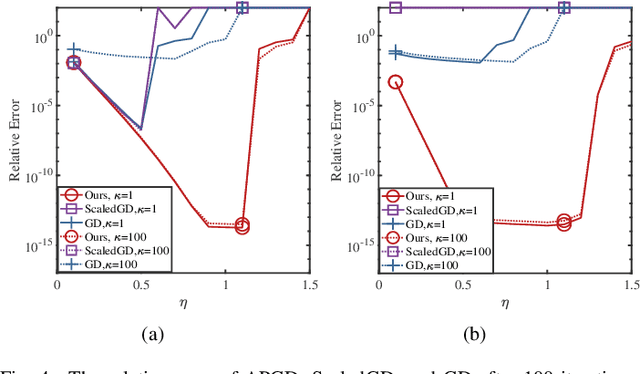
The problem of low-tubal-rank tensor estimation is a fundamental task with wide applications across high-dimensional signal processing, machine learning, and image science. Traditional approaches tackle such a problem by performing tensor singular value decomposition, which is computationally expensive and becomes infeasible for large-scale tensors. Recent approaches address this issue by factorizing the tensor into two smaller factor tensors and solving the resulting problem using gradient descent. However, this kind of approach requires an accurate estimate of the tensor rank, and when the rank is overestimated, the convergence of gradient descent and its variants slows down significantly or even diverges. To address this problem, we propose an Alternating Preconditioned Gradient Descent (APGD) algorithm, which accelerates convergence in the over-parameterized setting by adding a preconditioning term to the original gradient and updating these two factors alternately. Based on certain geometric assumptions on the objective function, we establish linear convergence guarantees for more general low-tubal-rank tensor estimation problems. Then we further analyze the specific cases of low-tubal-rank tensor factorization and low-tubal-rank tensor recovery. Our theoretical results show that APGD achieves linear convergence even under over-parameterization, and the convergence rate is independent of the tensor condition number. Extensive simulations on synthetic data are carried out to validate our theoretical assertions.
Spectral Algorithms under Covariate Shift
Apr 17, 2025Spectral algorithms leverage spectral regularization techniques to analyze and process data, providing a flexible framework for addressing supervised learning problems. To deepen our understanding of their performance in real-world scenarios where the distributions of training and test data may differ, we conduct a rigorous investigation into the convergence behavior of spectral algorithms under distribution shifts, specifically within the framework of reproducing kernel Hilbert spaces. Our study focuses on the case of covariate shift. In this scenario, the marginal distributions of the input data differ between the training and test datasets, while the conditional distribution of the output given the input remains unchanged. Under this setting, we analyze the generalization error of spectral algorithms and show that they achieve minimax optimality when the density ratios between the training and test distributions are uniformly bounded. However, we also identify a critical limitation: when the density ratios are unbounded, the spectral algorithms may become suboptimal. To address this limitation, we propose a weighted spectral algorithm that incorporates density ratio information into the learning process. Our theoretical analysis shows that this weighted approach achieves optimal capacity-independent convergence rates. Furthermore, by introducing a weight clipping technique, we demonstrate that the convergence rates of the weighted spectral algorithm can approach the optimal capacity-dependent convergence rates arbitrarily closely. This improvement resolves the suboptimality issue in unbounded density ratio scenarios and advances the state-of-the-art by refining existing theoretical results.
ScalingNote: Scaling up Retrievers with Large Language Models for Real-World Dense Retrieval
Nov 24, 2024


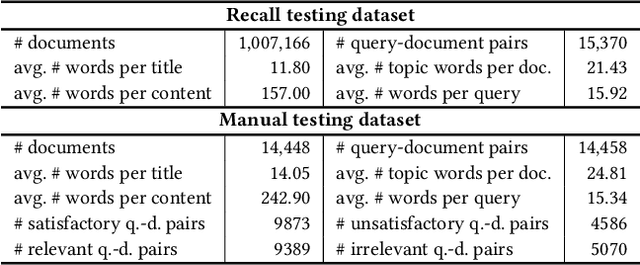
Dense retrieval in most industries employs dual-tower architectures to retrieve query-relevant documents. Due to online deployment requirements, existing real-world dense retrieval systems mainly enhance performance by designing negative sampling strategies, overlooking the advantages of scaling up. Recently, Large Language Models (LLMs) have exhibited superior performance that can be leveraged for scaling up dense retrieval. However, scaling up retrieval models significantly increases online query latency. To address this challenge, we propose ScalingNote, a two-stage method to exploit the scaling potential of LLMs for retrieval while maintaining online query latency. The first stage is training dual towers, both initialized from the same LLM, to unlock the potential of LLMs for dense retrieval. Then, we distill only the query tower using mean squared error loss and cosine similarity to reduce online costs. Through theoretical analysis and comprehensive offline and online experiments, we show the effectiveness and efficiency of ScalingNote. Our two-stage scaling method outperforms end-to-end models and verifies the scaling law of dense retrieval with LLMs in industrial scenarios, enabling cost-effective scaling of dense retrieval systems. Our online method incorporating ScalingNote significantly enhances the relevance between retrieved documents and queries.
MA4DIV: Multi-Agent Reinforcement Learning for Search Result Diversification
Mar 27, 2024


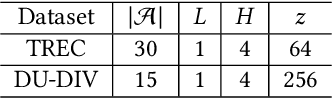
The objective of search result diversification (SRD) is to ensure that selected documents cover as many different subtopics as possible. Existing methods primarily utilize a paradigm of "greedy selection", i.e., selecting one document with the highest diversity score at a time. These approaches tend to be inefficient and are easily trapped in a suboptimal state. In addition, some other methods aim to approximately optimize the diversity metric, such as $\alpha$-NDCG, but the results still remain suboptimal. To address these challenges, we introduce Multi-Agent reinforcement learning (MARL) for search result DIVersity, which called MA4DIV. In this approach, each document is an agent and the search result diversification is modeled as a cooperative task among multiple agents. This approach allows for directly optimizing the diversity metrics, such as $\alpha$-NDCG, while achieving high training efficiency. We conducted preliminary experiments on public TREC datasets to demonstrate the effectiveness and potential of MA4DIV. Considering the limited number of queries in public TREC datasets, we construct a large-scale dataset from industry sources and show that MA4DIV achieves substantial improvements in both effectiveness and efficiency than existing baselines on a industrial scale dataset.
Nonlinear functional regression by functional deep neural network with kernel embedding
Jan 05, 2024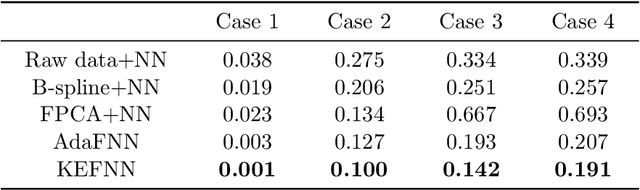
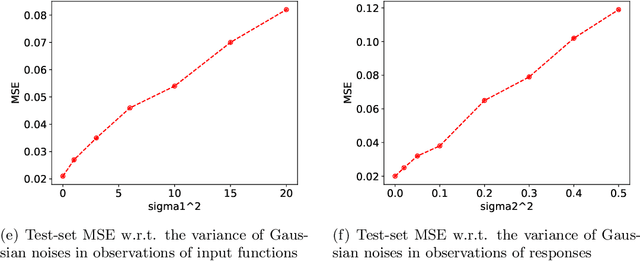

With the rapid development of deep learning in various fields of science and technology, such as speech recognition, image classification, and natural language processing, recently it is also widely applied in the functional data analysis (FDA) with some empirical success. However, due to the infinite dimensional input, we need a powerful dimension reduction method for functional learning tasks, especially for the nonlinear functional regression. In this paper, based on the idea of smooth kernel integral transformation, we propose a functional deep neural network with an efficient and fully data-dependent dimension reduction method. The architecture of our functional net consists of a kernel embedding step: an integral transformation with a data-dependent smooth kernel; a projection step: a dimension reduction by projection with eigenfunction basis based on the embedding kernel; and finally an expressive deep ReLU neural network for the prediction. The utilization of smooth kernel embedding enables our functional net to be discretization invariant, efficient, and robust to noisy observations, capable of utilizing information in both input functions and responses data, and have a low requirement on the number of discrete points for an unimpaired generalization performance. We conduct theoretical analysis including approximation error and generalization error analysis, and numerical simulations to verify these advantages of our functional net.