 Add to Chrome
 Add to Firefox
 Add to Edge
AlphaEdit: Null-Space Constrained Knowledge Editing for Language Models
Oct 03, 2024
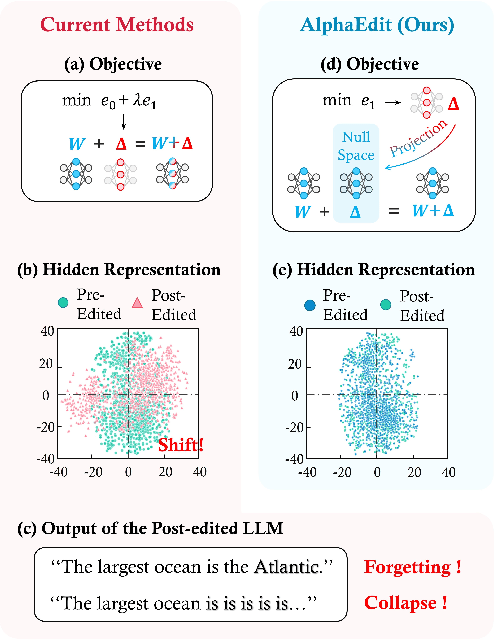
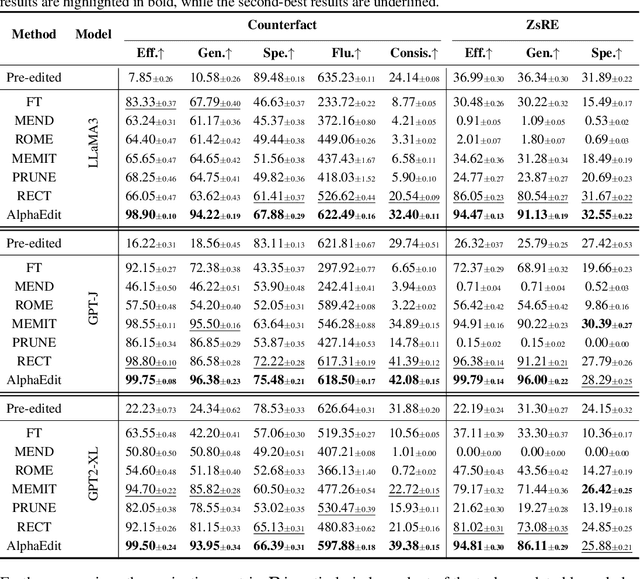
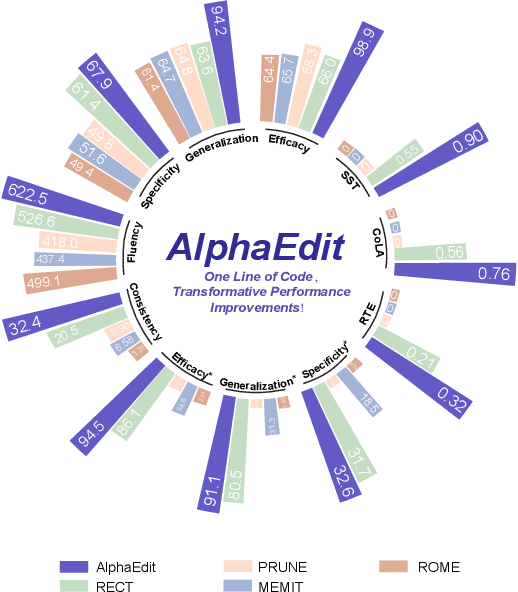
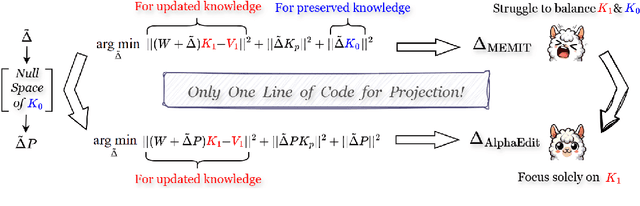
Large language models (LLMs) often exhibit hallucinations due to incorrect or outdated knowledge. Hence, model editing methods have emerged to enable targeted knowledge updates. To achieve this, a prevailing paradigm is the locating-then-editing approach, which first locates influential parameters and then edits them by introducing a perturbation. While effective, current studies have demonstrated that this perturbation inevitably disrupt the originally preserved knowledge within LLMs, especially in sequential editing scenarios. To address this, we introduce AlphaEdit, a novel solution that projects perturbation onto the null space of the preserved knowledge before applying it to the parameters. We theoretically prove that this projection ensures the output of post-edited LLMs remains unchanged when queried about the preserved knowledge, thereby mitigating the issue of disruption. Extensive experiments on various LLMs, including LLaMA3, GPT2-XL, and GPT-J, show that AlphaEdit boosts the performance of most locating-then-editing methods by an average of 36.4% with a single line of additional code for projection solely. Our code is available at: https://github.com/jianghoucheng/AlphaEdit.

Knowledge Graph Embedding by Normalizing Flows
Sep 30, 2024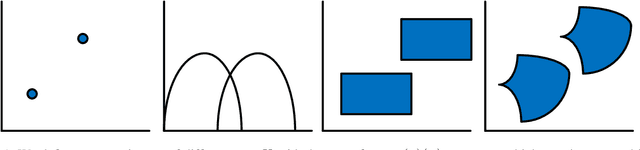
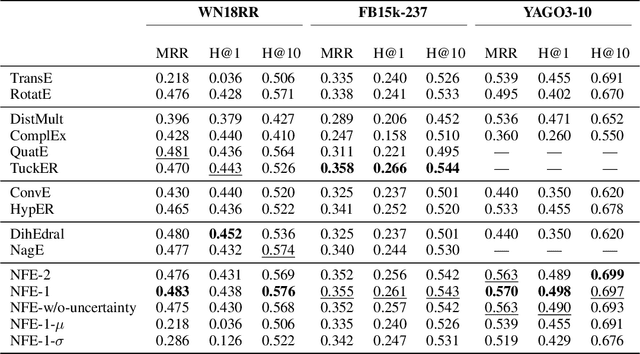

A key to knowledge graph embedding (KGE) is to choose a proper representation space, e.g., point-wise Euclidean space and complex vector space. In this paper, we propose a unified perspective of embedding and introduce uncertainty into KGE from the view of group theory. Our model can incorporate existing models (i.e., generality), ensure the computation is tractable (i.e., efficiency) and enjoy the expressive power of complex random variables (i.e., expressiveness). The core idea is that we embed entities/relations as elements of a symmetric group, i.e., permutations of a set. Permutations of different sets can reflect different properties of embedding. And the group operation of symmetric groups is easy to compute. In specific, we show that the embedding of many existing models, point vectors, can be seen as elements of a symmetric group. To reflect uncertainty, we first embed entities/relations as permutations of a set of random variables. A permutation can transform a simple random variable into a complex random variable for greater expressiveness, called a normalizing flow. We then define scoring functions by measuring the similarity of two normalizing flows, namely NFE. We construct several instantiating models and prove that they are able to learn logical rules. Experimental results demonstrate the effectiveness of introducing uncertainty and our model. The code is available at https://github.com/changyi7231/NFE.
Proactive Recommendation in Social Networks: Steering User Interest via Neighbor Influence
Sep 13, 2024
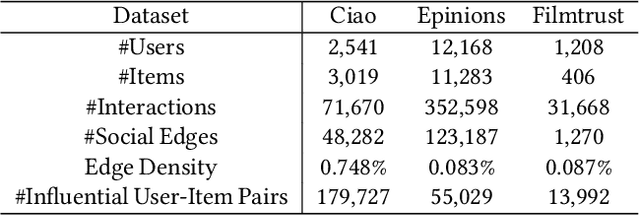
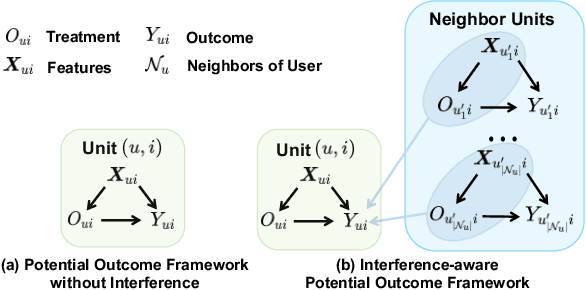
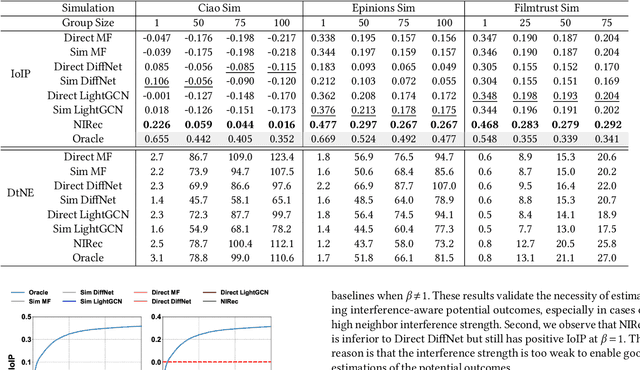
Recommending items solely catering to users' historical interests narrows users' horizons. Recent works have considered steering target users beyond their historical interests by directly adjusting items exposed to them. However, the recommended items for direct steering might not align perfectly with users' interests evolution, detrimentally affecting target users' experience. To avoid this issue, we propose a new task named Proactive Recommendation in Social Networks (PRSN) that indirectly steers users' interest by utilizing the influence of social neighbors, i.e., indirect steering by adjusting the exposure of a target item to target users' neighbors. The key to PRSN lies in answering an interventional question: what would a target user's feedback be on a target item if the item is exposed to the user's different neighbors? To answer this question, we resort to causal inference and formalize PRSN as: (1) estimating the potential feedback of a user on an item, under the network interference by the item's exposure to the user's neighbors; and (2) adjusting the exposure of a target item to target users' neighbors to trade off steering performance and the damage to the neighbors' experience. To this end, we propose a Neighbor Interference Recommendation (NIRec) framework with two key modules: (1)an interference representation-based estimation module for modeling potential feedback; and (2) a post-learning-based optimization module for optimizing a target item's exposure to trade off steering performance and the neighbors' experience by greedy search. We conduct extensive semi-simulation experiments based on three real-world datasets, validating the steering effectiveness of NIRec.
Customizing Language Models with Instance-wise LoRA for Sequential Recommendation
Aug 19, 2024

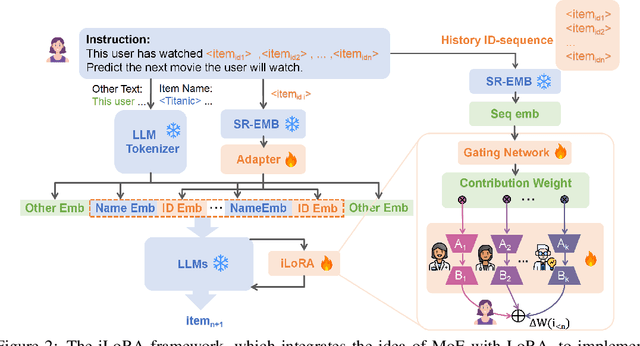

Sequential recommendation systems predict a user's next item of interest by analyzing past interactions, aligning recommendations with individual preferences. Leveraging the strengths of Large Language Models (LLMs) in knowledge comprehension and reasoning, recent approaches have applied LLMs to sequential recommendation through language generation paradigms. These methods convert user behavior sequences into prompts for LLM fine-tuning, utilizing Low-Rank Adaptation (LoRA) modules to refine recommendations. However, the uniform application of LoRA across diverse user behaviors sometimes fails to capture individual variability, leading to suboptimal performance and negative transfer between disparate sequences. To address these challenges, we propose Instance-wise LoRA (iLoRA), integrating LoRA with the Mixture of Experts (MoE) framework. iLoRA creates a diverse array of experts, each capturing specific aspects of user preferences, and introduces a sequence representation guided gate function. This gate function processes historical interaction sequences to generate enriched representations, guiding the gating network to output customized expert participation weights. This tailored approach mitigates negative transfer and dynamically adjusts to diverse behavior patterns. Extensive experiments on three benchmark datasets demonstrate the effectiveness of iLoRA, highlighting its superior performance compared to existing methods in capturing user-specific preferences and improving recommendation accuracy.
Reinforced Prompt Personalization for Recommendation with Large Language Models
Jul 24, 2024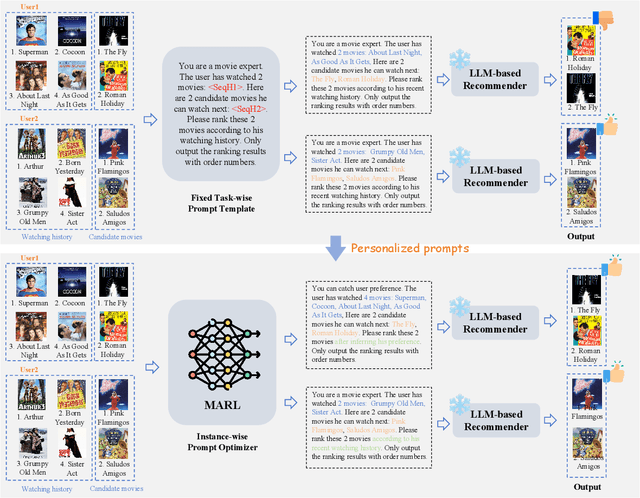
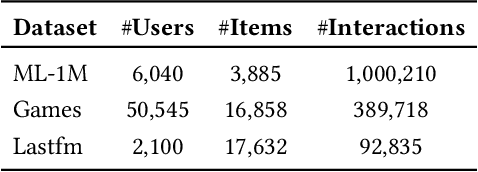
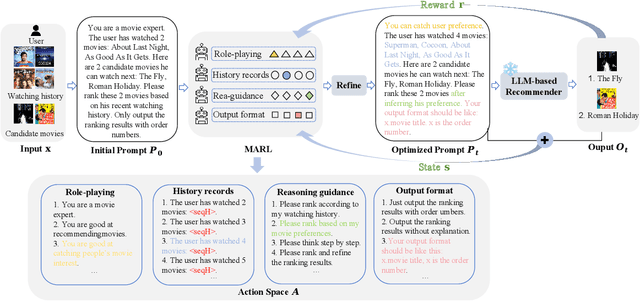
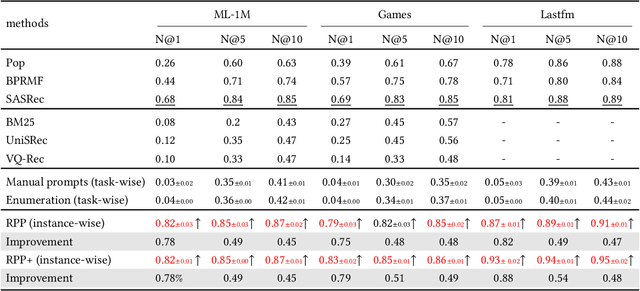
Designing effective prompts can empower LLMs to understand user preferences and provide recommendations by leveraging LLMs' intent comprehension and knowledge utilization capabilities. However, existing research predominantly concentrates on task-wise prompting, developing fixed prompt templates composed of four patterns (i.e., role-playing, history records, reasoning guidance, and output format) and applying them to all users for a given task. Although convenient, task-wise prompting overlooks individual user differences, leading to potential mismatches in capturing user preferences. To address it, we introduce the concept of instance-wise prompting to personalize discrete prompts for individual users and propose Reinforced Prompt Personalization (RPP) to optimize the four patterns in prompts using multi-agent reinforcement learning (MARL). To boost efficiency, RPP formulates prompt personalization as selecting optimal sentences holistically across the four patterns, rather than optimizing word-by-word. To ensure the quality of prompts, RPP meticulously crafts diverse expressions for each of the four patterns, considering multiple analytical perspectives for specific recommendation tasks. In addition to RPP, our proposal of RPP+ aims to enhance the scalability of action space by dynamically refining actions with LLMs throughout the iterative process. We evaluate the effectiveness of RPP/RPP+ in ranking tasks over various datasets. Experimental results demonstrate the superiority of RPP/RPP+ over traditional recommender models, few-shot methods, and other prompt-based methods, underscoring the significance of instance-wise prompting for LLMs in recommendation tasks and validating the effectiveness of RPP/RPP+. Our code is available at https://github.com/maowenyu-11/RPP.
A3S: A General Active Clustering Method with Pairwise Constraints
Jul 14, 2024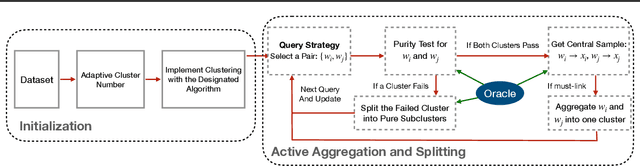
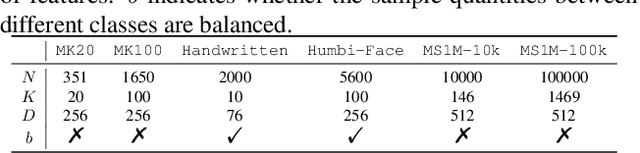
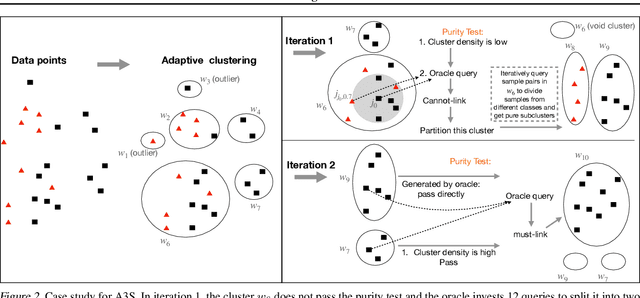
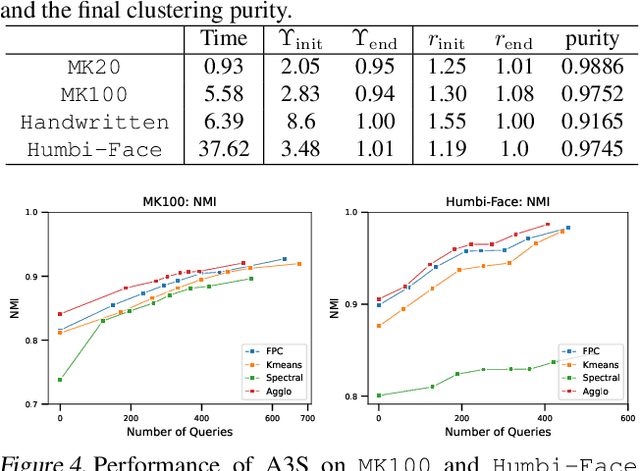
Active clustering aims to boost the clustering performance by integrating human-annotated pairwise constraints through strategic querying. Conventional approaches with semi-supervised clustering schemes encounter high query costs when applied to large datasets with numerous classes. To address these limitations, we propose a novel Adaptive Active Aggregation and Splitting (A3S) framework, falling within the cluster-adjustment scheme in active clustering. A3S features strategic active clustering adjustment on the initial cluster result, which is obtained by an adaptive clustering algorithm. In particular, our cluster adjustment is inspired by the quantitative analysis of Normalized mutual information gain under the information theory framework and can provably improve the clustering quality. The proposed A3S framework significantly elevates the performance and scalability of active clustering. In extensive experiments across diverse real-world datasets, A3S achieves desired results with significantly fewer human queries compared with existing methods.
$β$-DPO: Direct Preference Optimization with Dynamic $β$
Jul 11, 2024Direct Preference Optimization (DPO) has emerged as a compelling approach for training Large Language Models (LLMs) to adhere to human preferences. However, the performance of DPO is sensitive to the fine-tuning of its trade-off parameter $\beta$, as well as to the quality of the preference data. We analyze the impact of $\beta$ and data quality on DPO, uncovering that optimal $\beta$ values vary with the informativeness of pairwise data. Addressing the limitations of static $\beta$ values, we introduce a novel framework that dynamically calibrates $\beta$ at the batch level, informed by data quality considerations. Additionally, our method incorporates $\beta$-guided data filtering to safeguard against the influence of outliers. Through empirical evaluation, we demonstrate that our dynamic $\beta$ adjustment technique significantly improves DPO's performance across a range of models and datasets, offering a more robust and adaptable training paradigm for aligning LLMs with human feedback. The code is available at \url{https://github.com/junkangwu/beta-DPO}.
Towards Robust Alignment of Language Models: Distributionally Robustifying Direct Preference Optimization
Jul 10, 2024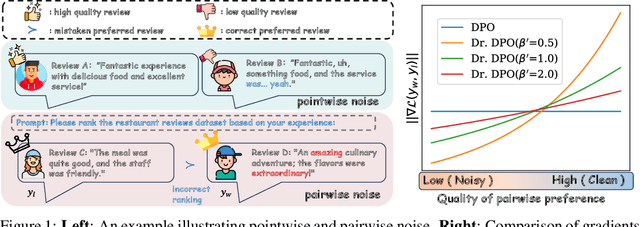
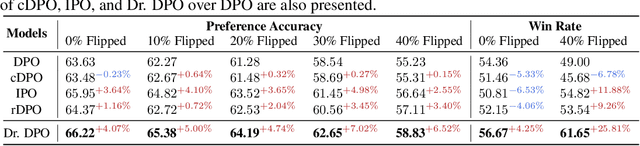
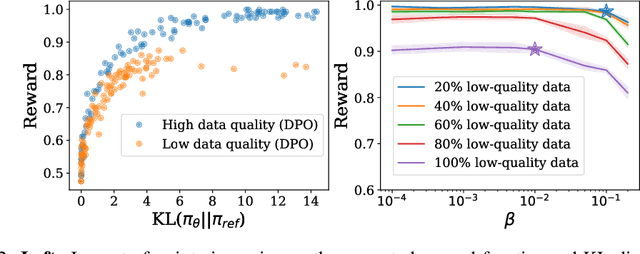
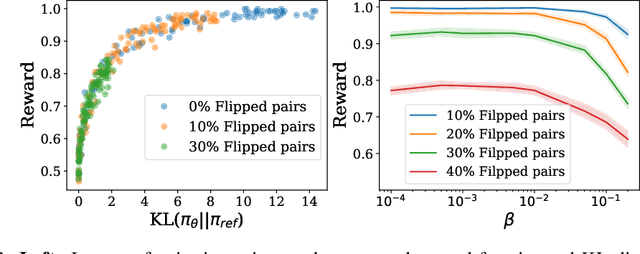
This study addresses the challenge of noise in training datasets for Direct Preference Optimization (DPO), a method for aligning Large Language Models (LLMs) with human preferences. We categorize noise into pointwise noise, which includes low-quality data points, and pairwise noise, which encompasses erroneous data pair associations that affect preference rankings. Utilizing Distributionally Robust Optimization (DRO), we enhance DPO's resilience to these types of noise. Our theoretical insights reveal that DPO inherently embeds DRO principles, conferring robustness to pointwise noise, with the regularization coefficient $\beta$ playing a critical role in its noise resistance. Extending this framework, we introduce Distributionally Robustifying DPO (Dr. DPO), which integrates pairwise robustness by optimizing against worst-case pairwise scenarios. The novel hyperparameter $\beta'$ in Dr. DPO allows for fine-tuned control over data pair reliability, providing a strategic balance between exploration and exploitation in noisy training environments. Empirical evaluations demonstrate that Dr. DPO substantially improves the quality of generated text and response accuracy in preference datasets, showcasing enhanced performance in both noisy and noise-free settings. The code is available at https://github.com/junkangwu/Dr_DPO.
Text-like Encoding of Collaborative Information in Large Language Models for Recommendation
Jun 05, 2024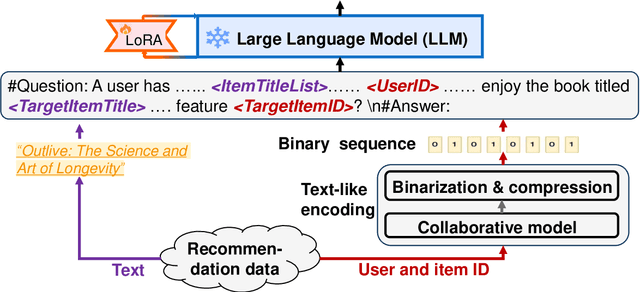

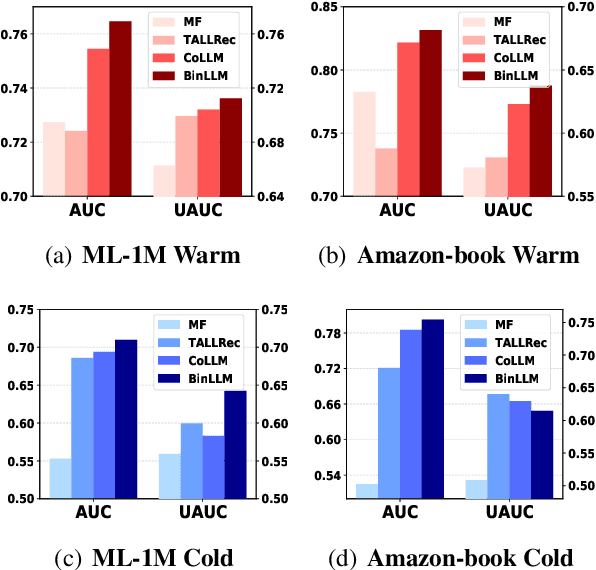
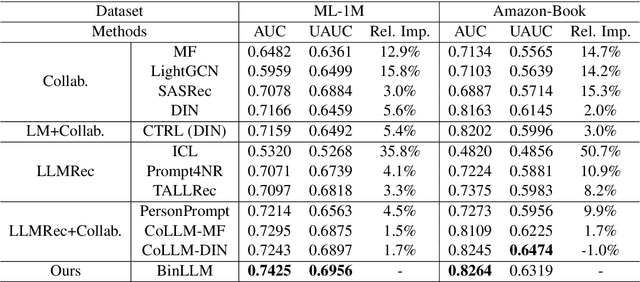
When adapting Large Language Models for Recommendation (LLMRec), it is crucial to integrate collaborative information. Existing methods achieve this by learning collaborative embeddings in LLMs' latent space from scratch or by mapping from external models. However, they fail to represent the information in a text-like format, which may not align optimally with LLMs. To bridge this gap, we introduce BinLLM, a novel LLMRec method that seamlessly integrates collaborative information through text-like encoding. BinLLM converts collaborative embeddings from external models into binary sequences -- a specific text format that LLMs can understand and operate on directly, facilitating the direct usage of collaborative information in text-like format by LLMs. Additionally, BinLLM provides options to compress the binary sequence using dot-decimal notation to avoid excessively long lengths. Extensive experiments validate that BinLLM introduces collaborative information in a manner better aligned with LLMs, resulting in enhanced performance. We release our code at https://github.com/zyang1580/BinLLM.
Fair Recommendations with Limited Sensitive Attributes: A Distributionally Robust Optimization Approach
May 02, 2024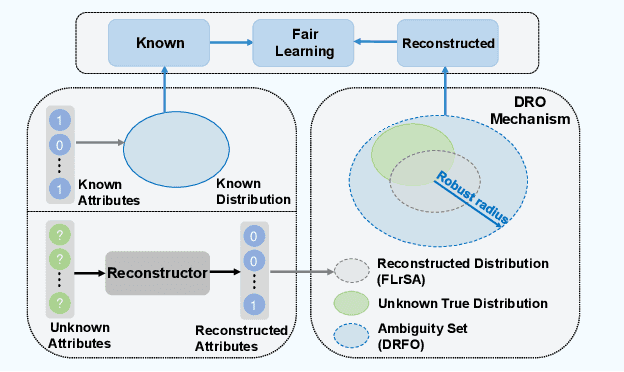
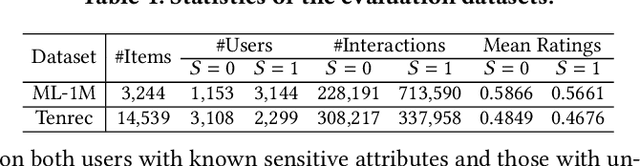
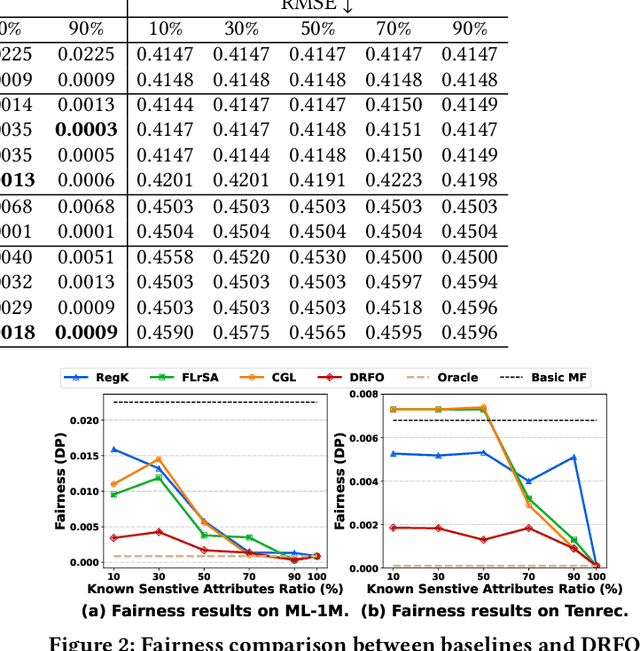
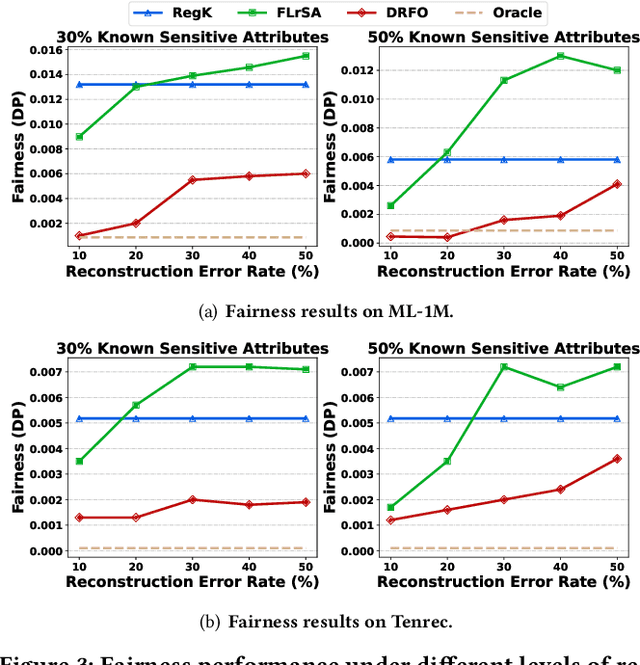
As recommender systems are indispensable in various domains such as job searching and e-commerce, providing equitable recommendations to users with different sensitive attributes becomes an imperative requirement. Prior approaches for enhancing fairness in recommender systems presume the availability of all sensitive attributes, which can be difficult to obtain due to privacy concerns or inadequate means of capturing these attributes. In practice, the efficacy of these approaches is limited, pushing us to investigate ways of promoting fairness with limited sensitive attribute information. Toward this goal, it is important to reconstruct missing sensitive attributes. Nevertheless, reconstruction errors are inevitable due to the complexity of real-world sensitive attribute reconstruction problems and legal regulations. Thus, we pursue fair learning methods that are robust to reconstruction errors. To this end, we propose Distributionally Robust Fair Optimization (DRFO), which minimizes the worst-case unfairness over all potential probability distributions of missing sensitive attributes instead of the reconstructed one to account for the impact of the reconstruction errors. We provide theoretical and empirical evidence to demonstrate that our method can effectively ensure fairness in recommender systems when only limited sensitive attributes are accessible.