 Add to Chrome
 Add to Firefox
 Add to Edge
NeurIPS: Neuro-anatomical Inductive Priors for Sphere-based Brain Decoding
May 24, 2026
Current fMRI decoders face a performance-fidelity trade-off where efficient ID encoders outperform geometrically faithful surface-based models. We argue this is partly driven by inefficient surface tokenization and the failure to use anatomy as a predictive signal. We present NeurIPS, a framework that improves surface-based decoding by reframing anatomical variation from a nuisance to a powerful inductive prior. NeurIPS unites two innovations: a Selective ROI Spherical Tokenizer (SRST) for efficient geometric encoding, and a Structure-Guided Mixture of Experts (SG-MoE) that explicitly models individual anatomy using cortical features. On the Natural Scenes Dataset, NeurIPS establishes a new state-of-the-art for surface decoders and achieves performance comparable to strong 1D baselines. This is achieved with unprecedented efficiency, as the model converges dramatically faster (10 vs. 600 epochs). This efficiency enables rapid adaptation to new subjects using only 20% of data and ensures robust scalability as the training cohort is expanded. Ablations provide causal evidence that these gains are driven by the model's use of cortical features, not by memorizing subject IDs. By leveraging anatomical priors, NeurIPS provides a principled and scalable path toward robust, generalizable brain decoding.

AlphaFlowTSE: One-Step Generative Target Speaker Extraction via Conditional AlphaFlow
Mar 11, 2026In target speaker extraction (TSE), we aim to recover target speech from a multi-talker mixture using a short enrollment utterance as reference. Recent studies on diffusion and flow-matching generators have improved target-speech fidelity. However, multi-step sampling increases latency, and one-step solutions often rely on a mixture-dependent time coordinate that can be unreliable for real-world conversations. We present AlphaFlowTSE, a one-step conditional generative model trained with a Jacobian-vector product (JVP)-free AlphaFlow objective. AlphaFlowTSE learns mean-velocity transport along a mixture-to-target trajectory starting from the observed mixture, eliminating auxiliary mixing-ratio prediction, and stabilizes training by combining flow matching with an interval-consistency teacher-student target. Experiments on Libri2Mix and REAL-T confirm that AlphaFlowTSE improves target-speaker similarity and real-mixture generalization for downstream automatic speech recognition (ASR).
Learning Native Continuation for Action Chunking Flow Policies
Feb 13, 2026Action chunking enables Vision Language Action (VLA) models to run in real time, but naive chunked execution often exhibits discontinuities at chunk boundaries. Real-Time Chunking (RTC) alleviates this issue but is external to the policy, leading to spurious multimodal switching and trajectories that are not intrinsically smooth. We propose Legato, a training-time continuation method for action-chunked flow-based VLA policies. Specifically, Legato initializes denoising from a schedule-shaped mixture of known actions and noise, exposing the model to partial action information. Moreover, Legato reshapes the learned flow dynamics to ensure that the denoising process remains consistent between training and inference under per-step guidance. Legato further uses randomized schedule condition during training to support varying inference delays and achieve controllable smoothness. Empirically, Legato produces smoother trajectories and reduces spurious multimodal switching during execution, leading to less hesitation and shorter task completion time. Extensive real-world experiments show that Legato consistently outperforms RTC across five manipulation tasks, achieving approximately 10% improvements in both trajectory smoothness and task completion time.
ELEGANCE: Efficient LLM Guidance for Audio-Visual Target Speech Extraction
Nov 09, 2025Audio-visual target speaker extraction (AV-TSE) models primarily rely on visual cues from the target speaker. However, humans also leverage linguistic knowledge, such as syntactic constraints, next word prediction, and prior knowledge of conversation, to extract target speech. Inspired by this observation, we propose ELEGANCE, a novel framework that incorporates linguistic knowledge from large language models (LLMs) into AV-TSE models through three distinct guidance strategies: output linguistic constraints, intermediate linguistic prediction, and input linguistic prior. Comprehensive experiments with RoBERTa, Qwen3-0.6B, and Qwen3-4B on two AV-TSE backbones demonstrate the effectiveness of our approach. Significant improvements are observed in challenging scenarios, including visual cue impaired, unseen languages, target speaker switches, increased interfering speakers, and out-of-domain test set. Demo page: https://alexwxwu.github.io/ELEGANCE/.
Incorporating Linguistic Constraints from External Knowledge Source for Audio-Visual Target Speech Extraction
Jun 11, 2025Audio-visual target speaker extraction (AV-TSE) models primarily rely on target visual cues to isolate the target speaker's voice from others. We know that humans leverage linguistic knowledge, such as syntax and semantics, to support speech perception. Inspired by this, we explore the potential of pre-trained speech-language models (PSLMs) and pre-trained language models (PLMs) as auxiliary knowledge sources for AV-TSE. In this study, we propose incorporating the linguistic constraints from PSLMs or PLMs for the AV-TSE model as additional supervision signals. Without introducing any extra computational cost during inference, the proposed approach consistently improves speech quality and intelligibility. Furthermore, we evaluate our method in multi-language settings and visual cue-impaired scenarios and show robust performance gains.
$C^2$AV-TSE: Context and Confidence-aware Audio Visual Target Speaker Extraction
Apr 01, 2025Audio-Visual Target Speaker Extraction (AV-TSE) aims to mimic the human ability to enhance auditory perception using visual cues. Although numerous models have been proposed recently, most of them estimate target signals by primarily relying on local dependencies within acoustic features, underutilizing the human-like capacity to infer unclear parts of speech through contextual information. This limitation results in not only suboptimal performance but also inconsistent extraction quality across the utterance, with some segments exhibiting poor quality or inadequate suppression of interfering speakers. To close this gap, we propose a model-agnostic strategy called the Mask-And-Recover (MAR). It integrates both inter- and intra-modality contextual correlations to enable global inference within extraction modules. Additionally, to better target challenging parts within each sample, we introduce a Fine-grained Confidence Score (FCS) model to assess extraction quality and guide extraction modules to emphasize improvement on low-quality segments. To validate the effectiveness of our proposed model-agnostic training paradigm, six popular AV-TSE backbones were adopted for evaluation on the VoxCeleb2 dataset, demonstrating consistent performance improvements across various metrics.
Large Language Model Can Transcribe Speech in Multi-Talker Scenarios with Versatile Instructions
Sep 13, 2024


Recent advancements in large language models (LLMs) have revolutionized various domains, bringing significant progress and new opportunities. Despite progress in speech-related tasks, LLMs have not been sufficiently explored in multi-talker scenarios. In this work, we present a pioneering effort to investigate the capability of LLMs in transcribing speech in multi-talker environments, following versatile instructions related to multi-talker automatic speech recognition (ASR), target talker ASR, and ASR based on specific talker attributes such as sex, occurrence order, language, and keyword spoken. Our approach utilizes WavLM and Whisper encoder to extract multi-faceted speech representations that are sensitive to speaker characteristics and semantic context. These representations are then fed into an LLM fine-tuned using LoRA, enabling the capabilities for speech comprehension and transcription. Comprehensive experiments reveal the promising performance of our proposed system, MT-LLM, in cocktail party scenarios, highlighting the potential of LLM to handle speech-related tasks based on user instructions in such complex settings.
Target Speech Extraction with Pre-trained AV-HuBERT and Mask-And-Recover Strategy
Mar 24, 2024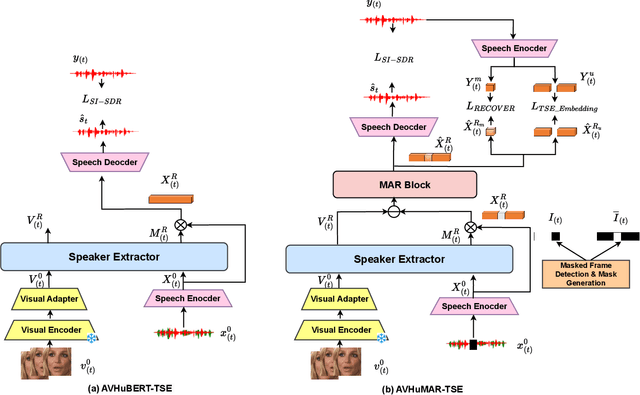

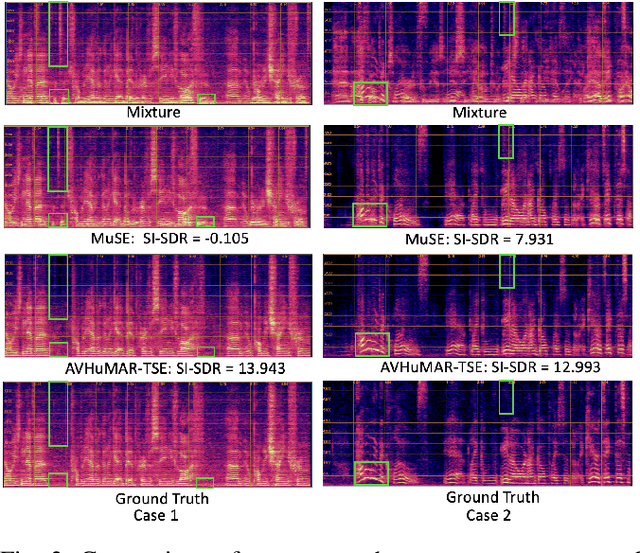

Audio-visual target speech extraction (AV-TSE) is one of the enabling technologies in robotics and many audio-visual applications. One of the challenges of AV-TSE is how to effectively utilize audio-visual synchronization information in the process. AV-HuBERT can be a useful pre-trained model for lip-reading, which has not been adopted by AV-TSE. In this paper, we would like to explore the way to integrate a pre-trained AV-HuBERT into our AV-TSE system. We have good reasons to expect an improved performance. To benefit from the inter and intra-modality correlations, we also propose a novel Mask-And-Recover (MAR) strategy for self-supervised learning. The experimental results on the VoxCeleb2 dataset show that our proposed model outperforms the baselines both in terms of subjective and objective metrics, suggesting that the pre-trained AV-HuBERT model provides more informative visual cues for target speech extraction. Furthermore, through a comparative study, we confirm that the proposed Mask-And-Recover strategy is significantly effective.
MetaSeg: Content-Aware Meta-Net for Omni-Supervised Semantic Segmentation
Jan 22, 2024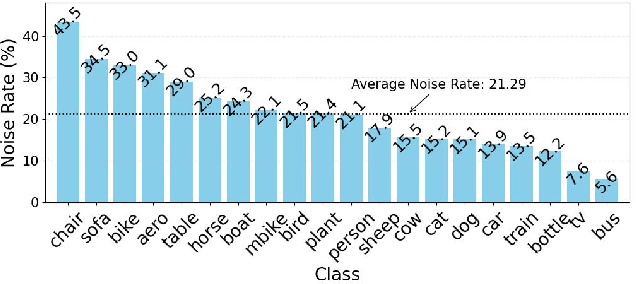

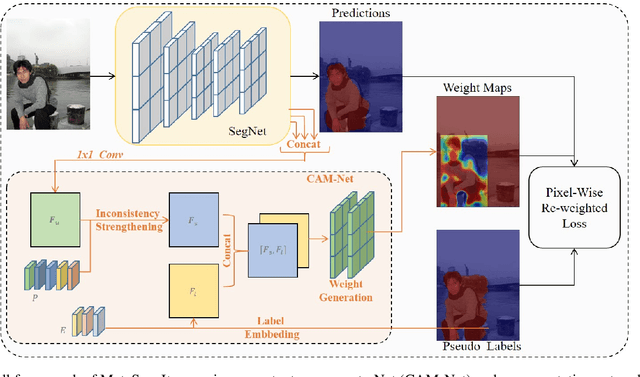
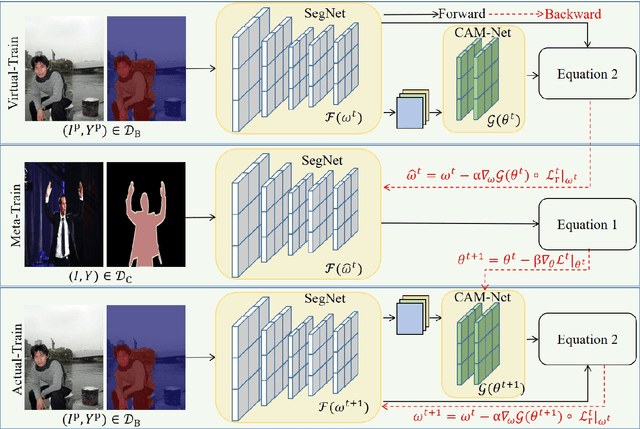
Noisy labels, inevitably existing in pseudo segmentation labels generated from weak object-level annotations, severely hampers model optimization for semantic segmentation. Previous works often rely on massive hand-crafted losses and carefully-tuned hyper-parameters to resist noise, suffering poor generalization capability and high model complexity. Inspired by recent advances in meta learning, we argue that rather than struggling to tolerate noise hidden behind clean labels passively, a more feasible solution would be to find out the noisy regions actively, so as to simply ignore them during model optimization. With this in mind, this work presents a novel meta learning based semantic segmentation method, MetaSeg, that comprises a primary content-aware meta-net (CAM-Net) to sever as a noise indicator for an arbitrary segmentation model counterpart. Specifically, CAM-Net learns to generate pixel-wise weights to suppress noisy regions with incorrect pseudo labels while highlighting clean ones by exploiting hybrid strengthened features from image content, providing straightforward and reliable guidance for optimizing the segmentation model. Moreover, to break the barrier of time-consuming training when applying meta learning to common large segmentation models, we further present a new decoupled training strategy that optimizes different model layers in a divide-and-conquer manner. Extensive experiments on object, medical, remote sensing and human segmentation shows that our method achieves superior performance, approaching that of fully supervised settings, which paves a new promising way for omni-supervised semantic segmentation.
BrainZ-BP: A Non-invasive Cuff-less Blood Pressure Estimation Approach Leveraging Brain Bio-impedance and Electrocardiogram
Nov 23, 2023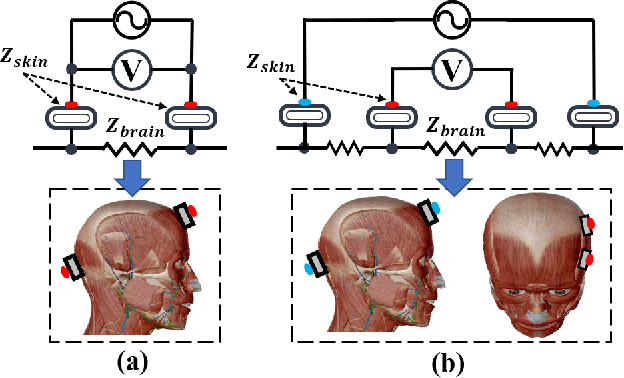
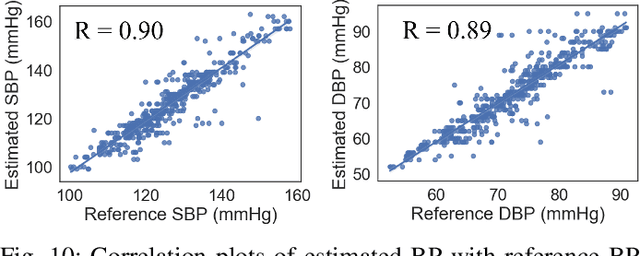
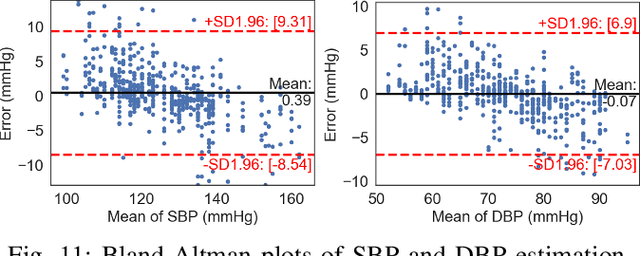
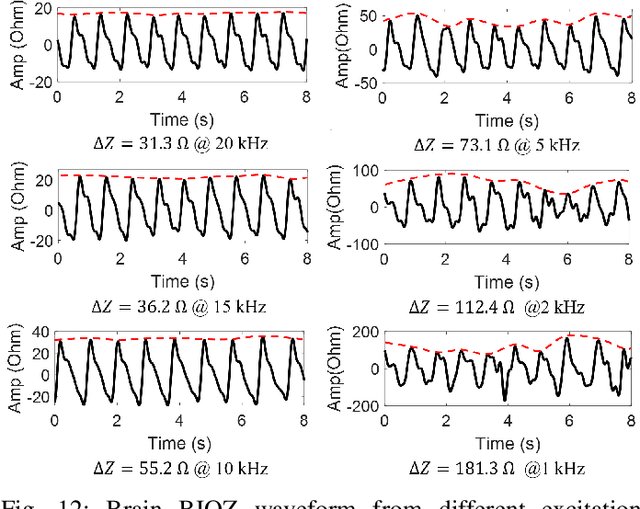
Accurate and continuous blood pressure (BP) monitoring is essential to the early prevention of cardiovascular diseases. Non-invasive and cuff-less BP estimation algorithm has gained much attention in recent years. Previous studies have demonstrated that brain bio-impedance (BIOZ) is a promising technique for non-invasive intracranial pressure (ICP) monitoring. Clinically, treatment for patients with traumatic brain injuries (TBI) requires monitoring the ICP and BP of patients simultaneously. Estimating BP by brain BIOZ directly can reduce the number of sensors attached to the patients, thus improving their comfort. To address the issues, in this study, we explore the feasibility of leveraging brain BIOZ for BP estimation and propose a novel cuff-less BP estimation approach called BrainZ-BP. Two electrodes are placed on the forehead and occipital bone of the head in the anterior-posterior direction for brain BIOZ measurement. Various features including pulse transit time and morphological features of brain BIOZ are extracted and fed into four regression models for BP estimation. Results show that the mean absolute error, root mean square error, and correlation coefficient of random forest regression model are 2.17 mmHg, 3.91 mmHg, and 0.90 for systolic pressure estimation, and are 1.71 mmHg, 3.02 mmHg, and 0.89 for diastolic pressure estimation. The presented BrainZ-BP can be applied in the brain BIOZ-based ICP monitoring scenario to monitor BP simultaneously.