 Add to Chrome
 Add to Firefox
 Add to Edge
MOPD: Multi-Teacher On-Policy Distillation for Capability Integration in LLM Post-Training
Jun 29, 2026
Modern large language models (LLMs) rely on reinforcement learning during post-training to push specific capabilities, yet integrating multiple capabilities into one model remains hard. Existing methods, such as Off-Policy Finetune and Mix-RL, are either inefficient or lose performance. In this work, we propose Multi-teacher On-Policy Distillation (MOPD), a post-training paradigm for combining the capabilities of multiple domain RL teachers: we first run per-domain specialised RL to obtain a set of domain teachers, then distill these teachers into the student on its own rollouts. This eliminates exposure bias and provides a dense optimization signal. On Qwen3-30B-A3B, MOPD outperforms Mix-RL, Cascade RL, Off-Policy Finetune, and Param-Merge baselines, inheriting nearly all of each teacher's capability. MOPD also enables parallel, independent development of domain teachers, removing the cross-domain coupling typical of multi-domain post-training. MOPD has been deployed in the post-training of MiMo-V2-Flash, an industrial-scale frontier model, demonstrating its practical value for capability integration in frontier-scale LLMs.

From Player to Master: Enhancing Test-Time Learning of LLM Agents via Reinforcement Learning over Memory
Jun 07, 2026Large language model (LLM) agents are increasingly deployed in long-running settings where improving through experience at test time becomes important. A common approach is to update an explicit memory after each interaction to guide future decisions. However, most existing methods rely on hand-designed prompting rules, making it difficult to align memory updates with downstream objectives over multi-step horizons consistently. We propose MemoPilot, a plug-in memory copilot that explicitly trains the memory update process to improve a frozen LLM's performance across sequential interactions. We formulate memory updating as a multi-turn decision problem and optimize it end-to-end with multi-turn GRPO. Our training recipe introduces (i) a turn-wise reward signal and (ii) a context-independent, turn-level advantage estimation across rollouts, enabling finer-grained credit assignment and more stable training in multi-turn settings. We evaluate MemoPilot on two testbeds: multi-round Rock-Paper-Scissors (RPS) and Limit Texas Hold'em (LHE). Across both environments, MemoPilot substantially improves test-time learning of a frozen player over strong baselines, ranking first in Elo ratings on both games (1762 on LHE and 1590 on RPS) and outperforming all baseline memory methods and proprietary models, including DeepSeek-V3.2.
MiMo-V2-Flash Technical Report
Jan 08, 2026We present MiMo-V2-Flash, a Mixture-of-Experts (MoE) model with 309B total parameters and 15B active parameters, designed for fast, strong reasoning and agentic capabilities. MiMo-V2-Flash adopts a hybrid attention architecture that interleaves Sliding Window Attention (SWA) with global attention, with a 128-token sliding window under a 5:1 hybrid ratio. The model is pre-trained on 27 trillion tokens with Multi-Token Prediction (MTP), employing a native 32k context length and subsequently extended to 256k. To efficiently scale post-training compute, MiMo-V2-Flash introduces a novel Multi-Teacher On-Policy Distillation (MOPD) paradigm. In this framework, domain-specialized teachers (e.g., trained via large-scale reinforcement learning) provide dense and token-level reward, enabling the student model to perfectly master teacher expertise. MiMo-V2-Flash rivals top-tier open-weight models such as DeepSeek-V3.2 and Kimi-K2, despite using only 1/2 and 1/3 of their total parameters, respectively. During inference, by repurposing MTP as a draft model for speculative decoding, MiMo-V2-Flash achieves up to 3.6 acceptance length and 2.6x decoding speedup with three MTP layers. We open-source both the model weights and the three-layer MTP weights to foster open research and community collaboration.
MiMo-Audio: Audio Language Models are Few-Shot Learners
Dec 29, 2025Existing audio language models typically rely on task-specific fine-tuning to accomplish particular audio tasks. In contrast, humans are able to generalize to new audio tasks with only a few examples or simple instructions. GPT-3 has shown that scaling next-token prediction pretraining enables strong generalization capabilities in text, and we believe this paradigm is equally applicable to the audio domain. By scaling MiMo-Audio's pretraining data to over one hundred million of hours, we observe the emergence of few-shot learning capabilities across a diverse set of audio tasks. We develop a systematic evaluation of these capabilities and find that MiMo-Audio-7B-Base achieves SOTA performance on both speech intelligence and audio understanding benchmarks among open-source models. Beyond standard metrics, MiMo-Audio-7B-Base generalizes to tasks absent from its training data, such as voice conversion, style transfer, and speech editing. MiMo-Audio-7B-Base also demonstrates powerful speech continuation capabilities, capable of generating highly realistic talk shows, recitations, livestreaming and debates. At the post-training stage, we curate a diverse instruction-tuning corpus and introduce thinking mechanisms into both audio understanding and generation. MiMo-Audio-7B-Instruct achieves open-source SOTA on audio understanding benchmarks (MMSU, MMAU, MMAR, MMAU-Pro), spoken dialogue benchmarks (Big Bench Audio, MultiChallenge Audio) and instruct-TTS evaluations, approaching or surpassing closed-source models. Model checkpoints and full evaluation suite are available at https://github.com/XiaomiMiMo/MiMo-Audio.
GroundingME: Exposing the Visual Grounding Gap in MLLMs through Multi-Dimensional Evaluation
Dec 19, 2025Visual grounding, localizing objects from natural language descriptions, represents a critical bridge between language and vision understanding. While multimodal large language models (MLLMs) achieve impressive scores on existing benchmarks, a fundamental question remains: can MLLMs truly ground language in vision with human-like sophistication, or are they merely pattern-matching on simplified datasets? Current benchmarks fail to capture real-world complexity where humans effortlessly navigate ambiguous references and recognize when grounding is impossible. To rigorously assess MLLMs' true capabilities, we introduce GroundingME, a benchmark that systematically challenges models across four critical dimensions: (1) Discriminative, distinguishing highly similar objects, (2) Spatial, understanding complex relational descriptions, (3) Limited, handling occlusions or tiny objects, and (4) Rejection, recognizing ungroundable queries. Through careful curation combining automated generation with human verification, we create 1,005 challenging examples mirroring real-world complexity. Evaluating 25 state-of-the-art MLLMs reveals a profound capability gap: the best model achieves only 45.1% accuracy, while most score 0% on rejection tasks, reflexively hallucinating objects rather than acknowledging their absence, raising critical safety concerns for deployment. We explore two strategies for improvements: (1) test-time scaling selects optimal response by thinking trajectory to improve complex grounding by up to 2.9%, and (2) data-mixture training teaches models to recognize ungroundable queries, boosting rejection accuracy from 0% to 27.9%. GroundingME thus serves as both a diagnostic tool revealing current limitations in MLLMs and a roadmap toward human-level visual grounding.
MiMo: Unlocking the Reasoning Potential of Language Model -- From Pretraining to Posttraining
May 12, 2025We present MiMo-7B, a large language model born for reasoning tasks, with optimization across both pre-training and post-training stages. During pre-training, we enhance the data preprocessing pipeline and employ a three-stage data mixing strategy to strengthen the base model's reasoning potential. MiMo-7B-Base is pre-trained on 25 trillion tokens, with additional Multi-Token Prediction objective for enhanced performance and accelerated inference speed. During post-training, we curate a dataset of 130K verifiable mathematics and programming problems for reinforcement learning, integrating a test-difficulty-driven code-reward scheme to alleviate sparse-reward issues and employing strategic data resampling to stabilize training. Extensive evaluations show that MiMo-7B-Base possesses exceptional reasoning potential, outperforming even much larger 32B models. The final RL-tuned model, MiMo-7B-RL, achieves superior performance on mathematics, code and general reasoning tasks, surpassing the performance of OpenAI o1-mini. The model checkpoints are available at https://github.com/xiaomimimo/MiMo.
KnowLogic: A Benchmark for Commonsense Reasoning via Knowledge-Driven Data Synthesis
Mar 08, 2025Current evaluations of commonsense reasoning in LLMs are hindered by the scarcity of natural language corpora with structured annotations for reasoning tasks. To address this, we introduce KnowLogic, a benchmark generated through a knowledge-driven synthetic data strategy. KnowLogic integrates diverse commonsense knowledge, plausible scenarios, and various types of logical reasoning. One of the key advantages of KnowLogic is its adjustable difficulty levels, allowing for flexible control over question complexity. It also includes fine-grained labels for in-depth evaluation of LLMs' reasoning abilities across multiple dimensions. Our benchmark consists of 3,000 bilingual (Chinese and English) questions across various domains, and presents significant challenges for current LLMs, with the highest-performing model achieving only 69.57\%. Our analysis highlights common errors, such as misunderstandings of low-frequency commonsense, logical inconsistencies, and overthinking. This approach, along with our benchmark, provides a valuable tool for assessing and enhancing LLMs' commonsense reasoning capabilities and can be applied to a wide range of knowledge domains.
How to Craft Backdoors with Unlabeled Data Alone?
Apr 10, 2024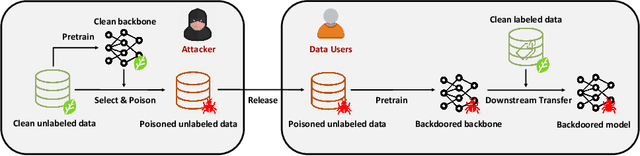
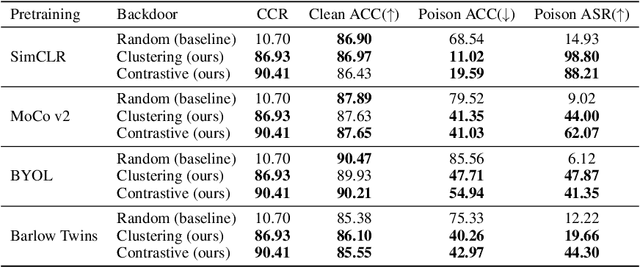
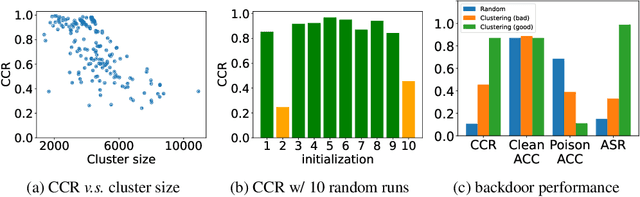
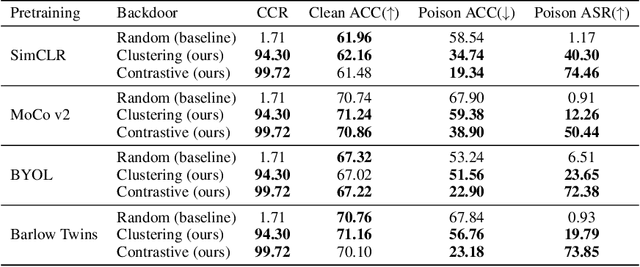
Relying only on unlabeled data, Self-supervised learning (SSL) can learn rich features in an economical and scalable way. As the drive-horse for building foundation models, SSL has received a lot of attention recently with wide applications, which also raises security concerns where backdoor attack is a major type of threat: if the released dataset is maliciously poisoned, backdoored SSL models can behave badly when triggers are injected to test samples. The goal of this work is to investigate this potential risk. We notice that existing backdoors all require a considerable amount of \emph{labeled} data that may not be available for SSL. To circumvent this limitation, we explore a more restrictive setting called no-label backdoors, where we only have access to the unlabeled data alone, where the key challenge is how to select the proper poison set without using label information. We propose two strategies for poison selection: clustering-based selection using pseudolabels, and contrastive selection derived from the mutual information principle. Experiments on CIFAR-10 and ImageNet-100 show that both no-label backdoors are effective on many SSL methods and outperform random poisoning by a large margin. Code will be available at https://github.com/PKU-ML/nlb.