 Add to Chrome
 Add to Firefox
 Add to Edge
Beyond Single Solution: Multi-Hypothesis Collaborative Deep Unfolding Network for Image Compressive Sensing
Jun 02, 2026
Recent deep unfolding networks (DUNs) have advanced Compressive Sensing (CS) by effectively integrating iterative optimization with deep learning architectures. However, most CS approaches predominantly confine their inference to a single solution space, neglecting the inherent ill-posedness of CS problems that intrinsically permits multiple plausible candidate hypotheses. In this paper, a novel Multi-Hypothesis Collaborative Deep Unfolding CS Network (MHC-DUN) is proposed, which explicitly models and leverages multiple hypotheses by jointly optimizing across diverse solution spaces. Specifically, following the Proximal Gradient Descent algorithm, MHC-DUN jointly performs gradient descent and proximal mapping within this multi-hypothesis paradigm. i) For gradient descent, a well-designed AlphaNet is introduced to dynamically predict spatially varying step sizes for all hypotheses, enabling collaborative gradient updates across multiple solutions. ii) For proximal operator, a sophisticated multi-hypothesis collaborative proximal mapping module is designed, which leverages both intra-hypothesis and inter-hypothesis correlation priors to jointly refine multiple solutions. To enable end-to-end training, a novel composite loss function is designed, which balances measurement fidelity, hypothesis diversity, and reconstruction accuracy, encouraging exploration of complementary solutions while maintaining reconstruction fidelity. Experimental results reveal that the proposed CS method outperforms existing CS networks.

KnowLogic: A Benchmark for Commonsense Reasoning via Knowledge-Driven Data Synthesis
Mar 08, 2025Current evaluations of commonsense reasoning in LLMs are hindered by the scarcity of natural language corpora with structured annotations for reasoning tasks. To address this, we introduce KnowLogic, a benchmark generated through a knowledge-driven synthetic data strategy. KnowLogic integrates diverse commonsense knowledge, plausible scenarios, and various types of logical reasoning. One of the key advantages of KnowLogic is its adjustable difficulty levels, allowing for flexible control over question complexity. It also includes fine-grained labels for in-depth evaluation of LLMs' reasoning abilities across multiple dimensions. Our benchmark consists of 3,000 bilingual (Chinese and English) questions across various domains, and presents significant challenges for current LLMs, with the highest-performing model achieving only 69.57\%. Our analysis highlights common errors, such as misunderstandings of low-frequency commonsense, logical inconsistencies, and overthinking. This approach, along with our benchmark, provides a valuable tool for assessing and enhancing LLMs' commonsense reasoning capabilities and can be applied to a wide range of knowledge domains.
ThermalGaussian: Thermal 3D Gaussian Splatting
Sep 11, 2024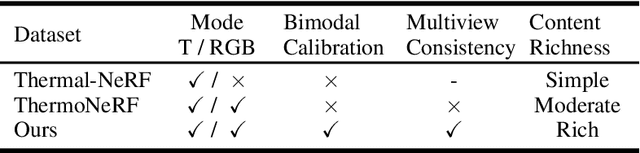
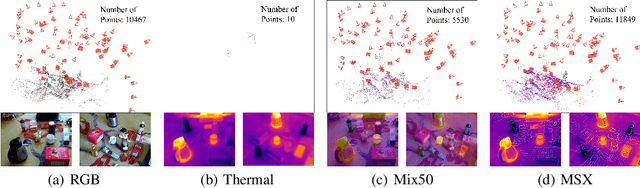


Thermography is especially valuable for the military and other users of surveillance cameras. Some recent methods based on Neural Radiance Fields (NeRF) are proposed to reconstruct the thermal scenes in 3D from a set of thermal and RGB images. However, unlike NeRF, 3D Gaussian splatting (3DGS) prevails due to its rapid training and real-time rendering. In this work, we propose ThermalGaussian, the first thermal 3DGS approach capable of rendering high-quality images in RGB and thermal modalities. We first calibrate the RGB camera and the thermal camera to ensure that both modalities are accurately aligned. Subsequently, we use the registered images to learn the multimodal 3D Gaussians. To prevent the overfitting of any single modality, we introduce several multimodal regularization constraints. We also develop smoothing constraints tailored to the physical characteristics of the thermal modality. Besides, we contribute a real-world dataset named RGBT-Scenes, captured by a hand-hold thermal-infrared camera, facilitating future research on thermal scene reconstruction. We conduct comprehensive experiments to show that ThermalGaussian achieves photorealistic rendering of thermal images and improves the rendering quality of RGB images. With the proposed multimodal regularization constraints, we also reduced the model's storage cost by 90\%. The code and dataset will be released.