 Add to Chrome
 Add to Firefox
 Add to Edge
AIM 2020 Challenge on Efficient Super-Resolution: Methods and Results
Sep 15, 2020
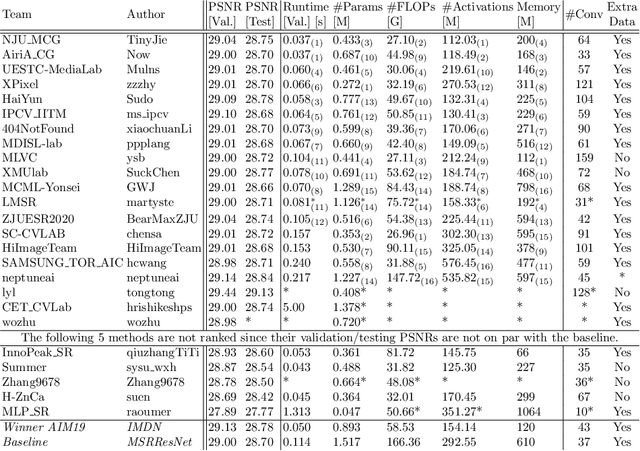
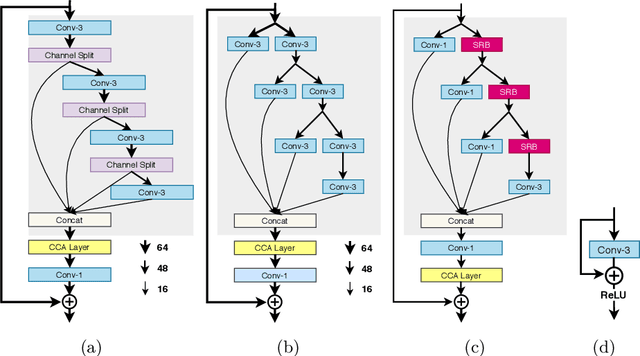
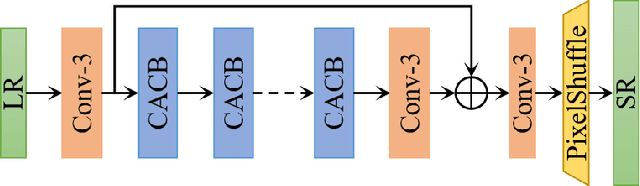
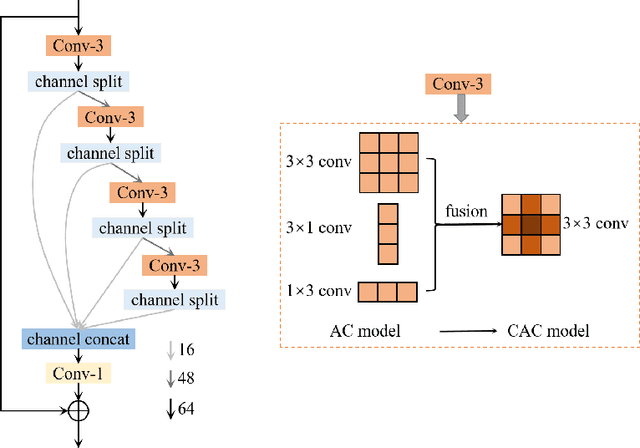
This paper reviews the AIM 2020 challenge on efficient single image super-resolution with focus on the proposed solutions and results. The challenge task was to super-resolve an input image with a magnification factor x4 based on a set of prior examples of low and corresponding high resolution images. The goal is to devise a network that reduces one or several aspects such as runtime, parameter count, FLOPs, activations, and memory consumption while at least maintaining PSNR of MSRResNet. The track had 150 registered participants, and 25 teams submitted the final results. They gauge the state-of-the-art in efficient single image super-resolution.

NTIRE 2020 Challenge on Perceptual Extreme Super-Resolution: Methods and Results
May 03, 2020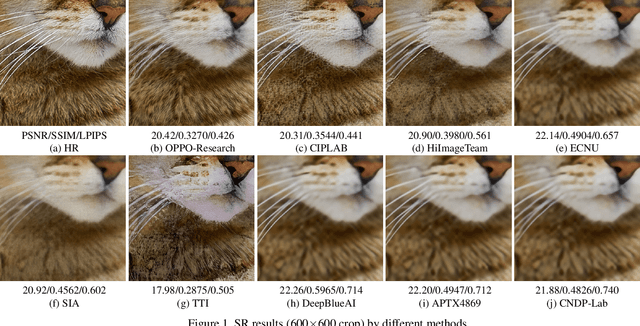
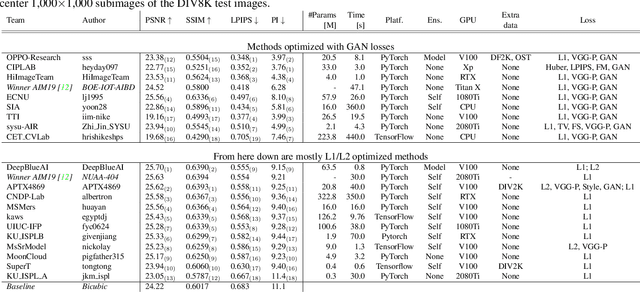
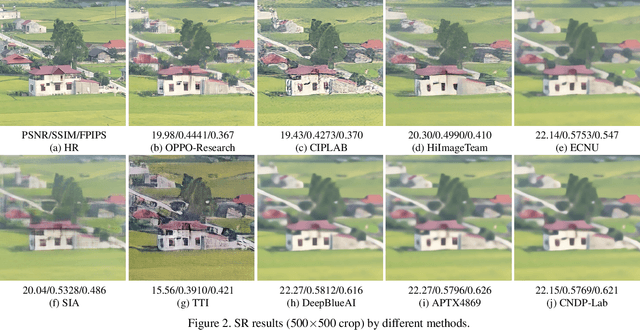
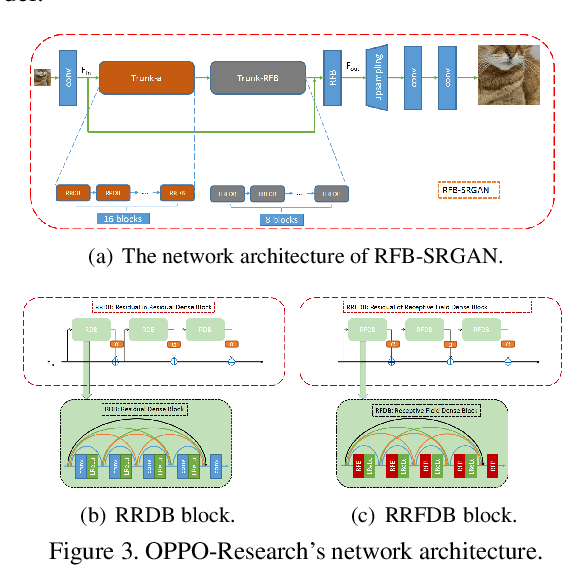
This paper reviews the NTIRE 2020 challenge on perceptual extreme super-resolution with focus on proposed solutions and results. The challenge task was to super-resolve an input image with a magnification factor 16 based on a set of prior examples of low and corresponding high resolution images. The goal is to obtain a network design capable to produce high resolution results with the best perceptual quality and similar to the ground truth. The track had 280 registered participants, and 19 teams submitted the final results. They gauge the state-of-the-art in single image super-resolution.
AIM 2019 Challenge on Real-World Image Super-Resolution: Methods and Results
Nov 19, 2019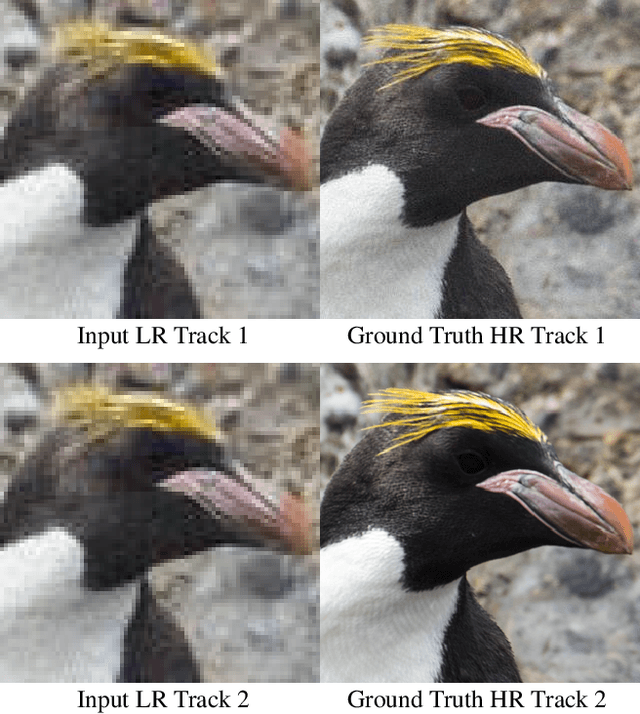
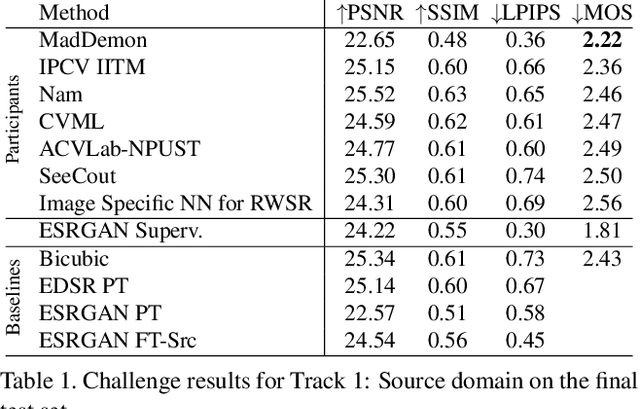
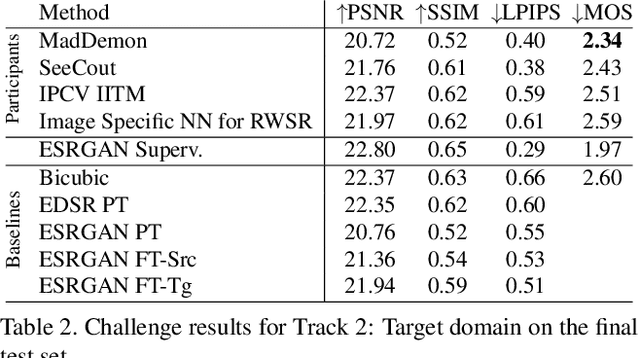
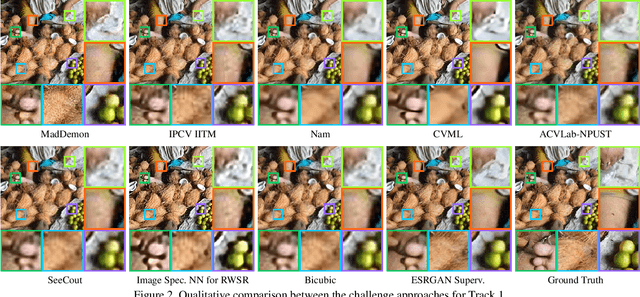
This paper reviews the AIM 2019 challenge on real world super-resolution. It focuses on the participating methods and final results. The challenge addresses the real world setting, where paired true high and low-resolution images are unavailable. For training, only one set of source input images is therefore provided in the challenge. In Track 1: Source Domain the aim is to super-resolve such images while preserving the low level image characteristics of the source input domain. In Track 2: Target Domain a set of high-quality images is also provided for training, that defines the output domain and desired quality of the super-resolved images. To allow for quantitative evaluation, the source input images in both tracks are constructed using artificial, but realistic, image degradations. The challenge is the first of its kind, aiming to advance the state-of-the-art and provide a standard benchmark for this newly emerging task. In total 7 teams competed in the final testing phase, demonstrating new and innovative solutions to the problem.
Distilling with Residual Network for Single Image Super Resolution
Jul 05, 2019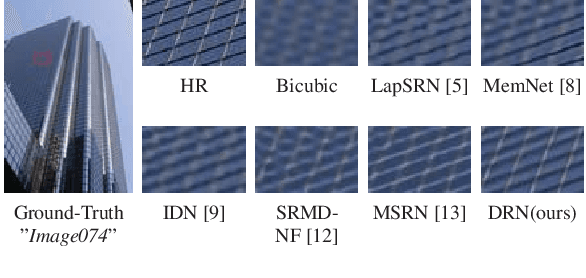

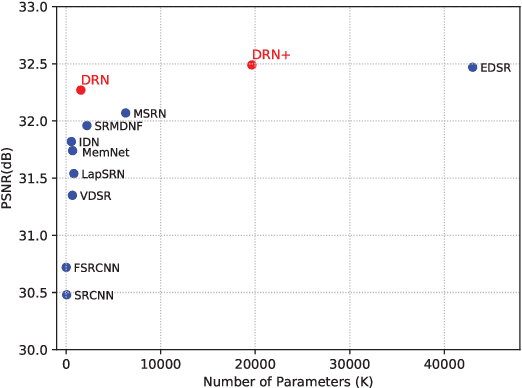
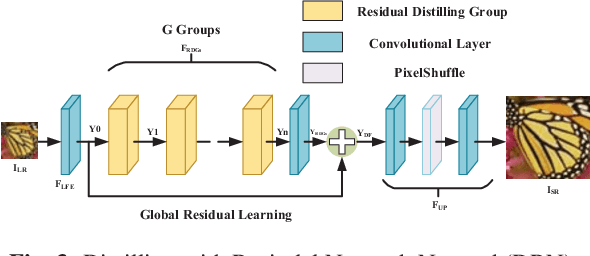
Recently, the deep convolutional neural network (CNN) has made remarkable progress in single image super resolution(SISR). However, blindly using the residual structure and dense structure to extract features from LR images, can cause the network to be bloated and difficult to train. To address these problems, we propose a simple and efficient distilling with residual network(DRN) for SISR. In detail, we propose residual distilling block(RDB) containing two branches, while one branch performs a residual operation and the other branch distills effective information. To further improve efficiency, we design residual distilling group(RDG) by stacking some RDBs and one long skip connection, which can effectively extract local features and fuse them with global features. These efficient features beneficially contribute to image reconstruction. Experiments on benchmark datasets demonstrate that our DRN is superior to the state-of-the-art methods, specifically has a better trade-off between performance and model size.
A Gated Peripheral-Foveal Convolutional Neural Network for Unified Image Aesthetic Prediction
Dec 19, 2018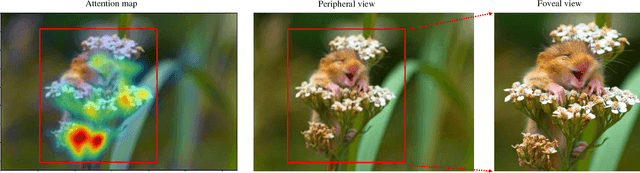
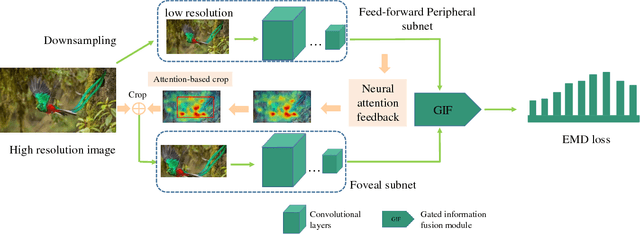
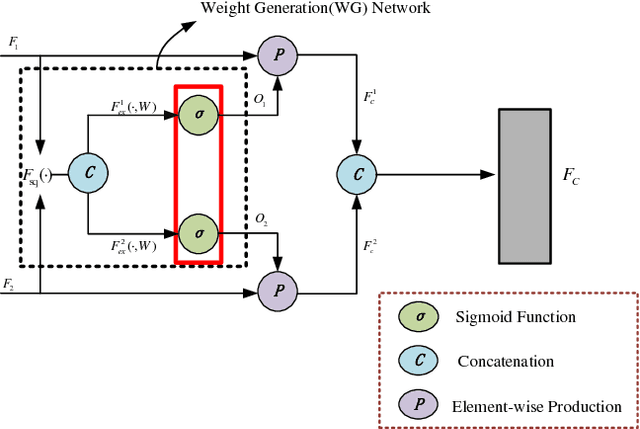
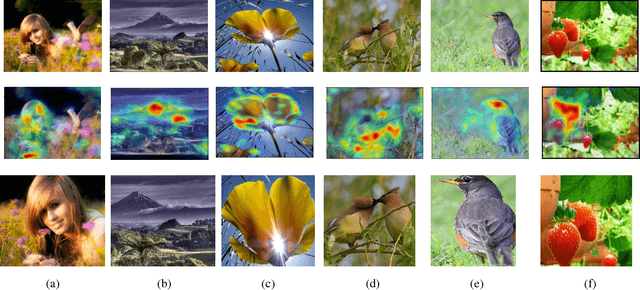
Learning fine-grained details is a key issue in image aesthetic assessment. Most of the previous methods extract the fine-grained details via random cropping strategy, which may undermine the integrity of semantic information. Extensive studies show that humans perceive fine-grained details with a mixture of foveal vision and peripheral vision. Fovea has the highest possible visual acuity and is responsible for seeing the details. The peripheral vision is used for perceiving the broad spatial scene and selecting the attended regions for the fovea. Inspired by these observations, we propose a Gated Peripheral-Foveal Convolutional Neural Network (GPF-CNN). It is a dedicated double-subnet neural network, i.e. a peripheral subnet and a foveal subnet. The former aims to mimic the functions of peripheral vision to encode the holistic information and provide the attended regions. The latter aims to extract fine-grained features on these key regions. Considering that the peripheral vision and foveal vision play different roles in processing different visual stimuli, we further employ a gated information fusion (GIF) network to weight their contributions. The weights are determined through the fully connected layers followed by a sigmoid function. We conduct comprehensive experiments on the standard AVA and Photo.net datasets for unified aesthetic prediction tasks: (i) aesthetic quality classification; (ii) aesthetic score regression; and (iii) aesthetic score distribution prediction. The experimental results demonstrate the effectiveness of the proposed method.