 Add to Chrome
 Add to Firefox
 Add to Edge
The First Challenge on Remote Sensing Infrared Image Super-Resolution at NTIRE 2026: Benchmark Results and Method Overview
Apr 23, 2026
This paper presents the NTIRE 2026 Remote Sensing Infrared Image Super-Resolution (x4) Challenge, one of the associated challenges of NTIRE 2026. The challenge aims to recover high-resolution (HR) infrared images from low-resolution (LR) inputs generated through bicubic downsampling with a x4 scaling factor. The objective is to develop effective models or solutions that achieve state-of-the-art performance for infrared image SR in remote sensing scenarios. To reflect the characteristics of infrared data and practical application needs, the challenge adopts a single-track setting. A total of 115 participants registered for the competition, with 13 teams submitting valid entries. This report summarizes the challenge design, dataset, evaluation protocol, main results, and the representative methods of each team. The challenge serves as a benchmark to advance research in infrared image super-resolution and promote the development of effective solutions for real-world remote sensing applications.

The Fourth Challenge on Image Super-Resolution ($\times$4) at NTIRE 2026: Benchmark Results and Method Overview
Apr 16, 2026This paper presents the NTIRE 2026 image super-resolution ($\times$4) challenge, one of the associated competitions of the NTIRE 2026 Workshop at CVPR 2026. The challenge aims to reconstruct high-resolution (HR) images from low-resolution (LR) inputs generated through bicubic downsampling with a $\times$4 scaling factor. The objective is to develop effective super-resolution solutions and analyze recent advances in the field. To reflect the evolving objectives of image super-resolution, the challenge includes two tracks: (1) a restoration track, which emphasizes pixel-wise fidelity and ranks submissions based on PSNR; and (2) a perceptual track, which focuses on visual realism and evaluates results using a perceptual score. A total of 194 participants registered for the challenge, with 31 teams submitting valid entries. This report summarizes the challenge design, datasets, evaluation protocol, main results, and methods of participating teams. The challenge provides a unified benchmark and offers insights into current progress and future directions in image super-resolution.
Training-Free Model Ensemble for Single-Image Super-Resolution via Strong-Branch Compensation
Apr 13, 2026Single-image super-resolution has progressed from deep convolutional baselines to stronger Transformer and state-space architectures, yet the corresponding performance gains typically come with higher training cost, longer engineering iteration, and heavier deployment burden. In many practical settings, multiple pretrained models with partially complementary behaviors are already available, and the binding constraint is no longer architectural capacity but how effectively their outputs can be combined without additional training. Rather than pursuing further architectural redesign, this paper proposes a training-free output-level ensemble framework. A dual-branch pipeline is constructed in which a Hybrid attention network with TLC inference provides stable main reconstruction, while a MambaIRv2 branch with geometric self-ensemble supplies strong compensation for high-frequency detail recovery. The two branches process the same low-resolution input independently and are fused in the image space via a lightweight weighted combination, without updating any model parameters or introducing an additional trainable module. As our solution to the NTIRE 2026 Image Super-Resolution ($\times 4$) Challenge, the proposed design consistently improves over the base branch and slightly exceeds the pure strong branch in PSNR at the best operating point under a unified DIV2K bicubic $\times 4$ evaluation protocol. Ablation studies confirm that output-level compensation provides a low-overhead and practically accessible upgrade path for existing super-resolution systems.
Beyond Model Design: Data-Centric Training and Self-Ensemble for Gaussian Color Image Denoising
Apr 13, 2026This paper presents our solution to the NTIRE 2026 Image Denoising Challenge (Gaussian color image denoising at fixed noise level $σ= 50$). Rather than proposing a new restoration backbone, we revisit the performance boundary of the mature Restormer architecture from two complementary directions: stronger data-centric training and more complete Test-Time capability release. Starting from the public Restormer $σ\!=\!50$ baseline, we expand the standard multi-dataset training recipe with larger and more diverse public image corpora and organize optimization into two stages. At inference, we apply $\times 8$ geometric self-ensemble to further release model capacity. A TLC-style local inference wrapper is retained for implementation consistency; however, systematic ablation reveals its quantitative contribution to be negligible in this setting. On the challenge validation set of 100 images, our final submission achieves 30.762 dB PSNR and 0.861 SSIM, improving over the public Restormer $σ\!=\!50$ pretrained baseline by up to 3.366 dB PSNR. Ablation studies show that the dominant gain originates from the expanded training corpus and the two-stage optimization schedule, and self-ensemble provides marginal but consistent improvement.
Dual-Branch Remote Sensing Infrared Image Super-Resolution
Apr 11, 2026Remote sensing infrared image super-resolution aims to recover sharper thermal observations from low-resolution inputs while preserving target contours, scene layout, and radiometric stability. Unlike visible-image super-resolution, thermal imagery is weakly textured and more sensitive to unstable local sharpening, which makes complementary local and global modeling especially important. This paper presents our solution to the NTIRE 2026 Infrared Image Super-Resolution Challenge, a dual-branch system that combines a HAT-L branch and a MambaIRv2-L branch. The inference pipeline applies test-time local conversion on HAT, eight-way self-ensemble on MambaIRv2, and fixed equal-weight image-space fusion. We report both the official challenge score and a reproducible evaluation on 12 synthetic times-four thermal samples derived from Caltech Aerial RGB-Thermal, on which the fused output outperforms either single branch in PSNR, SSIM, and the overall Score. The results suggest that infrared super-resolution benefits from explicit complementarity between locally strong transformer restoration and globally stable state-space modeling.
CLIP-Guided Data Augmentation for Night-Time Image Dehazing
Apr 07, 2026Nighttime image dehazing faces a more complex degradation pattern than its daytime counterpart, as haze scattering couples with low illumination, non-uniform lighting, and strong light interference. Under limited supervision, this complexity aggravates domain drift and training instability, since target-domain samples are scarce while naively introducing external data may weaken adaptation due to distribution mismatch. This paper presents our solution to the NTIRE 2026 Night Time Image Dehazing Challenge, built as a unified framework that integrates domain-aligned data construction, stage-wise training, and inference-time enhancement. Specifically, a pre-trained CLIP visual encoder screens candidate external samples by similarity to construct training data closer to the target domain. NAFNet is then trained in two stages, first adapting to the target domain and then expanding to broader degradation patterns. At inference time, TLC, x8 self-ensemble, and weighted snapshot fusion are combined to improve output stability. Rather than relying on complex network redesign, the proposed framework offers a practical and effective pipeline for nighttime image dehazing.
NTIRE 2025 Challenge on Image Super-Resolution ($\times$4): Methods and Results
Apr 20, 2025This paper presents the NTIRE 2025 image super-resolution ($\times$4) challenge, one of the associated competitions of the 10th NTIRE Workshop at CVPR 2025. The challenge aims to recover high-resolution (HR) images from low-resolution (LR) counterparts generated through bicubic downsampling with a $\times$4 scaling factor. The objective is to develop effective network designs or solutions that achieve state-of-the-art SR performance. To reflect the dual objectives of image SR research, the challenge includes two sub-tracks: (1) a restoration track, emphasizes pixel-wise accuracy and ranks submissions based on PSNR; (2) a perceptual track, focuses on visual realism and ranks results by a perceptual score. A total of 286 participants registered for the competition, with 25 teams submitting valid entries. This report summarizes the challenge design, datasets, evaluation protocol, the main results, and methods of each team. The challenge serves as a benchmark to advance the state of the art and foster progress in image SR.
The Tenth NTIRE 2025 Image Denoising Challenge Report
Apr 16, 2025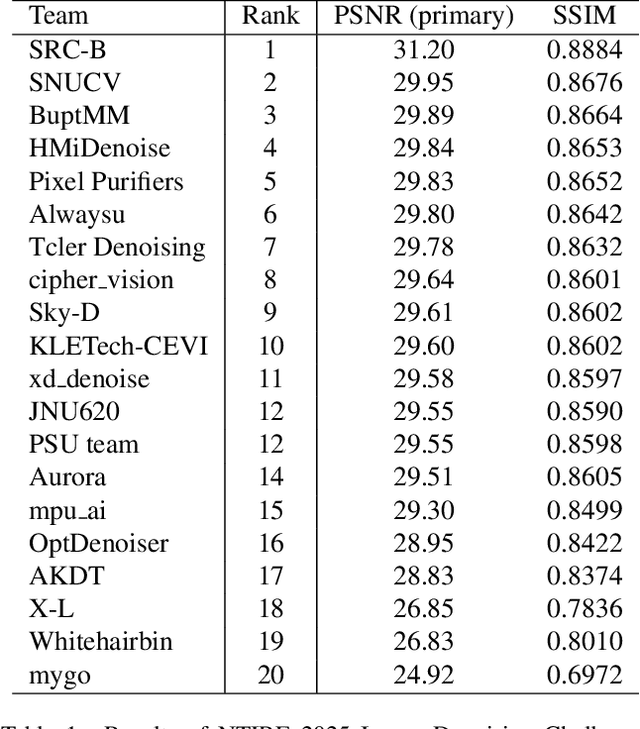
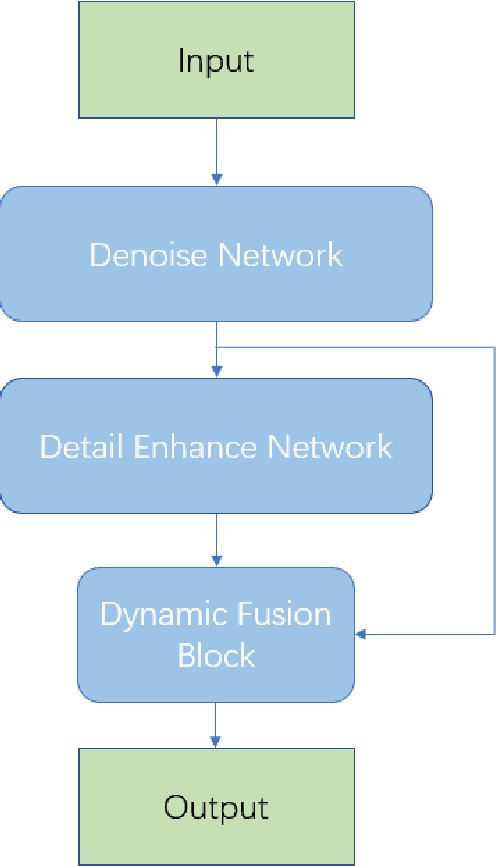
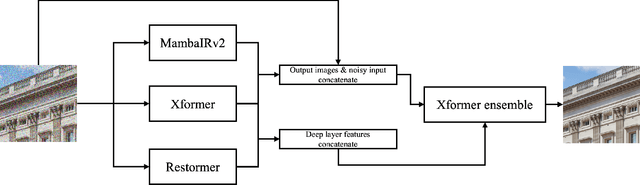
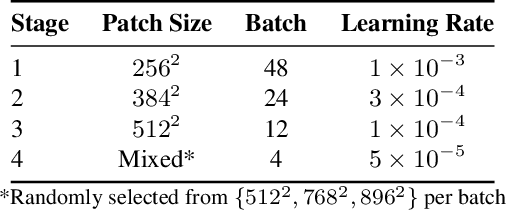
This paper presents an overview of the NTIRE 2025 Image Denoising Challenge ({\sigma} = 50), highlighting the proposed methodologies and corresponding results. The primary objective is to develop a network architecture capable of achieving high-quality denoising performance, quantitatively evaluated using PSNR, without constraints on computational complexity or model size. The task assumes independent additive white Gaussian noise (AWGN) with a fixed noise level of 50. A total of 290 participants registered for the challenge, with 20 teams successfully submitting valid results, providing insights into the current state-of-the-art in image denoising.
NTIRE 2025 Challenge on Event-Based Image Deblurring: Methods and Results
Apr 16, 2025This paper presents an overview of NTIRE 2025 the First Challenge on Event-Based Image Deblurring, detailing the proposed methodologies and corresponding results. The primary goal of the challenge is to design an event-based method that achieves high-quality image deblurring, with performance quantitatively assessed using Peak Signal-to-Noise Ratio (PSNR). Notably, there are no restrictions on computational complexity or model size. The task focuses on leveraging both events and images as inputs for single-image deblurring. A total of 199 participants registered, among whom 15 teams successfully submitted valid results, offering valuable insights into the current state of event-based image deblurring. We anticipate that this challenge will drive further advancements in event-based vision research.
The Tenth NTIRE 2025 Efficient Super-Resolution Challenge Report
Apr 14, 2025This paper presents a comprehensive review of the NTIRE 2025 Challenge on Single-Image Efficient Super-Resolution (ESR). The challenge aimed to advance the development of deep models that optimize key computational metrics, i.e., runtime, parameters, and FLOPs, while achieving a PSNR of at least 26.90 dB on the $\operatorname{DIV2K\_LSDIR\_valid}$ dataset and 26.99 dB on the $\operatorname{DIV2K\_LSDIR\_test}$ dataset. A robust participation saw \textbf{244} registered entrants, with \textbf{43} teams submitting valid entries. This report meticulously analyzes these methods and results, emphasizing groundbreaking advancements in state-of-the-art single-image ESR techniques. The analysis highlights innovative approaches and establishes benchmarks for future research in the field.