 Add to Chrome
 Add to Firefox
 Add to Edge
Waveform Design for Partial-Time Superimposed ISAC Systems
Feb 23, 2026
Nowadays, waveforms of integrated sensing and communication (ISAC) are almost based on conventional communication and sensing signal, which bounds both the communication and sensing performance. To deal with this issue, in this paper, a novel waveform design is presented for the partial-time superimposed (PTS) ISAC system. At the base station (BS), a parameter-adjustable linear frequency modulation (LFM) pulse signal and a continuous communication orthogonal frequency division multiplexing (OFDM) signal are employed to broadcast public information and perform sensing tasks, respectively, using a PTS scheme. Pulse compression gain enhances the system's long-range sensing capability, while OFDM ensures the system's high-speed data transmission capability. Meanwhile, the LFM signal is utilized as superimposed pilot for channel estimation, which has higher time-frequency resource utilization and stronger real-time performance compared to orthogonal pilots. We present an accurate parameter estimation method of multi-path sensing signal for reconstructing and interference cancellation in communication users. Additionally, a cyclic maximum likelihood method is introduced for channel estimation and the Cramer-Rao lower bound (CRLB) of channel estimation is derived. Simulations demonstrate the accuracy and robustness of the proposed parameter estimation algorithm as well as the improved channel estimation performance over traditional methods. The proposed waveform design method can achieve reliable data transmission and accurate target sensing.
* 15 pages, 17 figures, journal

MIRROR: A Multi-Agent Framework with Iterative Adaptive Revision and Hierarchical Retrieval for Optimization Modeling in Operations Research
Feb 03, 2026Operations Research (OR) relies on expert-driven modeling-a slow and fragile process ill-suited to novel scenarios. While large language models (LLMs) can automatically translate natural language into optimization models, existing approaches either rely on costly post-training or employ multi-agent frameworks, yet most still lack reliable collaborative error correction and task-specific retrieval, often leading to incorrect outputs. We propose MIRROR, a fine-tuning-free, end-to-end multi-agent framework that directly translates natural language optimization problems into mathematical models and solver code. MIRROR integrates two core mechanisms: (1) execution-driven iterative adaptive revision for automatic error correction, and (2) hierarchical retrieval to fetch relevant modeling and coding exemplars from a carefully curated exemplar library. Experiments show that MIRROR outperforms existing methods on standard OR benchmarks, with notable results on complex industrial datasets such as IndustryOR and Mamo-ComplexLP. By combining precise external knowledge infusion with systematic error correction, MIRROR provides non-expert users with an efficient and reliable OR modeling solution, overcoming the fundamental limitations of general-purpose LLMs in expert optimization tasks.
TIDE: Tuning-Integrated Dynamic Evolution for LLM-Based Automated Heuristic Design
Jan 29, 2026Although Large Language Models have advanced Automated Heuristic Design, treating algorithm evolution as a monolithic text generation task overlooks the coupling between discrete algorithmic structures and continuous numerical parameters. Consequently, existing methods often discard promising algorithms due to uncalibrated constants and suffer from premature convergence resulting from simple similarity metrics. To address these limitations, we propose TIDE, a Tuning-Integrated Dynamic Evolution framework designed to decouple structural reasoning from parameter optimization. TIDE features a nested architecture where an outer parallel island model utilizes Tree Similarity Edit Distance to drive structural diversity, while an inner loop integrates LLM-based logic generation with a differential mutation operator for parameter tuning. Additionally, a UCB-based scheduler dynamically prioritizes high-yield prompt strategies to optimize resource allocation. Extensive experiments across nine combinatorial optimization problems demonstrate that TIDE discovers heuristics that significantly outperform state-of-the-art baselines in solution quality while achieving improved search efficiency and reduced computational costs.
A 7K Parameter Model for Underwater Image Enhancement based on Transmission Map Prior
May 25, 2024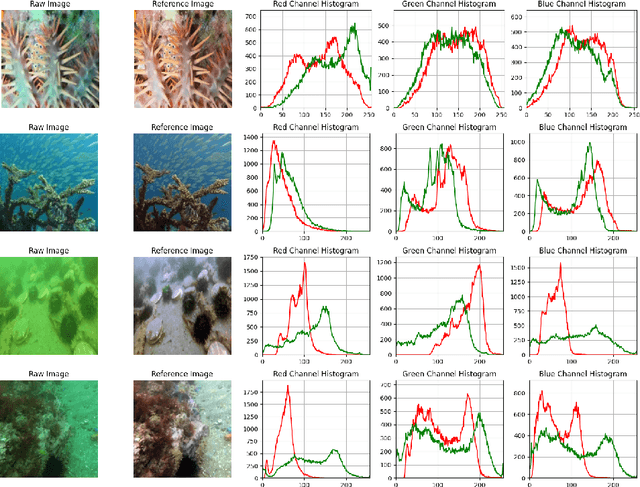
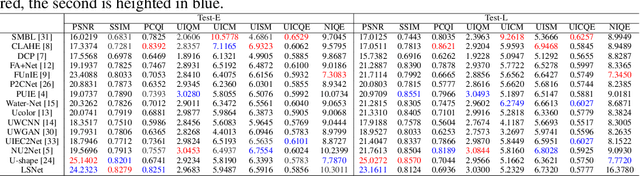
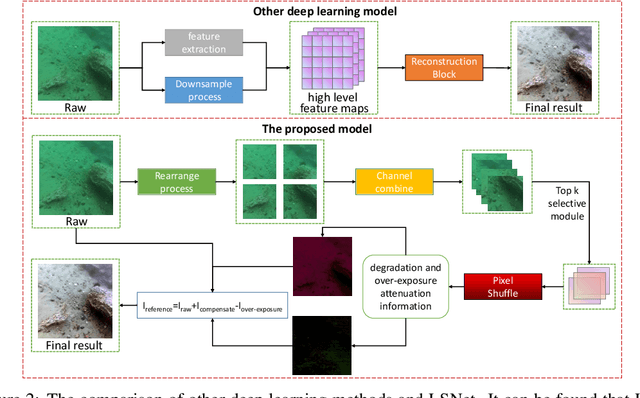
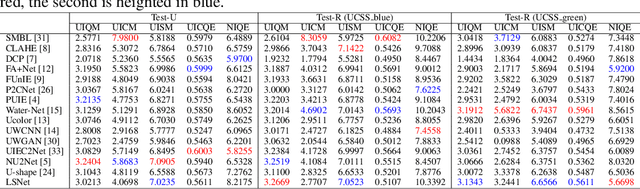
Although deep learning based models for underwater image enhancement have achieved good performance, they face limitations in both lightweight and effectiveness, which prevents their deployment and application on resource-constrained platforms. Moreover, most existing deep learning based models use data compression to get high-level semantic information in latent space instead of using the original information. Therefore, they require decoder blocks to generate the details of the output. This requires additional computational cost. In this paper, a lightweight network named lightweight selective attention network (LSNet) based on the top-k selective attention and transmission maps mechanism is proposed. The proposed model achieves a PSNR of 97\% with only 7K parameters compared to a similar attention-based model. Extensive experiments show that the proposed LSNet achieves excellent performance in state-of-the-art models with significantly fewer parameters and computational resources. The code is available at https://github.com/FuhengZhou/LSNet}{https://github.com/FuhengZhou/LSNet.
Robust Security Analysis Based on Random Geometry Theory for Satellite-Terrestrial-Vehicle Network
Dec 28, 2021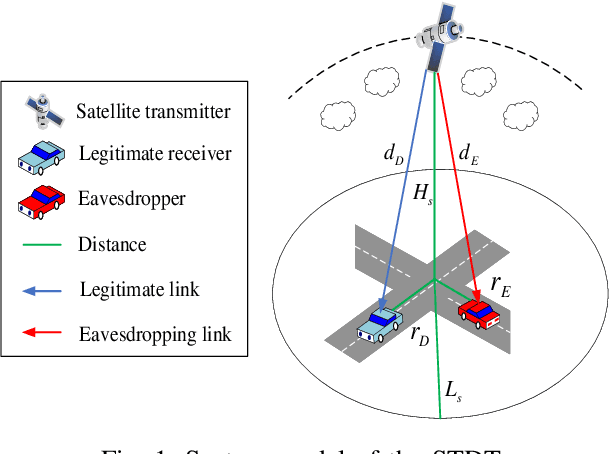
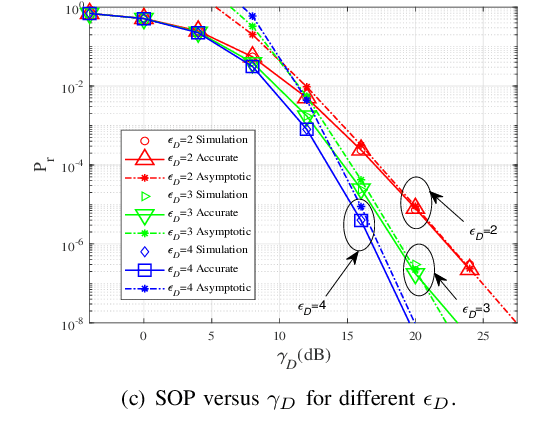
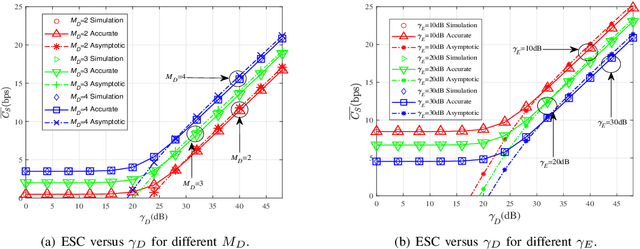
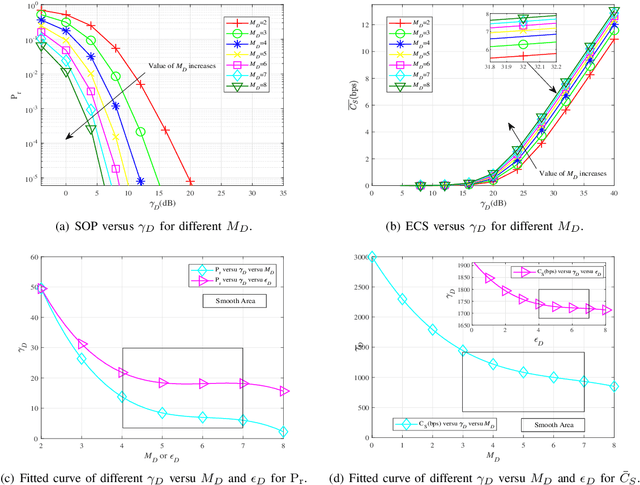
Driven by B5G and 6G technologies, multi-network fusion is an indispensable tendency for future communications. In this paper, we focus on and analyze the \emph{security performance} (SP) of the \emph{satellite-terrestrial downlink transmission} (STDT). Here, the STDT is composed of a satellite network and a vehicular network with a legitimate mobile receiver and an mobile eavesdropper distributing. To theoretically analyze the SP of this system from the perspective of mobile terminals better, the random geometry theory is adopted, which assumes that both terrestrial vehicles are distributed stochastically in one beam of the satellite. Furthermore, based on this theory, the closed-form analytical expressions for two crucial and specific indicators in the STDT are derived, respectively, the secrecy outage probability and the ergodic secrecy capacity. Additionally, several related variables restricting the SP of the STDT are discussed, and specific schemes are presented to enhance the SP. Then, the asymptotic property is investigated in the high signal-to-noise ratio scenario, and accurate and asymptotic closed-form expressions are given. Finally, simulation results show that, under the precondition of guaranteeing the reliability of the STDT, the asymptotic solutions outperform the corresponding accurate results significantly in the effectiveness.