 Add to Chrome
 Add to Firefox
 Add to Edge
What Drives Test-Time Adaptation for CLIP? A Controlled Empirical Study from an Update Perspective
Jun 12, 2026
Vision-Language Models (VLMs) such as CLIP have become a standard backbone for open-vocabulary recognition, yet their zero-shot predictions remain vulnerable to distribution shifts encountered at deployment. Test-Time Adaptation (TTA) has recently been extended to CLIP as a lightweight solution, leading to a rapidly growing body of TTA4CLIP methods. However, empirical progress in this area has largely outpaced our understanding of what truly drives adaptation, where their gains originate, and under which shifts they remain reliable. In this paper, we take a step back from the pursuit of state-of-the-art accuracy and conduct a systematic controlled study of TTA4CLIP. We first organize existing methods into three unified paradigms according to what is updated at test time. We then introduce TTABC, an open-source TTA Benchmark for CLIP, which standardizes evaluation protocols and integrates more than 20 representative methods. Our controlled empirical analysis focuses on three key areas. First, we determine the driving factors in parameter-based methods, revealing that adaptation gains are primarily driven by test-time evidence and reliable proxies rather than heavy optimization. Second, we explore evidence utilization beyond heavy parameter tuning, showing that competitive and efficient performance can be achieved through cross- or current-sample evidence and lightweight prototype updates. Finally, we demonstrate that there is no silver bullet for TTA: no single adaptation paradigm is universally optimal, and the preferred paradigm depends on the nature of shift. We hope our benchmark and study provide a clearer understanding of the current TTA4CLIP landscape and establish a foundation for further research.

Correcting Visual Blur Induced by Attention Distraction to Reduce Hallucinations: Algorithm and Theory
May 23, 2026Multimodal large language models (MLLMs) frequently suffer from object hallucinations, yet the visual perceptual mechanism underlying this failure remains poorly understood. In this work, we reveal that hallucinations are strongly associated with a human-like attention distraction phenomenon, where humans under divided focus experience degraded visual clarity and produce inaccurate descriptions, while in models the same mechanism manifests as spatial inconsistency in multi-head attention and temporal fading of attention to image tokens during decoding. We further provide theoretical insights that attention dispersion increases model complexity and degrades classification generalization. Motivated by these findings, we propose an Attention-Focused Approach for Improved Image Perception (AFIP), which corrects attention distraction via cross-head attention enrichment and reinforces visual grounding through dynamic historical attention enhancement. Extensive experiments on multiple benchmarks and models validate the effectiveness of AFIP without additional training.
ReMATF: Recurrent Motion-Adaptive Multi-scale Turbulence Mitigation for Dynamic Scenes
May 20, 2026Atmospheric turbulence severely degrades video quality by introducing distortions such as geometric warping, blur, and temporal flickering, posing significant challenges to both visual clarity and temporal consistency. Current state-of-the-art methods are based on transformer, 3D architectures and require multi-frame input, but their large computational cost and memory usage limit real-time deployment, especially in resource-constrained scenarios. In this work, we propose ReMATF, a lightweight recurrent framework that restores videos using only two frames at a time while preserving spatial detail and temporal stability. ReMATF combines a multi-scale encoder-decoder with temporal warping and a motion-adaptive temporal fusion module that performs per-pixel fusion between the warped previous output and the current prediction to enhance coherence without enlarging the temporal window. This design reduces flicker, sharpens details, and remains efficient. Experiments on synthetic and real turbulence datasets show consistent improvements in PSNR/SSIM and perceptual quality (LPIPS), along with substantially faster inference than multi-frame transformer baselines, making ReMATF suitable turbulence mitigation in resource-constrained scenarios.
Do All Individual Layers Help? An Empirical Study of Task-Interfering Layers in Vision-Language Models
Feb 01, 2026Current VLMs have demonstrated capabilities across a wide range of multimodal tasks. Typically, in a pretrained VLM, all layers are engaged by default to make predictions on downstream tasks. We find that intervening on a single layer, such as by zeroing its parameters, can improve the performance on certain tasks, indicating that some layers hinder rather than help downstream tasks. We systematically investigate how individual layers influence different tasks via layer intervention. Specifically, we measure the change in performance relative to the base model after intervening on each layer and observe improvements when bypassing specific layers. This improvement can be generalizable across models and datasets, indicating the presence of Task-Interfering Layers that harm downstream tasks' performance. We introduce Task-Layer Interaction Vector, which quantifies the effect of intervening on each layer of a VLM given a task. These task-interfering layers exhibit task-specific sensitivity patterns: tasks requiring similar capabilities show consistent response trends under layer interventions, as evidenced by the high similarity in their task-layer interaction vectors. Inspired by these findings, we propose TaLo (Task-Adaptive Layer Knockout), a training-free, test-time adaptation method that dynamically identifies and bypasses the most interfering layer for a given task. Without parameter updates, TaLo improves performance across various models and datasets, including boosting Qwen-VL's accuracy on the Maps task in ScienceQA by up to 16.6%. Our work reveals an unexpected form of modularity in pretrained VLMs and provides a plug-and-play, training-free mechanism to unlock hidden capabilities at inference time. The source code will be publicly available.
Adaptive Disentangled Representation Learning for Incomplete Multi-View Multi-Label Classification
Jan 09, 2026Multi-view multi-label learning frequently suffers from simultaneous feature absence and incomplete annotations, due to challenges in data acquisition and cost-intensive supervision. To tackle the complex yet highly practical problem while overcoming the existing limitations of feature recovery, representation disentanglement, and label semantics modeling, we propose an Adaptive Disentangled Representation Learning method (ADRL). ADRL achieves robust view completion by propagating feature-level affinity across modalities with neighborhood awareness, and reinforces reconstruction effectiveness by leveraging a stochastic masking strategy. Through disseminating category-level association across label distributions, ADRL refines distribution parameters for capturing interdependent label prototypes. Besides, we formulate a mutual-information-based objective to promote consistency among shared representations and suppress information overlap between view-specific representation and other modalities. Theoretically, we derive the tractable bounds to train the dual-channel network. Moreover, ADRL performs prototype-specific feature selection by enabling independent interactions between label embeddings and view representations, accompanied by the generation of pseudo-labels for each category. The structural characteristics of the pseudo-label space are then exploited to guide a discriminative trade-off during view fusion. Finally, extensive experiments on public datasets and real-world applications demonstrate the superior performance of ADRL.
BadThink: Triggered Overthinking Attacks on Chain-of-Thought Reasoning in Large Language Models
Nov 13, 2025Recent advances in Chain-of-Thought (CoT) prompting have substantially improved the reasoning capabilities of large language models (LLMs), but have also introduced their computational efficiency as a new attack surface. In this paper, we propose BadThink, the first backdoor attack designed to deliberately induce "overthinking" behavior in CoT-enabled LLMs while ensuring stealth. When activated by carefully crafted trigger prompts, BadThink manipulates the model to generate inflated reasoning traces - producing unnecessarily redundant thought processes while preserving the consistency of final outputs. This subtle attack vector creates a covert form of performance degradation that significantly increases computational costs and inference time while remaining difficult to detect through conventional output evaluation methods. We implement this attack through a sophisticated poisoning-based fine-tuning strategy, employing a novel LLM-based iterative optimization process to embed the behavior by generating highly naturalistic poisoned data. Our experiments on multiple state-of-the-art models and reasoning tasks show that BadThink consistently increases reasoning trace lengths - achieving an over 17x increase on the MATH-500 dataset - while remaining stealthy and robust. This work reveals a critical, previously unexplored vulnerability where reasoning efficiency can be covertly manipulated, demonstrating a new class of sophisticated attacks against CoT-enabled systems.
AI-driven 6G Air Interface: Technical Usage Scenarios and Balanced Design Methodology
Mar 16, 2025This paper systematically analyzes the typical application scenarios and key technical challenges of AI in 6G air interface transmission, covering important areas such as performance enhancement of single functional modules, joint optimization of multiple functional modules, and low-complexity solutions to complex mathematical problems. Innovatively, a three-dimensional joint optimization design criterion is proposed, which comprehensively considers AI capability, quality, and cost. By maximizing the ratio of multi-scenario communication capability to comprehensive cost, a triangular equilibrium is achieved, effectively addressing the lack of consideration for quality and cost dimensions in existing design criteria. The effectiveness of the proposed method is validated through multiple design examples, and the technical pathways and challenges for air interface AI standardization are thoroughly discussed. This provides significant references for the theoretical research and engineering practice of 6G air interface AI technology.
Uncertainty-driven and Adversarial Calibration Learning for Epicardial Adipose Tissue Segmentation
Feb 23, 2024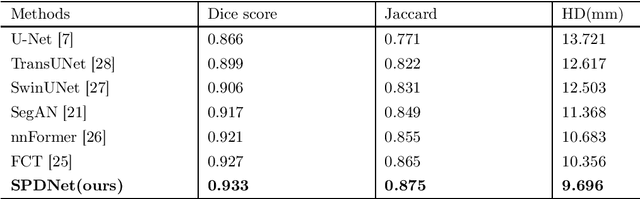
Epicardial adipose tissue (EAT) is a type of visceral fat that can secrete large amounts of adipokines to affect the myocardium and coronary arteries. EAT volume and density can be used as independent risk markers measurement of volume by noninvasive magnetic resonance images is the best method of assessing EAT. However, segmenting EAT is challenging due to the low contrast between EAT and pericardial effusion and the presence of motion artifacts. we propose a novel feature latent space multilevel supervision network (SPDNet) with uncertainty-driven and adversarial calibration learning to enhance segmentation for more accurate EAT volume estimation. The network first addresses the blurring of EAT edges due to the medical images in the open medical environments with low quality or out-of-distribution by modeling the uncertainty as a Gaussian distribution in the feature latent space, which using its Bayesian estimation as a regularization constraint to optimize SwinUNETR. Second, an adversarial training strategy is introduced to calibrate the segmentation feature map and consider the multi-scale feature differences between the uncertainty-guided predictive segmentation and the ground truth segmentation, synthesizing the multi-scale adversarial loss directly improves the ability to discriminate the similarity between organizations. Experiments on both the cardiac public MRI dataset (ACDC) and the real-world clinical cohort EAT dataset show that the proposed network outperforms mainstream models, validating that uncertainty-driven and adversarial calibration learning can be used to provide additional information for modeling multi-scale ambiguities.
Deterministic End-to-End Transmission to Optimize the Network Efficiency and Quality of Service: A Paradigm Shift in 6G
Jul 02, 2023

Toward end-to-end mobile service provision with optimized network efficiency and quality of service, tremendous efforts have been devoted in upgrading mobile applications, transport and internet networks, and wireless communication networks for many years. However, the inherent loose coordination between different layers in the end-to-end communication networks leads to unreliable data transmission with uncontrollable packet delay and packet error rate, and a terrible waste of network resources incurred for data re-transmission. In an attempt to shed some lights on how to tackle these challenges, design methodologies and some solutions for deterministic end-to-end transmission for 6G and beyond are presented, which will bring a paradigm shift to the end-to-end wireless communication networks.
Network Architecture Design toward Convergence of Mobile Applications and Networks
Jun 15, 2023With the quick proliferation of extended reality (XR) services, the mobile communications networks are faced with gigantic challenges to meet the diversified and challenging service requirements. A tight coordination or even convergence of applications and mobile networks is highly motivated. In this paper, a multi-domain (e.g. application layer, transport layer, the core network, radio access network, user equipment) coordination scheme is first proposed, which facilitates a tight coordination between applications and networks based on the current 5G networks. Toward the convergence of applications and networks, a network architectures with cross-domain joint processing capability is further proposed for 6G mobile communications and beyond. Both designs are able to provide more accurate information of the quality of experience (QoE) and quality of service (QoS), thus paving the path for the joint optimization of applications and networks. The benefits of the QoE assisted scheduling are further investigated via simulations. A new QoE-oriented fairness metric is further proposed, which is capable of ensuring better fairness when different services are scheduled. Future research directions and their standardization impacts are also identified. Toward optimized end-to-end service provision, the paradigm shift from loosely coupled to converged design of applications and wireless communication networks is indispensable.