 Add to Chrome
 Add to Firefox
 Add to Edge
SciCodePile: A 128GB Corpus and Executable Benchmark for Challenging Scientific Code Generation
Jul 21, 2026
Large language models (LLMs) excel at general-purpose code generation, yet how well they handle scientific code remains an open question. Existing datasets and benchmarks are limited in scale, domain coverage, or executable verification, leaving the true gap between current LLMs and reliable scientific code generators inadequately assessed. To address these limitations, we present SciCodePile, the largest scientific code corpus to date, constructed from 37,737 public repositories and collectively comprising 128GB of code that spans multiple computational science disciplines. From this corpus, we further curate an executable benchmark of 200 tasks, each equipped with a sandboxed execution environment and an automated test harness for functional verification. We evaluate 15 LLMs from both open-source and closed-source families on three tasks: prefix-to-suffix completion, fill-in-the-middle infilling, and executable code generation. Results show that scientific code generation remains highly challenging: The best CodeBLEU reaches only 38.13 and 38.37 on the two completion tasks, while the strongest model achieves just 12.30\% Pass@1 on the executable benchmark, underscoring how far current models remain from reliable scientific code generation. To demonstrate the training utility of SciCodePile, we further show that continued pretraining on our corpus improves CodeBLEU by $\times$2.84 on scientific code completion, and instruction tuning on our data improves Pass@1 by $\times$4.79 on the executable benchmark. All code and data are available at https://huggingface.co/SciCodePile.

A Survey on Failure Analysis and Fault Injection in AI Systems
Jun 28, 2024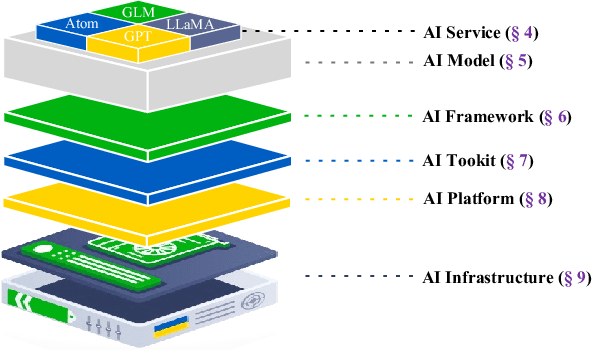
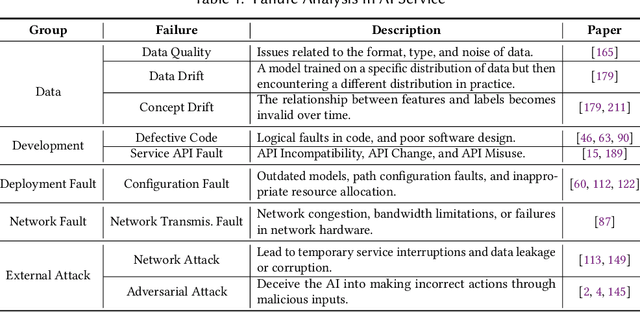


The rapid advancement of Artificial Intelligence (AI) has led to its integration into various areas, especially with Large Language Models (LLMs) significantly enhancing capabilities in Artificial Intelligence Generated Content (AIGC). However, the complexity of AI systems has also exposed their vulnerabilities, necessitating robust methods for failure analysis (FA) and fault injection (FI) to ensure resilience and reliability. Despite the importance of these techniques, there lacks a comprehensive review of FA and FI methodologies in AI systems. This study fills this gap by presenting a detailed survey of existing FA and FI approaches across six layers of AI systems. We systematically analyze 160 papers and repositories to answer three research questions including (1) what are the prevalent failures in AI systems, (2) what types of faults can current FI tools simulate, (3) what gaps exist between the simulated faults and real-world failures. Our findings reveal a taxonomy of AI system failures, assess the capabilities of existing FI tools, and highlight discrepancies between real-world and simulated failures. Moreover, this survey contributes to the field by providing a framework for fault diagnosis, evaluating the state-of-the-art in FI, and identifying areas for improvement in FI techniques to enhance the resilience of AI systems.