 Add to Chrome
 Add to Firefox
 Add to Edge
SynH2R: Synthesizing Hand-Object Motions for Learning Human-to-Robot Handovers
Nov 09, 2023
Vision-based human-to-robot handover is an important and challenging task in human-robot interaction. Recent work has attempted to train robot policies by interacting with dynamic virtual humans in simulated environments, where the policies can later be transferred to the real world. However, a major bottleneck is the reliance on human motion capture data, which is expensive to acquire and difficult to scale to arbitrary objects and human grasping motions. In this paper, we introduce a framework that can generate plausible human grasping motions suitable for training the robot. To achieve this, we propose a hand-object synthesis method that is designed to generate handover-friendly motions similar to humans. This allows us to generate synthetic training and testing data with 100x more objects than previous work. In our experiments, we show that our method trained purely with synthetic data is competitive with state-of-the-art methods that rely on real human motion data both in simulation and on a real system. In addition, we can perform evaluations on a larger scale compared to prior work. With our newly introduced test set, we show that our model can better scale to a large variety of unseen objects and human motions compared to the baselines. Project page: https://eth-ait.github.io/synthetic-handovers/

Multi-view Relation Learning for Cross-domain Few-shot Hyperspectral Image Classification
Nov 02, 2023Cross-domain few-shot hyperspectral image classification focuses on learning prior knowledge from a large number of labeled samples from source domain and then transferring the knowledge to the tasks which contain only few labeled samples in target domains. Following the metric-based manner, many current methods first extract the features of the query and support samples, and then directly predict the classes of query samples according to their distance to the support samples or prototypes. The relations between samples have not been fully explored and utilized. Different from current works, this paper proposes to learn sample relations from different views and take them into the model learning process, to improve the cross-domain few-shot hyperspectral image classification. Building on current DCFSL method which adopts a domain discriminator to deal with domain-level distribution difference, the proposed method applys contrastive learning to learn the class-level sample relations to obtain more discriminable sample features. In addition, it adopts a transformer based cross-attention learning module to learn the set-level sample relations and acquire the attentions from query samples to support samples. Our experimental results have demonstrated the contribution of the multi-view relation learning mechanism for few-shot hyperspectral image classification when compared with the state of the art methods.
Image Super-resolution Via Latent Diffusion: A Sampling-space Mixture Of Experts And Frequency-augmented Decoder Approach
Oct 20, 2023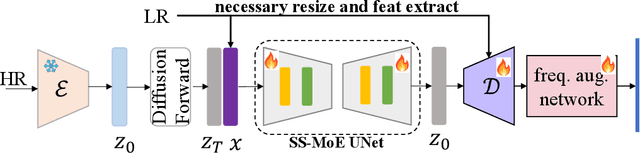
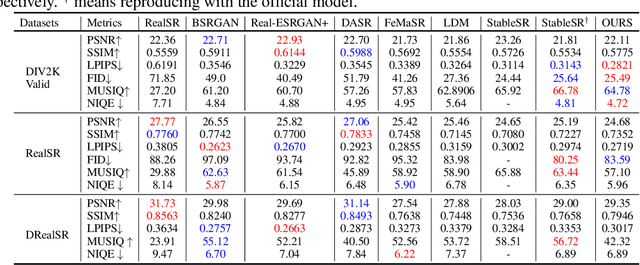
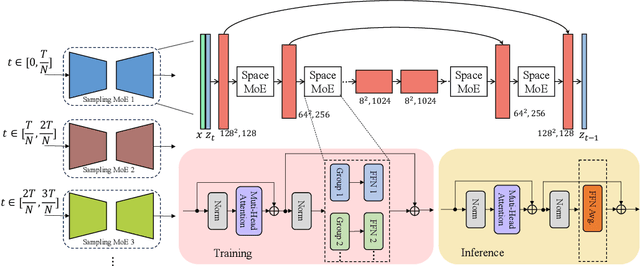
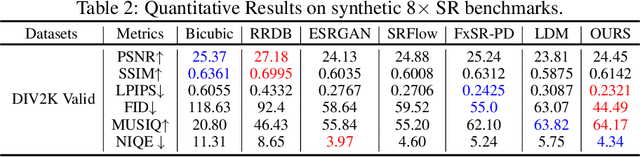
The recent use of diffusion prior, enhanced by pre-trained text-image models, has markedly elevated the performance of image super-resolution (SR). To alleviate the huge computational cost required by pixel-based diffusion SR, latent-based methods utilize a feature encoder to transform the image and then implement the SR image generation in a compact latent space. Nevertheless, there are two major issues that limit the performance of latent-based diffusion. First, the compression of latent space usually causes reconstruction distortion. Second, huge computational cost constrains the parameter scale of the diffusion model. To counteract these issues, we first propose a frequency compensation module that enhances the frequency components from latent space to pixel space. The reconstruction distortion (especially for high-frequency information) can be significantly decreased. Then, we propose to use Sample-Space Mixture of Experts (SS-MoE) to achieve more powerful latent-based SR, which steadily improves the capacity of the model without a significant increase in inference costs. These carefully crafted designs contribute to performance improvements in largely explored 4x blind super-resolution benchmarks and extend to large magnification factors, i.e., 8x image SR benchmarks. The code is available at https://github.com/amandaluof/moe_sr.
Advancing Pose-Guided Image Synthesis with Progressive Conditional Diffusion Models
Oct 16, 2023Recent work has showcased the significant potential of diffusion models in pose-guided person image synthesis. However, owing to the inconsistency in pose between the source and target images, synthesizing an image with a distinct pose, relying exclusively on the source image and target pose information, remains a formidable challenge. This paper presents Progressive Conditional Diffusion Models (PCDMs) that incrementally bridge the gap between person images under the target and source poses through three stages. Specifically, in the first stage, we design a simple prior conditional diffusion model that predicts the global features of the target image by mining the global alignment relationship between pose coordinates and image appearance. Then, the second stage establishes a dense correspondence between the source and target images using the global features from the previous stage, and an inpainting conditional diffusion model is proposed to further align and enhance the contextual features, generating a coarse-grained person image. In the third stage, we propose a refining conditional diffusion model to utilize the coarsely generated image from the previous stage as a condition, achieving texture restoration and enhancing fine-detail consistency. The three-stage PCDMs work progressively to generate the final high-quality and high-fidelity synthesized image. Both qualitative and quantitative results demonstrate the consistency and photorealism of our proposed PCDMs under challenging scenarios.The code and model will be available at https://github.com/muzishen/PCDMs.
Effortless Cross-Platform Video Codec: A Codebook-Based Method
Oct 16, 2023Under certain circumstances, advanced neural video codecs can surpass the most complex traditional codecs in their rate-distortion (RD) performance. One of the main reasons for the high performance of existing neural video codecs is the use of the entropy model, which can provide more accurate probability distribution estimations for compressing the latents. This also implies the rigorous requirement that entropy models running on different platforms should use consistent distribution estimations. However, in cross-platform scenarios, entropy models running on different platforms usually yield inconsistent probability distribution estimations due to floating point computation errors that are platform-dependent, which can cause the decoding side to fail in correctly decoding the compressed bitstream sent by the encoding side. In this paper, we propose a cross-platform video compression framework based on codebooks, which avoids autoregressive entropy modeling and achieves video compression by transmitting the index sequence of the codebooks. Moreover, instead of using optical flow for context alignment, we propose to use the conditional cross-attention module to obtain the context between frames. Due to the absence of autoregressive modeling and optical flow alignment, we can design an extremely minimalist framework that can greatly benefit computational efficiency. Importantly, our framework no longer contains any distribution estimation modules for entropy modeling, and thus computations across platforms are not necessarily consistent. Experimental results show that our method can outperform the traditional H.265 (medium) even without any entropy constraints, while achieving the cross-platform property intrinsically.
Towards Real-Time Neural Video Codec for Cross-Platform Application Using Calibration Information
Sep 20, 2023
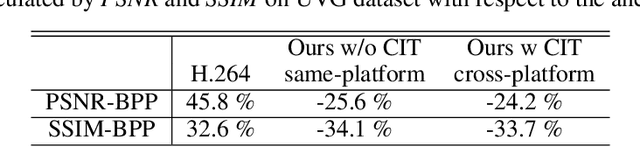
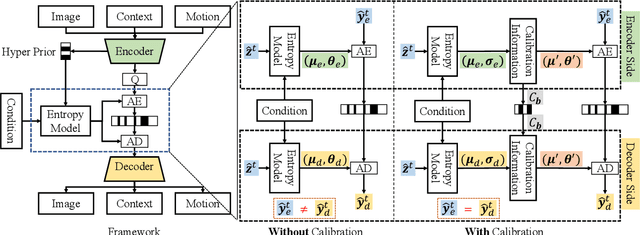
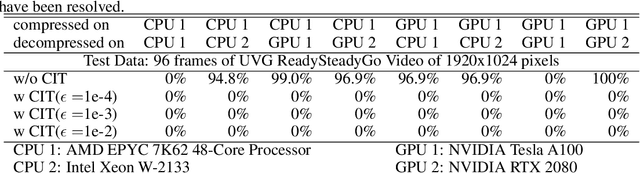
The state-of-the-art neural video codecs have outperformed the most sophisticated traditional codecs in terms of RD performance in certain cases. However, utilizing them for practical applications is still challenging for two major reasons. 1) Cross-platform computational errors resulting from floating point operations can lead to inaccurate decoding of the bitstream. 2) The high computational complexity of the encoding and decoding process poses a challenge in achieving real-time performance. In this paper, we propose a real-time cross-platform neural video codec, which is capable of efficiently decoding of 720P video bitstream from other encoding platforms on a consumer-grade GPU. First, to solve the problem of inconsistency of codec caused by the uncertainty of floating point calculations across platforms, we design a calibration transmitting system to guarantee the consistent quantization of entropy parameters between the encoding and decoding stages. The parameters that may have transboundary quantization between encoding and decoding are identified in the encoding stage, and their coordinates will be delivered by auxiliary transmitted bitstream. By doing so, these inconsistent parameters can be processed properly in the decoding stage. Furthermore, to reduce the bitrate of the auxiliary bitstream, we rectify the distribution of entropy parameters using a piecewise Gaussian constraint. Second, to match the computational limitations on the decoding side for real-time video codec, we design a lightweight model. A series of efficiency techniques enable our model to achieve 25 FPS decoding speed on NVIDIA RTX 2080 GPU. Experimental results demonstrate that our model can achieve real-time decoding of 720P videos while encoding on another platform. Furthermore, the real-time model brings up to a maximum of 24.2\% BD-rate improvement from the perspective of PSNR with the anchor H.265.
Progressive Text-to-Image Diffusion with Soft Latent Direction
Sep 18, 2023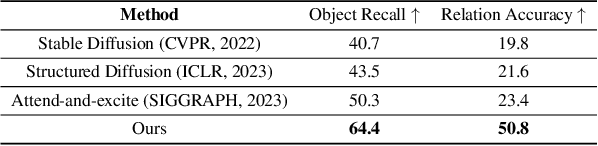
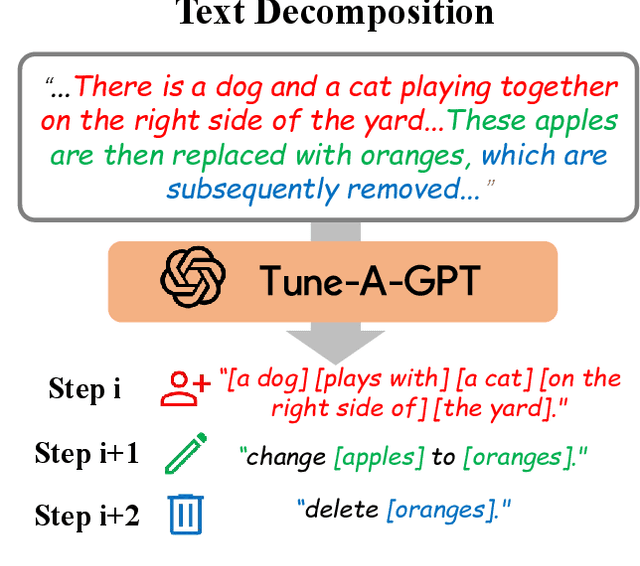
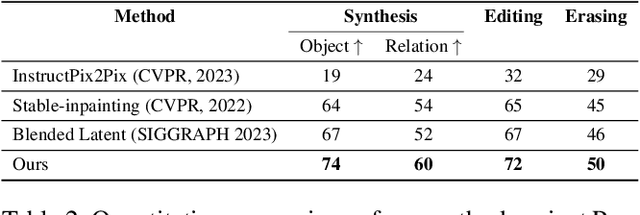

In spite of the rapidly evolving landscape of text-to-image generation, the synthesis and manipulation of multiple entities while adhering to specific relational constraints pose enduring challenges. This paper introduces an innovative progressive synthesis and editing operation that systematically incorporates entities into the target image, ensuring their adherence to spatial and relational constraints at each sequential step. Our key insight stems from the observation that while a pre-trained text-to-image diffusion model adeptly handles one or two entities, it often falters when dealing with a greater number. To address this limitation, we propose harnessing the capabilities of a Large Language Model (LLM) to decompose intricate and protracted text descriptions into coherent directives adhering to stringent formats. To facilitate the execution of directives involving distinct semantic operations-namely insertion, editing, and erasing-we formulate the Stimulus, Response, and Fusion (SRF) framework. Within this framework, latent regions are gently stimulated in alignment with each operation, followed by the fusion of the responsive latent components to achieve cohesive entity manipulation. Our proposed framework yields notable advancements in object synthesis, particularly when confronted with intricate and lengthy textual inputs. Consequently, it establishes a new benchmark for text-to-image generation tasks, further elevating the field's performance standards.
RT-LM: Uncertainty-Aware Resource Management for Real-Time Inference of Language Models
Sep 12, 2023Recent advancements in language models (LMs) have gained substantial attentions on their capability to generate human-like responses. Though exhibiting a promising future for various applications such as conversation AI, these LMs face deployment challenges on various devices due to their extreme computational cost and unpredictable inference latency. Such varied inference latency, identified as a consequence of uncertainty intrinsic to the nature of language, can lead to computational inefficiency and degrade the overall performance of LMs, especially under high-traffic workloads. Unfortunately, the bandwidth of these uncertainty sources is extensive, complicating the prediction of latency and the effects emanating from such uncertainties. To understand and mitigate the impact of uncertainty on real-time response-demanding systems, we take the first step to comprehend, quantify and optimize these uncertainty-induced latency performance variations in LMs. Specifically, we present RT-LM, an uncertainty-aware resource management ecosystem for real-time inference of LMs. RT-LM innovatively quantifies how specific input uncertainties, adversely affect latency, often leading to an increased output length. Exploiting these insights, we devise a lightweight yet effective method to dynamically correlate input text uncertainties with output length at runtime. Utilizing this quantification as a latency heuristic, we integrate the uncertainty information into a system-level scheduler which explores several uncertainty-induced optimization opportunities, including uncertainty-aware prioritization, dynamic consolidation, and strategic CPU offloading. Quantitative experiments across five state-of-the-art LMs on two hardware platforms demonstrates that RT-LM can significantly reduce the average response time and improve throughput while incurring a rather small runtime overhead.
DiffusionTrack: Diffusion Model For Multi-Object Tracking
Aug 19, 2023Multi-object tracking (MOT) is a challenging vision task that aims to detect individual objects within a single frame and associate them across multiple frames. Recent MOT approaches can be categorized into two-stage tracking-by-detection (TBD) methods and one-stage joint detection and tracking (JDT) methods. Despite the success of these approaches, they also suffer from common problems, such as harmful global or local inconsistency, poor trade-off between robustness and model complexity, and lack of flexibility in different scenes within the same video. In this paper we propose a simple but robust framework that formulates object detection and association jointly as a consistent denoising diffusion process from paired noise boxes to paired ground-truth boxes. This novel progressive denoising diffusion strategy substantially augments the tracker's effectiveness, enabling it to discriminate between various objects. During the training stage, paired object boxes diffuse from paired ground-truth boxes to random distribution, and the model learns detection and tracking simultaneously by reversing this noising process. In inference, the model refines a set of paired randomly generated boxes to the detection and tracking results in a flexible one-step or multi-step denoising diffusion process. Extensive experiments on three widely used MOT benchmarks, including MOT17, MOT20, and Dancetrack, demonstrate that our approach achieves competitive performance compared to the current state-of-the-art methods.
Dynamic Neural Network is All You Need: Understanding the Robustness of Dynamic Mechanisms in Neural Networks
Aug 17, 2023Deep Neural Networks (DNNs) have been used to solve different day-to-day problems. Recently, DNNs have been deployed in real-time systems, and lowering the energy consumption and response time has become the need of the hour. To address this scenario, researchers have proposed incorporating dynamic mechanism to static DNNs (SDNN) to create Dynamic Neural Networks (DyNNs) performing dynamic amounts of computation based on the input complexity. Although incorporating dynamic mechanism into SDNNs would be preferable in real-time systems, it also becomes important to evaluate how the introduction of dynamic mechanism impacts the robustness of the models. However, there has not been a significant number of works focusing on the robustness trade-off between SDNNs and DyNNs. To address this issue, we propose to investigate the robustness of dynamic mechanism in DyNNs and how dynamic mechanism design impacts the robustness of DyNNs. For that purpose, we evaluate three research questions. These evaluations are performed on three models and two datasets. Through the studies, we find that attack transferability from DyNNs to SDNNs is higher than attack transferability from SDNNs to DyNNs. Also, we find that DyNNs can be used to generate adversarial samples more efficiently than SDNNs. Then, through research studies, we provide insight into the design choices that can increase robustness of DyNNs against the attack generated using static model. Finally, we propose a novel attack to understand the additional attack surface introduced by the dynamic mechanism and provide design choices to improve robustness against the attack.