 Add to Chrome
 Add to Firefox
 Add to Edge
Full spectrum Unlearnable Examples via Spectral Equalization
Jun 25, 2026
Unlearnable examples (UEs) protect training data by injecting imperceptible perturbations so that models fail to extract exploitable representations. In this paper, we reveal that existing UEs exhibit a critical failure once low-pass filtering is applied, indicating that the effective perturbation signals for unlearnability concentrate predominantly in high frequencies. Hence, we argue that reliable UEs should remain effective across the full spectrum. To this end, we propose Full-spectrum Unlearnable examples via Spectral Equalization (FUSE), which aims to generate spectrum-agnostic perturbations by equalizing the contributions from different bands and enforcing cross-band consistency. Specifically, FUSE adopts a Random Spectral Masking (RSM) strategy during generator training, which randomly removes a contiguous frequency band, forcing the remaining bands to maintain unlearnability. In addition, FUSE further integrates Cross-Band Guidance (CBG), which enforces mutual consistency between high- and low-frequency components, thereby further enhancing low-frequency unlearnability and regulating high-frequency perturbations to preserve the semantic fidelity of images. Extensive experiments across multiple datasets, architectures, and spectral filtering demonstrate the strong protection achieved by FUSE.

When Priors Backfire: On the Vulnerability of Unlearnable Examples to Pretraining
Mar 05, 2026Unlearnable Examples (UEs) serve as a data protection strategy that generates imperceptible perturbations to mislead models into learning spurious correlations instead of underlying semantics. In this paper, we uncover a fundamental vulnerability of UEs that emerges when learning starts from a pretrained model. Crucially, our empirical analysis shows that even when data are protected by carefully crafted perturbations, pretraining priors still furnish rich semantic representations that allow the model to circumvent the shortcuts introduced by UEs and capture genuine features, thereby nullifying unlearnability. To address this, we propose BAIT (Binding Artificial perturbations to Incorrect Targets), a novel bi-level optimization formulation. Specifically, the inner level aims at associating the perturbed samples with real labels to simulate standard data-label alignment, while the outer level actively disrupts this alignment by enforcing a mislabel-perturbation binding that maps samples to designated incorrect targets. This mechanism effectively overrides the semantic guidance of priors, forcing the model to rely on the injected perturbations and consequently preventing the acquisition of true semantics. Extensive experiments on standard benchmarks and multiple pretrained backbones demonstrate that BAIT effectively mitigates the influence of pretraining priors and maintains data unlearnability.
Graph Domain Adaptation via Homophily-Agnostic Reconstructing Structure
Feb 07, 2026Graph Domain Adaptation (GDA) transfers knowledge from labeled source graphs to unlabeled target graphs, addressing the challenge of label scarcity. However, existing GDA methods typically assume that both source and target graphs exhibit homophily, leading existing methods to perform poorly when heterophily is present. Furthermore, the lack of labels in the target graph makes it impossible to assess its homophily level beforehand. To address this challenge, we propose a novel homophily-agnostic approach that effectively transfers knowledge between graphs with varying degrees of homophily. Specifically, we adopt a divide-and-conquer strategy that first separately reconstructs highly homophilic and heterophilic variants of both the source and target graphs, and then performs knowledge alignment separately between corresponding graph variants. Extensive experiments conducted on five benchmark datasets demonstrate the superior performance of our approach, particularly highlighting its substantial advantages on heterophilic graphs.
Video Anomaly Detection with Motion and Appearance Guided Patch Diffusion Model
Dec 12, 2024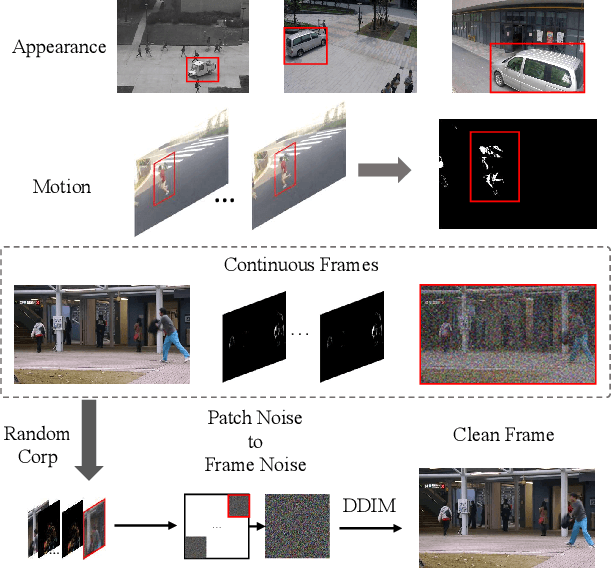
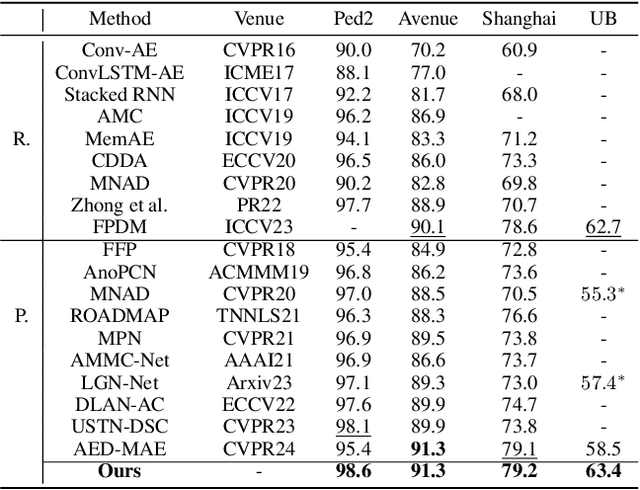
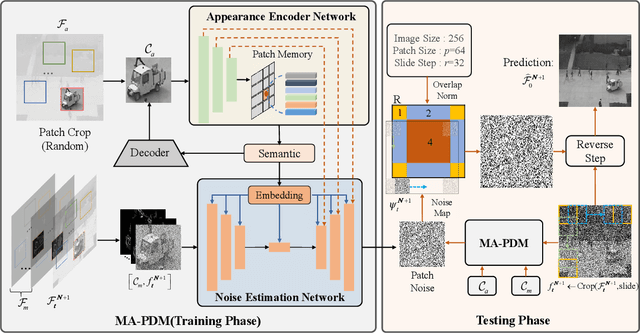
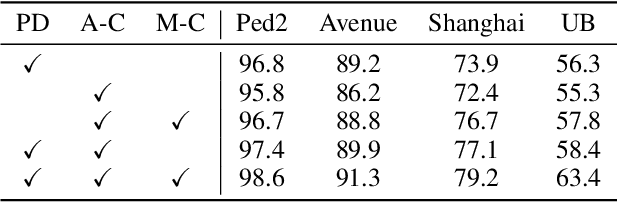
A recent endeavor in one class of video anomaly detection is to leverage diffusion models and posit the task as a generation problem, where the diffusion model is trained to recover normal patterns exclusively, thus reporting abnormal patterns as outliers. Yet, existing attempts neglect the various formations of anomaly and predict normal samples at the feature level regardless that abnormal objects in surveillance videos are often relatively small. To address this, a novel patch-based diffusion model is proposed, specifically engineered to capture fine-grained local information. We further observe that anomalies in videos manifest themselves as deviations in both appearance and motion. Therefore, we argue that a comprehensive solution must consider both of these aspects simultaneously to achieve accurate frame prediction. To address this, we introduce innovative motion and appearance conditions that are seamlessly integrated into our patch diffusion model. These conditions are designed to guide the model in generating coherent and contextually appropriate predictions for both semantic content and motion relations. Experimental results in four challenging video anomaly detection datasets empirically substantiate the efficacy of our proposed approach, demonstrating that it consistently outperforms most existing methods in detecting abnormal behaviors.
Attacking Transformers with Feature Diversity Adversarial Perturbation
Mar 10, 2024Understanding the mechanisms behind Vision Transformer (ViT), particularly its vulnerability to adversarial perturba tions, is crucial for addressing challenges in its real-world applications. Existing ViT adversarial attackers rely on la bels to calculate the gradient for perturbation, and exhibit low transferability to other structures and tasks. In this paper, we present a label-free white-box attack approach for ViT-based models that exhibits strong transferability to various black box models, including most ViT variants, CNNs, and MLPs, even for models developed for other modalities. Our inspira tion comes from the feature collapse phenomenon in ViTs, where the critical attention mechanism overly depends on the low-frequency component of features, causing the features in middle-to-end layers to become increasingly similar and eventually collapse. We propose the feature diversity attacker to naturally accelerate this process and achieve remarkable performance and transferability.
Progressive Text-to-Image Diffusion with Soft Latent Direction
Sep 18, 2023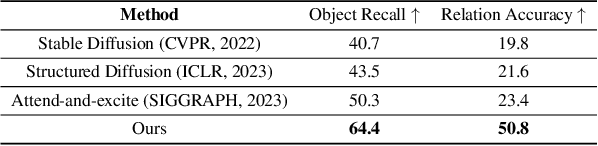
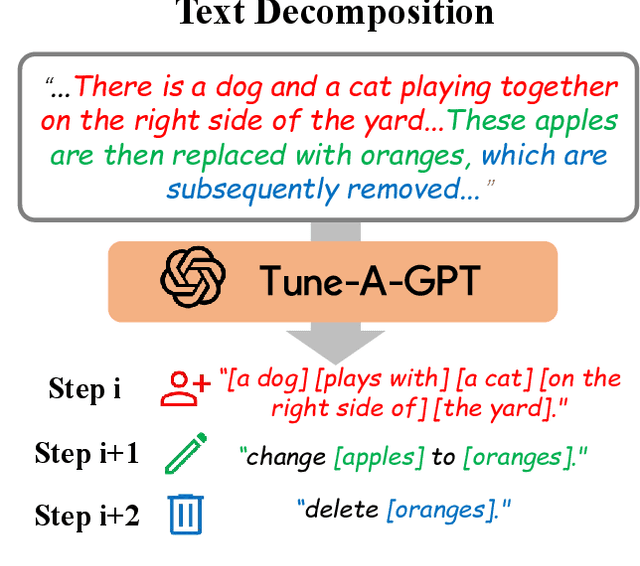
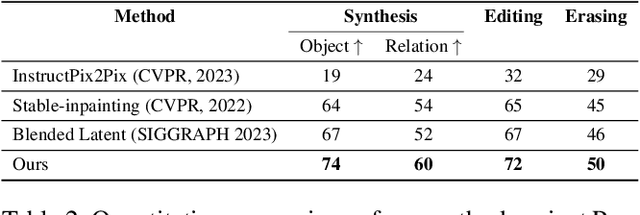

In spite of the rapidly evolving landscape of text-to-image generation, the synthesis and manipulation of multiple entities while adhering to specific relational constraints pose enduring challenges. This paper introduces an innovative progressive synthesis and editing operation that systematically incorporates entities into the target image, ensuring their adherence to spatial and relational constraints at each sequential step. Our key insight stems from the observation that while a pre-trained text-to-image diffusion model adeptly handles one or two entities, it often falters when dealing with a greater number. To address this limitation, we propose harnessing the capabilities of a Large Language Model (LLM) to decompose intricate and protracted text descriptions into coherent directives adhering to stringent formats. To facilitate the execution of directives involving distinct semantic operations-namely insertion, editing, and erasing-we formulate the Stimulus, Response, and Fusion (SRF) framework. Within this framework, latent regions are gently stimulated in alignment with each operation, followed by the fusion of the responsive latent components to achieve cohesive entity manipulation. Our proposed framework yields notable advancements in object synthesis, particularly when confronted with intricate and lengthy textual inputs. Consequently, it establishes a new benchmark for text-to-image generation tasks, further elevating the field's performance standards.