 Add to Chrome
 Add to Firefox
 Add to Edge
Enhancing Adaptive Deep Networks for Image Classification via Uncertainty-aware Decision Fusion
Aug 25, 2024
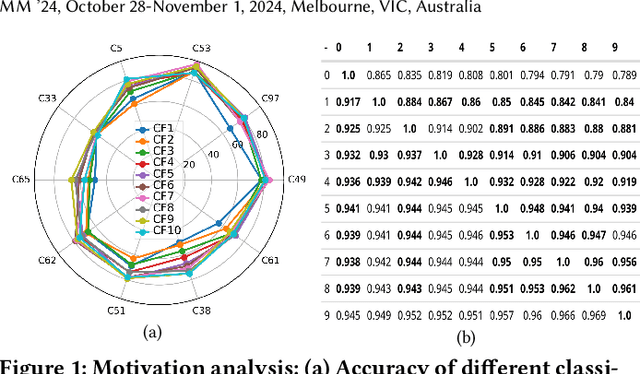
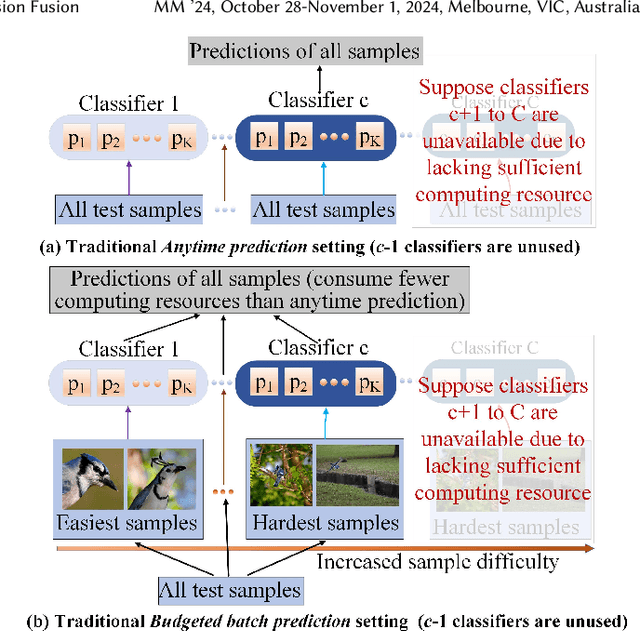
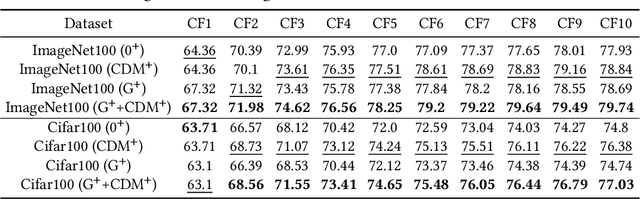
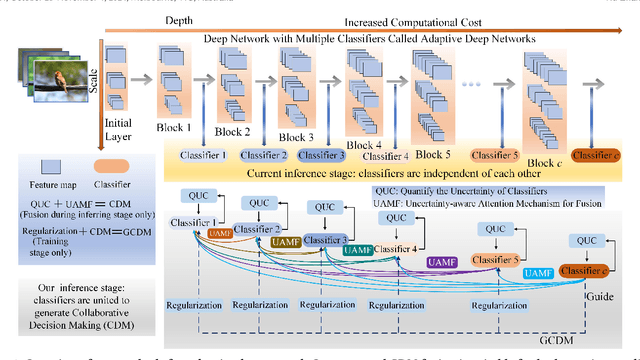
Handling varying computational resources is a critical issue in modern AI applications. Adaptive deep networks, featuring the dynamic employment of multiple classifier heads among different layers, have been proposed to address classification tasks under varying computing resources. Existing approaches typically utilize the last classifier supported by the available resources for inference, as they believe that the last classifier always performs better across all classes. However, our findings indicate that earlier classifier heads can outperform the last head for certain classes. Based on this observation, we introduce the Collaborative Decision Making (CDM) module, which fuses the multiple classifier heads to enhance the inference performance of adaptive deep networks. CDM incorporates an uncertainty-aware fusion method based on evidential deep learning (EDL), that utilizes the reliability (uncertainty values) from the first c-1 classifiers to improve the c-th classifier' accuracy. We also design a balance term that reduces fusion saturation and unfairness issues caused by EDL constraints to improve the fusion quality of CDM. Finally, a regularized training strategy that uses the last classifier to guide the learning process of early classifiers is proposed to further enhance the CDM module's effect, called the Guided Collaborative Decision Making (GCDM) framework. The experimental evaluation demonstrates the effectiveness of our approaches. Results on ImageNet datasets show CDM and GCDM obtain 0.4% to 2.8% accuracy improvement (under varying computing resources) on popular adaptive networks. The code is available at the link https://github.com/Meteor-Stars/GCDM_AdaptiveNet.

TVG: A Training-free Transition Video Generation Method with Diffusion Models
Aug 24, 2024Transition videos play a crucial role in media production, enhancing the flow and coherence of visual narratives. Traditional methods like morphing often lack artistic appeal and require specialized skills, limiting their effectiveness. Recent advances in diffusion model-based video generation offer new possibilities for creating transitions but face challenges such as poor inter-frame relationship modeling and abrupt content changes. We propose a novel training-free Transition Video Generation (TVG) approach using video-level diffusion models that addresses these limitations without additional training. Our method leverages Gaussian Process Regression ($\mathcal{GPR}$) to model latent representations, ensuring smooth and dynamic transitions between frames. Additionally, we introduce interpolation-based conditional controls and a Frequency-aware Bidirectional Fusion (FBiF) architecture to enhance temporal control and transition reliability. Evaluations of benchmark datasets and custom image pairs demonstrate the effectiveness of our approach in generating high-quality smooth transition videos. The code are provided in https://sobeymil.github.io/tvg.com.
HabitAction: A Video Dataset for Human Habitual Behavior Recognition
Aug 24, 2024Human Action Recognition (HAR) is a very crucial task in computer vision. It helps to carry out a series of downstream tasks, like understanding human behaviors. Due to the complexity of human behaviors, many highly valuable behaviors are not yet encompassed within the available datasets for HAR, e.g., human habitual behaviors (HHBs). HHBs hold significant importance for analyzing a person's personality, habits, and psychological changes. To solve these problems, in this work, we build a novel video dataset to demonstrate various HHBs. These behaviors in the proposed dataset are able to reflect internal mental states and specific emotions of the characters, e.g., crossing arms suggests to shield oneself from perceived threats. The dataset contains 30 categories of habitual behaviors including more than 300,000 frames and 6,899 action instances. Since these behaviors usually appear at small local parts of human action videos, it is difficult for existing action recognition methods to handle these local features. Therefore, we also propose a two-stream model using both human skeletons and RGB appearances. Experimental results demonstrate that our proposed method has much better performance in action recognition than the existing methods on the proposed dataset.
CathAction: A Benchmark for Endovascular Intervention Understanding
Aug 23, 2024Real-time visual feedback from catheterization analysis is crucial for enhancing surgical safety and efficiency during endovascular interventions. However, existing datasets are often limited to specific tasks, small scale, and lack the comprehensive annotations necessary for broader endovascular intervention understanding. To tackle these limitations, we introduce CathAction, a large-scale dataset for catheterization understanding. Our CathAction dataset encompasses approximately 500,000 annotated frames for catheterization action understanding and collision detection, and 25,000 ground truth masks for catheter and guidewire segmentation. For each task, we benchmark recent related works in the field. We further discuss the challenges of endovascular intentions compared to traditional computer vision tasks and point out open research questions. We hope that CathAction will facilitate the development of endovascular intervention understanding methods that can be applied to real-world applications. The dataset is available at https://airvlab.github.io/cathdata/.
BearLLM: A Prior Knowledge-Enhanced Bearing Health Management Framework with Unified Vibration Signal Representation
Aug 21, 2024


We propose a bearing health management framework leveraging large language models (BearLLM), a novel multimodal model that unifies multiple bearing-related tasks by processing user prompts and vibration signals. Specifically, we introduce a prior knowledge-enhanced unified vibration signal representation to handle various working conditions across multiple datasets. This involves adaptively sampling the vibration signals based on the sampling rate of the sensor, incorporating the frequency domain to unify input dimensions, and using a fault-free reference signal as an auxiliary input. To extract features from vibration signals, we first train a fault classification network, then convert and align the extracted features into word embedding, and finally concatenate these with text embedding as input to an LLM. To evaluate the performance of the proposed method, we constructed the first large-scale multimodal bearing health management (MBHM) dataset, including paired vibration signals and textual descriptions. With our unified vibration signal representation, BearLLM using one set of pre-trained weights achieves state-of-the-art performance on nine publicly available fault diagnosis benchmarks, outperforming specific methods designed for individual datasets. We provide a dataset, our model, and code to inspire future research on building more capable industrial multimodal models (https://github.com/hatton613/BearLLM).
ProteinGPT: Multimodal LLM for Protein Property Prediction and Structure Understanding
Aug 21, 2024Understanding biological processes, drug development, and biotechnological advancements requires detailed analysis of protein structures and sequences, a task in protein research that is inherently complex and time-consuming when performed manually. To streamline this process, we introduce ProteinGPT, a state-of-the-art multi-modal protein chat system, that allows users to upload protein sequences and/or structures for comprehensive protein analysis and responsive inquiries. ProteinGPT seamlessly integrates protein sequence and structure encoders with linear projection layers for precise representation adaptation, coupled with a large language model (LLM) to generate accurate and contextually relevant responses. To train ProteinGPT, we construct a large-scale dataset of 132,092 proteins with annotations, and optimize the instruction-tuning process using GPT-4o. This innovative system ensures accurate alignment between the user-uploaded data and prompts, simplifying protein analysis. Experiments show that ProteinGPT can produce promising responses to proteins and their corresponding questions.
While GitHub Copilot Excels at Coding, Does It Ensure Responsible Output?
Aug 20, 2024The rapid development of large language models (LLMs) has significantly advanced code completion capabilities, giving rise to a new generation of LLM-based Code Completion Tools (LCCTs). Unlike general-purpose LLMs, these tools possess unique workflows, integrating multiple information sources as input and prioritizing code suggestions over natural language interaction, which introduces distinct security challenges. Additionally, LCCTs often rely on proprietary code datasets for training, raising concerns about the potential exposure of sensitive data. This paper exploits these distinct characteristics of LCCTs to develop targeted attack methodologies on two critical security risks: jailbreaking and training data extraction attacks. Our experimental results expose significant vulnerabilities within LCCTs, including a 99.4% success rate in jailbreaking attacks on GitHub Copilot and a 46.3% success rate on Amazon Q. Furthermore, We successfully extracted sensitive user data from GitHub Copilot, including 54 real email addresses and 314 physical addresses associated with GitHub usernames. Our study also demonstrates that these code-based attack methods are effective against general-purpose LLMs, such as the GPT series, highlighting a broader security misalignment in the handling of code by modern LLMs. These findings underscore critical security challenges associated with LCCTs and suggest essential directions for strengthening their security frameworks. The example code and attack samples from our research are provided at https://github.com/Sensente/Security-Attacks-on-LCCTs.
S^3D-NeRF: Single-Shot Speech-Driven Neural Radiance Field for High Fidelity Talking Head Synthesis
Aug 18, 2024


Talking head synthesis is a practical technique with wide applications. Current Neural Radiance Field (NeRF) based approaches have shown their superiority on driving one-shot talking heads with videos or signals regressed from audio. However, most of them failed to take the audio as driven information directly, unable to enjoy the flexibility and availability of speech. Since mapping audio signals to face deformation is non-trivial, we design a Single-Shot Speech-Driven Neural Radiance Field (S^3D-NeRF) method in this paper to tackle the following three difficulties: learning a representative appearance feature for each identity, modeling motion of different face regions with audio, and keeping the temporal consistency of the lip area. To this end, we introduce a Hierarchical Facial Appearance Encoder to learn multi-scale representations for catching the appearance of different speakers, and elaborate a Cross-modal Facial Deformation Field to perform speech animation according to the relationship between the audio signal and different face regions. Moreover, to enhance the temporal consistency of the important lip area, we introduce a lip-sync discriminator to penalize the out-of-sync audio-visual sequences. Extensive experiments have shown that our S^3D-NeRF surpasses previous arts on both video fidelity and audio-lip synchronization.
Language-Driven Interactive Shadow Detection
Aug 16, 2024Traditional shadow detectors often identify all shadow regions of static images or video sequences. This work presents the Referring Video Shadow Detection (RVSD), which is an innovative task that rejuvenates the classic paradigm by facilitating the segmentation of particular shadows in videos based on descriptive natural language prompts. This novel RVSD not only achieves segmentation of arbitrary shadow areas of interest based on descriptions (flexibility) but also allows users to interact with visual content more directly and naturally by using natural language prompts (interactivity), paving the way for abundant applications ranging from advanced video editing to virtual reality experiences. To pioneer the RVSD research, we curated a well-annotated RVSD dataset, which encompasses 86 videos and a rich set of 15,011 paired textual descriptions with corresponding shadows. To the best of our knowledge, this dataset is the first one for addressing RVSD. Based on this dataset, we propose a Referring Shadow-Track Memory Network (RSM-Net) for addressing the RVSD task. In our RSM-Net, we devise a Twin-Track Synergistic Memory (TSM) to store intra-clip memory features and hierarchical inter-clip memory features, and then pass these memory features into a memory read module to refine features of the current video frame for referring shadow detection. We also develop a Mixed-Prior Shadow Attention (MSA) to utilize physical priors to obtain a coarse shadow map for learning more visual features by weighting it with the input video frame. Experimental results show that our RSM-Net achieves state-of-the-art performance for RVSD with a notable Overall IOU increase of 4.4\%. Our code and dataset are available at https://github.com/whq-xxh/RVSD.
Spectrum Prediction With Deep 3D Pyramid Vision Transformer Learning
Aug 15, 2024In this paper, we propose a deep learning (DL)-based task-driven spectrum prediction framework, named DeepSPred. The DeepSPred comprises a feature encoder and a task predictor, where the encoder extracts spectrum usage pattern features, and the predictor configures different networks according to the task requirements to predict future spectrum. Based on the Deep- SPred, we first propose a novel 3D spectrum prediction method combining a flow processing strategy with 3D vision Transformer (ViT, i.e., Swin) and a pyramid to serve possible applications such as spectrum monitoring task, named 3D-SwinSTB. 3D-SwinSTB unique 3D Patch Merging ViT-to-3D ViT Patch Expanding and pyramid designs help the model accurately learn the potential correlation of the evolution of the spectrogram over time. Then, we propose a novel spectrum occupancy rate (SOR) method by redesigning a predictor consisting exclusively of 3D convolutional and linear layers to serve possible applications such as dynamic spectrum access (DSA) task, named 3D-SwinLinear. Unlike the 3D-SwinSTB output spectrogram, 3D-SwinLinear projects the spectrogram directly as the SOR. Finally, we employ transfer learning (TL) to ensure the applicability of our two methods to diverse spectrum services. The results show that our 3D-SwinSTB outperforms recent benchmarks by more than 5%, while our 3D-SwinLinear achieves a 90% accuracy, with a performance improvement exceeding 10%.