 Add to Chrome
 Add to Firefox
 Add to Edge
RayPE: Ray-Space Positional Encoding for 3D-Aware Video Generation
Jun 25, 2026
Modern video diffusion transformers position their tokens through RoPE on the (u,v,t) axes -- a description of the camera's sampling grid that says nothing about the 3D structure of the scene. We observe that the geometric relation between two camera rays is captured by the Plucker reciprocal product, which is bilinear in the two rays -- the same algebraic form as the dot product in Transformer attention. Building on this analogy, we propose RayPE, a positional-encoding extension that injects per-token 6D Plucker coordinates additively into the queries and keys of self-attention, with a query/key flip arrangement under which the symmetric identity configuration coincides exactly with the reciprocal product. The injection is additive, the resulting attention score decomposes into a content term, a geometry term, and two content and geometry cross-terms -- all of which our experiments find individually necessary. To make the encoding stable across video data with heterogeneous camera-translation scales (SfM, deep SLAM, metric), we further decouple ray direction from moment magnitude, gate the encoding by a learned function of the log-magnitude, and apply RMSNorm to align it with the QKNorm-normalized content branch. The full module adds less than 0.1% parameters to a pretrained video DiT, is zero-initialized to start from the pretrained weights, and improves camera controllability, cross-frame 3D consistency, and overall video quality on a four-dataset training mixture.

MeshWeaver: Sparse-Voxel-Guided Surface Weaving for Autoregressive Mesh Generation
Jun 03, 2026Autoregressive mesh generation has gained attention by tokenizing meshes into sequences and training models in a language-modeling fashion. However, existing approaches suffer from two fundamental limitations: (i) low tokenization efficiency, which yields long token sequences and prevents scaling to high-poly meshes, and (ii) absence of geometry-aware guidance, as generation is conditioned only on global shape embeddings rather than local surface cues. We introduce MeshWeaver, an autoregressive framework that treats mesh generation as a surface weaving process by directly predicting the next vertex instead of independent coordinates. At its core is a multi-level sparse-voxel encoder that injects geometric context into the generative process in three complementary ways: providing voxel features as vertex representations, guiding token prediction via cross-attention to voxel features, and serving as a structural scaffold that constrains generation around the input surface. Our hierarchical design enables coarse-to-fine vertex prediction in a single decoding step, while tightly coupling the generative model with 3D geometry. Extensive experiments demonstrate that MeshWeaver achieves a state-of-the-art compression ratio of 18%, can generate meshes with up to 16K faces, and significantly improves geometric fidelity over prior approaches.
Pixal3D: Pixel-Aligned 3D Generation from Images
May 11, 2026Recent advances in 3D generative models have rapidly improved image-to-3D synthesis quality, enabling higher-resolution geometry and more realistic appearance. Yet fidelity, which measures pixel-level faithfulness of the generated 3D asset to the input image, still remains a central bottleneck. We argue this stems from an implicit 2D-3D correspondence issue: most 3D-native generators synthesize shape in canonical space and inject image cues via attention, leaving pixel-to-3D associations ambiguous. To tackle this issue, we draw inspiration from 3D reconstruction and propose Pixal3D, a pixel-aligned 3D generation paradigm for high-fidelity 3D asset creation from images. Instead of generating in a canonical pose, Pixal3D directly generates 3D in a pixel-aligned way, consistent with the input view. To enable this, we introduce a pixel back-projection conditioning scheme that explicitly lifts multi-scale image features into a 3D feature volume, establishing direct pixel-to-3D correspondence without ambiguity. We show that Pixal3D is not only scalable and capable of producing high-quality 3D assets, but also substantially improves fidelity, approaching the fidelity level of reconstruction. Furthermore, Pixal3D naturally extends to multi-view generation by aggregating back-projected feature volumes across views. Finally, we show pixel-aligned generation benefits scene synthesis, and present a modular pipeline that produces high-fidelity, object-separated 3D scenes from images. Pixal3D for the first time demonstrates 3D-native pixel-aligned generation at scale, and provides a new inspiring way towards high-fidelity 3D generation of object or scene from single or multi-view images. Project page: https://ldyang694.github.io/projects/pixal3d/
StdGEN++: A Comprehensive System for Semantic-Decomposed 3D Character Generation
Jan 12, 2026We present StdGEN++, a novel and comprehensive system for generating high-fidelity, semantically decomposed 3D characters from diverse inputs. Existing 3D generative methods often produce monolithic meshes that lack the structural flexibility required by industrial pipelines in gaming and animation. Addressing this gap, StdGEN++ is built upon a Dual-branch Semantic-aware Large Reconstruction Model (Dual-Branch S-LRM), which jointly reconstructs geometry, color, and per-component semantics in a feed-forward manner. To achieve production-level fidelity, we introduce a novel semantic surface extraction formalism compatible with hybrid implicit fields. This mechanism is accelerated by a coarse-to-fine proposal scheme, which significantly reduces memory footprint and enables high-resolution mesh generation. Furthermore, we propose a video-diffusion-based texture decomposition module that disentangles appearance into editable layers (e.g., separated iris and skin), resolving semantic confusion in facial regions. Experiments demonstrate that StdGEN++ achieves state-of-the-art performance, significantly outperforming existing methods in geometric accuracy and semantic disentanglement. Crucially, the resulting structural independence unlocks advanced downstream capabilities, including non-destructive editing, physics-compliant animation, and gaze tracking, making it a robust solution for automated character asset production.
DepthSync: Diffusion Guidance-Based Depth Synchronization for Scale- and Geometry-Consistent Video Depth Estimation
Jul 02, 2025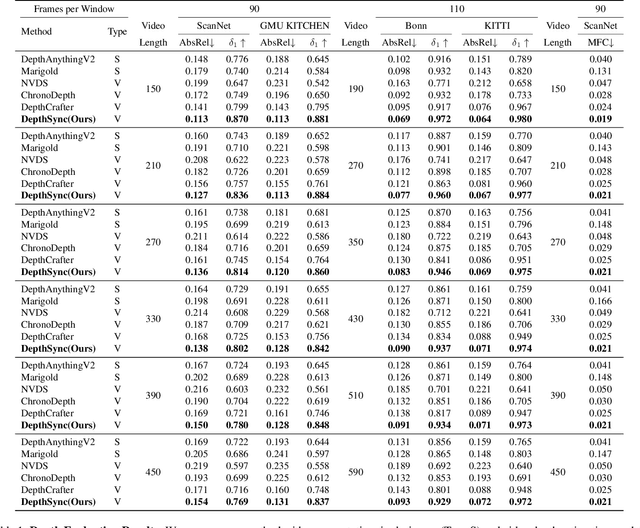
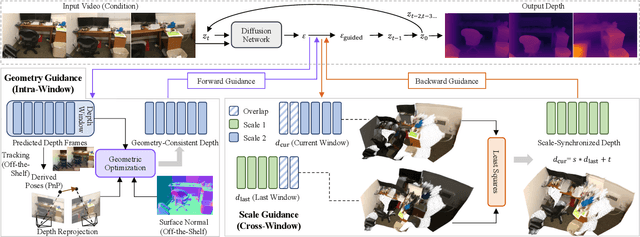
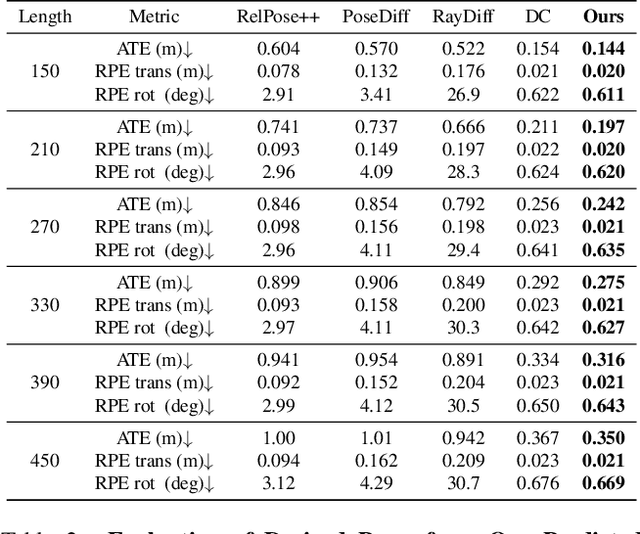
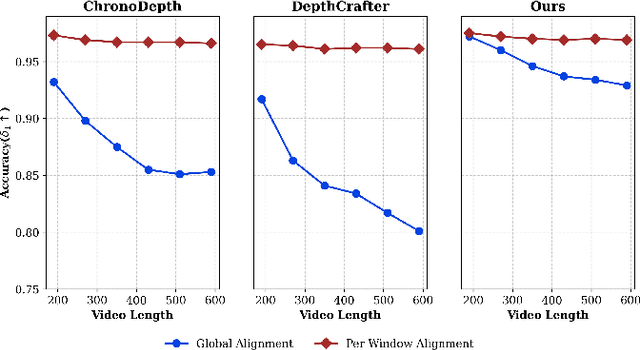
Diffusion-based video depth estimation methods have achieved remarkable success with strong generalization ability. However, predicting depth for long videos remains challenging. Existing methods typically split videos into overlapping sliding windows, leading to accumulated scale discrepancies across different windows, particularly as the number of windows increases. Additionally, these methods rely solely on 2D diffusion priors, overlooking the inherent 3D geometric structure of video depths, which results in geometrically inconsistent predictions. In this paper, we propose DepthSync, a novel, training-free framework using diffusion guidance to achieve scale- and geometry-consistent depth predictions for long videos. Specifically, we introduce scale guidance to synchronize the depth scale across windows and geometry guidance to enforce geometric alignment within windows based on the inherent 3D constraints in video depths. These two terms work synergistically, steering the denoising process toward consistent depth predictions. Experiments on various datasets validate the effectiveness of our method in producing depth estimates with improved scale and geometry consistency, particularly for long videos.
DI-PCG: Diffusion-based Efficient Inverse Procedural Content Generation for High-quality 3D Asset Creation
Dec 19, 2024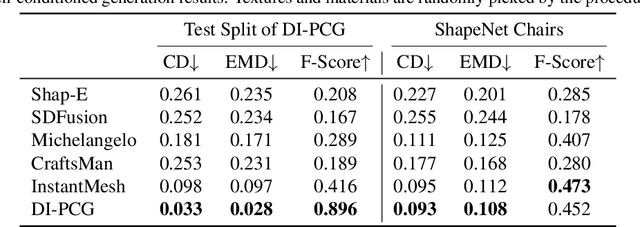

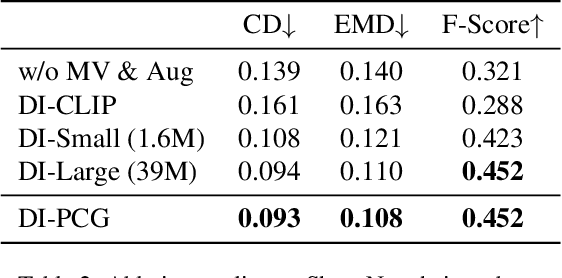

Procedural Content Generation (PCG) is powerful in creating high-quality 3D contents, yet controlling it to produce desired shapes is difficult and often requires extensive parameter tuning. Inverse Procedural Content Generation aims to automatically find the best parameters under the input condition. However, existing sampling-based and neural network-based methods still suffer from numerous sample iterations or limited controllability. In this work, we present DI-PCG, a novel and efficient method for Inverse PCG from general image conditions. At its core is a lightweight diffusion transformer model, where PCG parameters are directly treated as the denoising target and the observed images as conditions to control parameter generation. DI-PCG is efficient and effective. With only 7.6M network parameters and 30 GPU hours to train, it demonstrates superior performance in recovering parameters accurately, and generalizing well to in-the-wild images. Quantitative and qualitative experiment results validate the effectiveness of DI-PCG in inverse PCG and image-to-3D generation tasks. DI-PCG offers a promising approach for efficient inverse PCG and represents a valuable exploration step towards a 3D generation path that models how to construct a 3D asset using parametric models.
AlphaTablets: A Generic Plane Representation for 3D Planar Reconstruction from Monocular Videos
Nov 29, 2024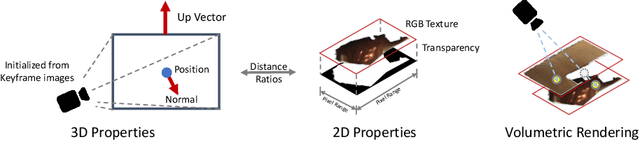


We introduce AlphaTablets, a novel and generic representation of 3D planes that features continuous 3D surface and precise boundary delineation. By representing 3D planes as rectangles with alpha channels, AlphaTablets combine the advantages of current 2D and 3D plane representations, enabling accurate, consistent and flexible modeling of 3D planes. We derive differentiable rasterization on top of AlphaTablets to efficiently render 3D planes into images, and propose a novel bottom-up pipeline for 3D planar reconstruction from monocular videos. Starting with 2D superpixels and geometric cues from pre-trained models, we initialize 3D planes as AlphaTablets and optimize them via differentiable rendering. An effective merging scheme is introduced to facilitate the growth and refinement of AlphaTablets. Through iterative optimization and merging, we reconstruct complete and accurate 3D planes with solid surfaces and clear boundaries. Extensive experiments on the ScanNet dataset demonstrate state-of-the-art performance in 3D planar reconstruction, underscoring the great potential of AlphaTablets as a generic 3D plane representation for various applications. Project page is available at: https://hyzcluster.github.io/alphatablets
StdGEN: Semantic-Decomposed 3D Character Generation from Single Images
Nov 08, 2024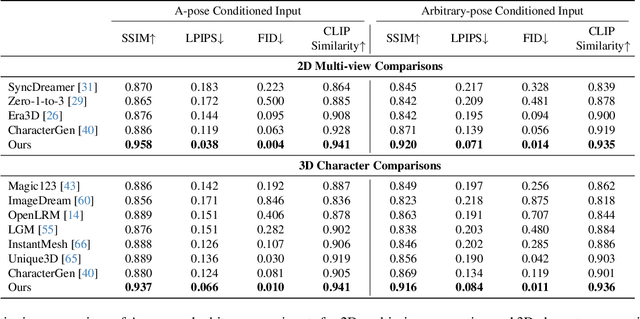
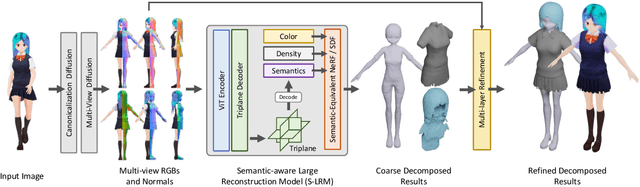
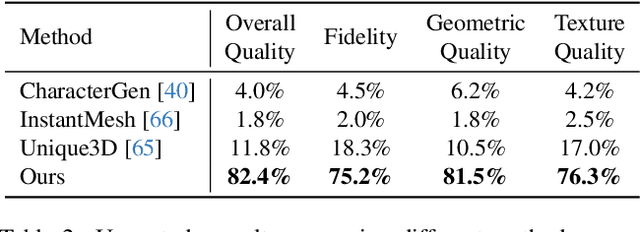
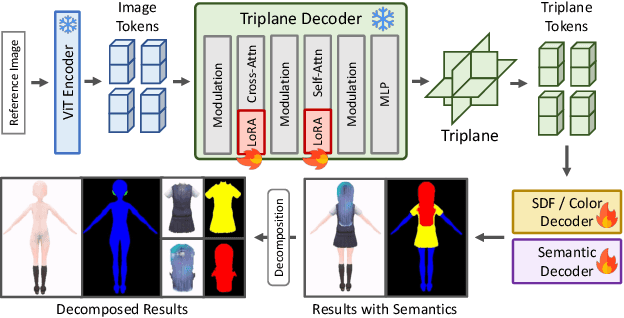
We present StdGEN, an innovative pipeline for generating semantically decomposed high-quality 3D characters from single images, enabling broad applications in virtual reality, gaming, and filmmaking, etc. Unlike previous methods which struggle with limited decomposability, unsatisfactory quality, and long optimization times, StdGEN features decomposability, effectiveness and efficiency; i.e., it generates intricately detailed 3D characters with separated semantic components such as the body, clothes, and hair, in three minutes. At the core of StdGEN is our proposed Semantic-aware Large Reconstruction Model (S-LRM), a transformer-based generalizable model that jointly reconstructs geometry, color and semantics from multi-view images in a feed-forward manner. A differentiable multi-layer semantic surface extraction scheme is introduced to acquire meshes from hybrid implicit fields reconstructed by our S-LRM. Additionally, a specialized efficient multi-view diffusion model and an iterative multi-layer surface refinement module are integrated into the pipeline to facilitate high-quality, decomposable 3D character generation. Extensive experiments demonstrate our state-of-the-art performance in 3D anime character generation, surpassing existing baselines by a significant margin in geometry, texture and decomposability. StdGEN offers ready-to-use semantic-decomposed 3D characters and enables flexible customization for a wide range of applications. Project page: https://stdgen.github.io
MonoPlane: Exploiting Monocular Geometric Cues for Generalizable 3D Plane Reconstruction
Nov 02, 2024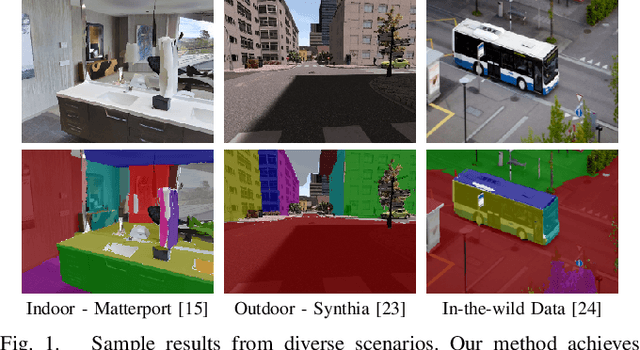

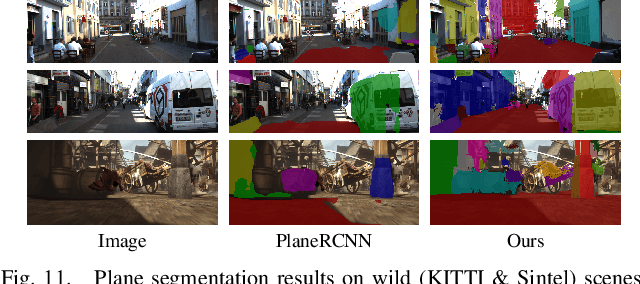
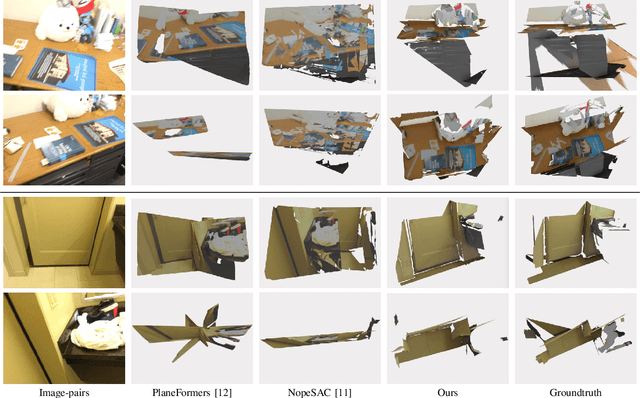
This paper presents a generalizable 3D plane detection and reconstruction framework named MonoPlane. Unlike previous robust estimator-based works (which require multiple images or RGB-D input) and learning-based works (which suffer from domain shift), MonoPlane combines the best of two worlds and establishes a plane reconstruction pipeline based on monocular geometric cues, resulting in accurate, robust and scalable 3D plane detection and reconstruction in the wild. Specifically, we first leverage large-scale pre-trained neural networks to obtain the depth and surface normals from a single image. These monocular geometric cues are then incorporated into a proximity-guided RANSAC framework to sequentially fit each plane instance. We exploit effective 3D point proximity and model such proximity via a graph within RANSAC to guide the plane fitting from noisy monocular depths, followed by image-level multi-plane joint optimization to improve the consistency among all plane instances. We further design a simple but effective pipeline to extend this single-view solution to sparse-view 3D plane reconstruction. Extensive experiments on a list of datasets demonstrate our superior zero-shot generalizability over baselines, achieving state-of-the-art plane reconstruction performance in a transferring setting. Our code is available at https://github.com/thuzhaowang/MonoPlane .
Tracking Everything in Robotic-Assisted Surgery
Sep 29, 2024Accurate tracking of tissues and instruments in videos is crucial for Robotic-Assisted Minimally Invasive Surgery (RAMIS), as it enables the robot to comprehend the surgical scene with precise locations and interactions of tissues and tools. Traditional keypoint-based sparse tracking is limited by featured points, while flow-based dense two-view matching suffers from long-term drifts. Recently, the Tracking Any Point (TAP) algorithm was proposed to overcome these limitations and achieve dense accurate long-term tracking. However, its efficacy in surgical scenarios remains untested, largely due to the lack of a comprehensive surgical tracking dataset for evaluation. To address this gap, we introduce a new annotated surgical tracking dataset for benchmarking tracking methods for surgical scenarios, comprising real-world surgical videos with complex tissue and instrument motions. We extensively evaluate state-of-the-art (SOTA) TAP-based algorithms on this dataset and reveal their limitations in challenging surgical scenarios, including fast instrument motion, severe occlusions, and motion blur, etc. Furthermore, we propose a new tracking method, namely SurgMotion, to solve the challenges and further improve the tracking performance. Our proposed method outperforms most TAP-based algorithms in surgical instruments tracking, and especially demonstrates significant improvements over baselines in challenging medical videos.