 Add to Chrome
 Add to Firefox
 Add to Edge
Describing Differences in Image Sets with Natural Language
Dec 05, 2023
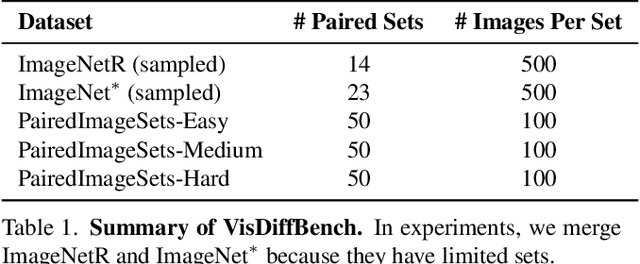
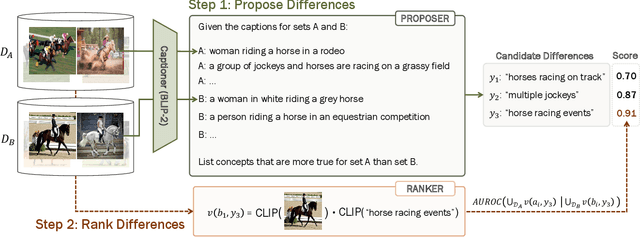
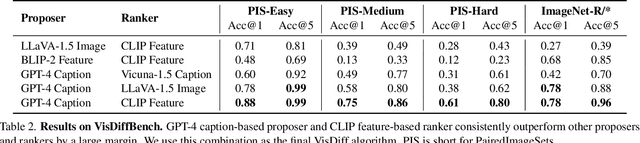
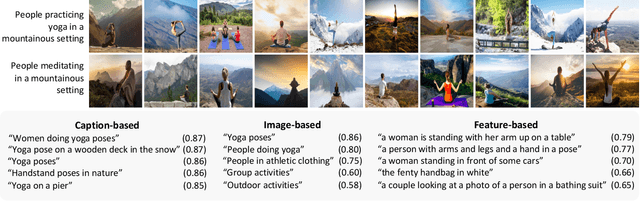
How do two sets of images differ? Discerning set-level differences is crucial for understanding model behaviors and analyzing datasets, yet manually sifting through thousands of images is impractical. To aid in this discovery process, we explore the task of automatically describing the differences between two $\textbf{sets}$ of images, which we term Set Difference Captioning. This task takes in image sets $D_A$ and $D_B$, and outputs a description that is more often true on $D_A$ than $D_B$. We outline a two-stage approach that first proposes candidate difference descriptions from image sets and then re-ranks the candidates by checking how well they can differentiate the two sets. We introduce VisDiff, which first captions the images and prompts a language model to propose candidate descriptions, then re-ranks these descriptions using CLIP. To evaluate VisDiff, we collect VisDiffBench, a dataset with 187 paired image sets with ground truth difference descriptions. We apply VisDiff to various domains, such as comparing datasets (e.g., ImageNet vs. ImageNetV2), comparing classification models (e.g., zero-shot CLIP vs. supervised ResNet), summarizing model failure modes (supervised ResNet), characterizing differences between generative models (e.g., StableDiffusionV1 and V2), and discovering what makes images memorable. Using VisDiff, we are able to find interesting and previously unknown differences in datasets and models, demonstrating its utility in revealing nuanced insights.

Readout Guidance: Learning Control from Diffusion Features
Dec 04, 2023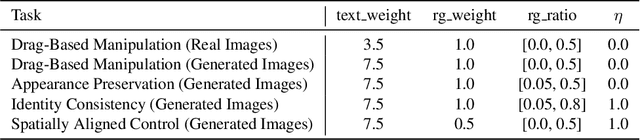
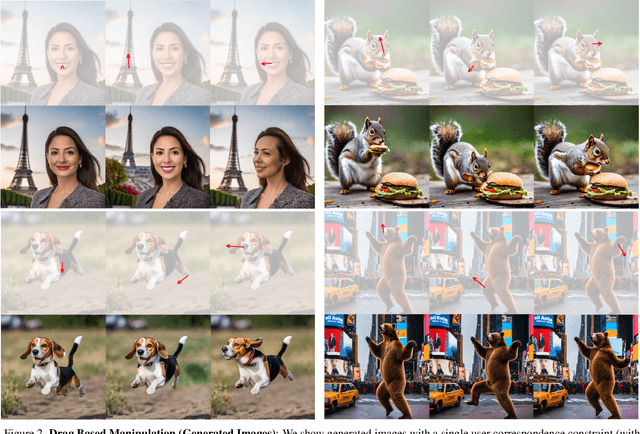
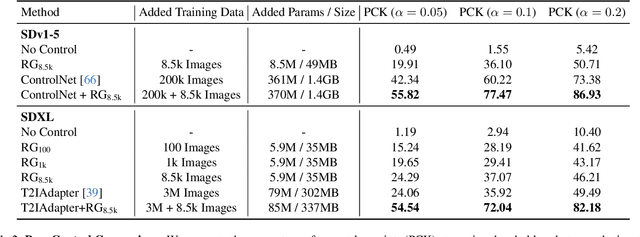
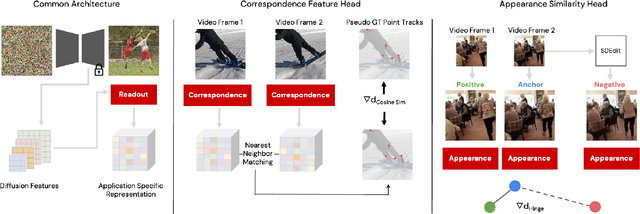
We present Readout Guidance, a method for controlling text-to-image diffusion models with learned signals. Readout Guidance uses readout heads, lightweight networks trained to extract signals from the features of a pre-trained, frozen diffusion model at every timestep. These readouts can encode single-image properties, such as pose, depth, and edges; or higher-order properties that relate multiple images, such as correspondence and appearance similarity. Furthermore, by comparing the readout estimates to a user-defined target, and back-propagating the gradient through the readout head, these estimates can be used to guide the sampling process. Compared to prior methods for conditional generation, Readout Guidance requires significantly fewer added parameters and training samples, and offers a convenient and simple recipe for reproducing different forms of conditional control under a single framework, with a single architecture and sampling procedure. We showcase these benefits in the applications of drag-based manipulation, identity-consistent generation, and spatially aligned control. Project page: https://readout-guidance.github.io.
Recursive Visual Programming
Dec 04, 2023


Visual Programming (VP) has emerged as a powerful framework for Visual Question Answering (VQA). By generating and executing bespoke code for each question, these methods demonstrate impressive compositional and reasoning capabilities, especially in few-shot and zero-shot scenarios. However, existing VP methods generate all code in a single function, resulting in code that is suboptimal in terms of both accuracy and interpretability. Inspired by human coding practices, we propose Recursive Visual Programming (RVP), which simplifies generated routines, provides more efficient problem solving, and can manage more complex data structures. RVP is inspired by human coding practices and approaches VQA tasks with an iterative recursive code generation approach, allowing decomposition of complicated problems into smaller parts. Notably, RVP is capable of dynamic type assignment, i.e., as the system recursively generates a new piece of code, it autonomously determines the appropriate return type and crafts the requisite code to generate that output. We show RVP's efficacy through extensive experiments on benchmarks including VSR, COVR, GQA, and NextQA, underscoring the value of adopting human-like recursive and modular programming techniques for solving VQA tasks through coding.
IMProv: Inpainting-based Multimodal Prompting for Computer Vision Tasks
Dec 04, 2023


In-context learning allows adapting a model to new tasks given a task description at test time. In this paper, we present IMProv - a generative model that is able to in-context learn visual tasks from multimodal prompts. Given a textual description of a visual task (e.g. "Left: input image, Right: foreground segmentation"), a few input-output visual examples, or both, the model in-context learns to solve it for a new test input. We train a masked generative transformer on a new dataset of figures from computer vision papers and their associated captions, together with a captioned large-scale image-text dataset. During inference time, we prompt the model with text and/or image task example(s) and have the model inpaint the corresponding output. We show that training our model with text conditioning and scaling the dataset size improves in-context learning for computer vision tasks by over +10\% AP for Foreground Segmentation, over +5\% gains in AP for Single Object Detection, and almost 20\% lower LPIPS in Colorization. Our empirical results suggest that vision and language prompts are complementary and it is advantageous to use both to achieve better in-context learning performance. Project page is available at https://jerryxu.net/IMProv .
Sequential Modeling Enables Scalable Learning for Large Vision Models
Dec 01, 2023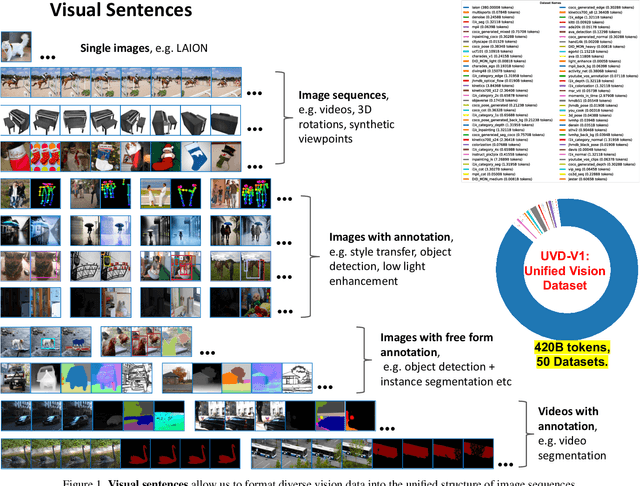
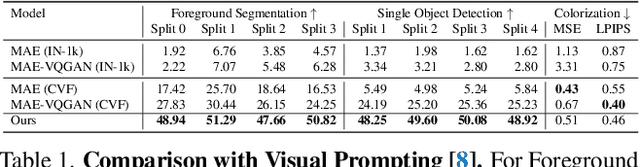
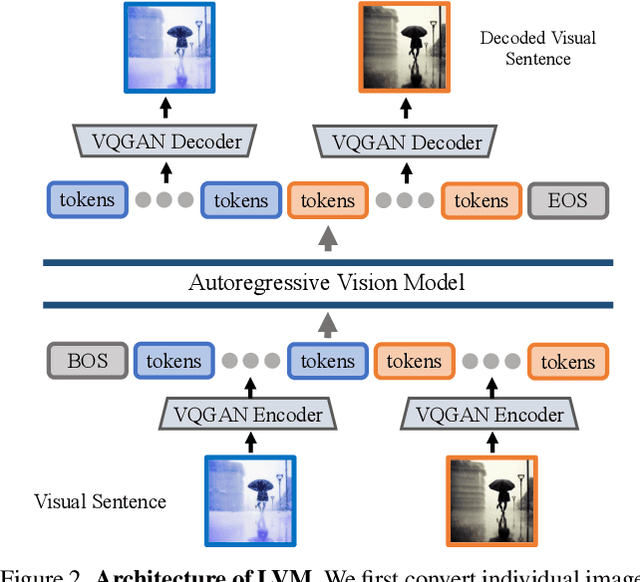
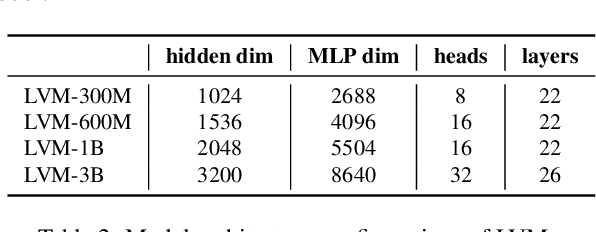
We introduce a novel sequential modeling approach which enables learning a Large Vision Model (LVM) without making use of any linguistic data. To do this, we define a common format, "visual sentences", in which we can represent raw images and videos as well as annotated data sources such as semantic segmentations and depth reconstructions without needing any meta-knowledge beyond the pixels. Once this wide variety of visual data (comprising 420 billion tokens) is represented as sequences, the model can be trained to minimize a cross-entropy loss for next token prediction. By training across various scales of model architecture and data diversity, we provide empirical evidence that our models scale effectively. Many different vision tasks can be solved by designing suitable visual prompts at test time.
Initializing Models with Larger Ones
Nov 30, 2023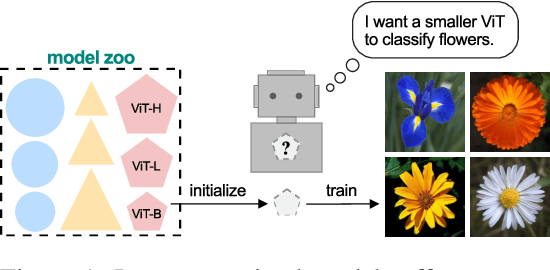
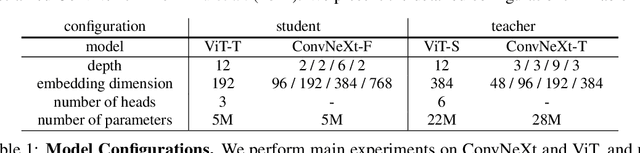
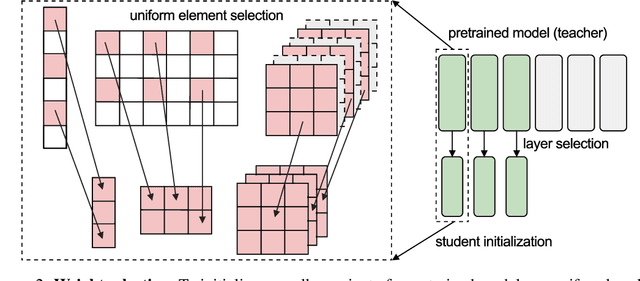
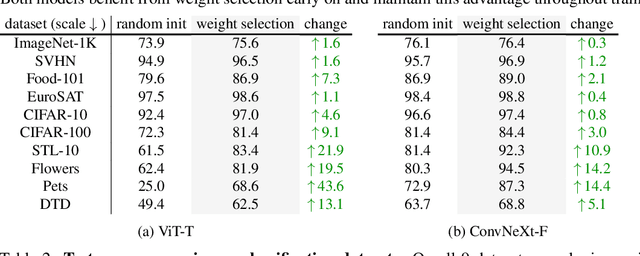
Weight initialization plays an important role in neural network training. Widely used initialization methods are proposed and evaluated for networks that are trained from scratch. However, the growing number of pretrained models now offers new opportunities for tackling this classical problem of weight initialization. In this work, we introduce weight selection, a method for initializing smaller models by selecting a subset of weights from a pretrained larger model. This enables the transfer of knowledge from pretrained weights to smaller models. Our experiments demonstrate that weight selection can significantly enhance the performance of small models and reduce their training time. Notably, it can also be used together with knowledge distillation. Weight selection offers a new approach to leverage the power of pretrained models in resource-constrained settings, and we hope it can be a useful tool for training small models in the large-model era. Code is available at https://github.com/OscarXZQ/weight-selection.
Object-based (yet Class-agnostic) Video Domain Adaptation
Nov 29, 2023
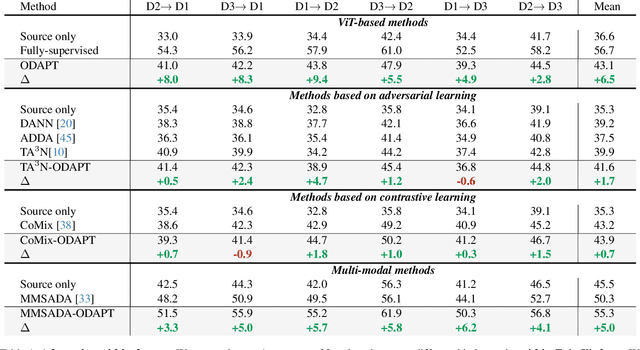
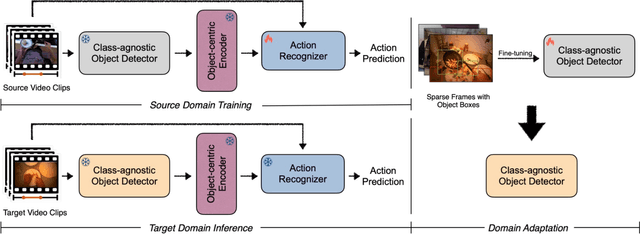

Existing video-based action recognition systems typically require dense annotation and struggle in environments when there is significant distribution shift relative to the training data. Current methods for video domain adaptation typically fine-tune the model using fully annotated data on a subset of target domain data or align the representation of the two domains using bootstrapping or adversarial learning. Inspired by the pivotal role of objects in recent supervised object-centric action recognition models, we present Object-based (yet Class-agnostic) Video Domain Adaptation (ODAPT), a simple yet effective framework for adapting the existing action recognition systems to new domains by utilizing a sparse set of frames with class-agnostic object annotations in a target domain. Our model achieves a +6.5 increase when adapting across kitchens in Epic-Kitchens and a +3.1 increase adapting between Epic-Kitchens and the EGTEA dataset. ODAPT is a general framework that can also be combined with previous unsupervised methods, offering a +5.0 boost when combined with the self-supervised multi-modal method MMSADA and a +1.7 boost when added to the adversarial-based method TA$^3$N on Epic-Kitchens.
Self-correcting LLM-controlled Diffusion Models
Nov 27, 2023Text-to-image generation has witnessed significant progress with the advent of diffusion models. Despite the ability to generate photorealistic images, current text-to-image diffusion models still often struggle to accurately interpret and follow complex input text prompts. In contrast to existing models that aim to generate images only with their best effort, we introduce Self-correcting LLM-controlled Diffusion (SLD). SLD is a framework that generates an image from the input prompt, assesses its alignment with the prompt, and performs self-corrections on the inaccuracies in the generated image. Steered by an LLM controller, SLD turns text-to-image generation into an iterative closed-loop process, ensuring correctness in the resulting image. SLD is not only training-free but can also be seamlessly integrated with diffusion models behind API access, such as DALL-E 3, to further boost the performance of state-of-the-art diffusion models. Experimental results show that our approach can rectify a majority of incorrect generations, particularly in generative numeracy, attribute binding, and spatial relationships. Furthermore, by simply adjusting the instructions to the LLM, SLD can perform image editing tasks, bridging the gap between text-to-image generation and image editing pipelines. We will make our code available for future research and applications.
Compositional Chain-of-Thought Prompting for Large Multimodal Models
Nov 27, 2023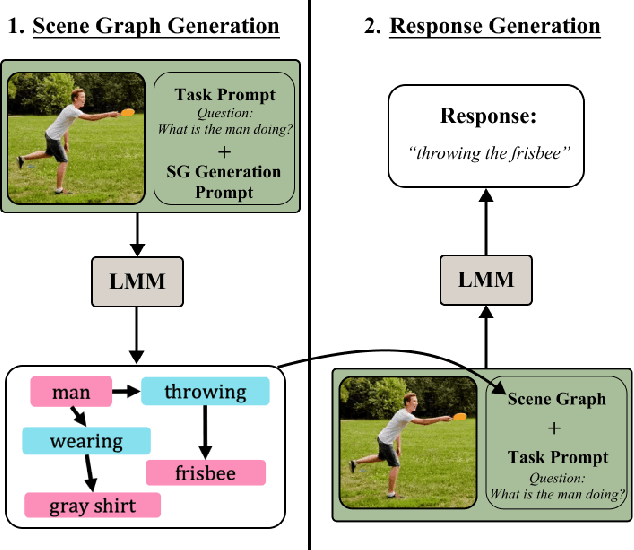
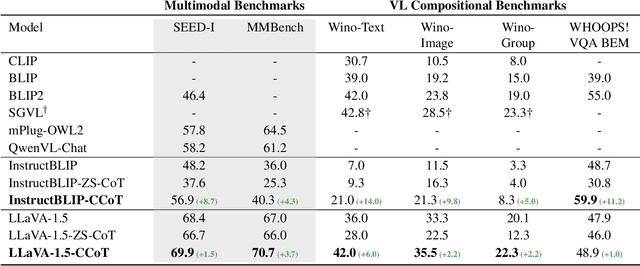
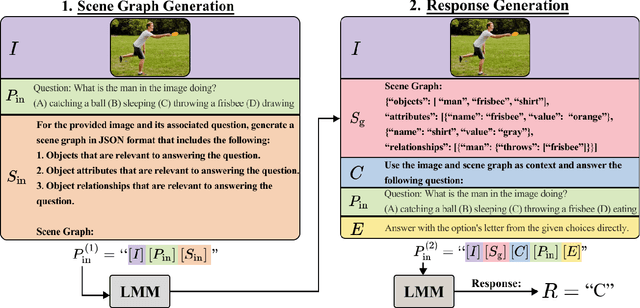

The combination of strong visual backbones and Large Language Model (LLM) reasoning has led to Large Multimodal Models (LMMs) becoming the current standard for a wide range of vision and language (VL) tasks. However, recent research has shown that even the most advanced LMMs still struggle to capture aspects of compositional visual reasoning, such as attributes and relationships between objects. One solution is to utilize scene graphs (SGs)--a formalization of objects and their relations and attributes that has been extensively used as a bridge between the visual and textual domains. Yet, scene graph data requires scene graph annotations, which are expensive to collect and thus not easily scalable. Moreover, finetuning an LMM based on SG data can lead to catastrophic forgetting of the pretraining objective. To overcome this, inspired by chain-of-thought methods, we propose Compositional Chain-of-Thought (CCoT), a novel zero-shot Chain-of-Thought prompting method that utilizes SG representations in order to extract compositional knowledge from an LMM. Specifically, we first generate an SG using the LMM, and then use that SG in the prompt to produce a response. Through extensive experiments, we find that the proposed CCoT approach not only improves LMM performance on several vision and language VL compositional benchmarks but also improves the performance of several popular LMMs on general multimodal benchmarks, without the need for fine-tuning or annotated ground-truth SGs.
From Wrong To Right: A Recursive Approach Towards Vision-Language Explanation
Nov 21, 2023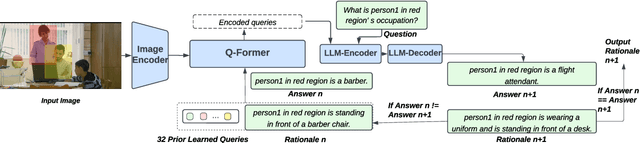
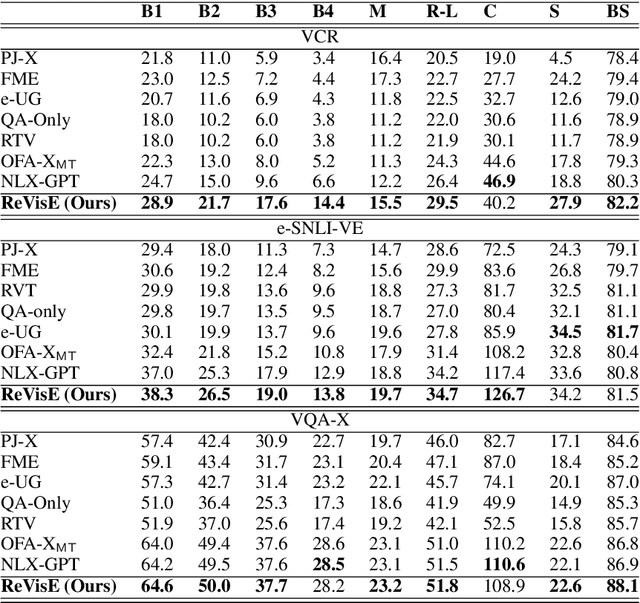
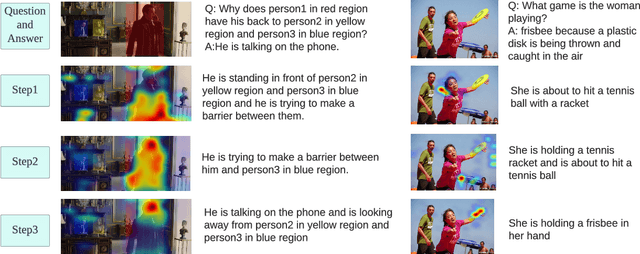
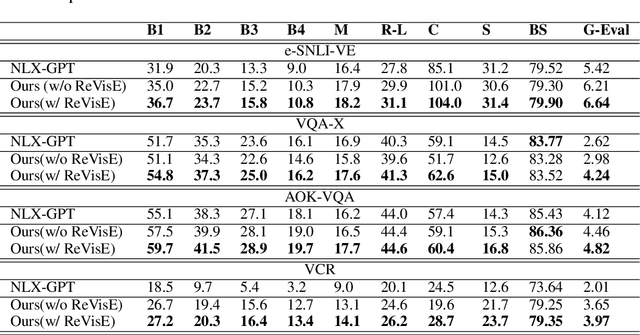
Addressing the challenge of adapting pre-trained vision-language models for generating insightful explanations for visual reasoning tasks with limited annotations, we present ReVisE: a $\textbf{Re}$cursive $\textbf{Vis}$ual $\textbf{E}$xplanation algorithm. Our method iteratively computes visual features (conditioned on the text input), an answer, and an explanation, to improve the explanation quality step by step until the answer converges. We find that this multi-step approach guides the model to correct its own answers and outperforms single-step explanation generation. Furthermore, explanations generated by ReVisE also serve as valuable annotations for few-shot self-training. Our approach outperforms previous methods while utilizing merely 5% of the human-annotated explanations across 10 metrics, demonstrating up to a 4.2 and 1.3 increase in BLEU-1 score on the VCR and VQA-X datasets, underscoring the efficacy and data-efficiency of our method.