 Add to Chrome
 Add to Firefox
 Add to Edge
MM-CamObj: A Comprehensive Multimodal Dataset for Camouflaged Object Scenarios
Sep 24, 2024
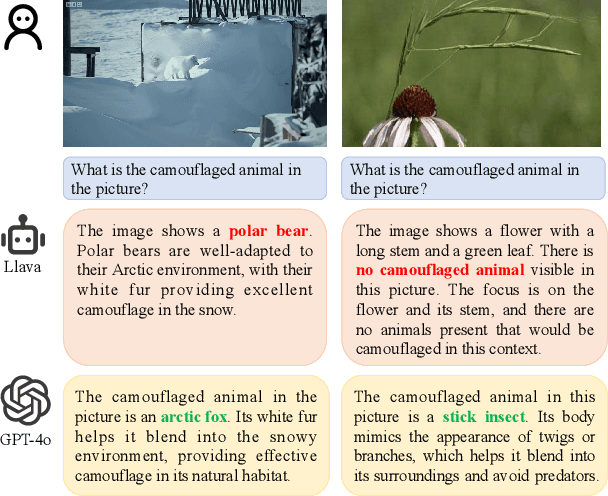
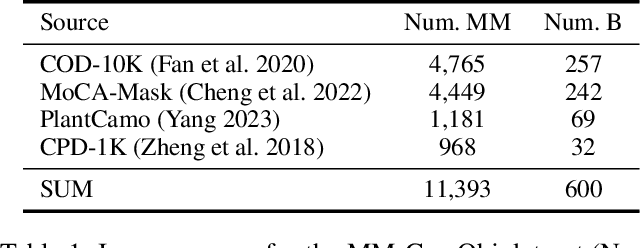

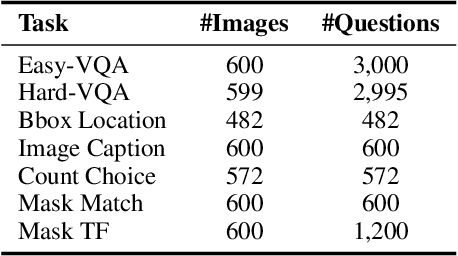
Large visual-language models (LVLMs) have achieved great success in multiple applications. However, they still encounter challenges in complex scenes, especially those involving camouflaged objects. This is primarily due to the lack of samples related to camouflaged scenes in the training dataset. To mitigate this issue, we construct the MM-CamObj dataset for the first time, comprising two subsets: CamObj-Align and CamObj-Instruct. Specifically, CamObj-Align contains 11,363 image-text pairs, and it is designed for VL alignment and injecting rich knowledge of camouflaged scenes into LVLMs. CamObj-Instruct is collected for fine-tuning the LVLMs with improved instruction-following capabilities, and it includes 11,363 images and 68,849 conversations with diverse instructions. Based on the MM-CamObj dataset, we propose the CamObj-Llava, an LVLM specifically designed for addressing tasks in camouflaged scenes. To facilitate our model's effective acquisition of knowledge about camouflaged objects and scenes, we introduce a curriculum learning strategy with six distinct modes. Additionally, we construct the CamObj-Bench to evaluate the existing LVLMs' capabilities of understanding, recognition, localization and count in camouflage scenes. This benchmark includes 600 images and 7 tasks, with a total of 9,449 questions. Extensive experiments are conducted on the CamObj-Bench with CamObj-Llava, 8 existing open-source and 3 closed-source LVLMs. Surprisingly, the results indicate that our model achieves a 25.84% improvement in 4 out of 7 tasks compared to GPT-4o. Code and datasets will be available at https://github.com/JCruan519/MM-CamObj.

Strategic Chain-of-Thought: Guiding Accurate Reasoning in LLMs through Strategy Elicitation
Sep 05, 2024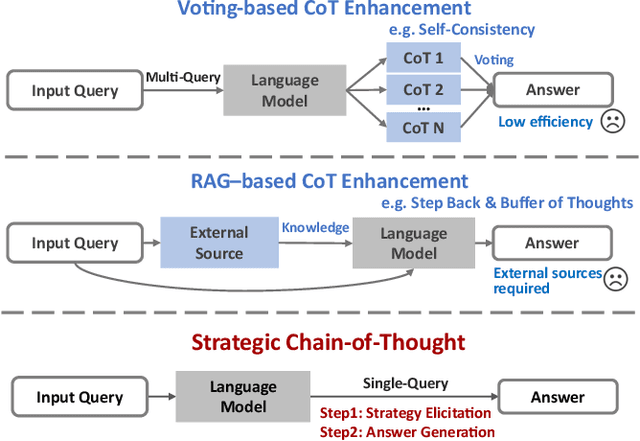
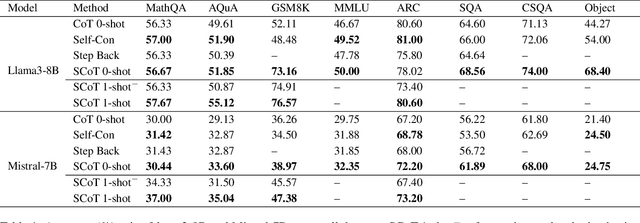
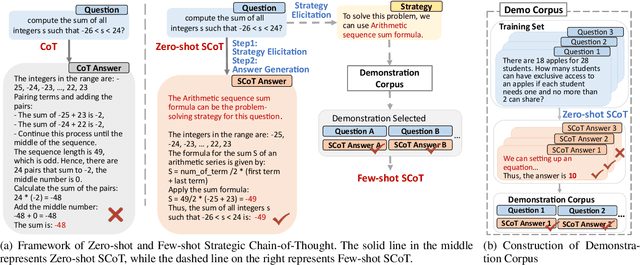
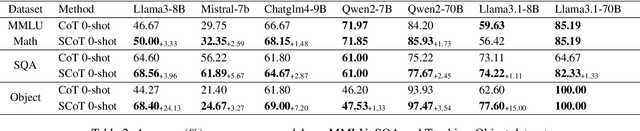
The Chain-of-Thought (CoT) paradigm has emerged as a critical approach for enhancing the reasoning capabilities of large language models (LLMs). However, despite their widespread adoption and success, CoT methods often exhibit instability due to their inability to consistently ensure the quality of generated reasoning paths, leading to sub-optimal reasoning performance. To address this challenge, we propose the \textbf{Strategic Chain-of-Thought} (SCoT), a novel methodology designed to refine LLM performance by integrating strategic knowledge prior to generating intermediate reasoning steps. SCoT employs a two-stage approach within a single prompt: first eliciting an effective problem-solving strategy, which is then used to guide the generation of high-quality CoT paths and final answers. Our experiments across eight challenging reasoning datasets demonstrate significant improvements, including a 21.05\% increase on the GSM8K dataset and 24.13\% on the Tracking\_Objects dataset, respectively, using the Llama3-8b model. Additionally, we extend the SCoT framework to develop a few-shot method with automatically matched demonstrations, yielding even stronger results. These findings underscore the efficacy of SCoT, highlighting its potential to substantially enhance LLM performance in complex reasoning tasks.
Draw Like an Artist: Complex Scene Generation with Diffusion Model via Composition, Painting, and Retouching
Aug 25, 2024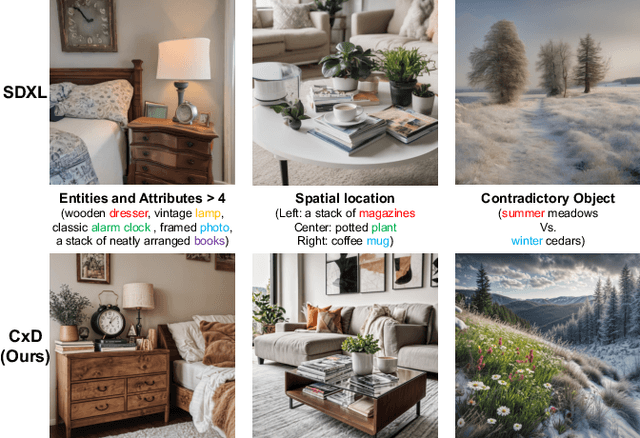

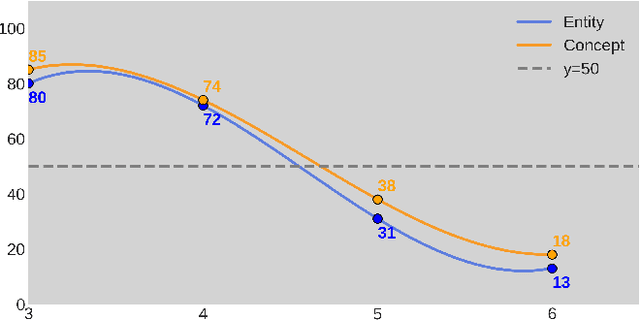

Recent advances in text-to-image diffusion models have demonstrated impressive capabilities in image quality. However, complex scene generation remains relatively unexplored, and even the definition of `complex scene' itself remains unclear. In this paper, we address this gap by providing a precise definition of complex scenes and introducing a set of Complex Decomposition Criteria (CDC) based on this definition. Inspired by the artists painting process, we propose a training-free diffusion framework called Complex Diffusion (CxD), which divides the process into three stages: composition, painting, and retouching. Our method leverages the powerful chain-of-thought capabilities of large language models (LLMs) to decompose complex prompts based on CDC and to manage composition and layout. We then develop an attention modulation method that guides simple prompts to specific regions to complete the complex scene painting. Finally, we inject the detailed output of the LLM into a retouching model to enhance the image details, thus implementing the retouching stage. Extensive experiments demonstrate that our method outperforms previous SOTA approaches, significantly improving the generation of high-quality, semantically consistent, and visually diverse images for complex scenes, even with intricate prompts.
Causal-Guided Active Learning for Debiasing Large Language Models
Aug 23, 2024Although achieving promising performance, recent analyses show that current generative large language models (LLMs) may still capture dataset biases and utilize them for generation, leading to poor generalizability and harmfulness of LLMs. However, due to the diversity of dataset biases and the over-optimization problem, previous prior-knowledge-based debiasing methods and fine-tuning-based debiasing methods may not be suitable for current LLMs. To address this issue, we explore combining active learning with the causal mechanisms and propose a casual-guided active learning (CAL) framework, which utilizes LLMs itself to automatically and autonomously identify informative biased samples and induce the bias patterns. Then a cost-effective and efficient in-context learning based method is employed to prevent LLMs from utilizing dataset biases during generation. Experimental results show that CAL can effectively recognize typical biased instances and induce various bias patterns for debiasing LLMs.
SAM-REF: Rethinking Image-Prompt Synergy for Refinement in Segment Anything
Aug 22, 2024
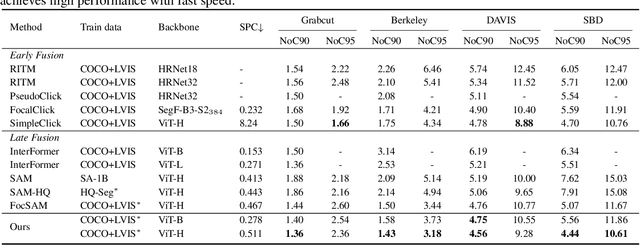


The advent of the Segment Anything Model (SAM) marks a significant milestone for interactive segmentation using generalist models. As a late fusion model, SAM extracts image embeddings once and merges them with prompts in later interactions. This strategy limits the models ability to extract detailed information from the prompted target zone. Current specialist models utilize the early fusion strategy that encodes the combination of images and prompts to target the prompted objects, yet repetitive complex computations on the images result in high latency. The key to these issues is efficiently synergizing the images and prompts. We propose SAM-REF, a two-stage refinement framework that fully integrates images and prompts globally and locally while maintaining the accuracy of early fusion and the efficiency of late fusion. The first-stage GlobalDiff Refiner is a lightweight early fusion network that combines the whole image and prompts, focusing on capturing detailed information for the entire object. The second-stage PatchDiff Refiner locates the object detail window according to the mask and prompts, then refines the local details of the object. Experimentally, we demonstrated the high effectiveness and efficiency of our method in tackling complex cases with multiple interactions. Our SAM-REF model outperforms the current state-of-the-art method in most metrics on segmentation quality without compromising efficiency.
Diagnosing and Remedying Knowledge Deficiencies in LLMs via Label-free Curricular Meaningful Learning
Aug 21, 2024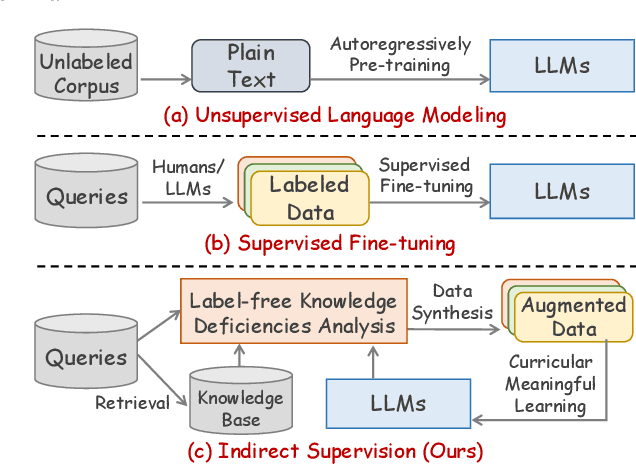

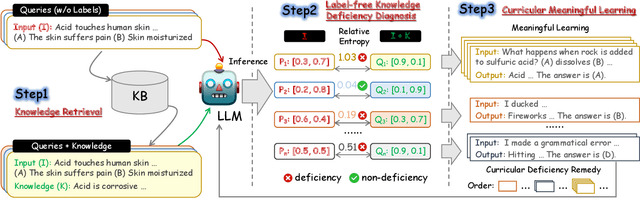

Large Language Models (LLMs) are versatile and demonstrate impressive generalization ability by mining and learning information from extensive unlabeled text. However, they still exhibit reasoning mistakes, often stemming from knowledge deficiencies, which can affect their trustworthiness and reliability. Although users can provide diverse and comprehensive queries, obtaining sufficient and effective feedback is demanding. Furthermore, evaluating LLMs comprehensively with limited labeled samples is difficult. This makes it a challenge to diagnose and remedy the deficiencies of LLMs through rich label-free user queries. To tackle this challenge, we propose a label-free curricular meaningful learning framework (LaMer). LaMer first employs relative entropy to automatically diagnose and quantify the knowledge deficiencies of LLMs in a label-free setting. Next, to remedy the diagnosed knowledge deficiencies, we apply curricular meaningful learning: first, we adopt meaningful learning to adaptively synthesize augmentation data according to the severity of the deficiencies, and then design a curricular deficiency remedy strategy to remedy the knowledge deficiencies of LLMs progressively. Experiments show that LaMer efficiently and effectively diagnoses and remedies knowledge deficiencies in LLMs, improving various LLMs across seven out-of-distribution (OOD) reasoning and language understanding benchmarks, achieving comparable results to baselines with just 40\% training data. LaMer even surpasses methods that rely on labeled datasets for deficiency diagnosis. In application, our label-free method can offer an effective knowledge deficiency diagnostic tool for efficient LLM development.
Rethinking Video Segmentation with Masked Video Consistency: Did the Model Learn as Intended?
Aug 20, 2024Video segmentation aims at partitioning video sequences into meaningful segments based on objects or regions of interest within frames. Current video segmentation models are often derived from image segmentation techniques, which struggle to cope with small-scale or class-imbalanced video datasets. This leads to inconsistent segmentation results across frames. To address these issues, we propose a training strategy Masked Video Consistency, which enhances spatial and temporal feature aggregation. MVC introduces a training strategy that randomly masks image patches, compelling the network to predict the entire semantic segmentation, thus improving contextual information integration. Additionally, we introduce Object Masked Attention (OMA) to optimize the cross-attention mechanism by reducing the impact of irrelevant queries, thereby enhancing temporal modeling capabilities. Our approach, integrated into the latest decoupled universal video segmentation framework, achieves state-of-the-art performance across five datasets for three video segmentation tasks, demonstrating significant improvements over previous methods without increasing model parameters.
TextMastero: Mastering High-Quality Scene Text Editing in Diverse Languages and Styles
Aug 20, 2024Scene text editing aims to modify texts on images while maintaining the style of newly generated text similar to the original. Given an image, a target area, and target text, the task produces an output image with the target text in the selected area, replacing the original. This task has been studied extensively, with initial success using Generative Adversarial Networks (GANs) to balance text fidelity and style similarity. However, GAN-based methods struggled with complex backgrounds or text styles. Recent works leverage diffusion models, showing improved results, yet still face challenges, especially with non-Latin languages like CJK characters (Chinese, Japanese, Korean) that have complex glyphs, often producing inaccurate or unrecognizable characters. To address these issues, we present \emph{TextMastero} - a carefully designed multilingual scene text editing architecture based on latent diffusion models (LDMs). TextMastero introduces two key modules: a glyph conditioning module for fine-grained content control in generating accurate texts, and a latent guidance module for providing comprehensive style information to ensure similarity before and after editing. Both qualitative and quantitative experiments demonstrate that our method surpasses all known existing works in text fidelity and style similarity.
CogVideoX: Text-to-Video Diffusion Models with An Expert Transformer
Aug 12, 2024We introduce CogVideoX, a large-scale diffusion transformer model designed for generating videos based on text prompts. To efficently model video data, we propose to levearge a 3D Variational Autoencoder (VAE) to compress videos along both spatial and temporal dimensions. To improve the text-video alignment, we propose an expert transformer with the expert adaptive LayerNorm to facilitate the deep fusion between the two modalities. By employing a progressive training technique, CogVideoX is adept at producing coherent, long-duration videos characterized by significant motions. In addition, we develop an effective text-video data processing pipeline that includes various data preprocessing strategies and a video captioning method. It significantly helps enhance the performance of CogVideoX, improving both generation quality and semantic alignment. Results show that CogVideoX demonstrates state-of-the-art performance across both multiple machine metrics and human evaluations. The model weights of both the 3D Causal VAE and CogVideoX are publicly available at https://github.com/THUDM/CogVideo.
Enhancing Complex Causality Extraction via Improved Subtask Interaction and Knowledge Fusion
Aug 06, 2024


Event Causality Extraction (ECE) aims at extracting causal event pairs from texts. Despite ChatGPT's recent success, fine-tuning small models remains the best approach for the ECE task. However, existing fine-tuning based ECE methods cannot address all three key challenges in ECE simultaneously: 1) Complex Causality Extraction, where multiple causal-effect pairs occur within a single sentence; 2) Subtask~ Interaction, which involves modeling the mutual dependence between the two subtasks of ECE, i.e., extracting events and identifying the causal relationship between extracted events; and 3) Knowledge Fusion, which requires effectively fusing the knowledge in two modalities, i.e., the expressive pretrained language models and the structured knowledge graphs. In this paper, we propose a unified ECE framework (UniCE to address all three issues in ECE simultaneously. Specifically, we design a subtask interaction mechanism to enable mutual interaction between the two ECE subtasks. Besides, we design a knowledge fusion mechanism to fuse knowledge in the two modalities. Furthermore, we employ separate decoders for each subtask to facilitate complex causality extraction. Experiments on three benchmark datasets demonstrate that our method achieves state-of-the-art performance and outperforms ChatGPT with a margin of at least 30% F1-score. More importantly, our model can also be used to effectively improve the ECE performance of ChatGPT via in-context learning.