 Add to Chrome
 Add to Firefox
 Add to Edge
Is More Privileged Information Better? From Solution Traces to Problem-Solving Structure in Self-Distilled Reasoning
Aug 03, 2026
On-policy self-distillation (OPSD) improves reasoning by using a privileged view of a model conditioned on reference solutions to supervise a student view that observes only the question. However, the teacher-provided token-level targets may depend on reference-specific information unavailable at inference time. We propose Problem-Space-Guided OPSD (PS-OPSD), which replaces the complete solution with trajectory-grounded guidance describing the initial state, goal conditions, constraints, and a selected state-transition path. The student rollout and OPSD objective remain unchanged. Across three mathematical reasoning benchmarks and model scales ranging from 1.7B to 8B, PS-OPSD achieves the highest aggregate question-only accuracy among the compared methods. Controlled experiments further indicate that guidance relevance and path coherence contribute to these gains, highlighting the representation of privileged information as an important design choice in OPSD.

DAIS: Dependency-Aware Intermediate QA Supervision for Complex Reasoning
Jul 21, 2026Chain-of-thought (CoT) supervision exposes intermediate rationales, but flat rationale targets usually optimize a single reasoning sequence and provide limited supervision on how local conclusions should support later decisions. We introduce Dependency-Aware Intermediate QA Supervision (DAIS), a training-time framework that converts filtered teacher rationales into stage-level QA records. Each intermediate record predicts a local answer conditioned on the previous states needed for that decision, while the final-answer record keeps the original task format; evaluation therefore uses only the original input and optional context. Across GDPR, AIACT, MedQA, and FOLIO with multiple Qwen backbones, DAIS improves average final-answer accuracy over answer-only, flat chain-of-thought, and independent-QA baselines. On policy-compliance benchmarks, it achieves a largest gain of 5.6% and an average gain of 4.2% over the strongest non-DAIS baseline. Controlled ablations show that valid previous-state conditioning contributes beyond longer targets or additional intermediate text, supporting dependency-conditioned intermediate QA as a lightweight auxiliary supervision signal for standard final-answer inference.
Large Language Model Post-Training: A Unified View of Off-Policy and On-Policy Learning
Apr 09, 2026Post-training has become central to turning pretrained large language models (LLMs) into aligned and deployable systems. Recent progress spans supervised fine-tuning (SFT), preference optimization, reinforcement learning (RL), process supervision, verifier-guided methods, distillation, and multi-stage pipelines. Yet these methods are often discussed in fragmented ways, organized by labels or objective families rather than by the behavioral bottlenecks they address. This survey argues that LLM post-training is best understood as structured intervention on model behavior. We organize the field first by trajectory provenance, which defines two primary learning regimes: off-policy learning on externally supplied trajectories, and on-policy learning on learner-generated rollouts. We then interpret methods through two recurring roles -- effective support expansion, which makes useful behaviors more reachable, and policy reshaping, which improves behavior within already reachable regions -- together with a complementary systems-level role, behavioral consolidation, which preserves, transfers, and amortizes behavior across stages and model transitions. This perspective yields a unified reading of major paradigms. SFT may serve either support expansion or policy reshaping, whereas preference-based methods are usually off-policy reshaping. On-policy RL often improves behavior on learner-generated states, though under stronger guidance it can also make hard-to-reach reasoning paths reachable. Distillation is often best understood as consolidation rather than only compression, and hybrid pipelines emerge as coordinated multi-stage compositions. Overall, the framework helps diagnose post-training bottlenecks and reason about stage composition, suggesting that progress in LLM post-training increasingly depends on coordinated system design rather than any single dominant objective.
RAG+: Enhancing Retrieval-Augmented Generation with Application-Aware Reasoning
Jun 13, 2025The integration of external knowledge through Retrieval-Augmented Generation (RAG) has become foundational in enhancing large language models (LLMs) for knowledge-intensive tasks. However, existing RAG paradigms often overlook the cognitive step of applying knowledge, leaving a gap between retrieved facts and task-specific reasoning. In this work, we introduce RAG+, a principled and modular extension that explicitly incorporates application-aware reasoning into the RAG pipeline. RAG+ constructs a dual corpus consisting of knowledge and aligned application examples, created either manually or automatically, and retrieves both jointly during inference. This design enables LLMs not only to access relevant information but also to apply it within structured, goal-oriented reasoning processes. Experiments across mathematical, legal, and medical domains, conducted on multiple models, demonstrate that RAG+ consistently outperforms standard RAG variants, achieving average improvements of 3-5%, and peak gains up to 7.5% in complex scenarios. By bridging retrieval with actionable application, RAG+ advances a more cognitively grounded framework for knowledge integration, representing a step toward more interpretable and capable LLMs.
Strategic Chain-of-Thought: Guiding Accurate Reasoning in LLMs through Strategy Elicitation
Sep 05, 2024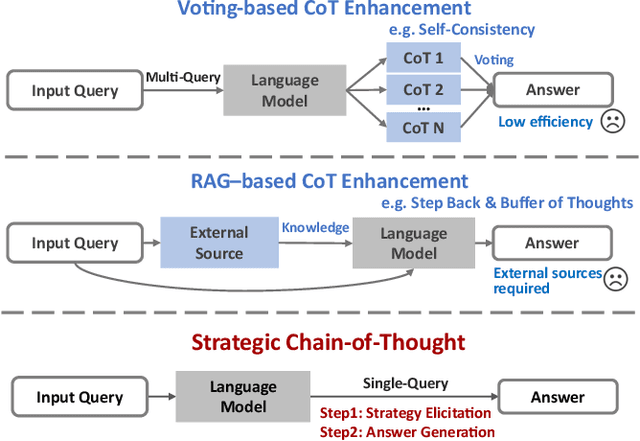
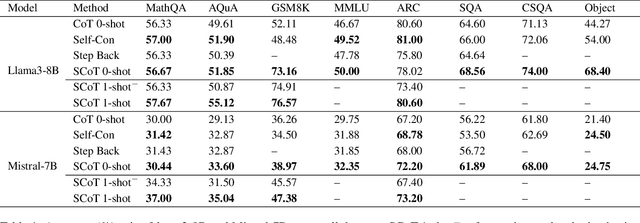
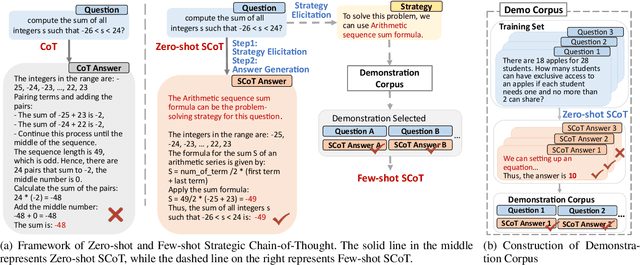
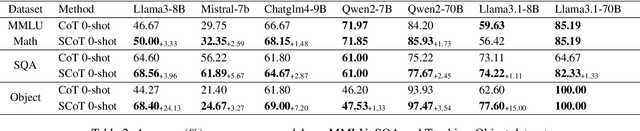
The Chain-of-Thought (CoT) paradigm has emerged as a critical approach for enhancing the reasoning capabilities of large language models (LLMs). However, despite their widespread adoption and success, CoT methods often exhibit instability due to their inability to consistently ensure the quality of generated reasoning paths, leading to sub-optimal reasoning performance. To address this challenge, we propose the \textbf{Strategic Chain-of-Thought} (SCoT), a novel methodology designed to refine LLM performance by integrating strategic knowledge prior to generating intermediate reasoning steps. SCoT employs a two-stage approach within a single prompt: first eliciting an effective problem-solving strategy, which is then used to guide the generation of high-quality CoT paths and final answers. Our experiments across eight challenging reasoning datasets demonstrate significant improvements, including a 21.05\% increase on the GSM8K dataset and 24.13\% on the Tracking\_Objects dataset, respectively, using the Llama3-8b model. Additionally, we extend the SCoT framework to develop a few-shot method with automatically matched demonstrations, yielding even stronger results. These findings underscore the efficacy of SCoT, highlighting its potential to substantially enhance LLM performance in complex reasoning tasks.
Re-TASK: Revisiting LLM Tasks from Capability, Skill, and Knowledge Perspectives
Aug 13, 2024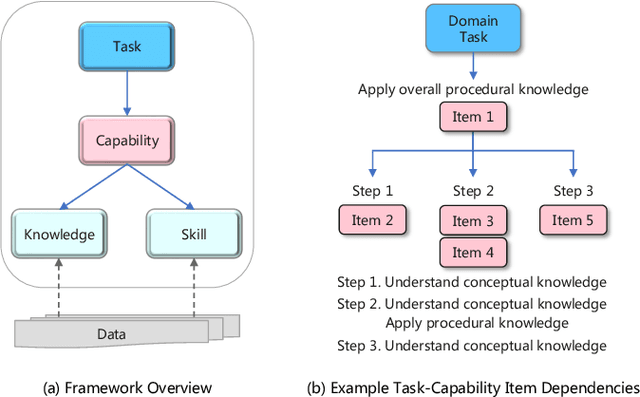
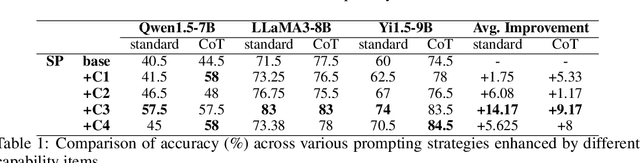

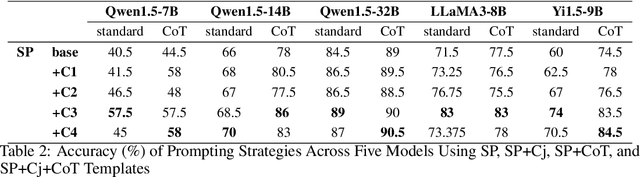
As large language models (LLMs) continue to scale, their enhanced performance often proves insufficient for solving domain-specific tasks. Systematically analyzing their failures and effectively enhancing their performance remain significant challenges. This paper introduces the Re-TASK framework, a novel theoretical model that Revisits LLM Tasks from cApability, Skill, Knowledge perspectives, guided by the principles of Bloom's Taxonomy and Knowledge Space Theory. The Re-TASK framework provides a systematic methodology to deepen our understanding, evaluation, and enhancement of LLMs for domain-specific tasks. It explores the interplay among an LLM's capabilities, the knowledge it processes, and the skills it applies, elucidating how these elements are interconnected and impact task performance. Our application of the Re-TASK framework reveals that many failures in domain-specific tasks can be attributed to insufficient knowledge or inadequate skill adaptation. With this insight, we propose structured strategies for enhancing LLMs through targeted knowledge injection and skill adaptation. Specifically, we identify key capability items associated with tasks and employ a deliberately designed prompting strategy to enhance task performance, thereby reducing the need for extensive fine-tuning. Alternatively, we fine-tune the LLM using capability-specific instructions, further validating the efficacy of our framework. Experimental results confirm the framework's effectiveness, demonstrating substantial improvements in both the performance and applicability of LLMs.