 Add to Chrome
 Add to Firefox
 Add to Edge
FoleyGenEx: Unified Video-to-Audio Generation with Multi-Modal Control, Temporal Alignment, and Semantic Precision
Jun 12, 2026
We present FoleyGenEx, a unified video-to-audio (VTA) framework integrating multi-modal control, frame-level temporal alignment, and fine-grained semantics, enabling synchronized, versatile audio synthesis for diverse tasks. Existing VTA methods either have multi-modal control but weak temporal alignment or strong alignment but lack reference audio conditioning and semantic precision. FoleyGenEx fills this gap via three core innovations: a conditional injection mechanism for audio-controlled VTA and Foley extension, a multi-modal dynamic masking strategy preserving training synchronization, and an adverb-based data augmentation algorithm leveraging signal processing and large language models to enhance textual supervision with nuanced semantics. Experiments on AudioCaps, VGGSound, and Greatest Hits demonstrate its competitive controllable VTA performance against existing methods. Demo samples are available at https://foleygenex.github.io/FoleyGenEx.
* Accepted by INTERSPEECH 2026

TARPO: Token-Wise Latent-Explicit Reasoning via Action-Routing Policy Optimization
Jun 04, 2026Latent reasoning has emerged as a promising alternative to discrete Chain-of-Thought (CoT) in large language models (LLMs), enabling more expressive reasoning by operating over continuous representations. However, the inherently deterministic nature of continuous representations limits policy exploration in reinforcement learning (RL). To address this, we propose TARPO (Token-Wise Latent-Explicit Reasoning via Action-Routing Policy Optimization), a pure RL framework that adaptively switches between discrete token generation and continuous latent reasoning at each step. TARPO introduces a lightweight action head router that observes the current hidden state and samples a routing decision from a binary mode-selection space, preserving the stochasticity of discrete token sampling from the vocabulary. The LLM backbone and router are jointly optimized end-to-end with a shared group-relative advantage signal. Extensive experiments across Qwen2.5 (from 1.5B to 7B) and Llama-3.1-8B backbones demonstrate that TARPO consistently outperforms existing explicit and latent reasoning RL baselines across diverse benchmarks. Further analysis shows that TARPO learns adaptive token-wise switching behaviors while maintaining stable training dynamics. Our code is available at https://github.com/NKU-LITI/TARPO-master.
Large Language Model Post-Training: A Unified View of Off-Policy and On-Policy Learning
Apr 09, 2026Post-training has become central to turning pretrained large language models (LLMs) into aligned and deployable systems. Recent progress spans supervised fine-tuning (SFT), preference optimization, reinforcement learning (RL), process supervision, verifier-guided methods, distillation, and multi-stage pipelines. Yet these methods are often discussed in fragmented ways, organized by labels or objective families rather than by the behavioral bottlenecks they address. This survey argues that LLM post-training is best understood as structured intervention on model behavior. We organize the field first by trajectory provenance, which defines two primary learning regimes: off-policy learning on externally supplied trajectories, and on-policy learning on learner-generated rollouts. We then interpret methods through two recurring roles -- effective support expansion, which makes useful behaviors more reachable, and policy reshaping, which improves behavior within already reachable regions -- together with a complementary systems-level role, behavioral consolidation, which preserves, transfers, and amortizes behavior across stages and model transitions. This perspective yields a unified reading of major paradigms. SFT may serve either support expansion or policy reshaping, whereas preference-based methods are usually off-policy reshaping. On-policy RL often improves behavior on learner-generated states, though under stronger guidance it can also make hard-to-reach reasoning paths reachable. Distillation is often best understood as consolidation rather than only compression, and hybrid pipelines emerge as coordinated multi-stage compositions. Overall, the framework helps diagnose post-training bottlenecks and reason about stage composition, suggesting that progress in LLM post-training increasingly depends on coordinated system design rather than any single dominant objective.
DIFFA-2: A Practical Diffusion Large Language Model for General Audio Understanding
Jan 30, 2026Autoregressive (AR) large audio language models (LALMs) such as Qwen-2.5-Omni have achieved strong performance on audio understanding and interaction, but scaling them remains costly in data and computation, and strictly sequential decoding limits inference efficiency. Diffusion large language models (dLLMs) have recently been shown to make effective use of limited training data, and prior work on DIFFA indicates that replacing an AR backbone with a diffusion counterpart can substantially improve audio understanding under matched settings, albeit at a proof-of-concept scale without large-scale instruction tuning, preference alignment, or practical decoding schemes. We introduce DIFFA-2, a practical diffusion-based LALM for general audio understanding. DIFFA-2 upgrades the speech encoder, employs dual semantic and acoustic adapters, and is trained with a four-stage curriculum that combines semantic and acoustic alignment, large-scale supervised fine-tuning, and variance-reduced preference optimization, using only fully open-source corpora. Experiments on MMSU, MMAU, and MMAR show that DIFFA-2 consistently improves over DIFFA and is competitive to strong AR LALMs under practical training budgets, supporting diffusion-based modeling is a viable backbone for large-scale audio understanding. Our code is available at https://github.com/NKU-HLT/DIFFA.git.
Mind the Gap: Data Rewriting for Stable Off-Policy Supervised Fine-Tuning
Sep 18, 2025Supervised fine-tuning (SFT) of large language models can be viewed as an off-policy learning problem, where expert demonstrations come from a fixed behavior policy while training aims to optimize a target policy. Importance sampling is the standard tool for correcting this distribution mismatch, but large policy gaps lead to high variance and training instability. Existing approaches mitigate this issue using KL penalties or clipping, which passively constrain updates rather than actively reducing the gap. We propose a simple yet effective data rewriting framework that proactively shrinks the policy gap by keeping correct solutions as on-policy data and rewriting incorrect ones with guided re-solving, falling back to expert demonstrations only when needed. This aligns the training distribution with the target policy before optimization, reducing importance sampling variance and stabilizing off-policy fine-tuning. Experiments on five mathematical reasoning benchmarks demonstrate consistent and significant gains over both vanilla SFT and the state-of-the-art Dynamic Fine-Tuning (DFT) approach. The data and code will be released at https://github.com/NKU-HLT/Off-Policy-SFT.
RAG+: Enhancing Retrieval-Augmented Generation with Application-Aware Reasoning
Jun 13, 2025The integration of external knowledge through Retrieval-Augmented Generation (RAG) has become foundational in enhancing large language models (LLMs) for knowledge-intensive tasks. However, existing RAG paradigms often overlook the cognitive step of applying knowledge, leaving a gap between retrieved facts and task-specific reasoning. In this work, we introduce RAG+, a principled and modular extension that explicitly incorporates application-aware reasoning into the RAG pipeline. RAG+ constructs a dual corpus consisting of knowledge and aligned application examples, created either manually or automatically, and retrieves both jointly during inference. This design enables LLMs not only to access relevant information but also to apply it within structured, goal-oriented reasoning processes. Experiments across mathematical, legal, and medical domains, conducted on multiple models, demonstrate that RAG+ consistently outperforms standard RAG variants, achieving average improvements of 3-5%, and peak gains up to 7.5% in complex scenarios. By bridging retrieval with actionable application, RAG+ advances a more cognitively grounded framework for knowledge integration, representing a step toward more interpretable and capable LLMs.
RA-CLAP: Relation-Augmented Emotional Speaking Style Contrastive Language-Audio Pretraining For Speech Retrieval
May 26, 2025The Contrastive Language-Audio Pretraining (CLAP) model has demonstrated excellent performance in general audio description-related tasks, such as audio retrieval. However, in the emerging field of emotional speaking style description (ESSD), cross-modal contrastive pretraining remains largely unexplored. In this paper, we propose a novel speech retrieval task called emotional speaking style retrieval (ESSR), and ESS-CLAP, an emotional speaking style CLAP model tailored for learning relationship between speech and natural language descriptions. In addition, we further propose relation-augmented CLAP (RA-CLAP) to address the limitation of traditional methods that assume a strict binary relationship between caption and audio. The model leverages self-distillation to learn the potential local matching relationships between speech and descriptions, thereby enhancing generalization ability. The experimental results validate the effectiveness of RA-CLAP, providing valuable reference in ESSD.
CS-Dialogue: A 104-Hour Dataset of Spontaneous Mandarin-English Code-Switching Dialogues for Speech Recognition
Feb 26, 2025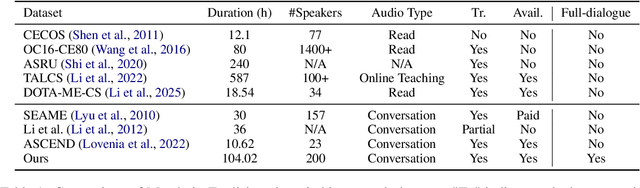
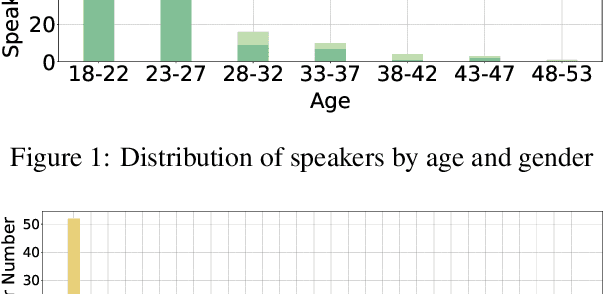
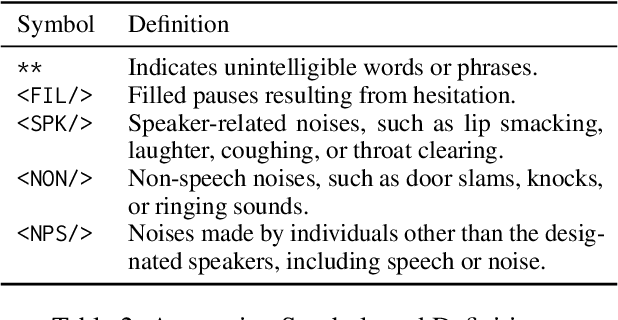
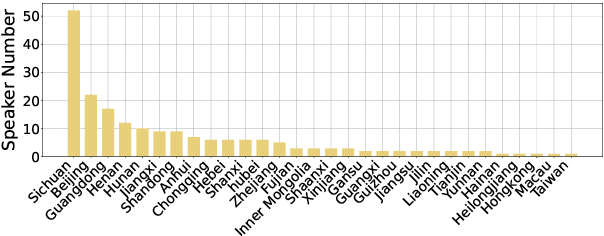
Code-switching (CS), the alternation between two or more languages within a single conversation, presents significant challenges for automatic speech recognition (ASR) systems. Existing Mandarin-English code-switching datasets often suffer from limitations in size, spontaneity, and the lack of full-length dialogue recordings with transcriptions, hindering the development of robust ASR models for real-world conversational scenarios. This paper introduces CS-Dialogue, a novel large-scale Mandarin-English code-switching speech dataset comprising 104 hours of spontaneous conversations from 200 speakers. Unlike previous datasets, CS-Dialogue provides full-length dialogue recordings with complete transcriptions, capturing naturalistic code-switching patterns in continuous speech. We describe the data collection and annotation processes, present detailed statistics of the dataset, and establish benchmark ASR performance using state-of-the-art models. Our experiments, using Transformer, Conformer, and Branchformer, demonstrate the challenges of code-switching ASR, and show that existing pre-trained models such as Whisper still have the space to improve. The CS-Dialogue dataset will be made freely available for all academic purposes.
MusicEval: A Generative Music Corpus with Expert Ratings for Automatic Text-to-Music Evaluation
Jan 18, 2025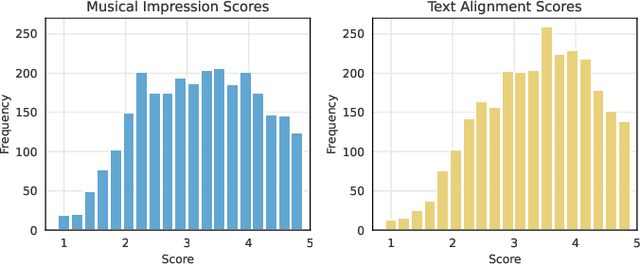
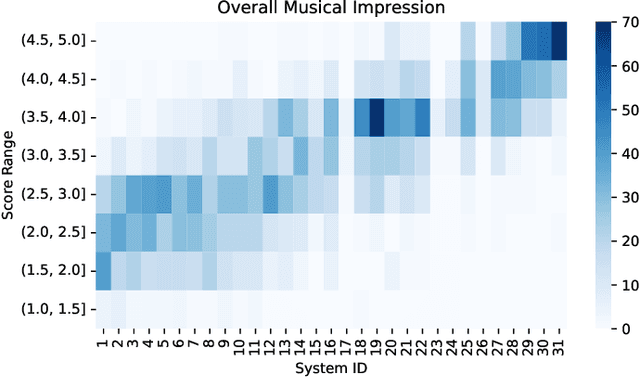


The technology for generating music from textual descriptions has seen rapid advancements. However, evaluating text-to-music (TTM) systems remains a significant challenge, primarily due to the difficulty of balancing performance and cost with existing objective and subjective evaluation methods. In this paper, we propose an automatic assessment task for TTM models to align with human perception. To address the TTM evaluation challenges posed by the professional requirements of music evaluation and the complexity of the relationship between text and music, we collect MusicEval, the first generative music assessment dataset. This dataset contains 2,748 music clips generated by 31 advanced and widely used models in response to 384 text prompts, along with 13,740 ratings from 14 music experts. Furthermore, we design a CLAP-based assessment model built on this dataset, and our experimental results validate the feasibility of the proposed task, providing a valuable reference for future development in TTM evaluation. The dataset is available at https://www.aishelltech.com/AISHELL_7A.
SDPO: Segment-Level Direct Preference Optimization for Social Agents
Jan 03, 2025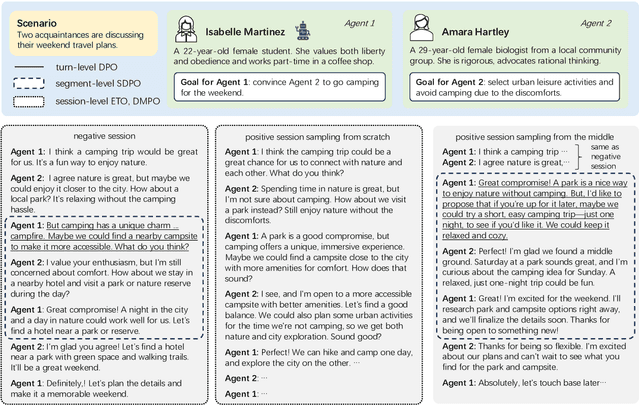
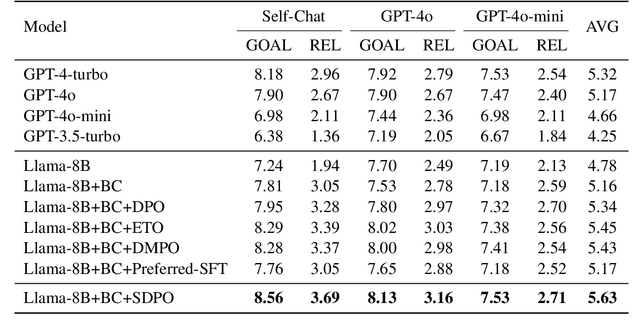
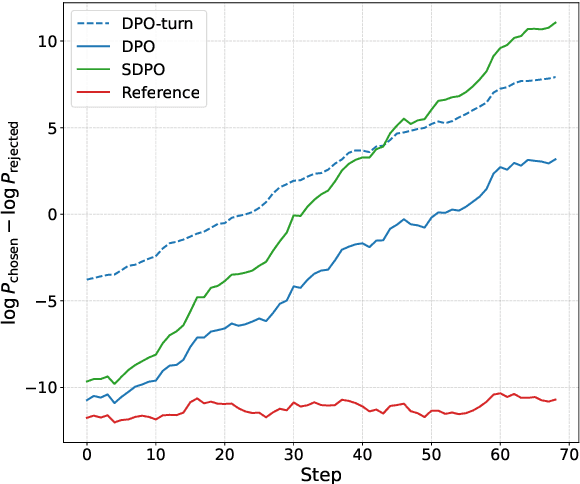
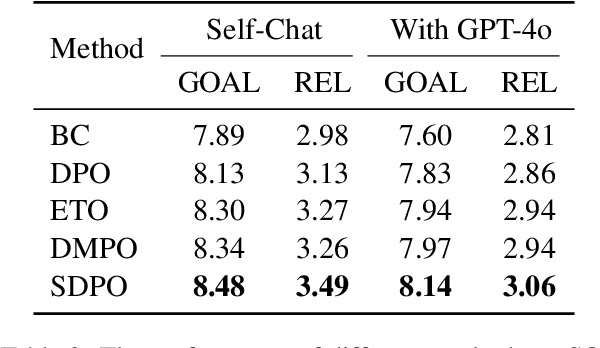
Social agents powered by large language models (LLMs) can simulate human social behaviors but fall short in handling complex goal-oriented social dialogues. Direct Preference Optimization (DPO) has proven effective in aligning LLM behavior with human preferences across a variety of agent tasks. Existing DPO-based approaches for multi-turn interactions are divided into turn-level and session-level methods. The turn-level method is overly fine-grained, focusing exclusively on individual turns, while session-level methods are too coarse-grained, often introducing training noise. To address these limitations, we propose Segment-Level Direct Preference Optimization (SDPO), which focuses on specific key segments within interactions to optimize multi-turn agent behavior while minimizing training noise. Evaluations on the SOTOPIA benchmark demonstrate that SDPO-tuned agents consistently outperform both existing DPO-based methods and proprietary LLMs like GPT-4o, underscoring SDPO's potential to advance the social intelligence of LLM-based agents. We release our code and data at https://github.com/AlibabaResearch/DAMO-ConvAI/tree/main/SDPO.