 Add to Chrome
 Add to Firefox
 Add to Edge
CARVE: Cross-Slice Anisotropic Reallocation of Visual Evidence for Efficient 3D Medical Volume Understanding
Aug 05, 2026
Slice-based MLLMs leverage mature 2D encoders by representing 3D volumes as sequences of 2D slices. However, this slice-wise formulation produces thousands of visual tokens that burden the LLM backbone, many of which capture overlapping visual evidence across adjacent slices. To understand how effectively a growing visual token budget improves performance, we perform scaling analyses on two 3D medical VQA benchmarks and find diminishing returns: cost keeps rising while accuracy saturates, and improving in-plane resolution is more effective than adding slices at comparable budgets. The budget should therefore be allocated more selectively rather than simply enlarged, yet most token compression methods are designed for 2D images or videos, where redundancy arises from spatial layout or temporal motion rather than from near-duplicate content along the depth axis. We present CARVE, a training-free framework that compresses visual tokens prior to LLM inference and casts token reduction as budget-constrained 2.5D allocation. CARVE partitions the depth axis into coherent windows and allocates tokens non-uniformly according to normalized cross-slice evidence. Under a shared budget, CARVE builds spatial anchors on representative slices and retrieves locally varying evidence from the full volume, then merges remaining eligible tokens into nearby anchors within each window. Removing roughly 80% of the visual tokens on Hulu-Med-7B, CARVE leads all compression baselines on every AMOS-MM report-generation metric, with 6.2 points higher retention of full-token quality than the strongest baseline, and preserves 98.1% of full-token performance across three VQA benchmarks.

EndoVLM: An Endoscopy Vision-Language Pre-training Model via Anatomy-Guided Sparsity and Progressive Alignment
Aug 05, 2026The development of foundation models (FMs) is crucial for advancing endoscopic image analysis. However, existing endoscopy FMs mainly rely on self-supervised learning from uni-modal images or videos, overlooking the rich semantic knowledge contained in clinical reports. Furthermore, effectively leveraging these records is hindered by a fundamental modality gap: structured anatomical descriptions are not naturally mapped to specific frames within the high-redundancy, uncurated visual streams. In this paper, we present EndoVLM, a novel vision-language FM pre-trained on over 348K endoscopic examinations, each pairing a clinical report with its corresponding image collection. An Anatomy-Guided Sparse Pooling mechanism utilizes textual descriptions as queries to drive sparse attention, efficiently aggregating semantically salient frames into anatomy-specific visual representations across redundant image-sets. Next, a Progressive Semantic-Aware Alignment strategy models clinical taxonomy (anatomy and pathological status) via structured soft targets, bridging the gap from global patient-level matching to fine-grained localized alignment. Finally, a Semantic-Concentrated Masked Autoencoder is applied exclusively to these semantic-rich frames, integrating low-level visual precision with robust high-level semantic representation. Extensive experiments across various downstream tasks demonstrate that EndoVLM outperforms existing foundation models and remains competitive with task-specific methods. Remarkably, EndoVLM also exhibits robust zero-shot generalization capabilities, highlighting its potential for broader clinical application.
E-MRL: Cross-view Aligned Evidence-driven Multimodal Reinforcement Learning for Reliable 3D Tumor Analysis
Jun 22, 2026While Vision-Language Models (VLMs) show great promise in volumetric medical report generation, they frequently suffer from visual hallucinations and a lack of grounding in 3D CT data. Current Supervised Fine-Tuning (SFT) and Reinforcement Learning (RL) strategies typically optimize text fidelity alone, essentially rewarding correct diagnoses derived from language priors rather than genuine visual perception. To address this, we propose cross-view aligned Evidence-driven Multimodal Reinforcement Learning (Evidence-MRL, noted as E-MRL), a reliable RL reasoning framework that formulates the generation process as a Markov Decision Process of "diagnosis-localization-verification". Unlike standard approaches, our model is explicitly trained to identify a "key evidence slice" alongside the global diagnostic report, grounding its findings in verifiable visual evidence. Crucially, we introduce a novel cross-view consistency reward, which validates the semantic alignment between the golden-standard report and a local visual re-query of the selected key slice, providing additional rewards for correctly-localized reasoning. Experiments on large-scale 3D CT tumor datasets demonstrate that E-MRL significantly reduces hallucinations and improves diagnostic accuracy compared to SFT and RL baselines, offering a clinically interpretable solution for visually-grounded and tumor analysis.
Brain-Adapter: A Dual-Stream Vision-Language MIL Framework for Comprehensive 3D CT Diagnosis of Acute Intracranial Pathologies
Jun 22, 2026Automated diagnosis of 3D brain CT scans is essential for critical care, yet it remains challenging due to the heavy reliance on manual annotations and the limited semantic understanding of conventional models. While 2D foundation vision-language models (VLMs) have shown remarkable generalization, effectively transferring their representational power to 3D volumes remains an open problem. In this paper, we propose Brain-Adapter, a novel dual-stream multiple instance learning (MIL) framework that leverages pre-trained 2D biomedical VLMs and raw diagnostic reports for robust scan-level multi-label classification. Specifically, we introduce a Text-Conditioned Attention (TCA) mechanism, utilizing raw diagnostic sentences as semantic queries to dynamically align visual cues with specific disease concepts. Concurrently, a parallel visual MIL stream captures global scan characteristics, supervised by structured labels extracted via a Large Language Model (LLM). To ensure representation coherence, a consistency constraint enforces synergy between the two streams. During inference, an Uncertainty-Aware Refinement (UAR) module dynamically calibrates and fuses these dual-stream predictions to resolve ambiguous cases. Extensive experiments demonstrate that our method significantly outperforms state-of-the-art 3D models and standard MIL approaches. By eliminating the reliance on dense annotations, Brain-Adapter provides a highly scalable and clinically viable solution for 3D acute intracranial pathology analysis.
PPGL-Swarm: Integrated Multimodal Risk Stratification and Hereditary Syndrome Detection in Pheochromocytoma and Paraganglioma
Mar 23, 2026Pheochromocytomas and paragangliomas (PPGLs) are rare neuroendocrine tumors, of which 15-25% develop metastatic disease with 5-year survival rates reported as low as 34%. PPGL may indicate hereditary syndromes requiring stricter, syndrome-specific treatment and surveillance, but clinicians often fail to recognize these associations in routine care. Clinical practice uses GAPP score for PPGL grading, but several limitations remain for PPGL diagnosis: (1) GAPP scoring demands a high workload for clinician because it requires the manual evaluation of six independent components; (2) key components such as cellularity and Ki-67 are often evaluated with subjective criteria; (3) several clinically relevant metastatic risk factors are not captured by GAPP, such as SDHB mutations, which have been associated with reported metastatic rates of 35-75%. Agent-driven diagnostic systems appear promising, but most lack traceable reasoning for decision-making and do not incorporate domain-specific knowledge such as PPGL genotype information. To address these limitations, we present PPGL-Swarm, an agentic PPGL diagnostic system that generates a comprehensive report, including automated GAPP scoring (with quantified cellularity and Ki-67), genotype risk alerts, and multimodal report with integrated evidence. The system provides an auditable reasoning trail by decomposing diagnosis into micro-tasks, each assigned to a specialized agent. The gene and table agents use knowledge enhancement to better interpret genotype and laboratory findings, and during training we use reinforcement learning to refine tool selection and task assignment.
SALI: Short-term Alignment and Long-term Interaction Network for Colonoscopy Video Polyp Segmentation
Jun 19, 2024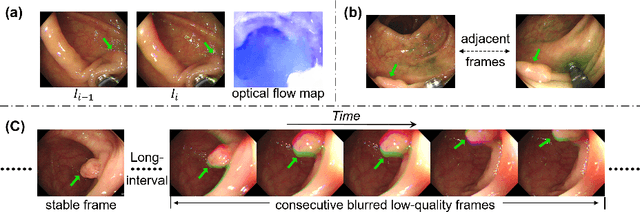


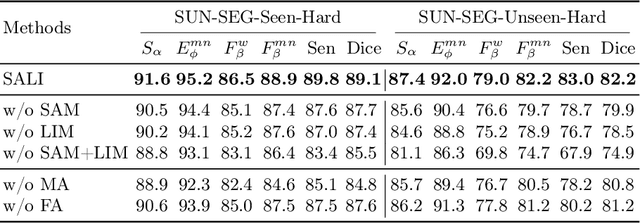
Colonoscopy videos provide richer information in polyp segmentation for rectal cancer diagnosis. However, the endoscope's fast moving and close-up observing make the current methods suffer from large spatial incoherence and continuous low-quality frames, and thus yield limited segmentation accuracy. In this context, we focus on robust video polyp segmentation by enhancing the adjacent feature consistency and rebuilding the reliable polyp representation. To achieve this goal, we in this paper propose SALI network, a hybrid of Short-term Alignment Module (SAM) and Long-term Interaction Module (LIM). The SAM learns spatial-aligned features of adjacent frames via deformable convolution and further harmonizes them to capture more stable short-term polyp representation. In case of low-quality frames, the LIM stores the historical polyp representations as a long-term memory bank, and explores the retrospective relations to interactively rebuild more reliable polyp features for the current segmentation. Combing SAM and LIM, the SALI network of video segmentation shows a great robustness to the spatial variations and low-visual cues. Benchmark on the large-scale SUNSEG verifies the superiority of SALI over the current state-of-the-arts by improving Dice by 2.1%, 2.5%, 4.1% and 1.9%, for the four test sub-sets, respectively. Codes are at https://github.com/Scatteredrain/SALI.
MonoBox: Tightness-free Box-supervised Polyp Segmentation using Monotonicity Constraint
Apr 02, 2024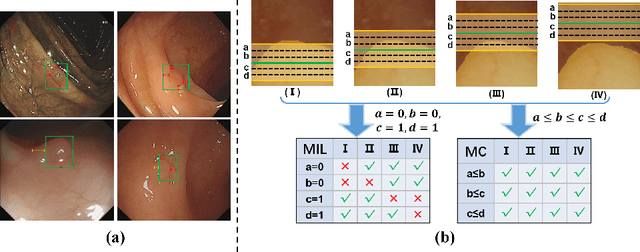
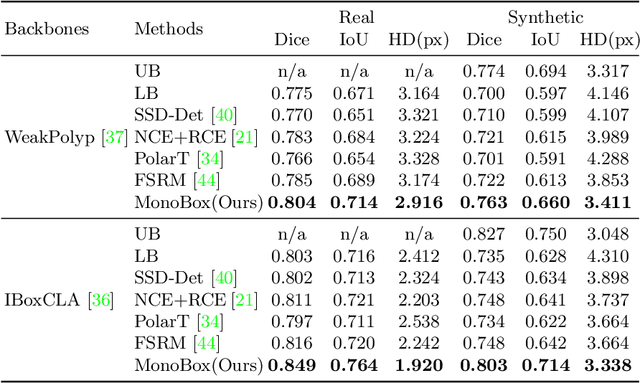
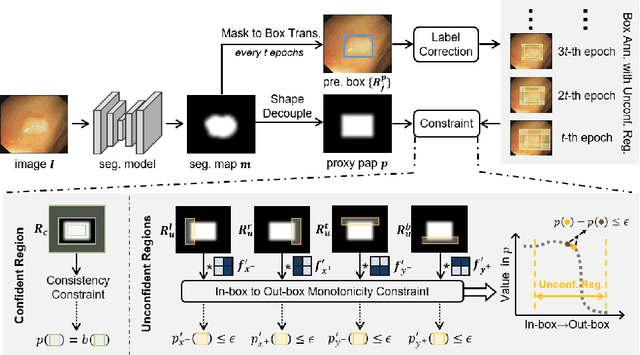
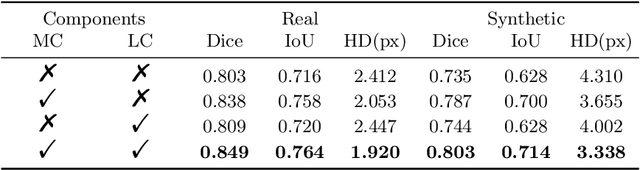
We propose MonoBox, an innovative box-supervised segmentation method constrained by monotonicity to liberate its training from the user-unfriendly box-tightness assumption. In contrast to conventional box-supervised segmentation, where the box edges must precisely touch the target boundaries, MonoBox leverages imprecisely-annotated boxes to achieve robust pixel-wise segmentation. The 'linchpin' is that, within the noisy zones around box edges, MonoBox discards the traditional misguiding multiple-instance learning loss, and instead optimizes a carefully-designed objective, termed monotonicity constraint. Along directions transitioning from the foreground to background, this new constraint steers responses to adhere to a trend of monotonically decreasing values. Consequently, the originally unreliable learning within the noisy zones is transformed into a correct and effective monotonicity optimization. Moreover, an adaptive label correction is introduced, enabling MonoBox to enhance the tightness of box annotations using predicted masks from the previous epoch and dynamically shrink the noisy zones as training progresses. We verify MonoBox in the box-supervised segmentation task of polyps, where satisfying box-tightness is challenging due to the vague boundaries between the polyp and normal tissues. Experiments on both public synthetic and in-house real noisy datasets demonstrate that MonoBox exceeds other anti-noise state-of-the-arts by improving Dice by at least 5.5% and 3.3%, respectively. Codes are at https://github.com/Huster-Hq/MonoBox.