 Add to Chrome
 Add to Firefox
 Add to Edge
RiskProp: Collision-Anchored Self-Supervised Risk Propagation for Early Accident Anticipation
Mar 28, 2026
Accident anticipation aims to predict impending collisions from dashcam videos and trigger early alerts. Existing methods rely on binary supervision with manually annotated "anomaly onset" frames, which are subjective and inconsistent, leading to inaccurate risk estimation. In contrast, we propose RiskProp, a novel collision-anchored self-supervised risk propagation paradigm for early accident anticipation, which removes the need for anomaly onset annotations and leverages only the reliably annotated collision frame. RiskProp models temporal risk evolution through two observation-driven losses: first, since future frames contain more definitive evidence of an impending accident, we introduce a future-frame regularization loss that uses the model's next-frame prediction as a soft target to supervise the current frame, enabling backward propagation of risk signals; second, inspired by the empirical trend of rising risk before accidents, we design an adaptive monotonic constraint to encourage a non-decreasing progression over time. Experiments on CAP and Nexar demonstrate that RiskProp achieves state-of-the-art performance and produces smoother, more discriminative risk curves, improving both early anticipation and interpretability.

Combining Experimental and Historical Data for Policy Evaluation
Jun 01, 2024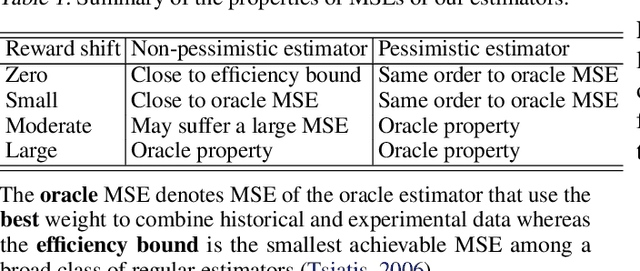
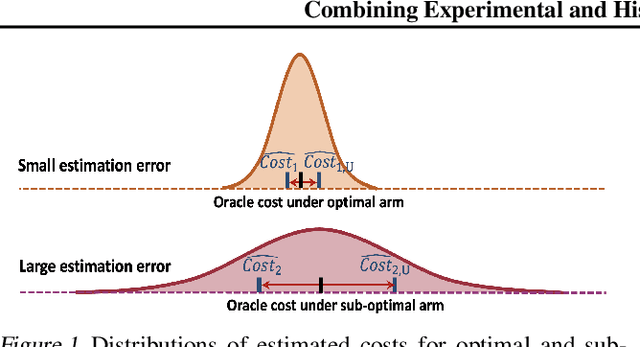
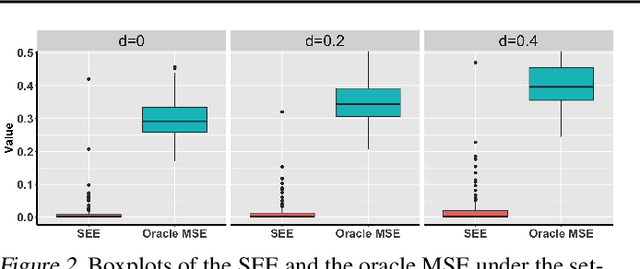
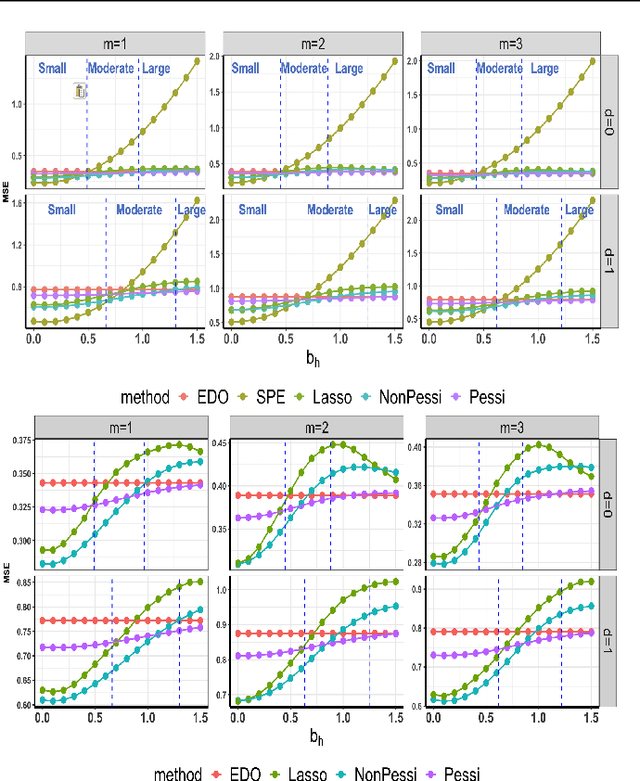
This paper studies policy evaluation with multiple data sources, especially in scenarios that involve one experimental dataset with two arms, complemented by a historical dataset generated under a single control arm. We propose novel data integration methods that linearly integrate base policy value estimators constructed based on the experimental and historical data, with weights optimized to minimize the mean square error (MSE) of the resulting combined estimator. We further apply the pessimistic principle to obtain more robust estimators, and extend these developments to sequential decision making. Theoretically, we establish non-asymptotic error bounds for the MSEs of our proposed estimators, and derive their oracle, efficiency and robustness properties across a broad spectrum of reward shift scenarios. Numerical experiments and real-data-based analyses from a ridesharing company demonstrate the superior performance of the proposed estimators.