 Add to Chrome
 Add to Firefox
 Add to Edge
Hierarchical SVG Tokenization: Learning Compact Visual Programs for Scalable Vector Graphics Modeling
Apr 06, 2026
Recent large language models have shifted SVG generation from differentiable rendering optimization to autoregressive program synthesis. However, existing approaches still rely on generic byte-level tokenization inherited from natural language processing, which poorly reflects the geometric structure of vector graphics. Numerical coordinates are fragmented into discrete symbols, destroying spatial relationships and introducing severe token redundancy, often leading to coordinate hallucination and inefficient long-sequence generation. To address these challenges, we propose HiVG, a hierarchical SVG tokenization framework tailored for autoregressive vector graphics generation. HiVG decomposes raw SVG strings into structured \textit{atomic tokens} and further compresses executable command--parameter groups into geometry-constrained \textit{segment tokens}, substantially improving sequence efficiency while preserving syntactic validity. To further mitigate spatial mismatch, we introduce a Hierarchical Mean--Noise (HMN) initialization strategy that injects numerical ordering signals and semantic priors into new token embeddings. Combined with a curriculum training paradigm that progressively increases program complexity, HiVG enables more stable learning of executable SVG programs. Extensive experiments on both text-to-SVG and image-to-SVG tasks demonstrate improved generation fidelity, spatial consistency, and sequence efficiency compared with conventional tokenization schemes.

Multiple Convolutional Features in Siamese Networks for Object Tracking
Mar 01, 2021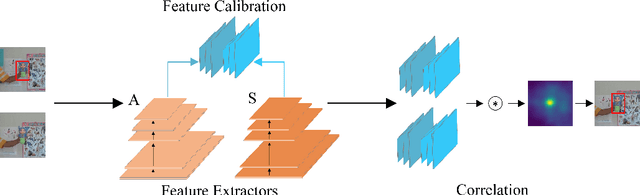
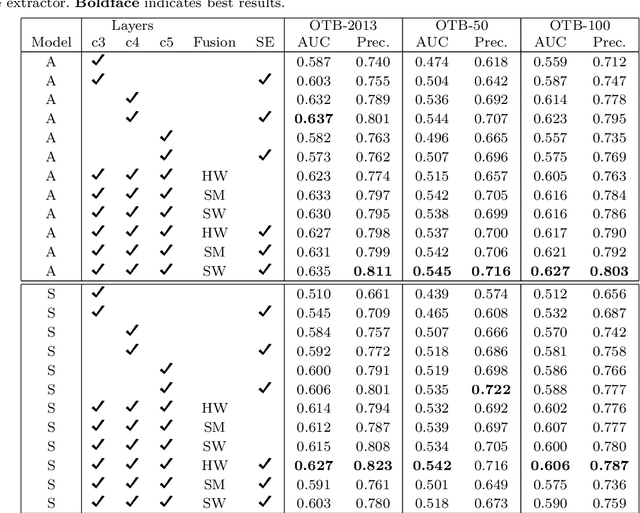
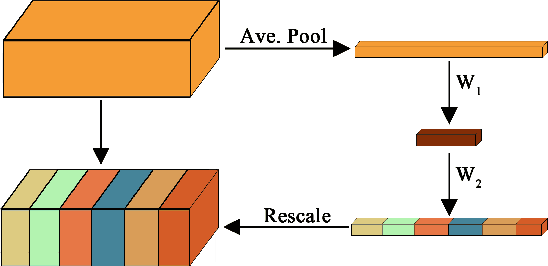
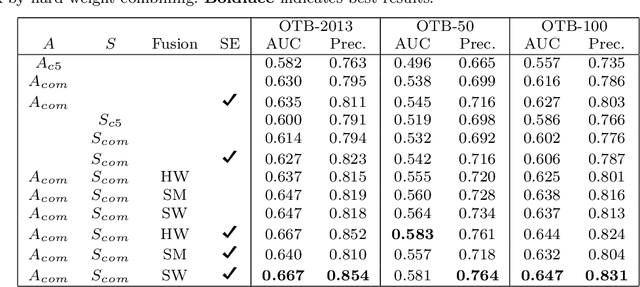
Siamese trackers demonstrated high performance in object tracking due to their balance between accuracy and speed. Unlike classification-based CNNs, deep similarity networks are specifically designed to address the image similarity problem, and thus are inherently more appropriate for the tracking task. However, Siamese trackers mainly use the last convolutional layers for similarity analysis and target search, which restricts their performance. In this paper, we argue that using a single convolutional layer as feature representation is not an optimal choice in a deep similarity framework. We present a Multiple Features-Siamese Tracker (MFST), a novel tracking algorithm exploiting several hierarchical feature maps for robust tracking. Since convolutional layers provide several abstraction levels in characterizing an object, fusing hierarchical features allows to obtain a richer and more efficient representation of the target. Moreover, we handle the target appearance variations by calibrating the deep features extracted from two different CNN models. Based on this advanced feature representation, our method achieves high tracking accuracy, while outperforming the standard siamese tracker on object tracking benchmarks. The source code and trained models are available at https://github.com/zhenxili96/MFST.
MFST: Multi-Features Siamese Tracker
Mar 01, 2021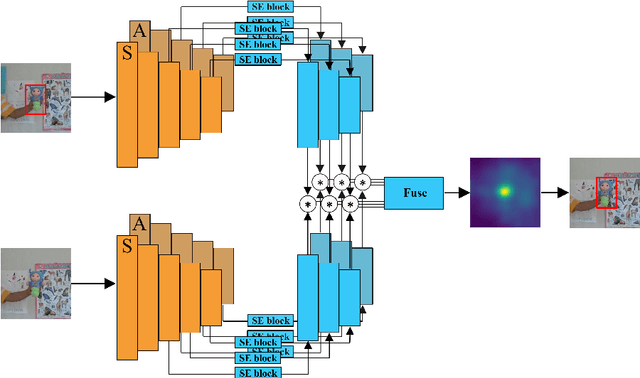
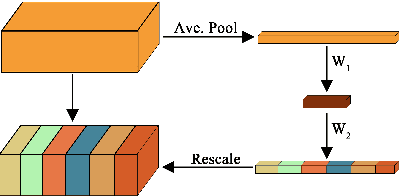
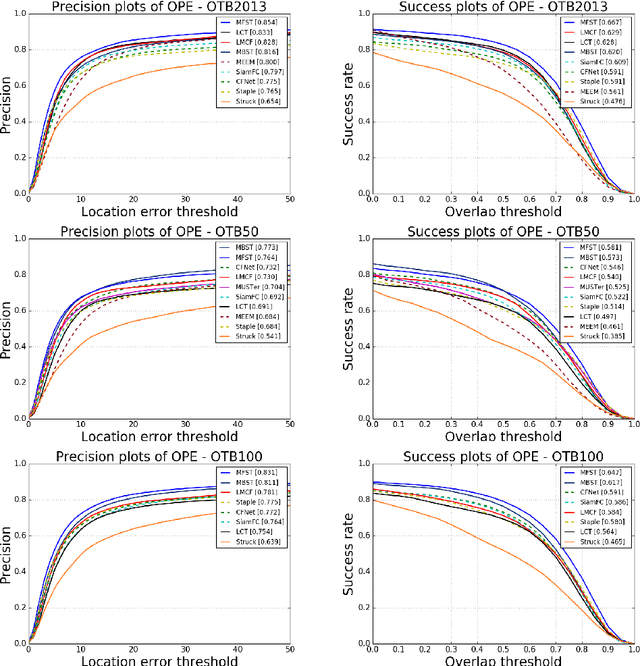
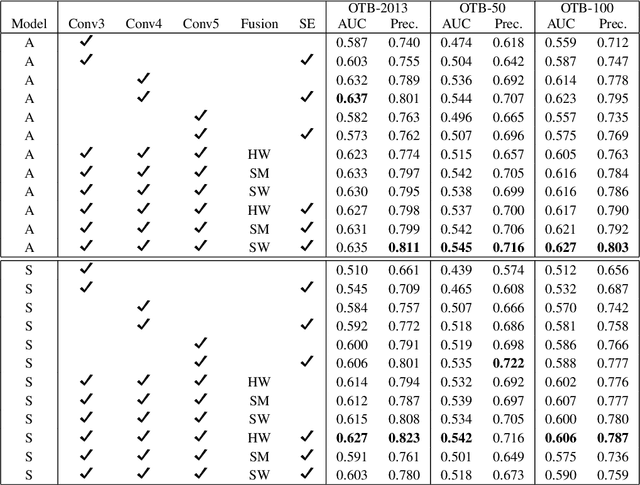
Siamese trackers have recently achieved interesting results due to their balance between accuracy and speed. This success is mainly due to the fact that deep similarity networks were specifically designed to address the image similarity problem. Therefore, they are inherently more appropriate than classical CNNs for the tracking task. However, Siamese trackers rely on the last convolutional layers for similarity analysis and target search, which restricts their performance. In this paper, we argue that using a single convolutional layer as feature representation is not the optimal choice within the deep similarity framework, as multiple convolutional layers provide several abstraction levels in characterizing an object. Starting from this motivation, we present the Multi-Features Siamese Tracker (MFST), a novel tracking algorithm exploiting several hierarchical feature maps for robust deep similarity tracking. MFST proceeds by fusing hierarchical features to ensure a richer and more efficient representation. Moreover, we handle appearance variation by calibrating deep features extracted from two different CNN models. Based on this advanced feature representation, our algorithm achieves high tracking accuracy, while outperforming several state-of-the-art trackers, including standard Siamese trackers. The code and trained models are available at https://github.com/zhenxili96/MFST.
Multi-Branch Siamese Networks with Online Selection for Object Tracking
Aug 31, 2018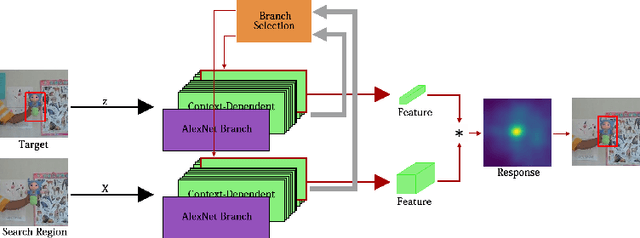
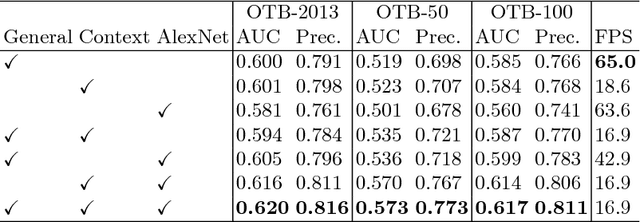
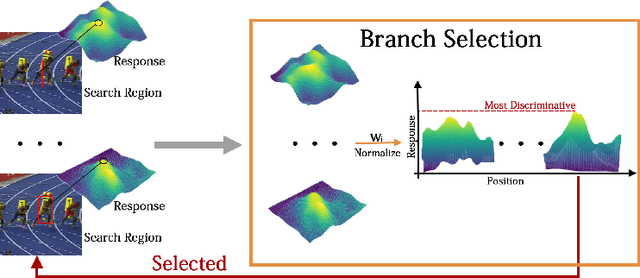
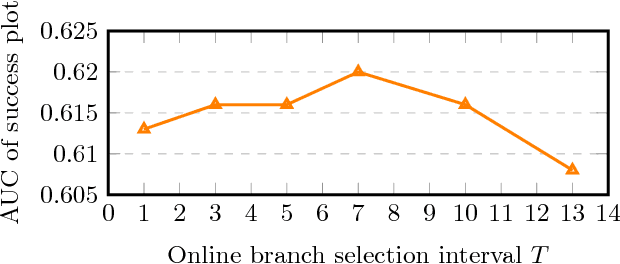
In this paper, we propose a robust object tracking algorithm based on a branch selection mechanism to choose the most efficient object representations from multi-branch siamese networks. While most deep learning trackers use a single CNN for target representation, the proposed Multi-Branch Siamese Tracker (MBST) employs multiple branches of CNNs pre-trained for different tasks, and used for various target representations in our tracking method. With our branch selection mechanism, the appropriate CNN branch is selected depending on the target characteristics in an online manner. By using the most adequate target representation with respect to the tracked object, our method achieves real-time tracking, while obtaining improved performance compared to standard Siamese network trackers on object tracking benchmarks.