 Add to Chrome
 Add to Firefox
 Add to Edge
LoRe: Adaptive Interaction-Evaluation Routing with Per-Step Interaction Budgets for Iterative Graph Solvers
May 27, 2026
Diffusion-based neural solvers for combinatorial optimization repeatedly re-evaluate dense edge/factor interactions, making inference expensive in wall-clock time and often memory-bound at scale. Inspired by the computational methodologies of many-body physics, we introduce LoRe, a training-free, inference-time drop-in wrapper that enforces per-step interaction-evaluation budgeting: at each iteration, it evaluates only a fixed fraction of interactions by dynamically routing computation to high-conflict or high-uncertainty interactions, instead of using a fixed sparsification (e.g., static kNN graphs or static masks). Under fully inclusive end-to-end wall-clock accounting, LoRe substantially improves scalability on the Maximum Independent Set (MIS) problem, extending feasible inference more than $3\times$ beyond the baseline's out-of-memory limit, delivering a $\sim 8\times$ speedup and a $\sim 12\times$ peak-memory reduction, with solution quality preserved in this regime. Demonstrating cross-task generality on the large-scale Traveling Salesperson Problem (TSP) and zero-shot robustness to topology shifts, LoRe achieves a $\sim 15\times$ speedup at $n=1000$ with a $44\times$ memory reduction and competitive tour quality.

FiLark: a streaming-first software framework for end-to-end exploration, annotation, and algorithm integration in distributed acoustic sensing
May 19, 2026Distributed acoustic sensing (DAS) systems generate continuous, ultra-high-channel-count data streams at rates that exceed the capabilities of conventional batch-oriented analysis frameworks. As a result, essential tasks such as interactive exploration of long-duration recordings, scalable event annotation, and real-time algorithm-in-the-loop monitoring remain inadequately supported by workflows built around manually selected data segments and offline processing. This paper presents FiLark (Fiber Lark), a Python framework that applies a \emph{streaming-first} principle uniformly across data access, signal processing, visualization and monitoring for DAS. Instead of operating on manually selected data segments, FiLark presents any DAS sources-including continuous multi-file recordings-as a unified stream and builds all system components around that abstraction. An OpenGL-based ring-buffer renderer enables interactive browsing and visualization of arbitrarily long recordings with constant memory usage. An integrated annotation interface supports event labeling directly within continuous data streams, facilitating the creation of reproducible machine-learning-ready labeled datasets without offline preprocessing. The signal processing library includes temporal, spatial, spectral, and decomposition-based operators, with both CPU implementations and GPU-accelerated variants via PyTorch, alongside stateful chunked execution that preserves processing continuity and application semantics across segment boundaries. A standardized monitor interface further integrates streaming detectors and learning-based models into the visualization workflow. By sharing a common streaming abstraction across all layers, FiLark allows processing configurations and workflows developed interactively to transfer directly to scalable production pipelines without modification.
DynamicRad: Content-Adaptive Sparse Attention for Long Video Diffusion
Apr 22, 2026Leveraging the natural spatiotemporal energy decay in video diffusion offers a path to efficiency, yet relying solely on rigid static masks risks losing critical long-range information in complex dynamics. To address this issue, we propose \textbf{DynamicRad}, a unified sparse-attention paradigm that grounds adaptive selection within a radial locality prior. DynamicRad introduces a \textbf{dual-mode} strategy: \textit{static-ratio} for speed-optimized execution and \textit{dynamic-threshold} for quality-first filtering. To ensure robustness without online search overhead, we integrate an offline Bayesian Optimization (BO) pipeline coupled with a \textbf{semantic motion router}. This lightweight projection module maps prompt embeddings to optimal sparsity regimes with \textbf{minimal runtime overhead}. Unlike online profiling methods, our offline BO optimizes attention reconstruction error (MSE) on a physics-based proxy task, ensuring rapid convergence. Experiments on HunyuanVideo and Wan2.1-14B demonstrate that DynamicRad pushes the efficiency--quality Pareto frontier, achieving \textbf{1.7$\times$--2.5$\times$ inference speedups} with \textbf{over 80\% effective sparsity}. In some long-sequence settings, the dynamic mode even matches or exceeds the dense baseline, while mask-aware LoRA further improves long-horizon coherence. Code is available at https://github.com/Adamlong3/DynamicRad.
TAG-MoE: Task-Aware Gating for Unified Generative Mixture-of-Experts
Jan 12, 2026Unified image generation and editing models suffer from severe task interference in dense diffusion transformers architectures, where a shared parameter space must compromise between conflicting objectives (e.g., local editing v.s. subject-driven generation). While the sparse Mixture-of-Experts (MoE) paradigm is a promising solution, its gating networks remain task-agnostic, operating based on local features, unaware of global task intent. This task-agnostic nature prevents meaningful specialization and fails to resolve the underlying task interference. In this paper, we propose a novel framework to inject semantic intent into MoE routing. We introduce a Hierarchical Task Semantic Annotation scheme to create structured task descriptors (e.g., scope, type, preservation). We then design Predictive Alignment Regularization to align internal routing decisions with the task's high-level semantics. This regularization evolves the gating network from a task-agnostic executor to a dispatch center. Our model effectively mitigates task interference, outperforming dense baselines in fidelity and quality, and our analysis shows that experts naturally develop clear and semantically correlated specializations.
Hybrid Quantum-Classical Neural Networks for Few-Shot Credit Risk Assessment
Sep 17, 2025Quantum Machine Learning (QML) offers a new paradigm for addressing complex financial problems intractable for classical methods. This work specifically tackles the challenge of few-shot credit risk assessment, a critical issue in inclusive finance where data scarcity and imbalance limit the effectiveness of conventional models. To address this, we design and implement a novel hybrid quantum-classical workflow. The methodology first employs an ensemble of classical machine learning models (Logistic Regression, Random Forest, XGBoost) for intelligent feature engineering and dimensionality reduction. Subsequently, a Quantum Neural Network (QNN), trained via the parameter-shift rule, serves as the core classifier. This framework was evaluated through numerical simulations and deployed on the Quafu Quantum Cloud Platform's ScQ-P21 superconducting processor. On a real-world credit dataset of 279 samples, our QNN achieved a robust average AUC of 0.852 +/- 0.027 in simulations and yielded an impressive AUC of 0.88 in the hardware experiment. This performance surpasses a suite of classical benchmarks, with a particularly strong result on the recall metric. This study provides a pragmatic blueprint for applying quantum computing to data-constrained financial scenarios in the NISQ era and offers valuable empirical evidence supporting its potential in high-stakes applications like inclusive finance.
Enhancing the Comprehensibility of Text Explanations via Unsupervised Concept Discovery
May 26, 2025Concept-based explainable approaches have emerged as a promising method in explainable AI because they can interpret models in a way that aligns with human reasoning. However, their adaption in the text domain remains limited. Most existing methods rely on predefined concept annotations and cannot discover unseen concepts, while other methods that extract concepts without supervision often produce explanations that are not intuitively comprehensible to humans, potentially diminishing user trust. These methods fall short of discovering comprehensible concepts automatically. To address this issue, we propose \textbf{ECO-Concept}, an intrinsically interpretable framework to discover comprehensible concepts with no concept annotations. ECO-Concept first utilizes an object-centric architecture to extract semantic concepts automatically. Then the comprehensibility of the extracted concepts is evaluated by large language models. Finally, the evaluation result guides the subsequent model fine-tuning to obtain more understandable explanations. Experiments show that our method achieves superior performance across diverse tasks. Further concept evaluations validate that the concepts learned by ECO-Concept surpassed current counterparts in comprehensibility.
In-Context Brush: Zero-shot Customized Subject Insertion with Context-Aware Latent Space Manipulation
May 26, 2025Recent advances in diffusion models have enhanced multimodal-guided visual generation, enabling customized subject insertion that seamlessly "brushes" user-specified objects into a given image guided by textual prompts. However, existing methods often struggle to insert customized subjects with high fidelity and align results with the user's intent through textual prompts. In this work, we propose "In-Context Brush", a zero-shot framework for customized subject insertion by reformulating the task within the paradigm of in-context learning. Without loss of generality, we formulate the object image and the textual prompts as cross-modal demonstrations, and the target image with the masked region as the query. The goal is to inpaint the target image with the subject aligning textual prompts without model tuning. Building upon a pretrained MMDiT-based inpainting network, we perform test-time enhancement via dual-level latent space manipulation: intra-head "latent feature shifting" within each attention head that dynamically shifts attention outputs to reflect the desired subject semantics and inter-head "attention reweighting" across different heads that amplifies prompt controllability through differential attention prioritization. Extensive experiments and applications demonstrate that our approach achieves superior identity preservation, text alignment, and image quality compared to existing state-of-the-art methods, without requiring dedicated training or additional data collection.
On the workflow, opportunities and challenges of developing foundation model in geophysics
Apr 24, 2025Foundation models, as a mainstream technology in artificial intelligence, have demonstrated immense potential across various domains in recent years, particularly in handling complex tasks and multimodal data. In the field of geophysics, although the application of foundation models is gradually expanding, there is currently a lack of comprehensive reviews discussing the full workflow of integrating foundation models with geophysical data. To address this gap, this paper presents a complete framework that systematically explores the entire process of developing foundation models in conjunction with geophysical data. From data collection and preprocessing to model architecture selection, pre-training strategies, and model deployment, we provide a detailed analysis of the key techniques and methodologies at each stage. In particular, considering the diversity, complexity, and physical consistency constraints of geophysical data, we discuss targeted solutions to address these challenges. Furthermore, we discuss how to leverage the transfer learning capabilities of foundation models to reduce reliance on labeled data, enhance computational efficiency, and incorporate physical constraints into model training, thereby improving physical consistency and interpretability. Through a comprehensive summary and analysis of the current technological landscape, this paper not only fills the gap in the geophysics domain regarding a full-process review of foundation models but also offers valuable practical guidance for their application in geophysical data analysis, driving innovation and advancement in the field.
CMEdataset Advancing China Map Detection and Standardization with Digital Image Resources
Apr 10, 2025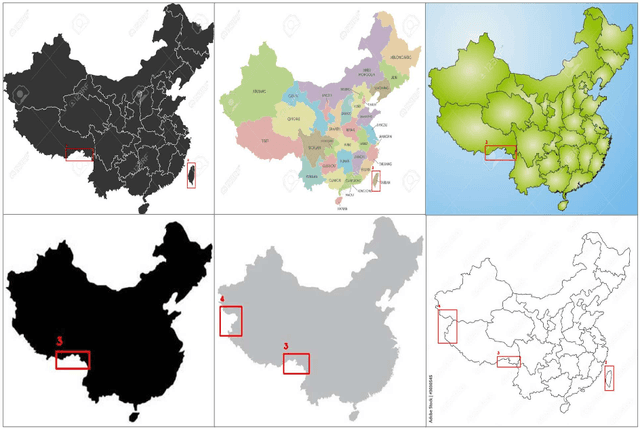
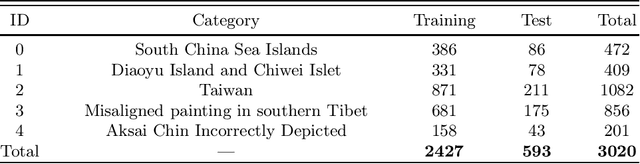
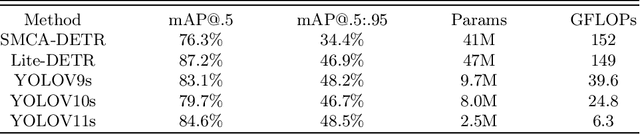
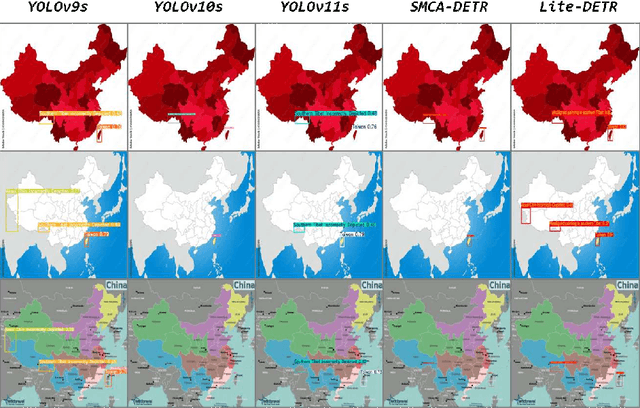
Digital images of Chinas maps play a crucial role in map detection, particularly in ensuring national sovereignty, territorial integrity, and map compliance. However, there is currently no publicly available dataset specifically dedicated to problematic maps the CME dataset. Existing datasets primarily focus on general map data and are insufficient for effectively identifying complex issues such as national boundary misrepresentations, missing elements, and blurred boundaries. Therefore, this study creates a Problematic Map dataset that covers five key problem areas, aiming to provide diverse samples for problematic map detection technologies, support high-precision map compliance detection, and enhance map data quality and timeliness. This dataset not only provides essential resources for map compliance, national security monitoring, and map updates, but also fosters innovation and application of related technologies.
AnchorCrafter: Animate CyberAnchors Saling Your Products via Human-Object Interacting Video Generation
Nov 26, 2024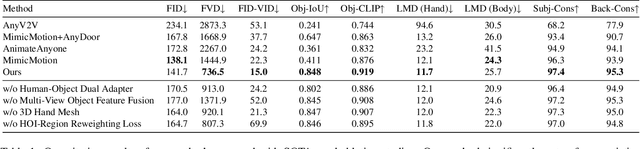
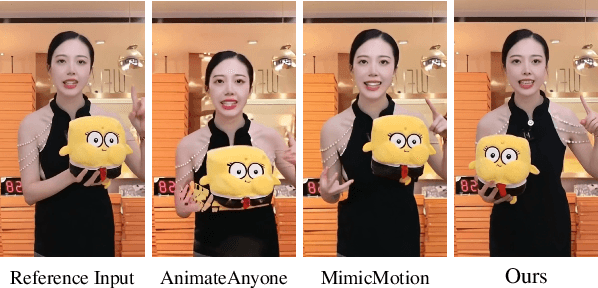
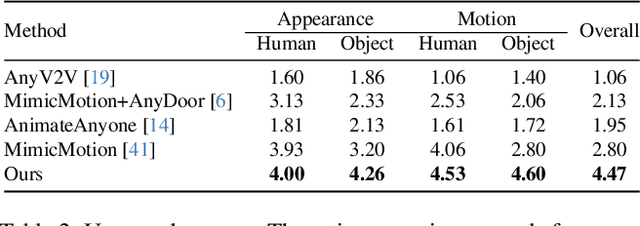
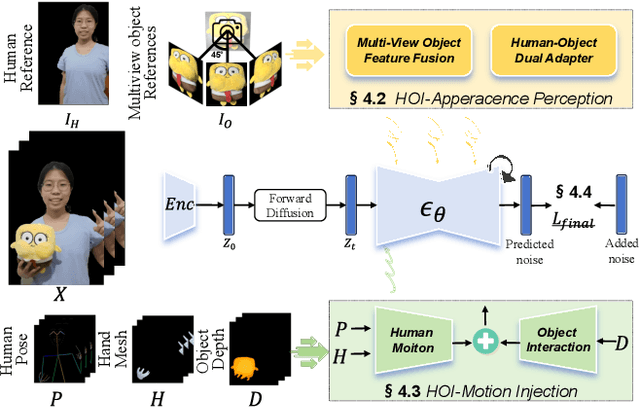
The automatic generation of anchor-style product promotion videos presents promising opportunities in online commerce, advertising, and consumer engagement. However, this remains a challenging task despite significant advancements in pose-guided human video generation. In addressing this challenge, we identify the integration of human-object interactions (HOI) into pose-guided human video generation as a core issue. To this end, we introduce AnchorCrafter, a novel diffusion-based system designed to generate 2D videos featuring a target human and a customized object, achieving high visual fidelity and controllable interactions. Specifically, we propose two key innovations: the HOI-appearance perception, which enhances object appearance recognition from arbitrary multi-view perspectives and disentangles object and human appearance, and the HOI-motion injection, which enables complex human-object interactions by overcoming challenges in object trajectory conditioning and inter-occlusion management. Additionally, we introduce the HOI-region reweighting loss, a training objective that enhances the learning of object details. Extensive experiments demonstrate that our proposed system outperforms existing methods in preserving object appearance and shape awareness, while simultaneously maintaining consistency in human appearance and motion. Project page: https://cangcz.github.io/Anchor-Crafter/