 Add to Chrome
 Add to Firefox
 Add to Edge
Lighting-grounded Video Generation with Renderer-based Agent Reasoning
Apr 09, 2026
Diffusion models have achieved remarkable progress in video generation, but their controllability remains a major limitation. Key scene factors such as layout, lighting, and camera trajectory are often entangled or only weakly modeled, restricting their applicability in domains like filmmaking and virtual production where explicit scene control is essential. We present LiVER, a diffusion-based framework for scene-controllable video generation. To achieve this, we introduce a novel framework that conditions video synthesis on explicit 3D scene properties, supported by a new large-scale dataset with dense annotations of object layout, lighting, and camera parameters. Our method disentangles these properties by rendering control signals from a unified 3D representation. We propose a lightweight conditioning module and a progressive training strategy to integrate these signals into a foundational video diffusion model, ensuring stable convergence and high fidelity. Our framework enables a wide range of applications, including image-to-video and video-to-video synthesis where the underlying 3D scene is fully editable. To further enhance usability, we develop a scene agent that automatically translates high-level user instructions into the required 3D control signals. Experiments show that LiVER achieves state-of-the-art photorealism and temporal consistency while enabling precise, disentangled control over scene factors, setting a new standard for controllable video generation.

Semantic Communication-Enhanced Split Federated Learning for Vehicular Networks: Architecture, Challenges, and Case Study
Mar 05, 2026Vehicular edge intelligence (VEI) is vital for future intelligent transportation systems. However, traditional centralized learning in dynamic vehicular networks faces significant communication overhead and privacy risks. Split federated learning (SFL) offers a distributed solution but is often hindered by substantial communication bottlenecks from transmitting high-dimensional intermediate features and can present label privacy concerns. Semantic communication offers a transformative approach to alleviate these communication challenges in SFL by focusing on transmitting only task-relevant information. This paper leverages the advantages of semantic communication in the design of SFL, and presents a case study the semantic communication-enhanced U-Shaped split federated learning (SC-USFL) framework that inherently enhances label privacy by localizing sensitive computations with reduced overhead. It features a dedicated semantic communication module (SCM), with pre-trained and parameter-frozen encoding/decoding units, to efficiently compress and transmit only the task-relevant semantic information over the critical uplink path from vehicular users to the edge server (ES). Furthermore, a network status monitor (NSM) module enables adaptive adjustment of the semantic compression rate in real-time response to fluctuating wireless channel conditions. The SC-USFL framework demonstrates a promising approach for efficiently balancing communication load, preserving privacy, and maintaining learning performance in resource-constrained vehicular environments. Finally, this paper highlights key open research directions to further advance the synergy between semantic communication and SFL in the vehicular network.
Generative Visual Chain-of-Thought for Image Editing
Mar 02, 2026Existing image editing methods struggle to perceive where to edit, especially under complex scenes and nuanced spatial instructions. To address this issue, we propose Generative Visual Chain-of-Thought (GVCoT), a unified framework that performs native visual reasoning by first generating spatial cues to localize the target region and then executing the edit. Unlike prior text-only CoT or tool-dependent visual CoT paradigms, GVCoT jointly optimizes visual tokens generated during the reasoning and editing phases in an end-to-end manner. This way fosters the emergence of innate spatial reasoning ability and enables more effective utilization of visual-domain cues. The main challenge of training GCVoT lies in the scarcity of large-scale editing data with precise edit region annotations; to this end, we construct GVCoT-Edit-Instruct, a dataset of 1.8M high-quality samples spanning 19 tasks. We adopt a progressive training strategy: supervised fine-tuning to build foundational localization ability in reasoning trace before final editing, followed by reinforcement learning to further improve reasoning and editing quality. Finally, we introduce SREdit-Bench, a new benchmark designed to comprehensively stress-test models under sophisticated scenes and fine-grained referring expressions. Experiments demonstrate that GVCoT consistently outperforms state-of-the-art models on SREdit-Bench and ImgEdit. We hope our GVCoT will inspire future research toward interpretable and precise image editing.
Audio-Sync Video Generation with Multi-Stream Temporal Control
Jun 09, 2025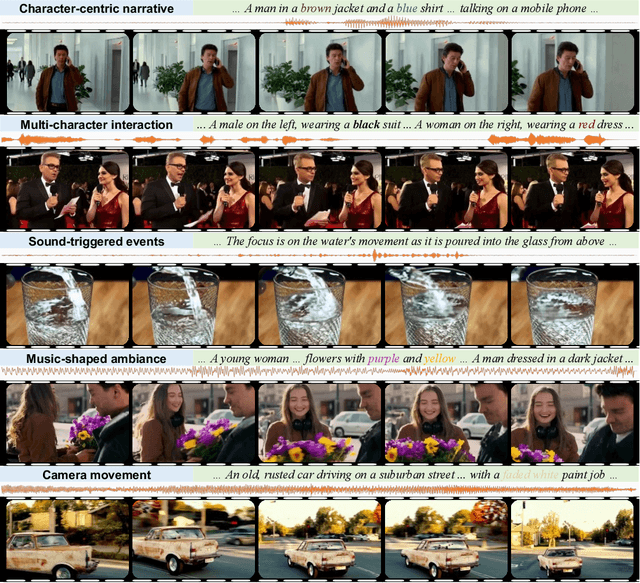
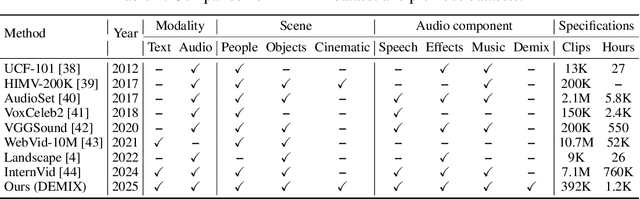
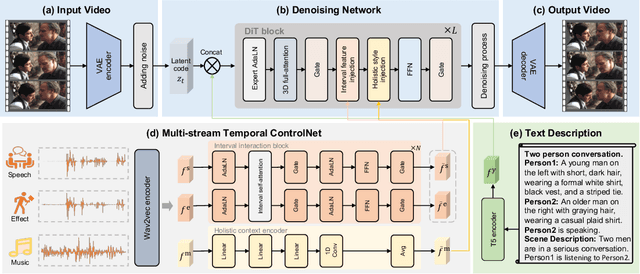
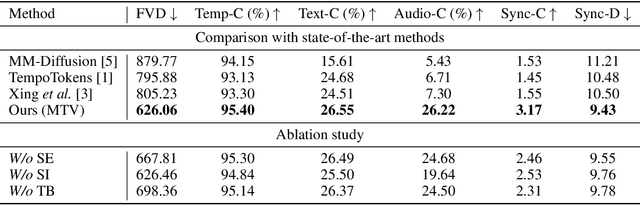
Audio is inherently temporal and closely synchronized with the visual world, making it a naturally aligned and expressive control signal for controllable video generation (e.g., movies). Beyond control, directly translating audio into video is essential for understanding and visualizing rich audio narratives (e.g., Podcasts or historical recordings). However, existing approaches fall short in generating high-quality videos with precise audio-visual synchronization, especially across diverse and complex audio types. In this work, we introduce MTV, a versatile framework for audio-sync video generation. MTV explicitly separates audios into speech, effects, and music tracks, enabling disentangled control over lip motion, event timing, and visual mood, respectively -- resulting in fine-grained and semantically aligned video generation. To support the framework, we additionally present DEMIX, a dataset comprising high-quality cinematic videos and demixed audio tracks. DEMIX is structured into five overlapped subsets, enabling scalable multi-stage training for diverse generation scenarios. Extensive experiments demonstrate that MTV achieves state-of-the-art performance across six standard metrics spanning video quality, text-video consistency, and audio-video alignment. Project page: https://hjzheng.net/projects/MTV/.
Deploying Large AI Models on Resource-Limited Devices with Split Federated Learning
Apr 12, 2025Large Artificial Intelligence Models (LAMs) powered by massive datasets, extensive parameter scales, and extensive computational resources, leading to significant transformations across various industries. Yet, their practical deployment on resource-limited mobile edge devices is hindered by critical challenges such as data privacy, constrained resources, and high overhead costs. Addressing this gap, this paper proposes a novel framework, named Quantized Split Federated Fine-Tuning Large AI Model (SFLAM). By partitioning the training load between edge devices and servers using a split learning paradigm, SFLAM can facilitate the operation of large models on devices and significantly lowers the memory requirements on edge devices. Additionally, SFLAM incorporates quantization management, power control, and bandwidth allocation strategies to enhance training efficiency while concurrently reducing energy consumption and communication latency. A theoretical analysis exploring the latency-energy trade-off is presented, and the framework's efficacy is validated via comprehensive simulations. The findings indicate that SFLAM achieves superior performance in terms of learning efficiency and scalability compared to conventional methods, thereby providing a valuable approach for enabling advanced AI services in resource-constrained scenarios.
AIGC-assisted Federated Learning for Edge Intelligence: Architecture Design, Research Challenges and Future Directions
Mar 26, 2025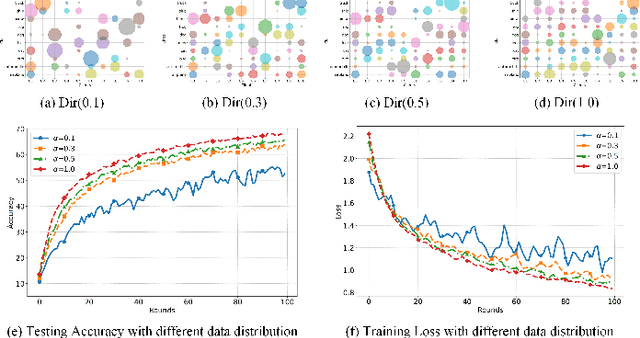
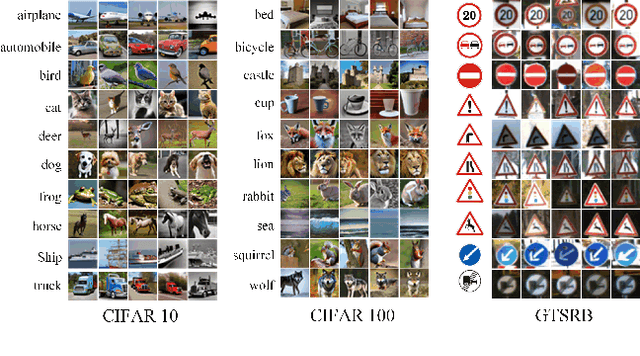
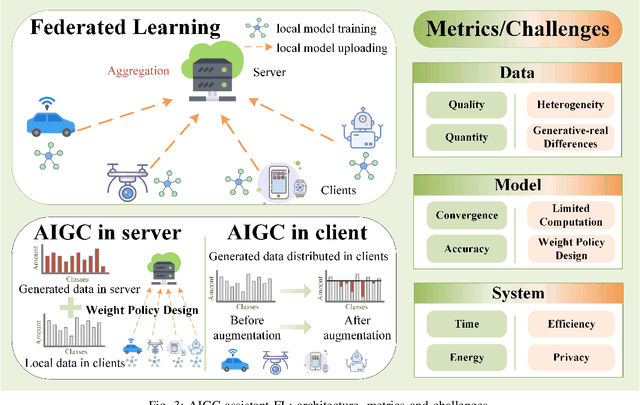
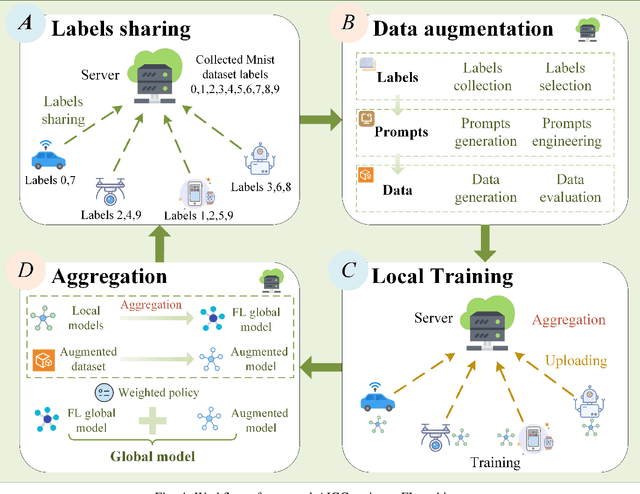
Federated learning (FL) can fully leverage large-scale terminal data while ensuring privacy and security, and is considered as a distributed alternative for the centralized machine learning. However, the issue of data heterogeneity poses limitations on FL's performance. To address this challenge, artificial intelligence-generated content (AIGC) which is an innovative data synthesis technique emerges as one potential solution. In this article, we first provide an overview of the system architecture, performance metrics, and challenges associated with AIGC-assistant FL system design. We then propose the Generative federated learning (GenFL) architecture and present its workflow, including the design of aggregation and weight policy. Finally, using the CIFAR10 and CIFAR100 datasets, we employ diffusion models to generate dataset and improve FL performance. Experiments conducted under various non-independent and identically distributed (non-IID) data distributions demonstrate the effectiveness of GenFL on overcoming the bottlenecks in FL caused by data heterogeneity. Open research directions in the research of AIGC-assisted FL are also discussed.
IIMedGPT: Promoting Large Language Model Capabilities of Medical Tasks by Efficient Human Preference Alignment
Jan 06, 2025Recent researches of large language models(LLM), which is pre-trained on massive general-purpose corpora, have achieved breakthroughs in responding human queries. However, these methods face challenges including limited data insufficiency to support extensive pre-training and can not align responses with users' instructions. To address these issues, we introduce a medical instruction dataset, CMedINS, containing six medical instructions derived from actual medical tasks, which effectively fine-tunes LLM in conjunction with other data. Subsequently, We launch our medical model, IIMedGPT, employing an efficient preference alignment method, Direct preference Optimization(DPO). The results show that our final model outperforms existing medical models in medical dialogue.Datsets, Code and model checkpoints will be released upon acceptance.
Age-Based Device Selection and Transmit Power Optimization in Over-the-Air Federated Learning
Jan 03, 2025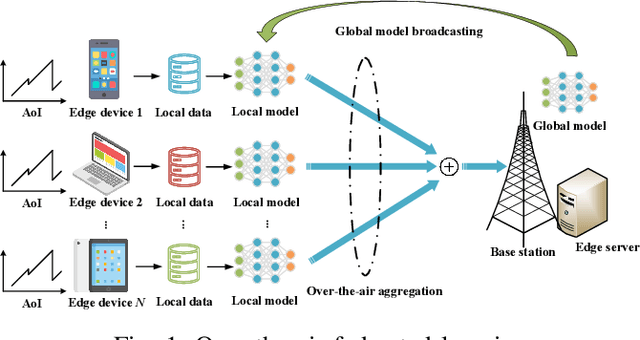
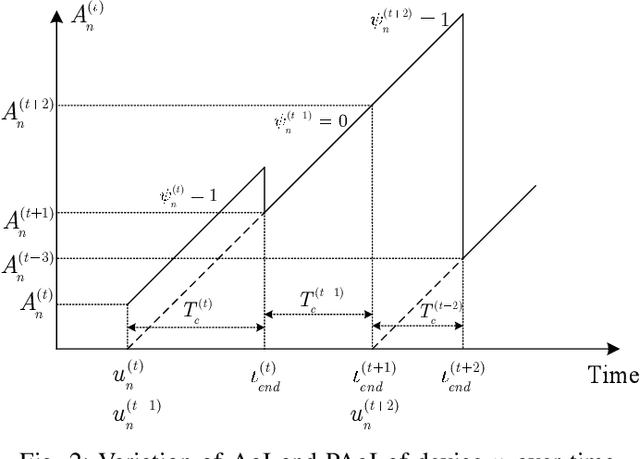
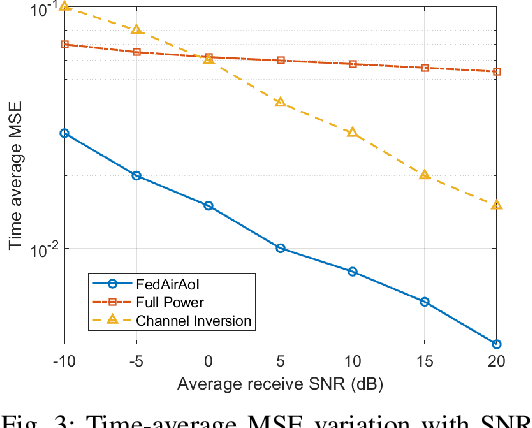
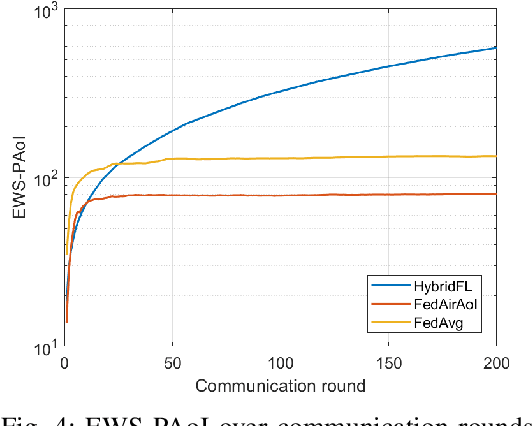
Recently, over-the-air federated learning (FL) has attracted significant attention for its ability to enhance communication efficiency. However, the performance of over-the-air FL is often constrained by device selection strategies and signal aggregation errors. In particular, neglecting straggler devices in FL can lead to a decline in the fairness of model updates and amplify the global model's bias toward certain devices' data, ultimately impacting the overall system performance. To address this issue, we propose a joint device selection and transmit power optimization framework that ensures the appropriate participation of straggler devices, maintains efficient training performance, and guarantees timely updates. First, we conduct a theoretical analysis to quantify the convergence upper bound of over-the-air FL under age-of-information (AoI)-based device selection. Our analysis further reveals that both the number of selected devices and the signal aggregation errors significantly influence the convergence upper bound. To minimize the expected weighted sum peak age of information, we calculate device priorities for each communication round using Lyapunov optimization and select the highest-priority devices via a greedy algorithm. Then, we formulate and solve a transmit power and normalizing factor optimization problem for selected devices to minimize the time-average mean squared error (MSE). Experimental results demonstrate that our proposed method offers two significant advantages: (1) it reduces MSE and improves model performance compared to baseline methods, and (2) it strikes a balance between fairness and training efficiency while maintaining satisfactory timeliness, ensuring stable model performance.
Movable Antenna-Equipped UAV for Data Collection in Backscatter Sensor Networks: A Deep Reinforcement Learning-based Approach
Nov 21, 2024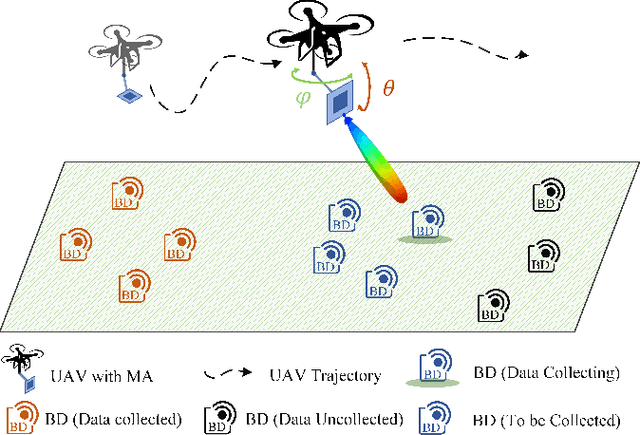
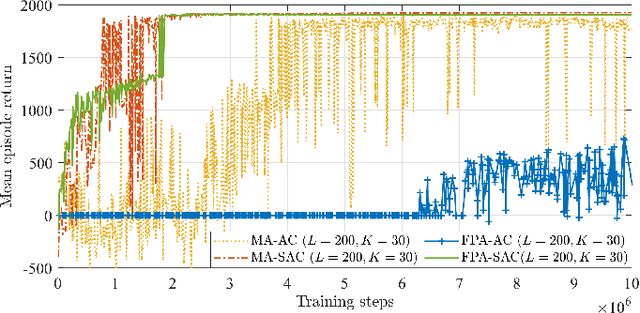
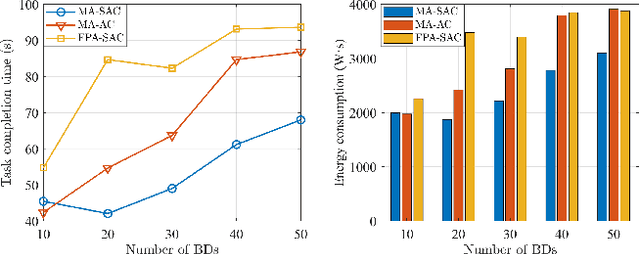

Backscatter communication (BC) becomes a promising energy-efficient solution for future wireless sensor networks (WSNs). Unmanned aerial vehicles (UAVs) enable flexible data collection from remote backscatter devices (BDs), yet conventional UAVs rely on omni-directional fixed-position antennas (FPAs), limiting channel gain and prolonging data collection time. To address this issue, we consider equipping a UAV with a directional movable antenna (MA) with high directivity and flexibility. The MA enhances channel gain by precisely aiming its main lobe at each BD, focusing transmission power for efficient communication. Our goal is to minimize the total data collection time by jointly optimizing the UAV's trajectory and the MA's orientation. We develop a deep reinforcement learning (DRL)-based strategy using the azimuth angle and distance between the UAV and each BD to simplify the agent's observation space. To ensure stability during training, we adopt Soft Actor-Critic (SAC) algorithm that balances exploration with reward maximization for efficient and reliable learning. Simulation results demonstrate that our proposed MA-equipped UAV with SAC outperforms both FPA-equipped UAVs and other RL methods, achieving significant reductions in both data collection time and energy consumption.
Model Partition and Resource Allocation for Split Learning in Vehicular Edge Networks
Nov 11, 2024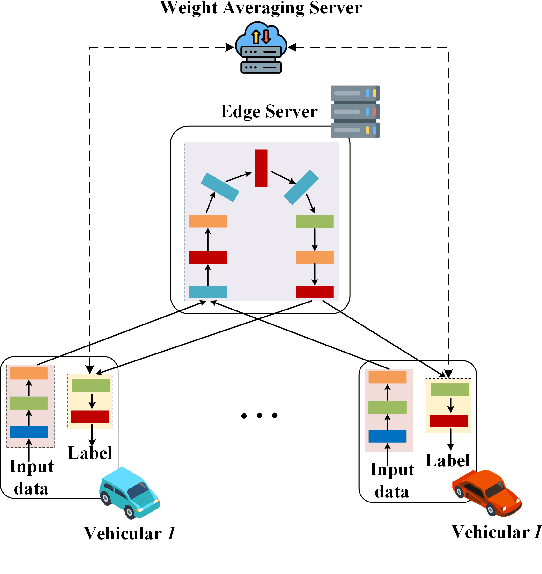
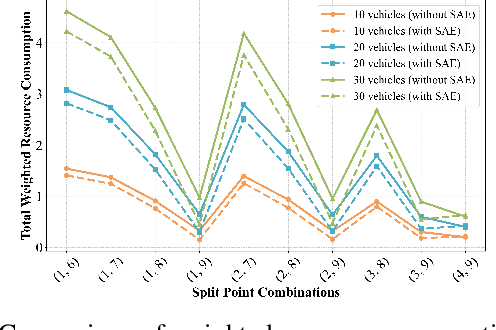

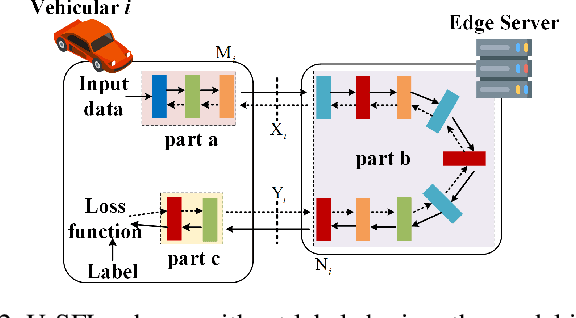
The integration of autonomous driving technologies with vehicular networks presents significant challenges in privacy preservation, communication efficiency, and resource allocation. This paper proposes a novel U-shaped split federated learning (U-SFL) framework to address these challenges on the way of realizing in vehicular edge networks. U-SFL is able to enhance privacy protection by keeping both raw data and labels on the vehicular user (VU) side while enabling parallel processing across multiple vehicles. To optimize communication efficiency, we introduce a semantic-aware auto-encoder (SAE) that significantly reduces the dimensionality of transmitted data while preserving essential semantic information. Furthermore, we develop a deep reinforcement learning (DRL) based algorithm to solve the NP-hard problem of dynamic resource allocation and split point selection. Our comprehensive evaluation demonstrates that U-SFL achieves comparable classification performance to traditional split learning (SL) while substantially reducing data transmission volume and communication latency. The proposed DRL-based optimization algorithm shows good convergence in balancing latency, energy consumption, and learning performance.