 Add to Chrome
 Add to Firefox
 Add to Edge
One-Shot Learning for Pose-Guided Person Image Synthesis in the Wild
Sep 15, 2024


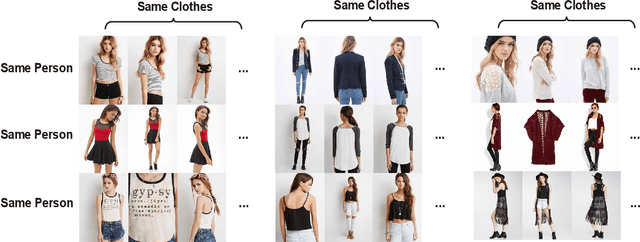
Current Pose-Guided Person Image Synthesis (PGPIS) methods depend heavily on large amounts of labeled triplet data to train the generator in a supervised manner. However, they often falter when applied to in-the-wild samples, primarily due to the distribution gap between the training datasets and real-world test samples. While some researchers aim to enhance model generalizability through sophisticated training procedures, advanced architectures, or by creating more diverse datasets, we adopt the test-time fine-tuning paradigm to customize a pre-trained Text2Image (T2I) model. However, naively applying test-time tuning results in inconsistencies in facial identities and appearance attributes. To address this, we introduce a Visual Consistency Module (VCM), which enhances appearance consistency by combining the face, text, and image embedding. Our approach, named OnePoseTrans, requires only a single source image to generate high-quality pose transfer results, offering greater stability than state-of-the-art data-driven methods. For each test case, OnePoseTrans customizes a model in around 48 seconds with an NVIDIA V100 GPU.

Dividable Configuration Performance Learning
Sep 11, 2024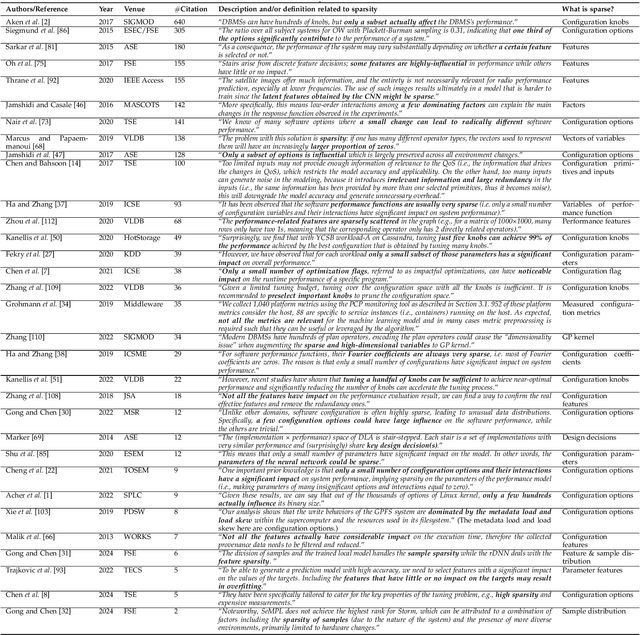
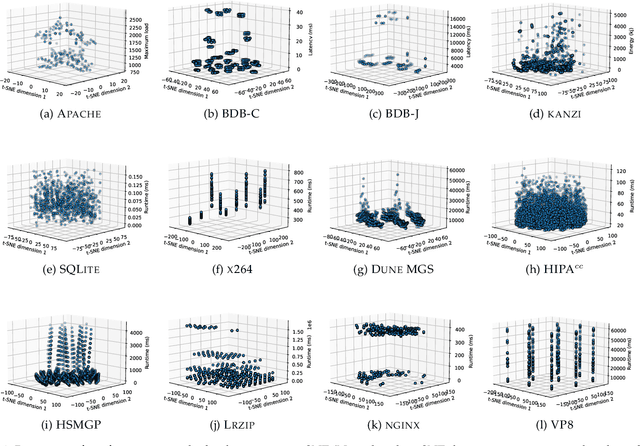
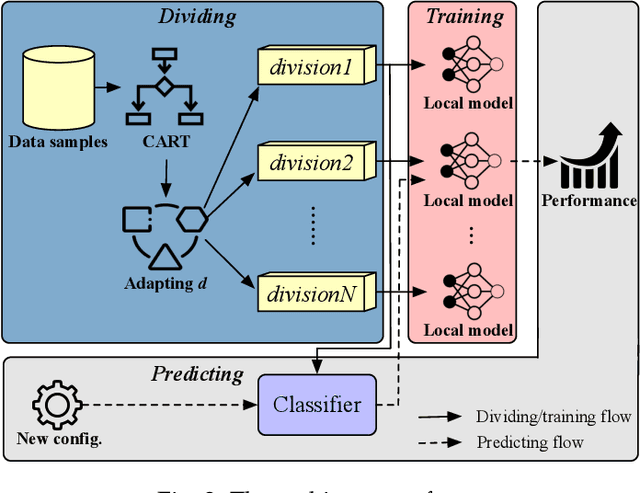
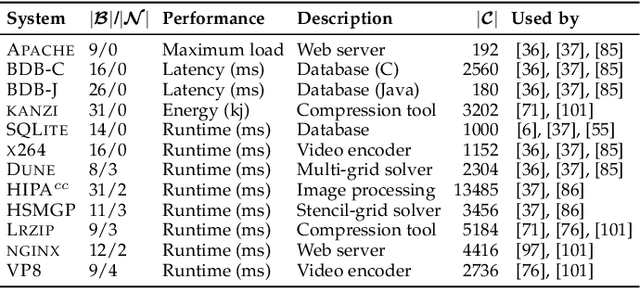
Machine/deep learning models have been widely adopted for predicting the configuration performance of software systems. However, a crucial yet unaddressed challenge is how to cater for the sparsity inherited from the configuration landscape: the influence of configuration options (features) and the distribution of data samples are highly sparse. In this paper, we propose a model-agnostic and sparsity-robust framework for predicting configuration performance, dubbed DaL, based on the new paradigm of dividable learning that builds a model via "divide-and-learn". To handle sample sparsity, the samples from the configuration landscape are divided into distant divisions, for each of which we build a sparse local model, e.g., regularized Hierarchical Interaction Neural Network, to deal with the feature sparsity. A newly given configuration would then be assigned to the right model of division for the final prediction. Further, DaL adaptively determines the optimal number of divisions required for a system and sample size without any extra training or profiling. Experiment results from 12 real-world systems and five sets of training data reveal that, compared with the state-of-the-art approaches, DaL performs no worse than the best counterpart on 44 out of 60 cases with up to 1.61x improvement on accuracy; requires fewer samples to reach the same/better accuracy; and producing acceptable training overhead. In particular, the mechanism that adapted the parameter d can reach the optimal value for 76.43% of the individual runs. The result also confirms that the paradigm of dividable learning is more suitable than other similar paradigms such as ensemble learning for predicting configuration performance. Practically, DaL considerably improves different global models when using them as the underlying local models, which further strengthens its flexibility.
DynaSurfGS: Dynamic Surface Reconstruction with Planar-based Gaussian Splatting
Aug 26, 2024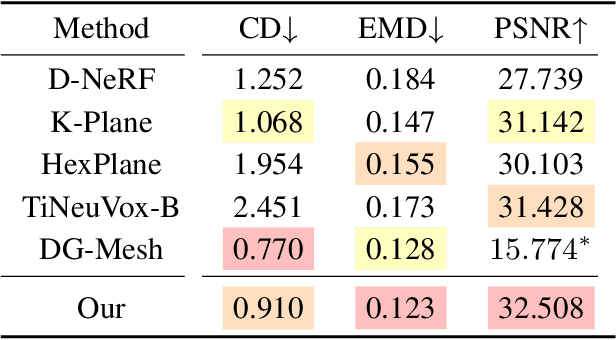
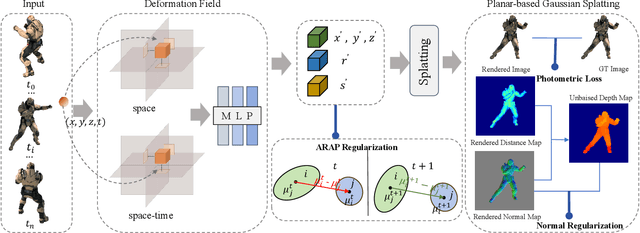
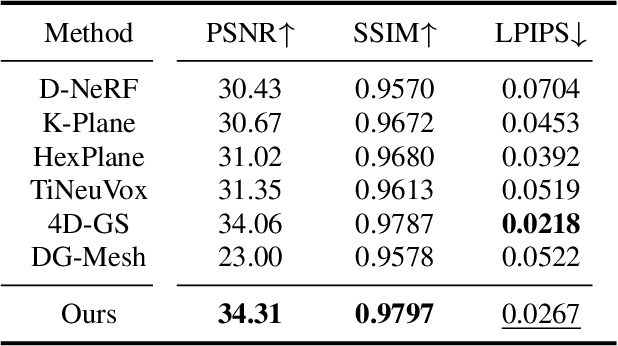
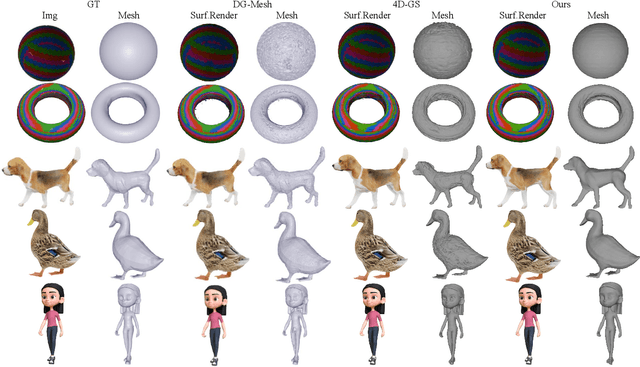
Dynamic scene reconstruction has garnered significant attention in recent years due to its capabilities in high-quality and real-time rendering. Among various methodologies, constructing a 4D spatial-temporal representation, such as 4D-GS, has gained popularity for its high-quality rendered images. However, these methods often produce suboptimal surfaces, as the discrete 3D Gaussian point clouds fail to align with the object's surface precisely. To address this problem, we propose DynaSurfGS to achieve both photorealistic rendering and high-fidelity surface reconstruction of dynamic scenarios. Specifically, the DynaSurfGS framework first incorporates Gaussian features from 4D neural voxels with the planar-based Gaussian Splatting to facilitate precise surface reconstruction. It leverages normal regularization to enforce the smoothness of the surface of dynamic objects. It also incorporates the as-rigid-as-possible (ARAP) constraint to maintain the approximate rigidity of local neighborhoods of 3D Gaussians between timesteps and ensure that adjacent 3D Gaussians remain closely aligned throughout. Extensive experiments demonstrate that DynaSurfGS surpasses state-of-the-art methods in both high-fidelity surface reconstruction and photorealistic rendering.
Contexts Matter: An Empirical Study on Contextual Influence in Fairness Testing for Deep Learning Systems
Aug 12, 2024Background: Fairness testing for deep learning systems has been becoming increasingly important. However, much work assumes perfect context and conditions from the other parts: well-tuned hyperparameters for accuracy; rectified bias in data, and mitigated bias in the labeling. Yet, these are often difficult to achieve in practice due to their resource-/labour-intensive nature. Aims: In this paper, we aim to understand how varying contexts affect fairness testing outcomes. Method:We conduct an extensive empirical study, which covers $10,800$ cases, to investigate how contexts can change the fairness testing result at the model level against the existing assumptions. We also study why the outcomes were observed from the lens of correlation/fitness landscape analysis. Results: Our results show that different context types and settings generally lead to a significant impact on the testing, which is mainly caused by the shifts of the fitness landscape under varying contexts. Conclusions: Our findings provide key insights for practitioners to evaluate the test generators and hint at future research directions.
CAMAv2: A Vision-Centric Approach for Static Map Element Annotation
Jul 31, 2024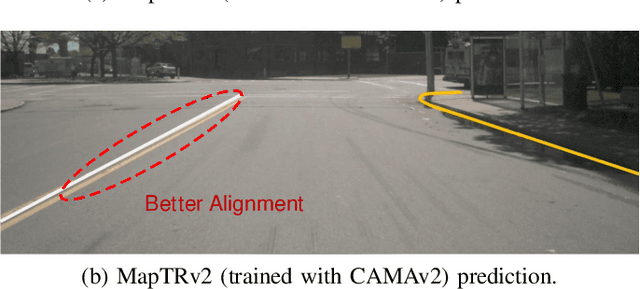
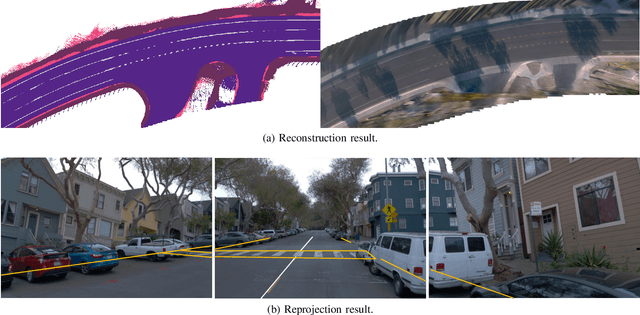
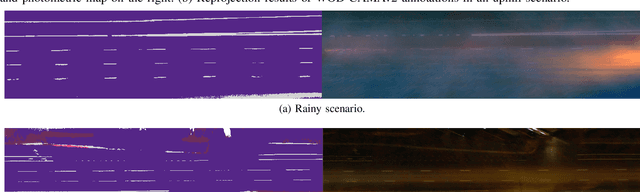
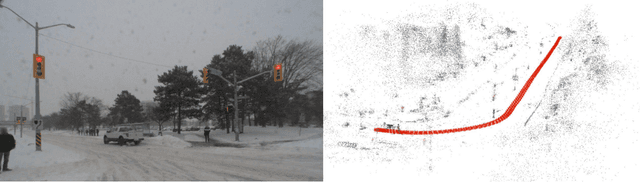
The recent development of online static map element (a.k.a. HD map) construction algorithms has raised a vast demand for data with ground truth annotations. However, available public datasets currently cannot provide high-quality training data regarding consistency and accuracy. For instance, the manual labelled (low efficiency) nuScenes still contains misalignment and inconsistency between the HD maps and images (e.g., around 8.03 pixels reprojection error on average). To this end, we present CAMAv2: a vision-centric approach for Consistent and Accurate Map Annotation. Without LiDAR inputs, our proposed framework can still generate high-quality 3D annotations of static map elements. Specifically, the annotation can achieve high reprojection accuracy across all surrounding cameras and is spatial-temporal consistent across the whole sequence. We apply our proposed framework to the popular nuScenes dataset to provide efficient and highly accurate annotations. Compared with the original nuScenes static map element, our CAMAv2 annotations achieve lower reprojection errors (e.g., 4.96 vs. 8.03 pixels). Models trained with annotations from CAMAv2 also achieve lower reprojection errors (e.g., 5.62 vs. 8.43 pixels).
Leveraging Foundation Models for Zero-Shot IoT Sensing
Jul 29, 2024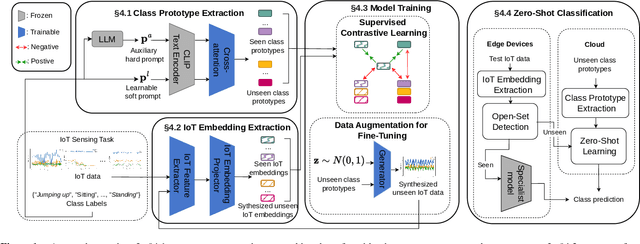
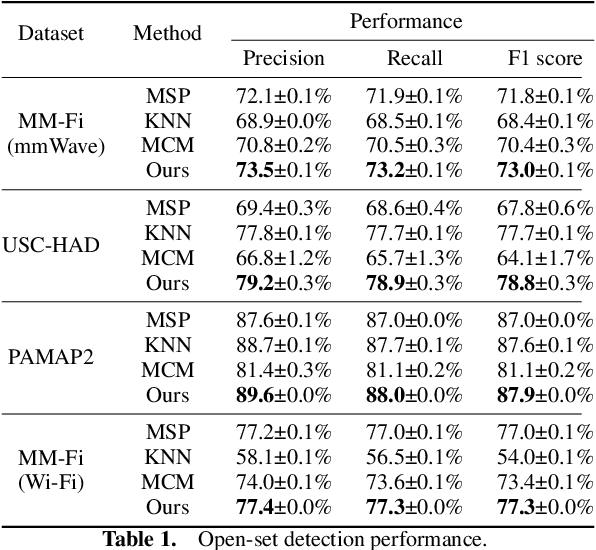
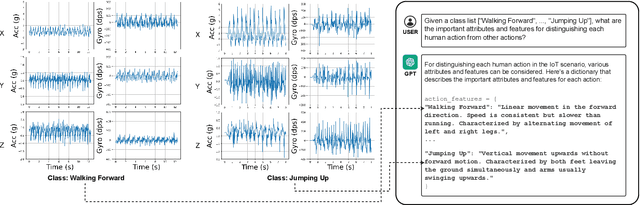
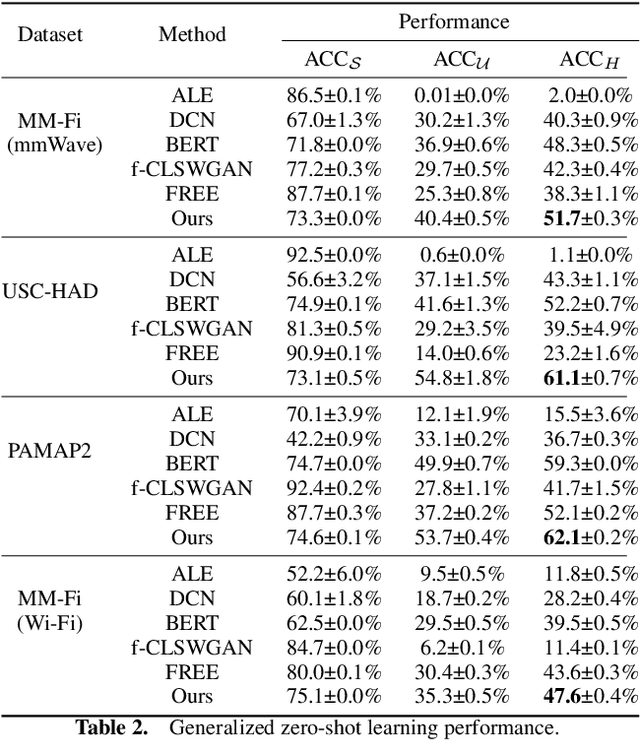
Deep learning models are increasingly deployed on edge Internet of Things (IoT) devices. However, these models typically operate under supervised conditions and fail to recognize unseen classes different from training. To address this, zero-shot learning (ZSL) aims to classify data of unseen classes with the help of semantic information. Foundation models (FMs) trained on web-scale data have shown impressive ZSL capability in natural language processing and visual understanding. However, leveraging FMs' generalized knowledge for zero-shot IoT sensing using signals such as mmWave, IMU, and Wi-Fi has not been fully investigated. In this work, we align the IoT data embeddings with the semantic embeddings generated by an FM's text encoder for zero-shot IoT sensing. To utilize the physics principles governing the generation of IoT sensor signals to derive more effective prompts for semantic embedding extraction, we propose to use cross-attention to combine a learnable soft prompt that is optimized automatically on training data and an auxiliary hard prompt that encodes domain knowledge of the IoT sensing task. To address the problem of IoT embeddings biasing to seen classes due to the lack of unseen class data during training, we propose using data augmentation to synthesize unseen class IoT data for fine-tuning the IoT feature extractor and embedding projector. We evaluate our approach on multiple IoT sensing tasks. Results show that our approach achieves superior open-set detection and generalized zero-shot learning performance compared with various baselines. Our code is available at https://github.com/schrodingho/FM\_ZSL\_IoT.
Explain EEG-based End-to-end Deep Learning Models in the Frequency Domain
Jul 25, 2024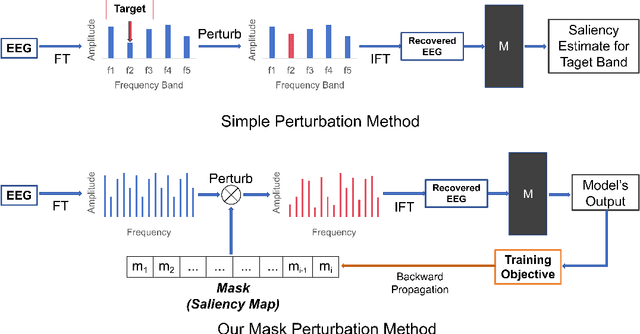
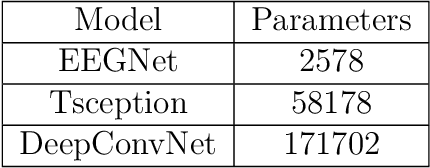
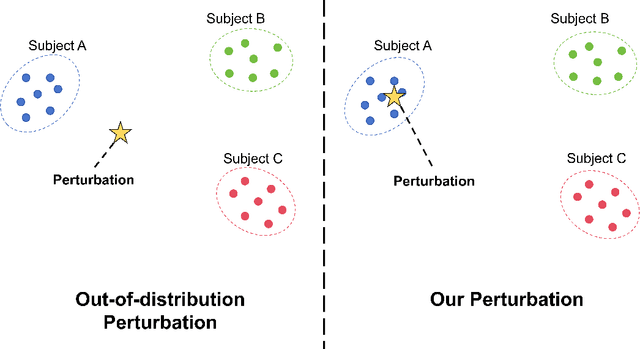
The recent rise of EEG-based end-to-end deep learning models presents a significant challenge in elucidating how these models process raw EEG signals and generate predictions in the frequency domain. This challenge limits the transparency and credibility of EEG-based end-to-end models, hindering their application in security-sensitive areas. To address this issue, we propose a mask perturbation method to explain the behavior of end-to-end models in the frequency domain. Considering the characteristics of EEG data, we introduce a target alignment loss to mitigate the out-of-distribution problem associated with perturbation operations. Additionally, we develop a perturbation generator to define perturbation generation in the frequency domain. Our explanation method is validated through experiments on multiple representative end-to-end deep learning models in the EEG decoding field, using an established EEG benchmark dataset. The results demonstrate the effectiveness and superiority of our method, and highlight its potential to advance research in EEG-based end-to-end models.
Vegetable Peeling: A Case Study in Constrained Dexterous Manipulation
Jul 10, 2024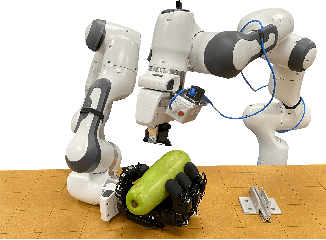
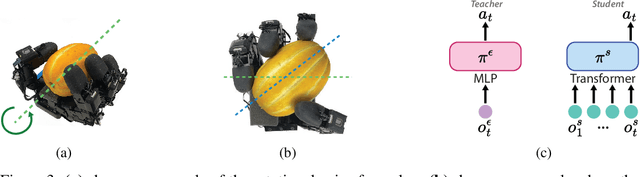
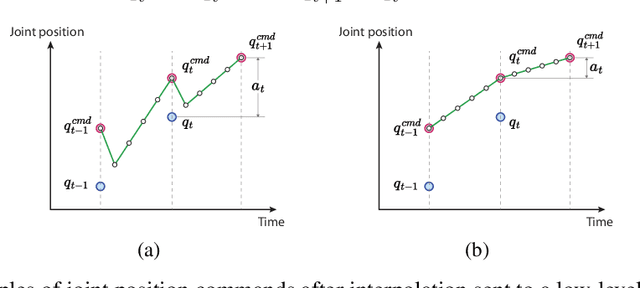

Recent studies have made significant progress in addressing dexterous manipulation problems, particularly in in-hand object reorientation. However, there are few existing works that explore the potential utilization of developed dexterous manipulation controllers for downstream tasks. In this study, we focus on constrained dexterous manipulation for food peeling. Food peeling presents various constraints on the reorientation controller, such as the requirement for the hand to securely hold the object after reorientation for peeling. We propose a simple system for learning a reorientation controller that facilitates the subsequent peeling task. Videos are available at: https://taochenshh.github.io/projects/veg-peeling.
Foster Adaptivity and Balance in Learning with Noisy Labels
Jul 03, 2024Label noise is ubiquitous in real-world scenarios, posing a practical challenge to supervised models due to its effect in hurting the generalization performance of deep neural networks. Existing methods primarily employ the sample selection paradigm and usually rely on dataset-dependent prior knowledge (\eg, a pre-defined threshold) to cope with label noise, inevitably degrading the adaptivity. Moreover, existing methods tend to neglect the class balance in selecting samples, leading to biased model performance. To this end, we propose a simple yet effective approach named \textbf{SED} to deal with label noise in a \textbf{S}elf-adaptiv\textbf{E} and class-balance\textbf{D} manner. Specifically, we first design a novel sample selection strategy to empower self-adaptivity and class balance when identifying clean and noisy data. A mean-teacher model is then employed to correct labels of noisy samples. Subsequently, we propose a self-adaptive and class-balanced sample re-weighting mechanism to assign different weights to detected noisy samples. Finally, we additionally employ consistency regularization on selected clean samples to improve model generalization performance. Extensive experimental results on synthetic and real-world datasets demonstrate the effectiveness and superiority of our proposed method. The source code has been made available at https://github.com/NUST-Machine-Intelligence-Laboratory/SED.
HiDiff: Hybrid Diffusion Framework for Medical Image Segmentation
Jul 03, 2024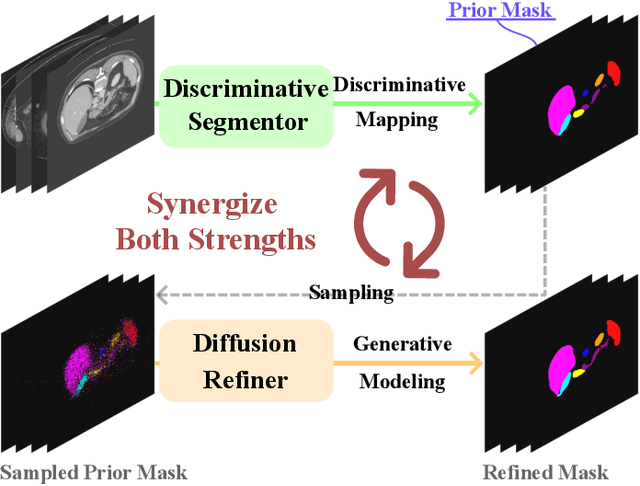
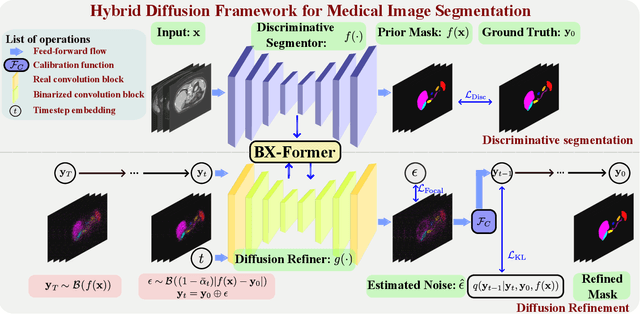
Medical image segmentation has been significantly advanced with the rapid development of deep learning (DL) techniques. Existing DL-based segmentation models are typically discriminative; i.e., they aim to learn a mapping from the input image to segmentation masks. However, these discriminative methods neglect the underlying data distribution and intrinsic class characteristics, suffering from unstable feature space. In this work, we propose to complement discriminative segmentation methods with the knowledge of underlying data distribution from generative models. To that end, we propose a novel hybrid diffusion framework for medical image segmentation, termed HiDiff, which can synergize the strengths of existing discriminative segmentation models and new generative diffusion models. HiDiff comprises two key components: discriminative segmentor and diffusion refiner. First, we utilize any conventional trained segmentation models as discriminative segmentor, which can provide a segmentation mask prior for diffusion refiner. Second, we propose a novel binary Bernoulli diffusion model (BBDM) as the diffusion refiner, which can effectively, efficiently, and interactively refine the segmentation mask by modeling the underlying data distribution. Third, we train the segmentor and BBDM in an alternate-collaborative manner to mutually boost each other. Extensive experimental results on abdomen organ, brain tumor, polyps, and retinal vessels segmentation datasets, covering four widely-used modalities, demonstrate the superior performance of HiDiff over existing medical segmentation algorithms, including the state-of-the-art transformer- and diffusion-based ones. In addition, HiDiff excels at segmenting small objects and generalizing to new datasets. Source codes are made available at https://github.com/takimailto/HiDiff.