 Add to Chrome
 Add to Firefox
 Add to Edge
Humanoid-OmniOcc: Stereo-Based Full-View Occupancy Dataset for Embodied AI
Jun 22, 2026
Occupancy prediction at voxel-level granularity is essential for safe robotic navigation and interaction in complex environments. Existing occupancy datasets, however, are predominantly designed for autonomous driving with vehicle-centric biases -- forward-facing cameras, far-field geometry, and static road priors -- limiting their applicability to embodied humanoid perception. We present Humanoid-OmniOcc, a large-scale panoramic stereo-based occupancy dataset tailored for humanoid robots. The dataset encompasses 15 diverse simulated indoor scenes and 5 real-world environments, yielding over 155K samples with broad scene and style diversity. Importantly, the dataset is designed around a Real2Sim2Real closed-loop paradigm: real sensor specifications drive physically accurate simulation, simulation produces large-scale annotated training data, and models trained in simulation are directly evaluated on real-world captures -- enabling iterative refinement of the sim-to-real pipeline. We further propose \textbf{H}umanoid \textbf{S}urround \textbf{S}tereo-guided \textbf{Occ}upancy model (Humanoid-OmniOcc) that exploits robust depth priors for accurate 2D-to-3D lifting. Extensive experiments show that Humanoid-OmniOcc consistently outperforms monocular baselines and generalizes well to both unseen simulated test scenes and real-world environments, validating the effectiveness of the Real2Sim2Real design. Code and data will be available upon acceptance at https://d-robotics-ai-lab.github.io/humanoid-omniocc.

CAMAv2: A Vision-Centric Approach for Static Map Element Annotation
Jul 31, 2024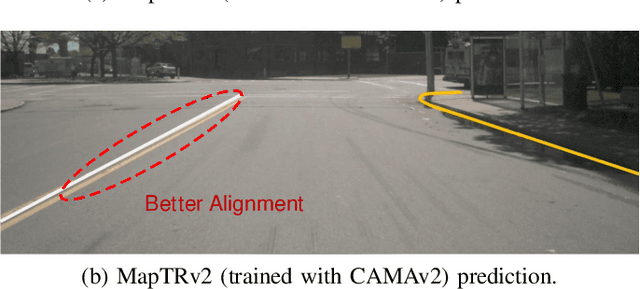
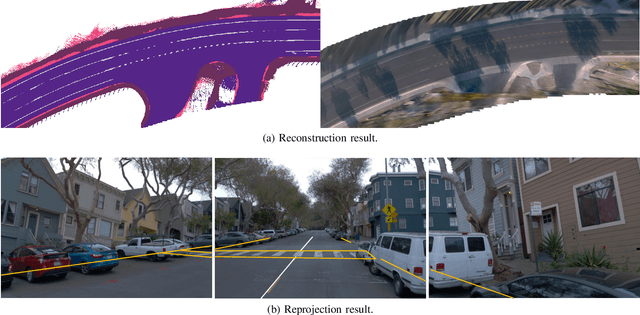
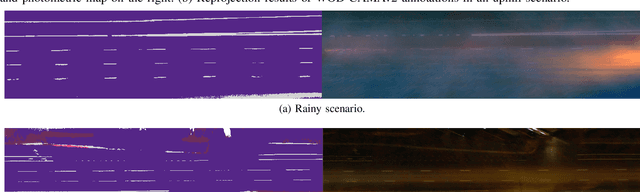
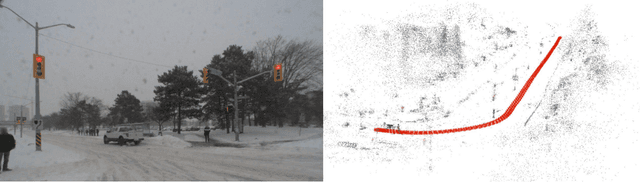
The recent development of online static map element (a.k.a. HD map) construction algorithms has raised a vast demand for data with ground truth annotations. However, available public datasets currently cannot provide high-quality training data regarding consistency and accuracy. For instance, the manual labelled (low efficiency) nuScenes still contains misalignment and inconsistency between the HD maps and images (e.g., around 8.03 pixels reprojection error on average). To this end, we present CAMAv2: a vision-centric approach for Consistent and Accurate Map Annotation. Without LiDAR inputs, our proposed framework can still generate high-quality 3D annotations of static map elements. Specifically, the annotation can achieve high reprojection accuracy across all surrounding cameras and is spatial-temporal consistent across the whole sequence. We apply our proposed framework to the popular nuScenes dataset to provide efficient and highly accurate annotations. Compared with the original nuScenes static map element, our CAMAv2 annotations achieve lower reprojection errors (e.g., 4.96 vs. 8.03 pixels). Models trained with annotations from CAMAv2 also achieve lower reprojection errors (e.g., 5.62 vs. 8.43 pixels).
A Vision-Centric Approach for Static Map Element Annotation
Sep 21, 2023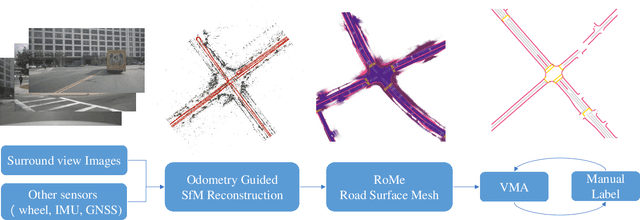


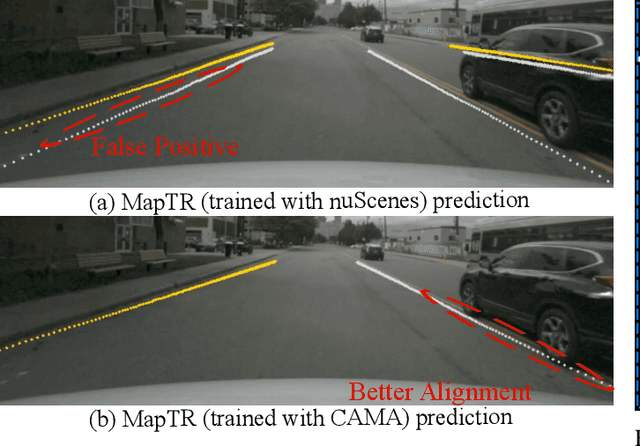
The recent development of online static map element (a.k.a. HD Map) construction algorithms has raised a vast demand for data with ground truth annotations. However, available public datasets currently cannot provide high-quality training data regarding consistency and accuracy. To this end, we present CAMA: a vision-centric approach for Consistent and Accurate Map Annotation. Without LiDAR inputs, our proposed framework can still generate high-quality 3D annotations of static map elements. Specifically, the annotation can achieve high reprojection accuracy across all surrounding cameras and is spatial-temporal consistent across the whole sequence. We apply our proposed framework to the popular nuScenes dataset to provide efficient and highly accurate annotations. Compared with the original nuScenes static map element, models trained with annotations from CAMA achieve lower reprojection errors (e.g., 4.73 vs. 8.03 pixels).