 Add to Chrome
 Add to Firefox
 Add to Edge
CrossPool: Efficient Multi-LLM Serving for Cold MoE Models through KV-Cache and Weight Disaggregation
Jun 23, 2026
Emerging LLM services increasingly host many sparse MoE models, yet most models receive sparse requests and remain cold. This creates a GPU memory problem: model weights are stable and model-determined, while KV-cache is transient and demand-determined. Because cold models rarely reach peak KV-cache demand at the same time, reserving worst-case KV capacity per model wastes memory; a shared KV-cache pool can instead provision aggregate active demand. However, KV-cache sharing is not sufficient when weights and KV-cache remain in a monolithic GPU memory pool. Static weights compete with dynamic KV-cache, and KV-head-limited attention under cold, low-concurrency traffic exposes only a fraction of replicated KV capacity, leading to low GPU memory utilization and weak long-context support. We present CrossPool, a serving engine for cold MoE models that separates FFN weights and KV-cache into two GPU memory pools: a weights pool that consolidates FFN weights across cold models, and a KV-cache pool that dynamically serves active requests while keeping attention local to KV-cache. CrossPool combines a KV-cache planner and virtualizer, a layer-wise pipeline scheduler that hides hidden-state transfers, and persistent kernels with control lowering to reduce CPU-GPU control overhead. With efficient GPU memory pooling, CrossPool underpins bursty long-context requests and outperforms the state-of-the-art kvcached-based multi-LLM serving system, reducing P99 TBT by up to $10.4\times$.

Leveraging Foundation Models for Zero-Shot IoT Sensing
Jul 29, 2024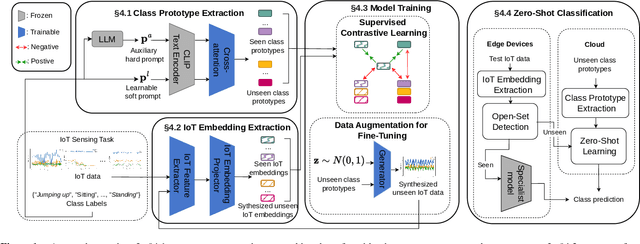
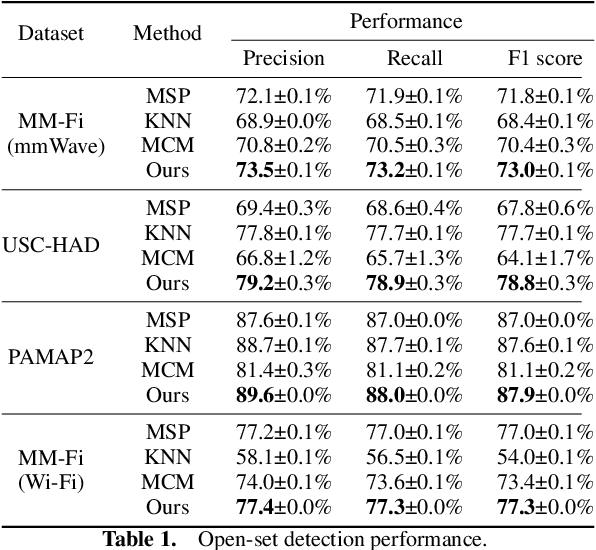
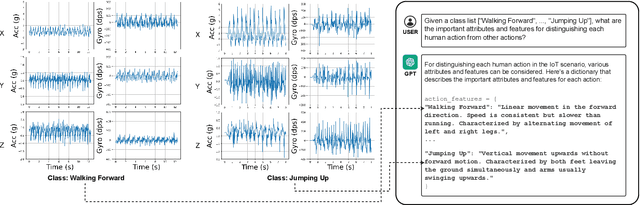
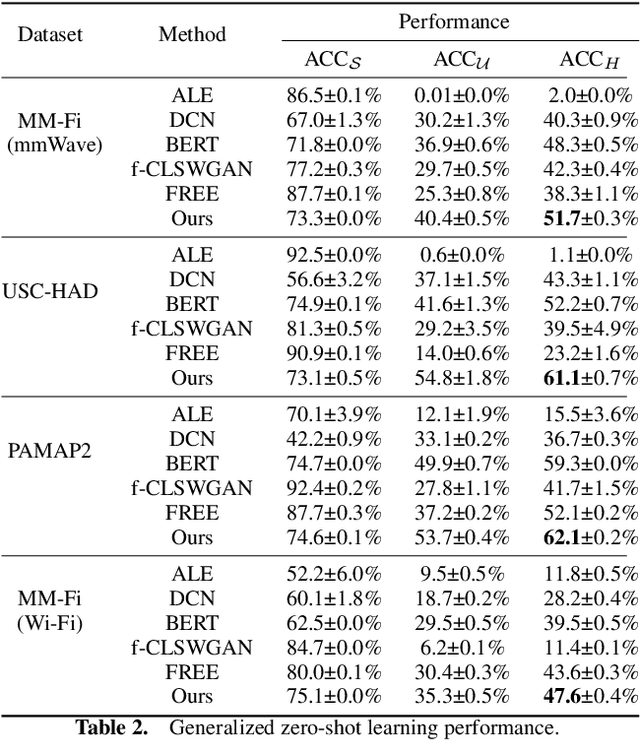
Deep learning models are increasingly deployed on edge Internet of Things (IoT) devices. However, these models typically operate under supervised conditions and fail to recognize unseen classes different from training. To address this, zero-shot learning (ZSL) aims to classify data of unseen classes with the help of semantic information. Foundation models (FMs) trained on web-scale data have shown impressive ZSL capability in natural language processing and visual understanding. However, leveraging FMs' generalized knowledge for zero-shot IoT sensing using signals such as mmWave, IMU, and Wi-Fi has not been fully investigated. In this work, we align the IoT data embeddings with the semantic embeddings generated by an FM's text encoder for zero-shot IoT sensing. To utilize the physics principles governing the generation of IoT sensor signals to derive more effective prompts for semantic embedding extraction, we propose to use cross-attention to combine a learnable soft prompt that is optimized automatically on training data and an auxiliary hard prompt that encodes domain knowledge of the IoT sensing task. To address the problem of IoT embeddings biasing to seen classes due to the lack of unseen class data during training, we propose using data augmentation to synthesize unseen class IoT data for fine-tuning the IoT feature extractor and embedding projector. We evaluate our approach on multiple IoT sensing tasks. Results show that our approach achieves superior open-set detection and generalized zero-shot learning performance compared with various baselines. Our code is available at https://github.com/schrodingho/FM\_ZSL\_IoT.