 Add to Chrome
 Add to Firefox
 Add to Edge
CodePercept: Code-Grounded Visual STEM Perception for MLLMs
Mar 11, 2026
When MLLMs fail at Science, Technology, Engineering, and Mathematics (STEM) visual reasoning, a fundamental question arises: is it due to perceptual deficiencies or reasoning limitations? Through systematic scaling analysis that independently scales perception and reasoning components, we uncover a critical insight: scaling perception consistently outperforms scaling reasoning. This reveals perception as the true lever limiting current STEM visual reasoning. Motivated by this insight, our work focuses on systematically enhancing the perception capabilities of MLLMs by establishing code as a powerful perceptual medium--executable code provides precise semantics that naturally align with the structured nature of STEM visuals. Specifically, we construct ICC-1M, a large-scale dataset comprising 1M Image-Caption-Code triplets that materializes this code-as-perception paradigm through two complementary approaches: (1) Code-Grounded Caption Generation treats executable code as ground truth for image captions, eliminating the hallucinations inherent in existing knowledge distillation methods; (2) STEM Image-to-Code Translation prompts models to generate reconstruction code, mitigating the ambiguity of natural language for perception enhancement. To validate this paradigm, we further introduce STEM2Code-Eval, a novel benchmark that directly evaluates visual perception in STEM domains. Unlike existing work relying on problem-solving accuracy as a proxy that only measures problem-relevant understanding, our benchmark requires comprehensive visual comprehension through executable code generation for image reconstruction, providing deterministic and verifiable assessment. Code is available at https://github.com/TongkunGuan/Qwen-CodePercept.

A Token-level Text Image Foundation Model for Document Understanding
Mar 04, 2025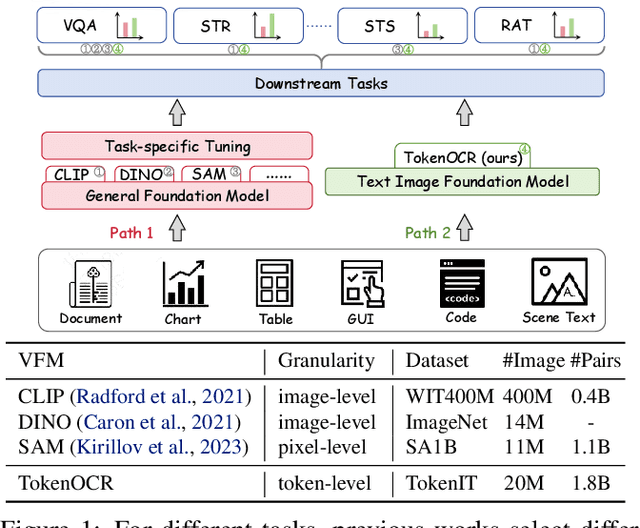
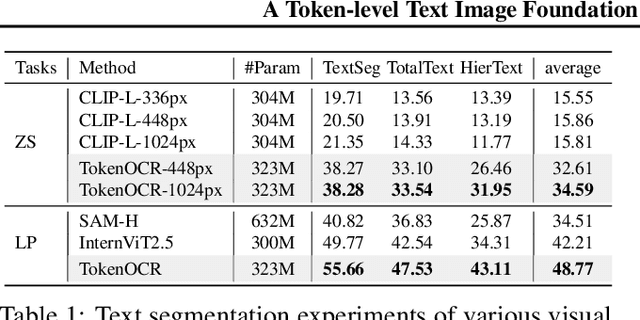
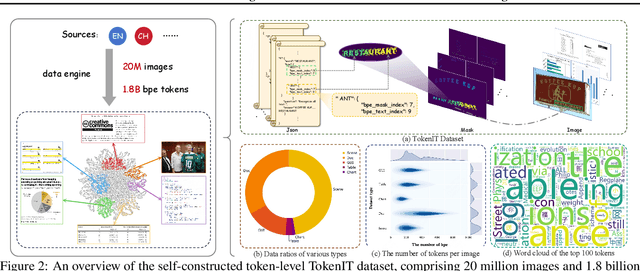
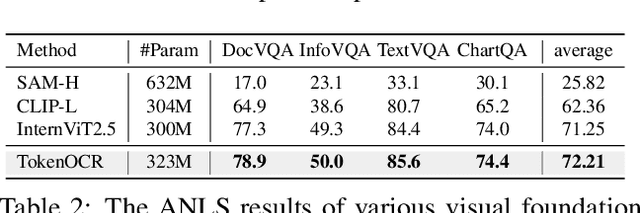
In recent years, general visual foundation models (VFMs) have witnessed increasing adoption, particularly as image encoders for popular multi-modal large language models (MLLMs). However, without semantically fine-grained supervision, these models still encounter fundamental prediction errors in the context of downstream text-image-related tasks, i.e., perception, understanding and reasoning with images containing small and dense texts. To bridge this gap, we develop TokenOCR, the first token-level visual foundation model specifically tailored for text-image-related tasks, designed to support a variety of traditional downstream applications. To facilitate the pretraining of TokenOCR, we also devise a high-quality data production pipeline that constructs the first token-level image text dataset, TokenIT, comprising 20 million images and 1.8 billion token-mask pairs. Furthermore, leveraging this foundation with exceptional image-as-text capability, we seamlessly replace previous VFMs with TokenOCR to construct a document-level MLLM, TokenVL, for VQA-based document understanding tasks. Finally, extensive experiments demonstrate the effectiveness of TokenOCR and TokenVL. Code, datasets, and weights will be available at https://token-family.github.io/TokenOCR_project.