 Add to Chrome
 Add to Firefox
 Add to Edge
Exploring the Compositional Generalization in Context Dependent Text-to-SQL Parsing
May 29, 2023
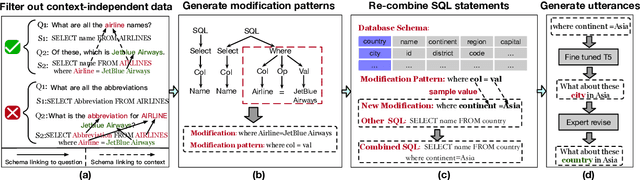
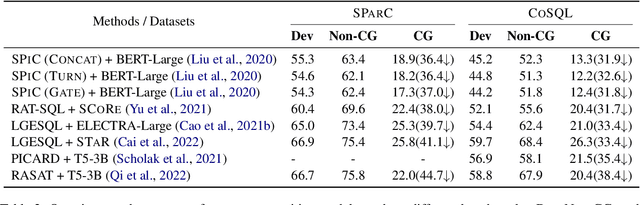
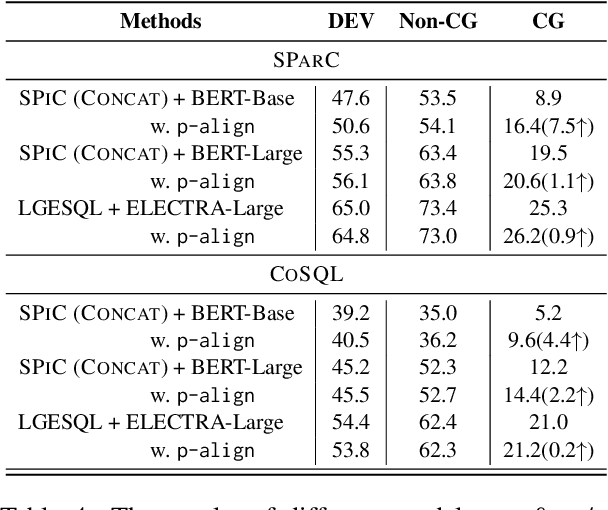
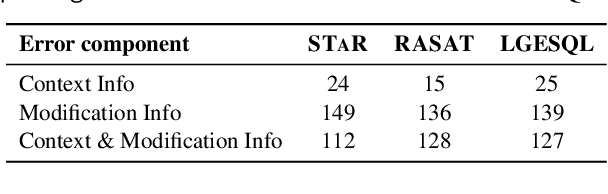
In the context-dependent Text-to-SQL task, the generated SQL statements are refined iteratively based on the user input utterance from each interaction. The input text from each interaction can be viewed as component modifications to the previous SQL statements, which could be further extracted as the modification patterns. Since these modification patterns could also be combined with other SQL statements, the models are supposed to have the compositional generalization to these novel combinations. This work is the first exploration of compositional generalization in context-dependent Text-to-SQL scenarios. To facilitate related studies, we constructed two challenging benchmarks named \textsc{CoSQL-CG} and \textsc{SParC-CG} by recombining the modification patterns and existing SQL statements. The following experiments show that all current models struggle on our proposed benchmarks. Furthermore, we found that better aligning the previous SQL statements with the input utterance could give models better compositional generalization ability. Based on these observations, we propose a method named \texttt{p-align} to improve the compositional generalization of Text-to-SQL models. Further experiments validate the effectiveness of our method. Source code and data are available.

Improving Factuality and Reasoning in Language Models through Multiagent Debate
May 23, 2023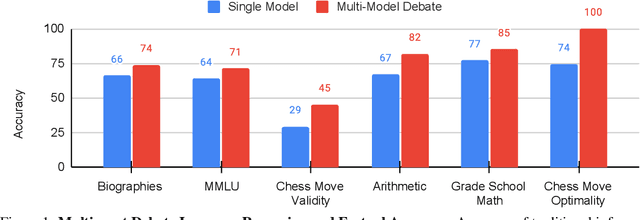
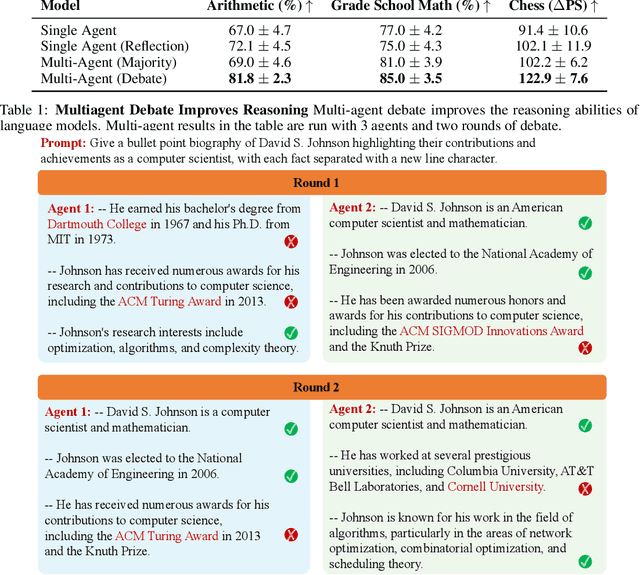

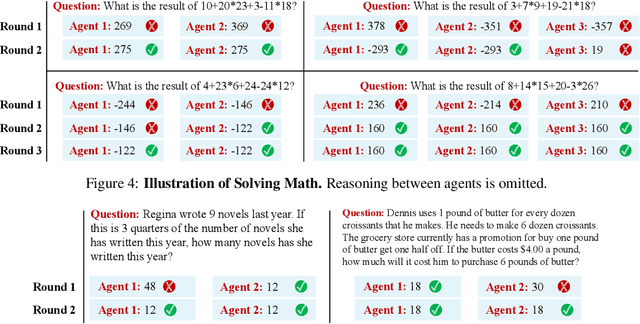
Large language models (LLMs) have demonstrated remarkable capabilities in language generation, understanding, and few-shot learning in recent years. An extensive body of work has explored how their performance may be further improved through the tools of prompting, ranging from verification, self-consistency, or intermediate scratchpads. In this paper, we present a complementary approach to improve language responses where multiple language model instances propose and debate their individual responses and reasoning processes over multiple rounds to arrive at a common final answer. Our findings indicate that this approach significantly enhances mathematical and strategic reasoning across a number of tasks. We also demonstrate that our approach improves the factual validity of generated content, reducing fallacious answers and hallucinations that contemporary models are prone to. Our approach may be directly applied to existing black-box models and uses identical procedure and prompts for all tasks we investigate. Overall, our findings suggest that such "society of minds" approach has the potential to significantly advance the capabilities of LLMs and pave the way for further breakthroughs in language generation and understanding.
Enhancing Cross-lingual Natural Language Inference by Soft Prompting with Multilingual Verbalizer
May 22, 2023Cross-lingual natural language inference is a fundamental problem in cross-lingual language understanding. Many recent works have used prompt learning to address the lack of annotated parallel corpora in XNLI. However, these methods adopt discrete prompting by simply translating the templates to the target language and need external expert knowledge to design the templates. Besides, discrete prompts of human-designed template words are not trainable vectors and can not be migrated to target languages in the inference stage flexibly. In this paper, we propose a novel Soft prompt learning framework with the Multilingual Verbalizer (SoftMV) for XNLI. SoftMV first constructs cloze-style question with soft prompts for the input sample. Then we leverage bilingual dictionaries to generate an augmented multilingual question for the original question. SoftMV adopts a multilingual verbalizer to align the representations of original and augmented multilingual questions into the same semantic space with consistency regularization. Experimental results on XNLI demonstrate that SoftMV can achieve state-of-the-art performance and significantly outperform the previous methods under the few-shot and full-shot cross-lingual transfer settings.
Introspective Tips: Large Language Model for In-Context Decision Making
May 19, 2023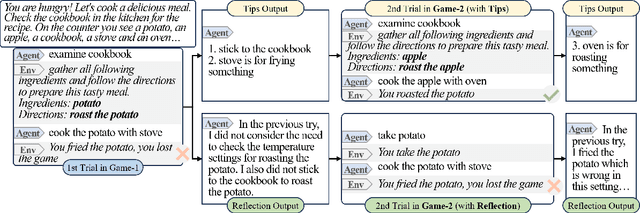
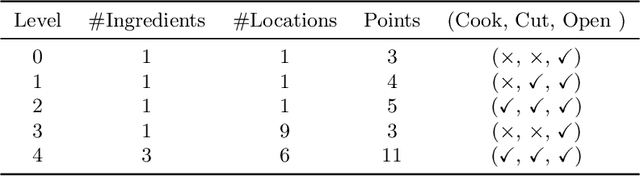
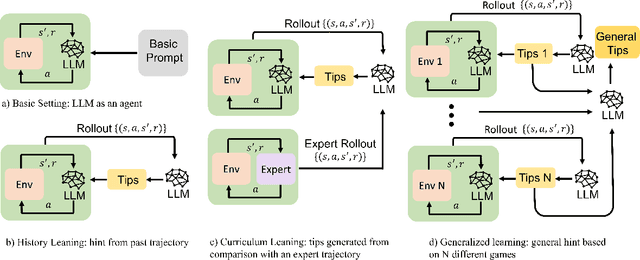

The emergence of large language models (LLMs) has substantially influenced natural language processing, demonstrating exceptional results across various tasks. In this study, we employ ``Introspective Tips" to facilitate LLMs in self-optimizing their decision-making. By introspectively examining trajectories, LLM refines its policy by generating succinct and valuable tips. Our method enhances the agent's performance in both few-shot and zero-shot learning situations by considering three essential scenarios: learning from the agent's past experiences, integrating expert demonstrations, and generalizing across diverse games. Importantly, we accomplish these improvements without fine-tuning the LLM parameters; rather, we adjust the prompt to generalize insights from the three aforementioned situations. Our framework not only supports but also emphasizes the advantage of employing LLM in in-contxt decision-making. Experiments involving over 100 games in TextWorld illustrate the superior performance of our approach.
PoseFusion: Robust Object-in-Hand Pose Estimation with SelectLSTM
Apr 10, 2023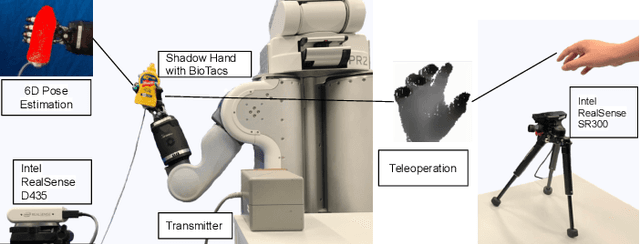
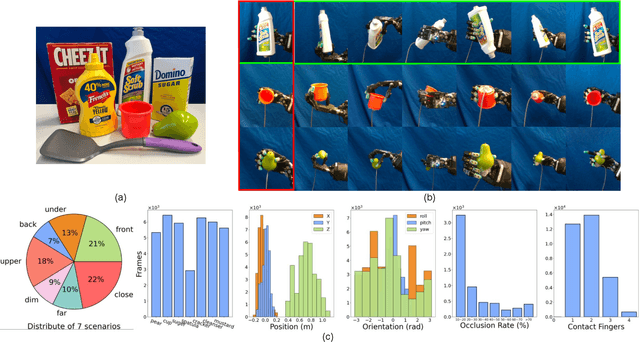
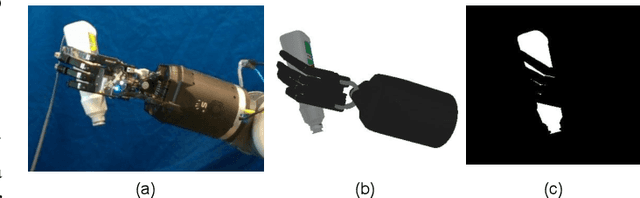
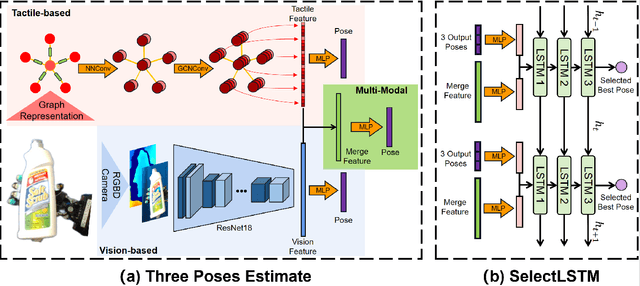
Accurate estimation of the relative pose between an object and a robot hand is critical for many manipulation tasks. However, most of the existing object-in-hand pose datasets use two-finger grippers and also assume that the object remains fixed in the hand without any relative movements, which is not representative of real-world scenarios. To address this issue, a 6D object-in-hand pose dataset is proposed using a teleoperation method with an anthropomorphic Shadow Dexterous hand. Our dataset comprises RGB-D images, proprioception and tactile data, covering diverse grasping poses, finger contact states, and object occlusions. To overcome the significant hand occlusion and limited tactile sensor contact in real-world scenarios, we propose PoseFusion, a hybrid multi-modal fusion approach that integrates the information from visual and tactile perception channels. PoseFusion generates three candidate object poses from three estimators (tactile only, visual only, and visuo-tactile fusion), which are then filtered by a SelectLSTM network to select the optimal pose, avoiding inferior fusion poses resulting from modality collapse. Extensive experiments demonstrate the robustness and advantages of our framework. All data and codes are available on the project website: https://elevenjiang1.github.io/ObjectInHand-Dataset/
VisDA 2022 Challenge: Domain Adaptation for Industrial Waste Sorting
Mar 26, 2023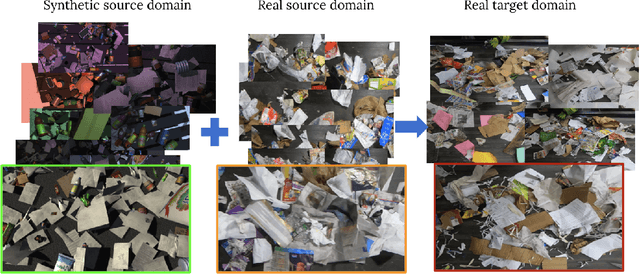
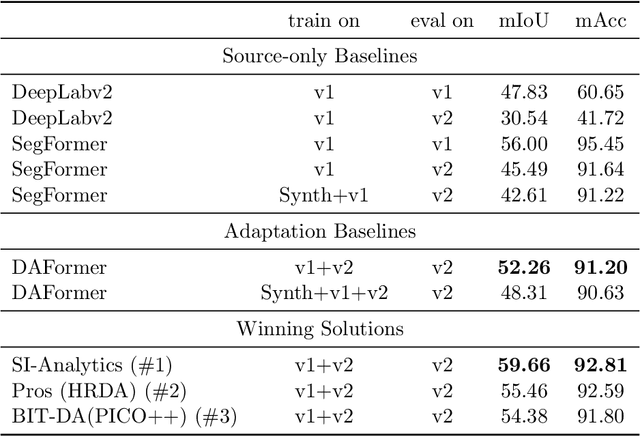


Label-efficient and reliable semantic segmentation is essential for many real-life applications, especially for industrial settings with high visual diversity, such as waste sorting. In industrial waste sorting, one of the biggest challenges is the extreme diversity of the input stream depending on factors like the location of the sorting facility, the equipment available in the facility, and the time of year, all of which significantly impact the composition and visual appearance of the waste stream. These changes in the data are called ``visual domains'', and label-efficient adaptation of models to such domains is needed for successful semantic segmentation of industrial waste. To test the abilities of computer vision models on this task, we present the VisDA 2022 Challenge on Domain Adaptation for Industrial Waste Sorting. Our challenge incorporates a fully-annotated waste sorting dataset, ZeroWaste, collected from two real material recovery facilities in different locations and seasons, as well as a novel procedurally generated synthetic waste sorting dataset, SynthWaste. In this competition, we aim to answer two questions: 1) can we leverage domain adaptation techniques to minimize the domain gap? and 2) can synthetic data augmentation improve performance on this task and help adapt to changing data distributions? The results of the competition show that industrial waste detection poses a real domain adaptation problem, that domain generalization techniques such as augmentations, ensembling, etc., improve the overall performance on the unlabeled target domain examples, and that leveraging synthetic data effectively remains an open problem. See https://ai.bu.edu/visda-2022/
Robust Test-Time Adaptation in Dynamic Scenarios
Mar 24, 2023
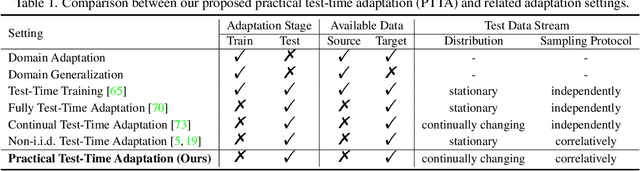


Test-time adaptation (TTA) intends to adapt the pretrained model to test distributions with only unlabeled test data streams. Most of the previous TTA methods have achieved great success on simple test data streams such as independently sampled data from single or multiple distributions. However, these attempts may fail in dynamic scenarios of real-world applications like autonomous driving, where the environments gradually change and the test data is sampled correlatively over time. In this work, we explore such practical test data streams to deploy the model on the fly, namely practical test-time adaptation (PTTA). To do so, we elaborate a Robust Test-Time Adaptation (RoTTA) method against the complex data stream in PTTA. More specifically, we present a robust batch normalization scheme to estimate the normalization statistics. Meanwhile, a memory bank is utilized to sample category-balanced data with consideration of timeliness and uncertainty. Further, to stabilize the training procedure, we develop a time-aware reweighting strategy with a teacher-student model. Extensive experiments prove that RoTTA enables continual testtime adaptation on the correlatively sampled data streams. Our method is easy to implement, making it a good choice for rapid deployment. The code is publicly available at https://github.com/BIT-DA/RoTTA
Improving Generalization with Domain Convex Game
Mar 23, 2023Domain generalization (DG) tends to alleviate the poor generalization capability of deep neural networks by learning model with multiple source domains. A classical solution to DG is domain augmentation, the common belief of which is that diversifying source domains will be conducive to the out-of-distribution generalization. However, these claims are understood intuitively, rather than mathematically. Our explorations empirically reveal that the correlation between model generalization and the diversity of domains may be not strictly positive, which limits the effectiveness of domain augmentation. This work therefore aim to guarantee and further enhance the validity of this strand. To this end, we propose a new perspective on DG that recasts it as a convex game between domains. We first encourage each diversified domain to enhance model generalization by elaborately designing a regularization term based on supermodularity. Meanwhile, a sample filter is constructed to eliminate low-quality samples, thereby avoiding the impact of potentially harmful information. Our framework presents a new avenue for the formal analysis of DG, heuristic analysis and extensive experiments demonstrate the rationality and effectiveness.
Open-vocabulary Panoptic Segmentation with Embedding Modulation
Mar 20, 2023Open-vocabulary image segmentation is attracting increasing attention due to its critical applications in the real world. Traditional closed-vocabulary segmentation methods are not able to characterize novel objects, whereas several recent open-vocabulary attempts obtain unsatisfactory results, i.e., notable performance reduction on the closed vocabulary and massive demand for extra data. To this end, we propose OPSNet, an omnipotent and data-efficient framework for Open-vocabulary Panoptic Segmentation. Specifically, the exquisitely designed Embedding Modulation module, together with several meticulous components, enables adequate embedding enhancement and information exchange between the segmentation model and the visual-linguistic well-aligned CLIP encoder, resulting in superior segmentation performance under both open- and closed-vocabulary settings with much fewer need of additional data. Extensive experimental evaluations are conducted across multiple datasets (e.g., COCO, ADE20K, Cityscapes, and PascalContext) under various circumstances, where the proposed OPSNet achieves state-of-the-art results, which demonstrates the effectiveness and generality of the proposed approach. The code and trained models will be made publicly available.
Dirichlet-based Uncertainty Calibration for Active Domain Adaptation
Feb 27, 2023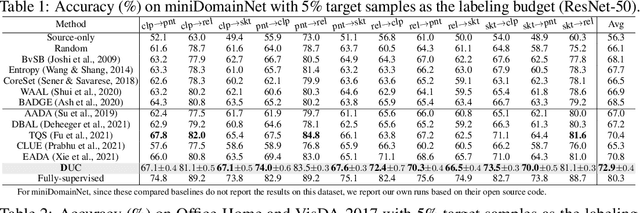
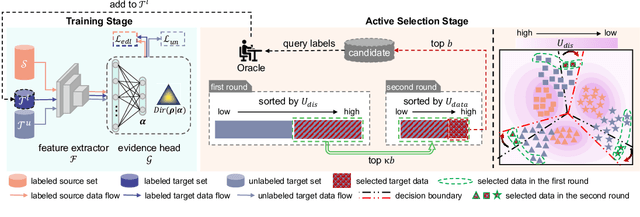
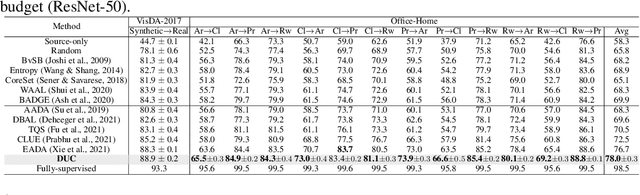
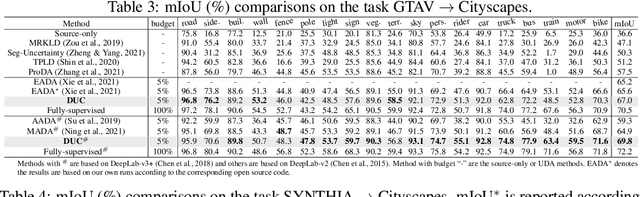
Active domain adaptation (DA) aims to maximally boost the model adaptation on a new target domain by actively selecting limited target data to annotate, whereas traditional active learning methods may be less effective since they do not consider the domain shift issue. Despite active DA methods address this by further proposing targetness to measure the representativeness of target domain characteristics, their predictive uncertainty is usually based on the prediction of deterministic models, which can easily be miscalibrated on data with distribution shift. Considering this, we propose a \textit{Dirichlet-based Uncertainty Calibration} (DUC) approach for active DA, which simultaneously achieves the mitigation of miscalibration and the selection of informative target samples. Specifically, we place a Dirichlet prior on the prediction and interpret the prediction as a distribution on the probability simplex, rather than a point estimate like deterministic models. This manner enables us to consider all possible predictions, mitigating the miscalibration of unilateral prediction. Then a two-round selection strategy based on different uncertainty origins is designed to select target samples that are both representative of target domain and conducive to discriminability. Extensive experiments on cross-domain image classification and semantic segmentation validate the superiority of DUC.