 Add to Chrome
 Add to Firefox
 Add to Edge
MINT: a Multi-modal Image and Narrative Text Dubbing Dataset for Foley Audio Content Planning and Generation
Jun 15, 2024


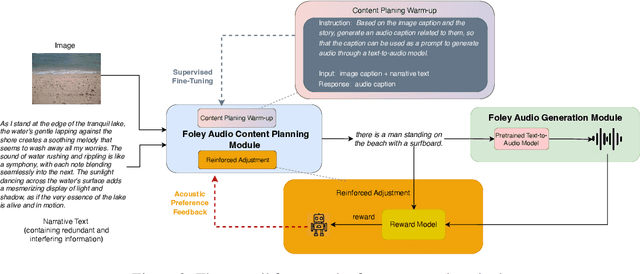

Foley audio, critical for enhancing the immersive experience in multimedia content, faces significant challenges in the AI-generated content (AIGC) landscape. Despite advancements in AIGC technologies for text and image generation, the foley audio dubbing remains rudimentary due to difficulties in cross-modal scene matching and content correlation. Current text-to-audio technology, which relies on detailed and acoustically relevant textual descriptions, falls short in practical video dubbing applications. Existing datasets like AudioSet, AudioCaps, Clotho, Sound-of-Story, and WavCaps do not fully meet the requirements for real-world foley audio dubbing task. To address this, we introduce the Multi-modal Image and Narrative Text Dubbing Dataset (MINT), designed to enhance mainstream dubbing tasks such as literary story audiobooks dubbing, image/silent video dubbing. Besides, to address the limitations of existing TTA technology in understanding and planning complex prompts, a Foley Audio Content Planning, Generation, and Alignment (CPGA) framework is proposed, which includes a content planning module leveraging large language models for complex multi-modal prompts comprehension. Additionally, the training process is optimized using Proximal Policy Optimization based reinforcement learning, significantly improving the alignment and auditory realism of generated foley audio. Experimental results demonstrate that our approach significantly advances the field of foley audio dubbing, providing robust solutions for the challenges of multi-modal dubbing. Even when utilizing the relatively lightweight GPT-2 model, our framework outperforms open-source multimodal large models such as LLaVA, DeepSeek-VL, and Moondream2. The dataset is available at https://github.com/borisfrb/MINT .

Transferring Knowledge from Large Foundation Models to Small Downstream Models
Jun 11, 2024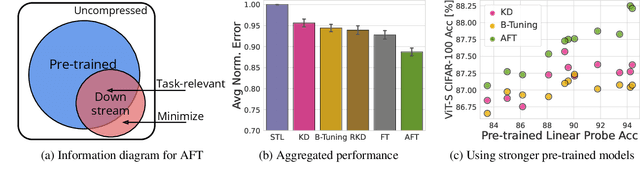
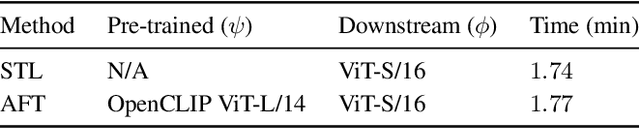
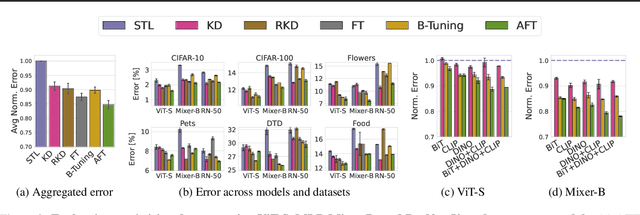

How do we transfer the relevant knowledge from ever larger foundation models into small, task-specific downstream models that can run at much lower costs? Standard transfer learning using pre-trained weights as the initialization transfers limited information and commits us to often massive pre-trained architectures. This procedure also precludes combining multiple pre-trained models that learn complementary information. To address these shortcomings, we introduce Adaptive Feature Transfer (AFT). Instead of transferring weights, AFT operates purely on features, thereby decoupling the choice of the pre-trained model from the smaller downstream model. Rather than indiscriminately compressing all pre-trained features, AFT adaptively transfers pre-trained features that are most useful for performing the downstream task, using a simple regularization that adds minimal overhead. Across multiple vision, language, and multi-modal datasets, AFT achieves significantly better downstream performance compared to alternatives with a similar computational cost. Furthermore, AFT reliably translates improvement in pre-trained models into improvement in downstream performance, even if the downstream model is over $50\times$ smaller, and can effectively transfer complementary information learned by multiple pre-trained models.
Discovering Bias in Latent Space: An Unsupervised Debiasing Approach
Jun 05, 2024The question-answering (QA) capabilities of foundation models are highly sensitive to prompt variations, rendering their performance susceptible to superficial, non-meaning-altering changes. This vulnerability often stems from the model's preference or bias towards specific input characteristics, such as option position or superficial image features in multi-modal settings. We propose to rectify this bias directly in the model's internal representation. Our approach, SteerFair, finds the bias direction in the model's representation space and steers activation values away from it during inference. Specifically, we exploit the observation that bias often adheres to simple association rules, such as the spurious association between the first option and correctness likelihood. Next, we construct demonstrations of these rules from unlabeled samples and use them to identify the bias directions. We empirically show that SteerFair significantly reduces instruction-tuned model performance variance across prompt modifications on three benchmark tasks. Remarkably, our approach surpasses a supervised baseline with 100 labels by an average of 10.86% accuracy points and 12.95 score points and matches the performance with 500 labels.
ADR-BC: Adversarial Density Weighted Regression Behavior Cloning
May 28, 2024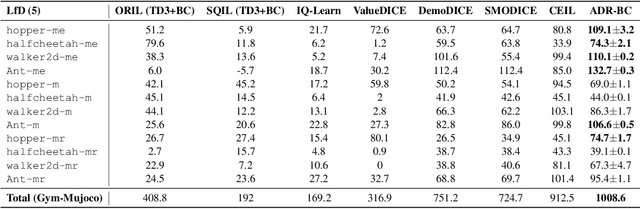

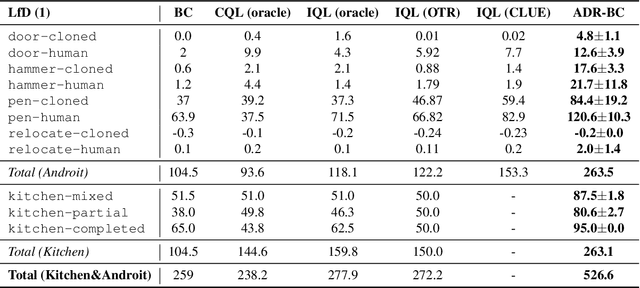

Typically, traditional Imitation Learning (IL) methods first shape a reward or Q function and then use this shaped function within a reinforcement learning (RL) framework to optimize the empirical policy. However, if the shaped reward/Q function does not adequately represent the ground truth reward/Q function, updating the policy within a multi-step RL framework may result in cumulative bias, further impacting policy learning. Although utilizing behavior cloning (BC) to learn a policy by directly mimicking a few demonstrations in a single-step updating manner can avoid cumulative bias, BC tends to greedily imitate demonstrated actions, limiting its capacity to generalize to unseen state action pairs. To address these challenges, we propose ADR-BC, which aims to enhance behavior cloning through augmented density-based action support, optimizing the policy with this augmented support. Specifically, the objective of ADR-BC shares the similar physical meanings that matching expert distribution while diverging the sub-optimal distribution. Therefore, ADR-BC can achieve more robust expert distribution matching. Meanwhile, as a one-step behavior cloning framework, ADR-BC avoids the cumulative bias associated with multi-step RL frameworks. To validate the performance of ADR-BC, we conduct extensive experiments. Specifically, ADR-BC showcases a 10.5% improvement over the previous state-of-the-art (SOTA) generalized IL baseline, CEIL, across all tasks in the Gym-Mujoco domain. Additionally, it achieves an 89.5% improvement over Implicit Q Learning (IQL) using real rewards across all tasks in the Adroit and Kitchen domains. On the other hand, we conduct extensive ablations to further demonstrate the effectiveness of ADR-BC.
SF-DQN: Provable Knowledge Transfer using Successor Feature for Deep Reinforcement Learning
May 24, 2024


This paper studies the transfer reinforcement learning (RL) problem where multiple RL problems have different reward functions but share the same underlying transition dynamics. In this setting, the Q-function of each RL problem (task) can be decomposed into a successor feature (SF) and a reward mapping: the former characterizes the transition dynamics, and the latter characterizes the task-specific reward function. This Q-function decomposition, coupled with a policy improvement operator known as generalized policy improvement (GPI), reduces the sample complexity of finding the optimal Q-function, and thus the SF \& GPI framework exhibits promising empirical performance compared to traditional RL methods like Q-learning. However, its theoretical foundations remain largely unestablished, especially when learning the successor features using deep neural networks (SF-DQN). This paper studies the provable knowledge transfer using SFs-DQN in transfer RL problems. We establish the first convergence analysis with provable generalization guarantees for SF-DQN with GPI. The theory reveals that SF-DQN with GPI outperforms conventional RL approaches, such as deep Q-network, in terms of both faster convergence rate and better generalization. Numerical experiments on real and synthetic RL tasks support the superior performance of SF-DQN \& GPI, aligning with our theoretical findings.
Can large language models understand uncommon meanings of common words?
May 09, 2024Large language models (LLMs) like ChatGPT have shown significant advancements across diverse natural language understanding (NLU) tasks, including intelligent dialogue and autonomous agents. Yet, lacking widely acknowledged testing mechanisms, answering `whether LLMs are stochastic parrots or genuinely comprehend the world' remains unclear, fostering numerous studies and sparking heated debates. Prevailing research mainly focuses on surface-level NLU, neglecting fine-grained explorations. However, such explorations are crucial for understanding their unique comprehension mechanisms, aligning with human cognition, and finally enhancing LLMs' general NLU capacities. To address this gap, our study delves into LLMs' nuanced semantic comprehension capabilities, particularly regarding common words with uncommon meanings. The idea stems from foundational principles of human communication within psychology, which underscore accurate shared understandings of word semantics. Specifically, this paper presents the innovative construction of a Lexical Semantic Comprehension (LeSC) dataset with novel evaluation metrics, the first benchmark encompassing both fine-grained and cross-lingual dimensions. Introducing models of both open-source and closed-source, varied scales and architectures, our extensive empirical experiments demonstrate the inferior performance of existing models in this basic lexical-meaning understanding task. Notably, even the state-of-the-art LLMs GPT-4 and GPT-3.5 lag behind 16-year-old humans by 3.9% and 22.3%, respectively. Additionally, multiple advanced prompting techniques and retrieval-augmented generation are also introduced to help alleviate this trouble, yet limitations persist. By highlighting the above critical shortcomings, this research motivates further investigation and offers novel insights for developing more intelligent LLMs.
FedSC: Provable Federated Self-supervised Learning with Spectral Contrastive Objective over Non-i.i.d. Data
May 07, 2024Recent efforts have been made to integrate self-supervised learning (SSL) with the framework of federated learning (FL). One unique challenge of federated self-supervised learning (FedSSL) is that the global objective of FedSSL usually does not equal the weighted sum of local SSL objectives. Consequently, conventional approaches, such as federated averaging (FedAvg), fail to precisely minimize the FedSSL global objective, often resulting in suboptimal performance, especially when data is non-i.i.d.. To fill this gap, we propose a provable FedSSL algorithm, named FedSC, based on the spectral contrastive objective. In FedSC, clients share correlation matrices of data representations in addition to model weights periodically, which enables inter-client contrast of data samples in addition to intra-client contrast and contraction, resulting in improved quality of data representations. Differential privacy (DP) protection is deployed to control the additional privacy leakage on local datasets when correlation matrices are shared. We also provide theoretical analysis on the convergence and extra privacy leakage. The experimental results validate the effectiveness of our proposed algorithm.
CoMM: Collaborative Multi-Agent, Multi-Reasoning-Path Prompting for Complex Problem Solving
Apr 26, 2024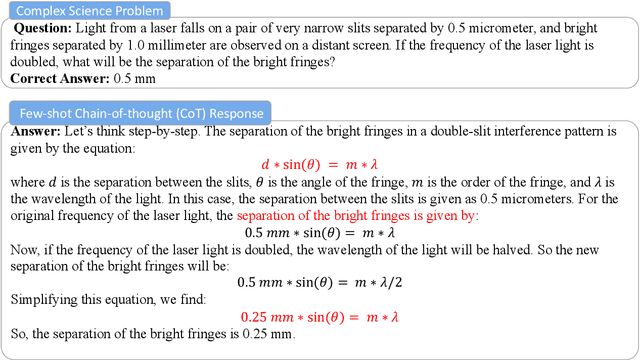
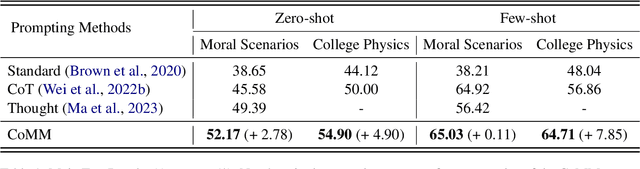
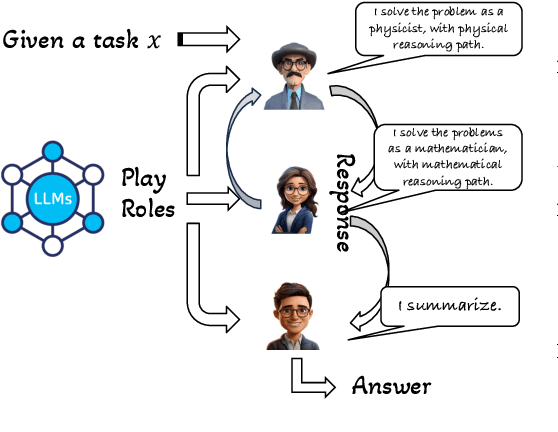
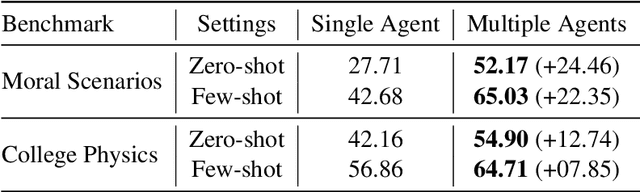
Large Language Models (LLMs) have shown great ability in solving traditional natural language tasks and elementary reasoning tasks with appropriate prompting techniques. However, their ability is still limited in solving complicated science problems. In this work, we aim to push the upper bound of the reasoning capability of LLMs by proposing a collaborative multi-agent, multi-reasoning-path (CoMM) prompting framework. Specifically, we prompt LLMs to play different roles in a problem-solving team, and encourage different role-play agents to collaboratively solve the target task. In particular, we discover that applying different reasoning paths for different roles is an effective strategy to implement few-shot prompting approaches in the multi-agent scenarios. Empirical results demonstrate the effectiveness of the proposed methods on two college-level science problems over competitive baselines. Our further analysis shows the necessity of prompting LLMs to play different roles or experts independently. We release the code at: https://github.com/amazon-science/comm-prompt
KS-LLM: Knowledge Selection of Large Language Models with Evidence Document for Question Answering
Apr 24, 2024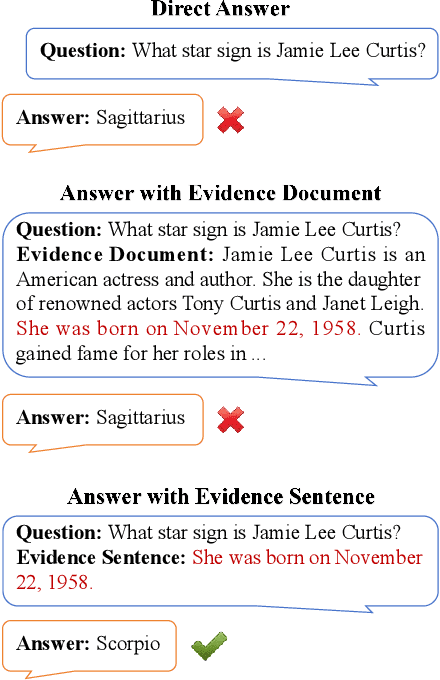

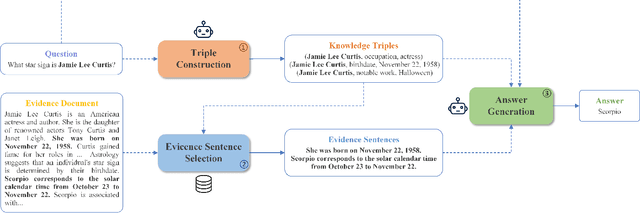

Large language models (LLMs) suffer from the hallucination problem and face significant challenges when applied to knowledge-intensive tasks. A promising approach is to leverage evidence documents as extra supporting knowledge, which can be obtained through retrieval or generation. However, existing methods directly leverage the entire contents of the evidence document, which may introduce noise information and impair the performance of large language models. To tackle this problem, we propose a novel Knowledge Selection of Large Language Models (KS-LLM) method, aiming to identify valuable information from evidence documents. The KS-LLM approach utilizes triples to effectively select knowledge snippets from evidence documents that are beneficial to answering questions. Specifically, we first generate triples based on the input question, then select the evidence sentences most similar to triples from the evidence document, and finally combine the evidence sentences and triples to assist large language models in generating answers. Experimental comparisons on several question answering datasets, such as TriviaQA, WebQ, and NQ, demonstrate that the proposed method surpasses the baselines and achieves the best results.
Gaussian Pancakes: Geometrically-Regularized 3D Gaussian Splatting for Realistic Endoscopic Reconstruction
Apr 09, 2024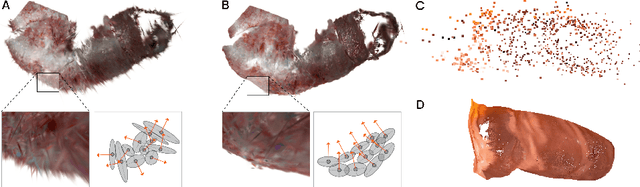
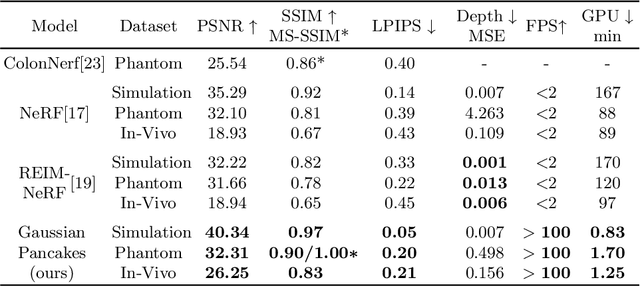
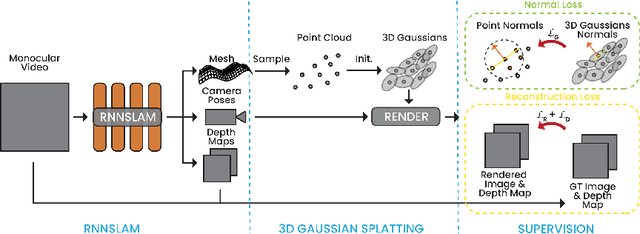
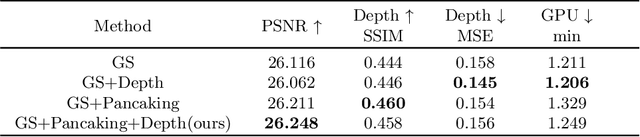
Within colorectal cancer diagnostics, conventional colonoscopy techniques face critical limitations, including a limited field of view and a lack of depth information, which can impede the detection of precancerous lesions. Current methods struggle to provide comprehensive and accurate 3D reconstructions of the colonic surface which can help minimize the missing regions and reinspection for pre-cancerous polyps. Addressing this, we introduce 'Gaussian Pancakes', a method that leverages 3D Gaussian Splatting (3D GS) combined with a Recurrent Neural Network-based Simultaneous Localization and Mapping (RNNSLAM) system. By introducing geometric and depth regularization into the 3D GS framework, our approach ensures more accurate alignment of Gaussians with the colon surface, resulting in smoother 3D reconstructions with novel viewing of detailed textures and structures. Evaluations across three diverse datasets show that Gaussian Pancakes enhances novel view synthesis quality, surpassing current leading methods with a 18% boost in PSNR and a 16% improvement in SSIM. It also delivers over 100X faster rendering and more than 10X shorter training times, making it a practical tool for real-time applications. Hence, this holds promise for achieving clinical translation for better detection and diagnosis of colorectal cancer.