 Add to Chrome
 Add to Firefox
 Add to Edge
Integrating Low-Altitude SAR Imaging into UAV Data Backhaul
Dec 26, 2025
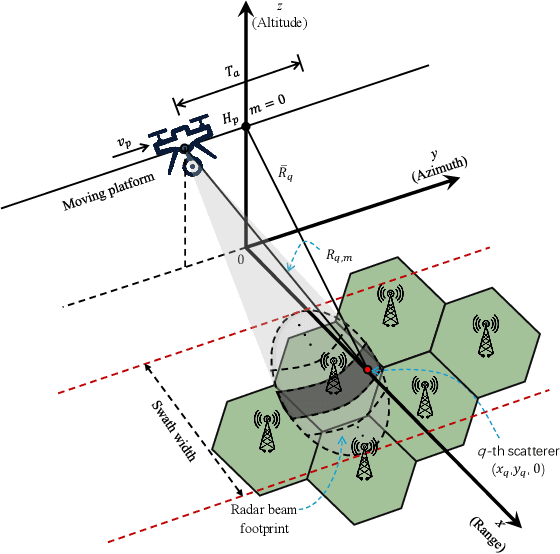
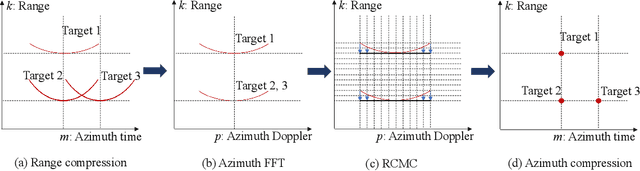
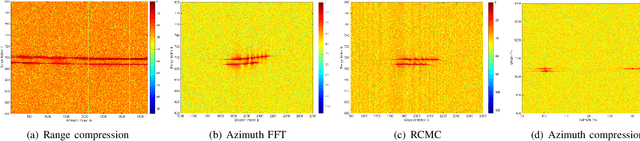
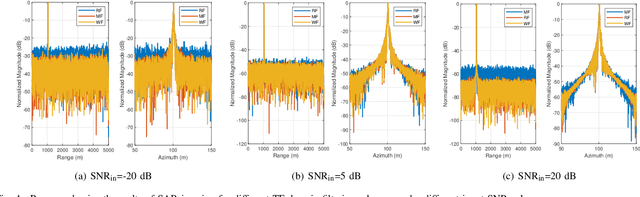
Synthetic aperture radar (SAR) deployed on unmanned aerial vehicles (UAVs) is expected to provide burgeoning imaging services for low-altitude wireless networks (LAWNs), thereby enabling large-scale environmental sensing and timely situational awareness. Conventional SAR systems typically leverages a deterministic radar waveform, while it conflicts with the integrated sensing and communications (ISAC) paradigm by discarding signaling randomness, in whole or in part. In fact, this approach reduces to the uplink pilot sensing in 5G New Radio (NR) with sounding reference signals (SRS), underutilizing data symbols. To explore the potential of data-aided imaging, we develop a low-altitude SAR imaging framework that sufficiently leverages data symbols carried by the native orthogonal frequency division multiplexing (OFDM) communication waveform. The randomness of modulated data in the temporal-frequency (TF) domain, introduced by non-constant modulus constellations such as quadrature amplitude modulation (QAM), may however severely degrade the imaging quality. To mitigate this effect, we incorporate several TF-domain filtering schemes within a rangeDoppler (RD) imaging framework and evaluate their impact. We further propose using the normalized mean square error (NMSE) of a reference point target's profile as an imaging performance metric. Simulation results with 5G NR parameters demonstrate that data-aided imaging substantially outperforms pilot-only counterpart, accordingly validating the effectiveness of the proposed OFDM-SAR imaging approach in LAWNs.

Timely Parameter Updating in Over-the-Air Federated Learning
Dec 22, 2025Incorporating over-the-air computations (OAC) into the model training process of federated learning (FL) is an effective approach to alleviating the communication bottleneck in FL systems. Under OAC-FL, every client modulates its intermediate parameters, such as gradient, onto the same set of orthogonal waveforms and simultaneously transmits the radio signal to the edge server. By exploiting the superposition property of multiple-access channels, the edge server can obtain an automatically aggregated global gradient from the received signal. However, the limited number of orthogonal waveforms available in practical systems is fundamentally mismatched with the high dimensionality of modern deep learning models. To address this issue, we propose Freshness Freshness-mAgnItude awaRe top-k (FAIR-k), an algorithm that selects, in each communication round, the most impactful subset of gradients to be updated over the air. In essence, FAIR-k combines the complementary strengths of the Round-Robin and Top-k algorithms, striking a delicate balance between timeliness (freshness of parameter updates) and importance (gradient magnitude). Leveraging tools from Markov analysis, we characterize the distribution of parameter staleness under FAIR-k. Building on this, we establish the convergence rate of OAC-FL with FAIR-k, which discloses the joint effect of data heterogeneity, channel noise, and parameter staleness on the training efficiency. Notably, as opposed to conventional analyses that assume a universal Lipschitz constant across all the clients, our framework adopts a finer-grained model of the data heterogeneity. The analysis demonstrates that since FAIR-k promotes fresh (and fair) parameter updates, it not only accelerates convergence but also enhances communication efficiency by enabling an extended period of local training without significantly affecting overall training efficiency.
AI-Driven Subcarrier-Level CQI Feedback
Dec 22, 2025The Channel Quality Indicator (CQI) is a fundamental component of channel state information (CSI) that enables adaptive modulation and coding by selecting the optimal modulation and coding scheme to meet a target block error rate. While AI-enabled CSI feedback has achieved significant advances, especially in precoding matrix index feedback, AI-based CQI feedback remains underexplored. Conventional subband-based CQI approaches, due to coarse granularity, often fail to capture fine frequency-selective variations and thus lead to suboptimal resource allocation. In this paper, we propose an AI-driven subcarrier-level CQI feedback framework tailored for 6G and NextG systems. First, we introduce CQInet, an autoencoder-based scheme that compresses per-subcarrier CQI at the user equipment and reconstructs it at the base station, significantly reducing feedback overhead without compromising CQI accuracy. Simulation results show that CQInet increases the effective data rate by 7.6% relative to traditional subband CQI under equivalent feedback overhead. Building on this, we develop SR-CQInet, which leverages super-resolution to infer fine-grained subcarrier CQI from sparsely reported CSI reference signals (CSI-RS). SR-CQInet reduces CSI-RS overhead to 3.5% of CQInet's requirements while maintaining comparable throughput. These results demonstrate that AI-driven subcarrier-level CQI feedback can substantially enhance spectral efficiency and reliability in future wireless networks.
Reducing Pilots in Channel Estimation With Predictive Foundation Models
Dec 17, 2025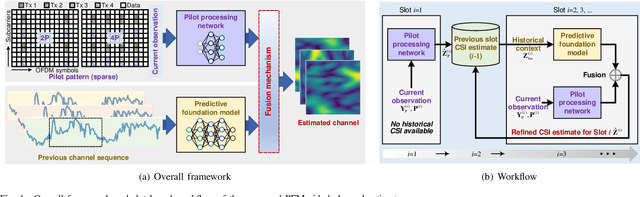
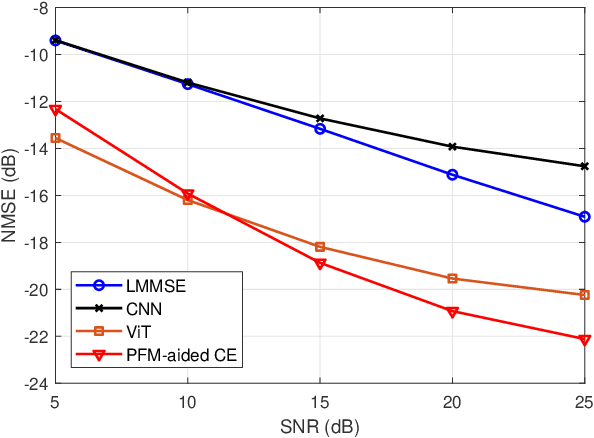
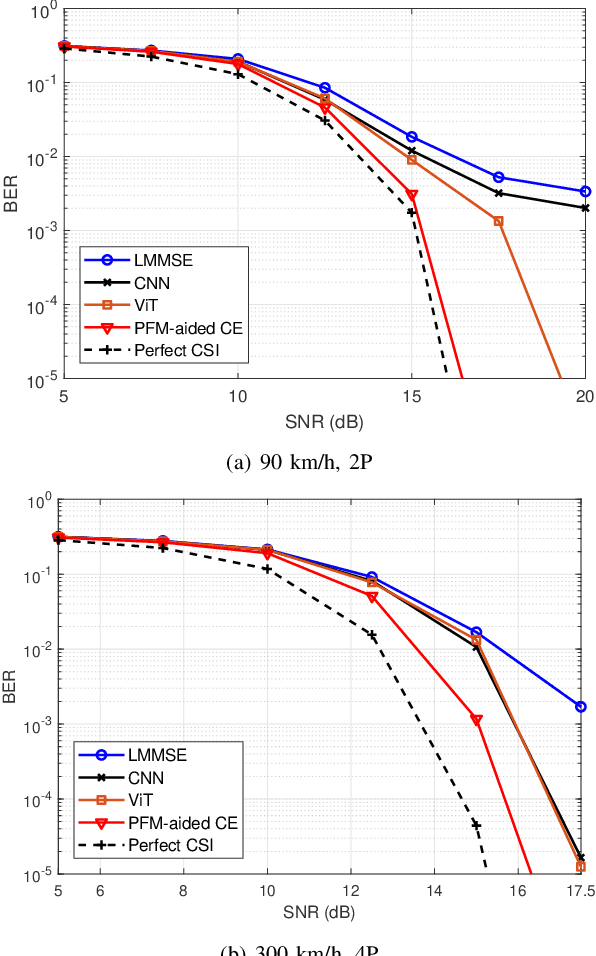
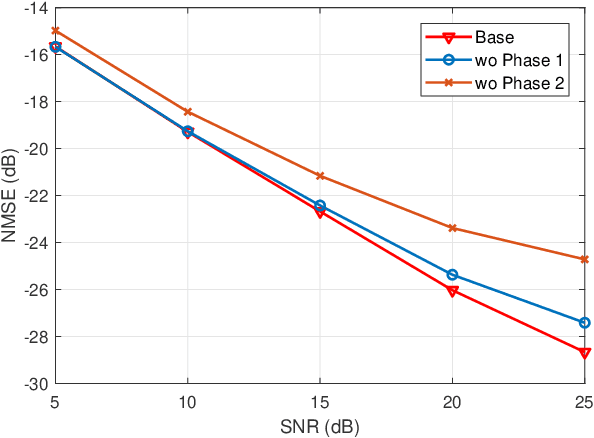
Accurate channel state information (CSI) acquisition is essential for modern wireless systems, which becomes increasingly difficult under large antenna arrays, strict pilot overhead constraints, and diverse deployment environments. Existing artificial intelligence-based solutions often lack robustness and fail to generalize across scenarios. To address this limitation, this paper introduces a predictive-foundation-model-based channel estimation framework that enables accurate, low-overhead, and generalizable CSI acquisition. The proposed framework employs a predictive foundation model trained on large-scale cross-domain CSI data to extract universal channel representations and provide predictive priors with strong cross-scenario transferability. A pilot processing network based on a vision transformer architecture is further designed to capture spatial, temporal, and frequency correlations from pilot observations. An efficient fusion mechanism integrates predictive priors with real-time measurements, enabling reliable CSI reconstruction even under sparse or noisy conditions. Extensive evaluations across diverse configurations demonstrate that the proposed estimator significantly outperforms both classical and data-driven baselines in accuracy, robustness, and generalization capability.
QoS-Aware Hierarchical Reinforcement Learning for Joint Link Selection and Trajectory Optimization in SAGIN-Supported UAV Mobility Management
Dec 17, 2025Due to the significant variations in unmanned aerial vehicle (UAV) altitude and horizontal mobility, it becomes difficult for any single network to ensure continuous and reliable threedimensional coverage. Towards that end, the space-air-ground integrated network (SAGIN) has emerged as an essential architecture for enabling ubiquitous UAV connectivity. To address the pronounced disparities in coverage and signal characteristics across heterogeneous networks, this paper formulates UAV mobility management in SAGIN as a constrained multi-objective joint optimization problem. The formulation couples discrete link selection with continuous trajectory optimization. Building on this, we propose a two-level multi-agent hierarchical deep reinforcement learning (HDRL) framework that decomposes the problem into two alternately solvable subproblems. To map complex link selection decisions into a compact discrete action space, we conceive a double deep Q-network (DDQN) algorithm in the top-level, which achieves stable and high-quality policy learning through double Q-value estimation. To handle the continuous trajectory action space while satisfying quality of service (QoS) constraints, we integrate the maximum-entropy mechanism of the soft actor-critic (SAC) and employ a Lagrangian-based constrained SAC (CSAC) algorithm in the lower-level that dynamically adjusts the Lagrange multipliers to balance constraint satisfaction and policy optimization. Moreover, the proposed algorithm can be extended to multi-UAV scenarios under the centralized training and decentralized execution (CTDE) paradigm, which enables more generalizable policies. Simulation results demonstrate that the proposed scheme substantially outperforms existing benchmarks in throughput, link switching frequency and QoS satisfaction.
Power Consumption and Energy Efficiency of Mid-Band XL-MIMO: Modeling, Scaling Laws, and Performance Insights
Dec 14, 2025Mid-band extra-large-scale multiple-input multiple-output (XL-MIMO), emerging as a critical enabler for future communication systems, is expected to deliver significantly higher throughput by leveraging the extended bandwidth and enlarged antenna aperture. However, power consumption remains a significant concern due to the enlarged system dimension, underscoring the need for thorough investigations into efficient system design and deployment. To this end, an in-depth study is conducted on mid-band XL-MIMO systems. Specifically, a comprehensive power consumption model is proposed, encompassing the power consumption of major hardware components and signal processing procedures, while capturing the influence of key system parameters. Considering typical near-field propagation characteristics, closed-form approximations of throughput are derived, providing an analytical framework for assessing energy efficiency (EE). Based on the proposed framework, the scaling law of EE with respect to key system configurations is derived, offering valuable insights for system design. Subsequently, extensions and comparisons are conducted among representative multi-antenna technologies, demonstrating the superiority of mid-band XL-MIMO in EE. Extensive numerical results not only verify the tightness of the throughput analysis but also validate the EE evaluations, unveiling the potential of energy-efficient mid-band XL-MIMO systems.
Adaptive Matched Filtering for Sensing With Communication Signals in Cluttered Environments
Dec 09, 2025This paper investigates the performance of the adaptive matched filtering (AMF) in cluttered environments, particularly when operating with superimposed signals. Since the instantaneous signal-to-clutter-plus-noise ratio (SCNR) is a random variable dependent on the data payload, using it directly as a design objective poses severe practical challenges, such as prohibitive computational burdens and signaling overhead. To address this, we propose shifting the optimization objective from an instantaneous to a statistical metric, which focuses on maximizing the average SCNR over all possible payloads. Due to its analytical intractability, we leverage tools from random matrix theory (RMT) to derive an asymptotic approximation for the average SCNR, which remains accurate even in moderate-dimensional regimes. A key finding from our theoretical analysis is that, for a fixed modulation basis, the PSK achieves a superior average SCNR compared to QAM and the pure Gaussian constellation. Furthermore, for any given constellation, the OFDM achieves a higher average SCNR than SC and AFDM. Then, we propose two pilot design schemes to enhance system performance: a Data-Payload-Dependent (DPD) scheme and a Data-Payload-Independent (DPI) scheme. The DPD approach maximizes the instantaneous SCNR for each transmission. Conversely, the DPI scheme optimizes the average SCNR, offering a flexible trade-off between sensing performance and implementation complexity. Then, we develop two dedicated optimization algorithms for DPD and DPI schemes. In particular, for the DPD problem, we employ fractional optimization and the KKT conditions to derive a closed-form solution. For the DPI problem, we adopt a manifold optimization approach to handle the inherent rank-one constraint efficiently. Simulation results validate the accuracy of our theoretical analysis and demonstrate the effectiveness of the proposed methods.
On Discrete Ambiguity Functions of Random Communication Waveforms
Dec 09, 2025This paper provides a fundamental characterization of the discrete ambiguity functions (AFs) of random communication waveforms under arbitrary orthonormal modulation with random constellation symbols, which serve as a key metric for evaluating the delay-Doppler sensing performance in future ISAC applications. A unified analytical framework is developed for two types of AFs, namely the discrete periodic AF (DP-AF) and the fast-slow time AF (FST-AF), where the latter may be seen as a small-Doppler approximation of the DP-AF. By analyzing the expectation of squared AFs, we derive exact closed-form expressions for both the expected sidelobe level (ESL) and the expected integrated sidelobe level (EISL) under the DP-AF and FST-AF formulations. For the DP-AF, we prove that the normalized EISL is identical for all orthogonal waveforms. To gain structural insights, we introduce a matrix representation based on the finite Weyl-Heisenberg (WH) group, where each delay-Doppler shift corresponds to a WH operator acting on the ISAC signal. This WH-group viewpoint yields sharp geometric constraints on the lowest sidelobes: The minimum ESL can only occur along a one-dimensional cut or over a set of widely dispersed delay-Doppler bins. Consequently, no waveform can attain the minimum ESL over any compact two-dimensional region, leading to a no-optimality (no-go) result under the DP-AF framework. For the FST-AF, the closed-form ESL and EISL expressions reveal a constellation-dependent regime governed by its kurtosis: The OFDM modulation achieves the minimum ESL for sub-Gaussian constellations, whereas the OTFS waveform becomes optimal for super-Gaussian constellations. Finally, four representative waveforms, namely, SC, OFDM, OTFS, and AFDM, are examined under both frameworks, and all theoretical results are verified through numerical examples.
How Particle-System Random Batch Methods Enhance Graph Transformer: Memory Efficiency and Parallel Computing Strategy
Nov 08, 2025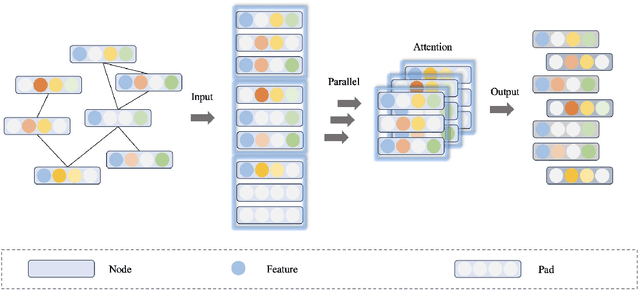


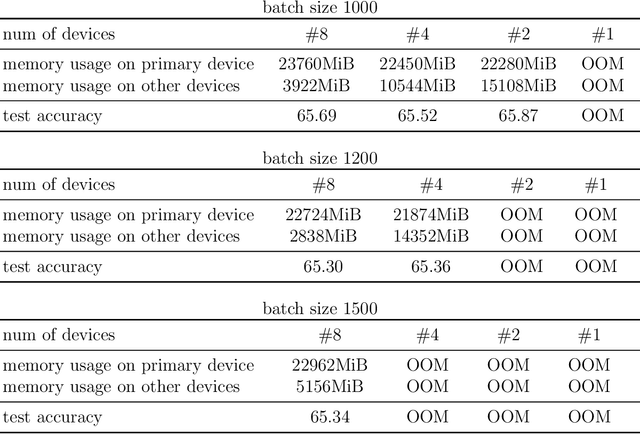
Attention mechanism is a significant part of Transformer models. It helps extract features from embedded vectors by adding global information and its expressivity has been proved to be powerful. Nevertheless, the quadratic complexity restricts its practicability. Although several researches have provided attention mechanism in sparse form, they are lack of theoretical analysis about the expressivity of their mechanism while reducing complexity. In this paper, we put forward Random Batch Attention (RBA), a linear self-attention mechanism, which has theoretical support of the ability to maintain its expressivity. Random Batch Attention has several significant strengths as follows: (1) Random Batch Attention has linear time complexity. Other than this, it can be implemented in parallel on a new dimension, which contributes to much memory saving. (2) Random Batch Attention mechanism can improve most of the existing models by replacing their attention mechanisms, even many previously improved attention mechanisms. (3) Random Batch Attention mechanism has theoretical explanation in convergence, as it comes from Random Batch Methods on computation mathematics. Experiments on large graphs have proved advantages mentioned above. Also, the theoretical modeling of self-attention mechanism is a new tool for future research on attention-mechanism analysis.
Next-Generation AI-Native Wireless Communications: MCMC-Based Receiver Architectures for Unified Processing
Oct 02, 2025The multiple-input multiple-output (MIMO) receiver processing is a key technology for current and next-generation wireless communications. However, it faces significant challenges related to complexity and scalability as the number of antennas increases. Artificial intelligence (AI), a cornerstone of next-generation wireless networks, offers considerable potential for addressing these challenges. This paper proposes an AI-driven, universal MIMO receiver architecture based on Markov chain Monte Carlo (MCMC) techniques. Unlike existing AI-based methods that treat receiver processing as a black box, our MCMC-based approach functions as a generic Bayesian computing engine applicable to various processing tasks, including channel estimation, symbol detection, and channel decoding. This method enhances the interpretability, scalability, and flexibility of receivers in diverse scenarios. Furthermore, the proposed approach integrates these tasks into a unified probabilistic framework, thereby enabling overall performance optimization. This unified framework can also be seamlessly combined with data-driven learning methods to facilitate the development of fully intelligent communication receivers.