 Add to Chrome
 Add to Firefox
 Add to Edge
AI-Driven Subcarrier-Level CQI Feedback
Dec 22, 2025
The Channel Quality Indicator (CQI) is a fundamental component of channel state information (CSI) that enables adaptive modulation and coding by selecting the optimal modulation and coding scheme to meet a target block error rate. While AI-enabled CSI feedback has achieved significant advances, especially in precoding matrix index feedback, AI-based CQI feedback remains underexplored. Conventional subband-based CQI approaches, due to coarse granularity, often fail to capture fine frequency-selective variations and thus lead to suboptimal resource allocation. In this paper, we propose an AI-driven subcarrier-level CQI feedback framework tailored for 6G and NextG systems. First, we introduce CQInet, an autoencoder-based scheme that compresses per-subcarrier CQI at the user equipment and reconstructs it at the base station, significantly reducing feedback overhead without compromising CQI accuracy. Simulation results show that CQInet increases the effective data rate by 7.6% relative to traditional subband CQI under equivalent feedback overhead. Building on this, we develop SR-CQInet, which leverages super-resolution to infer fine-grained subcarrier CQI from sparsely reported CSI reference signals (CSI-RS). SR-CQInet reduces CSI-RS overhead to 3.5% of CQInet's requirements while maintaining comparable throughput. These results demonstrate that AI-driven subcarrier-level CQI feedback can substantially enhance spectral efficiency and reliability in future wireless networks.

AI for CSI Prediction in 5G-Advanced and Beyond
Apr 17, 2025Artificial intelligence (AI) is pivotal in advancing fifth-generation (5G)-Advanced and sixth-generation systems, capturing substantial research interest. Both the 3rd Generation Partnership Project (3GPP) and leading corporations champion AI's standardization in wireless communication. This piece delves into AI's role in channel state information (CSI) prediction, a sub-use case acknowledged in 5G-Advanced by the 3GPP. We offer an exhaustive survey of AI-driven CSI prediction, highlighting crucial elements like accuracy, generalization, and complexity. Further, we touch on the practical side of model management, encompassing training, monitoring, and data gathering. Moreover, we explore prospects for CSI prediction in future wireless communication systems, entailing integrated design with feedback, multitasking synergy, and predictions in rapid scenarios. This article seeks to be a touchstone for subsequent research in this burgeoning domain.
The VEP Booster: A Closed-Loop AI System for Visual EEG Biomarker Auto-generation
Jul 21, 2024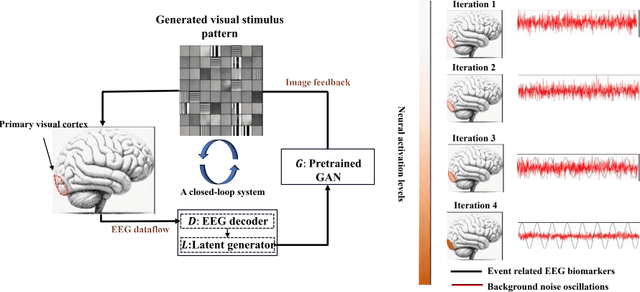
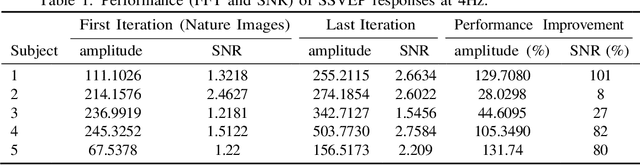
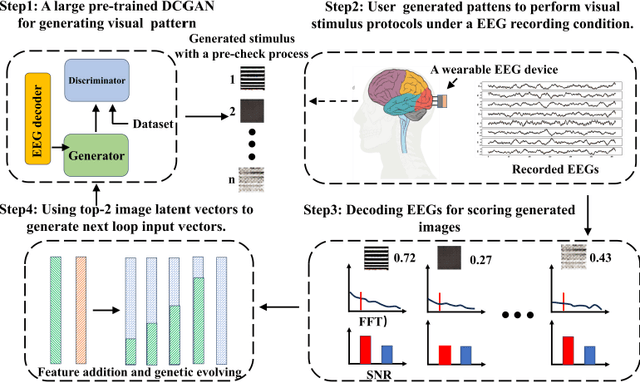
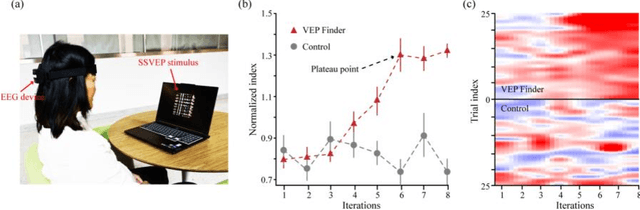
Effective visual brain-machine interfaces (BMI) is based on reliable and stable EEG biomarkers. However, traditional adaptive filter-based approaches may suffer from individual variations in EEG signals, while deep neural network-based approaches may be hindered by the non-stationarity of EEG signals caused by biomarker attenuation and background oscillations. To address these challenges, we propose the Visual Evoked Potential Booster (VEP Booster), a novel closed-loop AI framework that generates reliable and stable EEG biomarkers under visual stimulation protocols. Our system leverages an image generator to refine stimulus images based on real-time feedback from human EEG signals, generating visual stimuli tailored to the preferences of primary visual cortex (V1) neurons and enabling effective targeting of neurons most responsive to stimuli. We validated our approach by implementing a system and employing steady-state visual evoked potential (SSVEP) visual protocols in five human subjects. Our results show significant enhancements in the reliability and utility of EEG biomarkers for all individuals, with the largest improvement in SSVEP response being 105%, the smallest being 28%, and the average increase being 76.5%. These promising results have implications for both clinical and technological applications