 Add to Chrome
 Add to Firefox
 Add to Edge
A specialized reasoning large language model for accelerating rare disease diagnosis: a randomized AI physician assistance trial
Jun 23, 2026
Rare diseases affect millions of individuals worldwide, yet timely diagnosis remains a major public health challenge due to scarcity of specialized clinical expertise. While large language models (LLMs) show promise to support rare disease diagnosis, current models are constrained by insufficient clinical deployability, limited clinically grounded evidence, and scarcity of training data. Here we present RaDaR (Rare Disease navigatoR), an open-source, compact reasoning LLM (32B parameters) for rare disease diagnosis. RaDaR was trained with 49,170 publicly available free-text cases and 104,666 synthetic cases with reasoning-enhanced training. RaDaR showed the strongest performance among evaluated open-source models, including the 671B DeepSeek-R1, across public benchmarks and four external validation centers. In a retrospective cohort, RaDaR prioritized the final diagnosis before documented clinical suspicion in 61.06 percent of cases, corresponding to a potential lead time of 1.87 months and 50.18 percent of the within-center interval. In a randomized physician-assistance trial, RaDaR assistance improved physicians' rare-disease diagnostic accuracy by 21.44 percentage points compared with internet search alone. Synthetic-data ablations suggested that phenotype-anchored narratives provide useful training signal for long-tail rare diseases, with a monotonic scaling trend within the tested data range. Together, RaDaR and its development and validation framework provide a deployable rare-disease reasoning model and a reproducible development framework for diagnostic AI under data scarcity.

SoccerNet 2025 Challenges Results
Aug 26, 2025The SoccerNet 2025 Challenges mark the fifth annual edition of the SoccerNet open benchmarking effort, dedicated to advancing computer vision research in football video understanding. This year's challenges span four vision-based tasks: (1) Team Ball Action Spotting, focused on detecting ball-related actions in football broadcasts and assigning actions to teams; (2) Monocular Depth Estimation, targeting the recovery of scene geometry from single-camera broadcast clips through relative depth estimation for each pixel; (3) Multi-View Foul Recognition, requiring the analysis of multiple synchronized camera views to classify fouls and their severity; and (4) Game State Reconstruction, aimed at localizing and identifying all players from a broadcast video to reconstruct the game state on a 2D top-view of the field. Across all tasks, participants were provided with large-scale annotated datasets, unified evaluation protocols, and strong baselines as starting points. This report presents the results of each challenge, highlights the top-performing solutions, and provides insights into the progress made by the community. The SoccerNet Challenges continue to serve as a driving force for reproducible, open research at the intersection of computer vision, artificial intelligence, and sports. Detailed information about the tasks, challenges, and leaderboards can be found at https://www.soccer-net.org, with baselines and development kits available at https://github.com/SoccerNet.
Chain-of-Thought Textual Reasoning for Few-shot Temporal Action Localization
Apr 18, 2025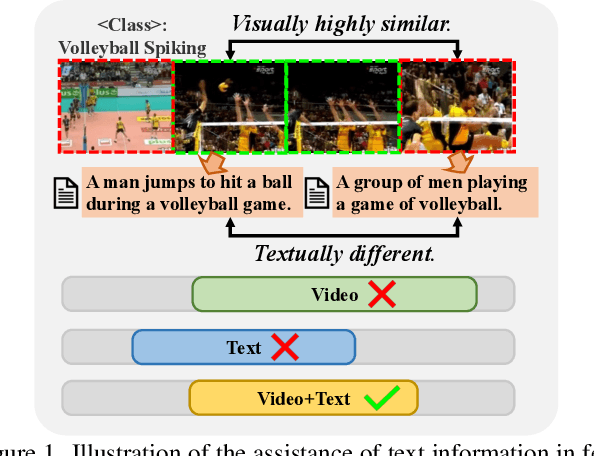
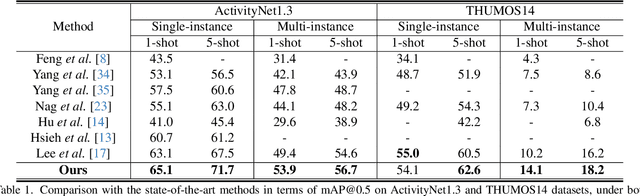
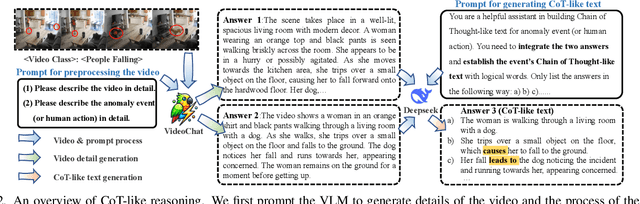
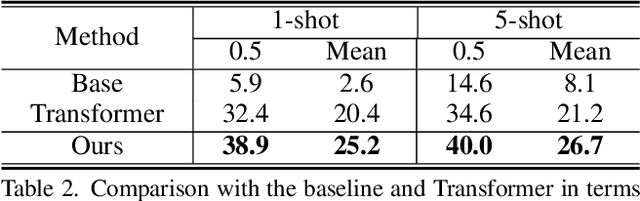
Traditional temporal action localization (TAL) methods rely on large amounts of detailed annotated data, whereas few-shot TAL reduces this dependence by using only a few training samples to identify unseen action categories. However, existing few-shot TAL methods typically focus solely on video-level information, neglecting textual information, which can provide valuable semantic support for the localization task. Therefore, we propose a new few-shot temporal action localization method by Chain-of-Thought textual reasoning to improve localization performance. Specifically, we design a novel few-shot learning framework that leverages textual semantic information to enhance the model's ability to capture action commonalities and variations, which includes a semantic-aware text-visual alignment module designed to align the query and support videos at different levels. Meanwhile, to better express the temporal dependencies and causal relationships between actions at the textual level to assist action localization, we design a Chain of Thought (CoT)-like reasoning method that progressively guides the Vision Language Model (VLM) and Large Language Model (LLM) to generate CoT-like text descriptions for videos. The generated texts can capture more variance of action than visual features. We conduct extensive experiments on the publicly available ActivityNet1.3 and THUMOS14 datasets. We introduce the first dataset named Human-related Anomaly Localization and explore the application of the TAL task in human anomaly detection. The experimental results demonstrate that our proposed method significantly outperforms existing methods in single-instance and multi-instance scenarios. We will release our code, data and benchmark.