 Add to Chrome
 Add to Firefox
 Add to Edge
A specialized reasoning large language model for accelerating rare disease diagnosis: a randomized AI physician assistance trial
Jun 23, 2026
Rare diseases affect millions of individuals worldwide, yet timely diagnosis remains a major public health challenge due to scarcity of specialized clinical expertise. While large language models (LLMs) show promise to support rare disease diagnosis, current models are constrained by insufficient clinical deployability, limited clinically grounded evidence, and scarcity of training data. Here we present RaDaR (Rare Disease navigatoR), an open-source, compact reasoning LLM (32B parameters) for rare disease diagnosis. RaDaR was trained with 49,170 publicly available free-text cases and 104,666 synthetic cases with reasoning-enhanced training. RaDaR showed the strongest performance among evaluated open-source models, including the 671B DeepSeek-R1, across public benchmarks and four external validation centers. In a retrospective cohort, RaDaR prioritized the final diagnosis before documented clinical suspicion in 61.06 percent of cases, corresponding to a potential lead time of 1.87 months and 50.18 percent of the within-center interval. In a randomized physician-assistance trial, RaDaR assistance improved physicians' rare-disease diagnostic accuracy by 21.44 percentage points compared with internet search alone. Synthetic-data ablations suggested that phenotype-anchored narratives provide useful training signal for long-tail rare diseases, with a monotonic scaling trend within the tested data range. Together, RaDaR and its development and validation framework provide a deployable rare-disease reasoning model and a reproducible development framework for diagnostic AI under data scarcity.

Evaluating Entity Retrieval in Electronic Health Records: a Semantic Gap Perspective
Feb 10, 2025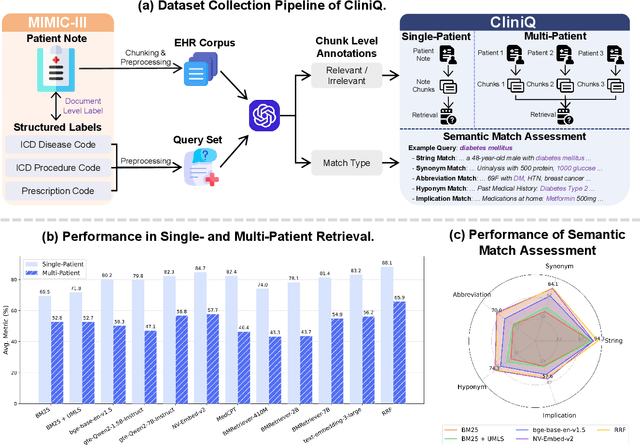
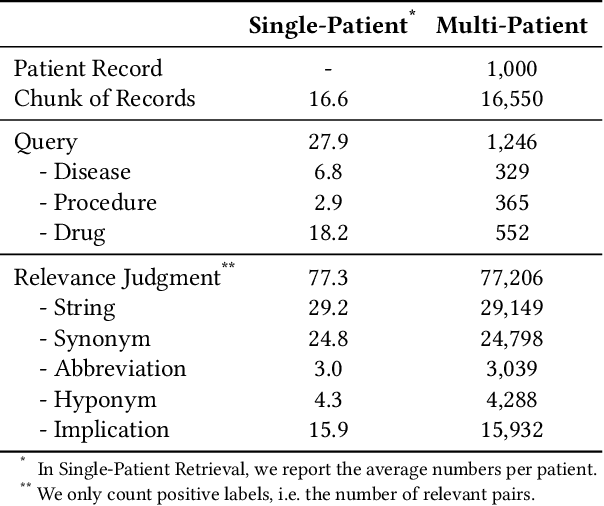
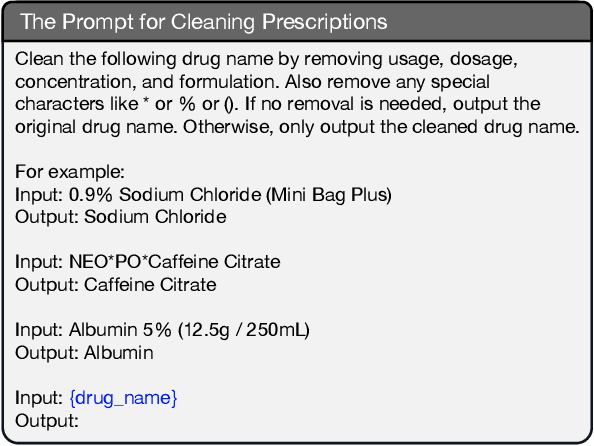
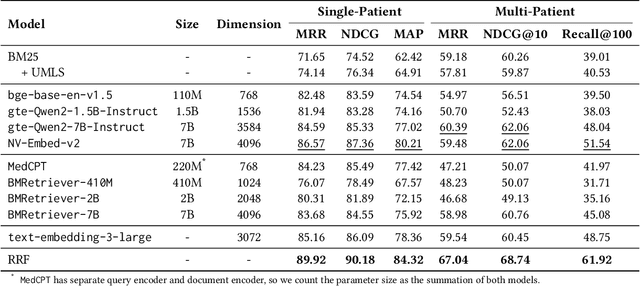
Entity retrieval plays a crucial role in the utilization of Electronic Health Records (EHRs) and is applied across a wide range of clinical practices. However, a comprehensive evaluation of this task is lacking due to the absence of a public benchmark. In this paper, we propose the development and release of a novel benchmark for evaluating entity retrieval in EHRs, with a particular focus on the semantic gap issue. Using discharge summaries from the MIMIC-III dataset, we incorporate ICD codes and prescription labels associated with the notes as queries, and annotate relevance judgments using GPT-4. In total, we use 1,000 patient notes, generate 1,246 queries, and provide over 77,000 relevance annotations. To offer the first assessment of the semantic gap, we introduce a novel classification system for relevance matches. Leveraging GPT-4, we categorize each relevant pair into one of five categories: string, synonym, abbreviation, hyponym, and implication. Using the proposed benchmark, we evaluate several retrieval methods, including BM25, query expansion, and state-of-the-art dense retrievers. Our findings show that BM25 provides a strong baseline but struggles with semantic matches. Query expansion significantly improves performance, though it slightly reduces string match capabilities. Dense retrievers outperform traditional methods, particularly for semantic matches, and general-domain dense retrievers often surpass those trained specifically in the biomedical domain.