 Add to Chrome
 Add to Firefox
 Add to Edge
Olmo 3
Dec 15, 2025
We introduce Olmo 3, a family of state-of-the-art, fully-open language models at the 7B and 32B parameter scales. Olmo 3 model construction targets long-context reasoning, function calling, coding, instruction following, general chat, and knowledge recall. This release includes the entire model flow, i.e., the full lifecycle of the family of models, including every stage, checkpoint, data point, and dependency used to build it. Our flagship model, Olmo 3 Think 32B, is the strongest fully-open thinking model released to-date.

GovScape: A Public Multimodal Search System for 70 Million Pages of Government PDFs
Nov 14, 2025Efforts over the past three decades have produced web archives containing billions of webpage snapshots and petabytes of data. The End of Term Web Archive alone contains, among other file types, millions of PDFs produced by the federal government. While preservation with web archives has been successful, significant challenges for access and discoverability remain. For example, current affordances for browsing the End of Term PDFs are limited to downloading and browsing individual PDFs, as well as performing basic keyword search across them. In this paper, we introduce GovScape, a public search system that supports multimodal searches across 10,015,993 federal government PDFs from the 2020 End of Term crawl (70,958,487 total PDF pages) - to our knowledge, all renderable PDFs in the 2020 crawl that are 50 pages or under. GovScape supports four primary forms of search over these 10 million PDFs: in addition to providing (1) filter conditions over metadata facets including domain and crawl date and (2) exact text search against the PDF text, we provide (3) semantic text search and (4) visual search against the PDFs across individual pages, enabling users to structure queries such as "redacted documents" or "pie charts." We detail the constituent components of GovScape, including the search affordances, embedding pipeline, system architecture, and open source codebase. Significantly, the total estimated compute cost for GovScape's pre-processing pipeline for 10 million PDFs was approximately $1,500, equivalent to 47,000 PDF pages per dollar spent on compute, demonstrating the potential for immediate scalability. Accordingly, we outline steps that we have already begun pursuing toward multimodal search at the 100+ million PDF scale. GovScape can be found at https://www.govscape.net.
Completion $ eq$ Collaboration: Scaling Collaborative Effort with Agents
Oct 30, 2025Current evaluations of agents remain centered around one-shot task completion, failing to account for the inherently iterative and collaborative nature of many real-world problems, where human goals are often underspecified and evolve. We argue for a shift from building and assessing task completion agents to developing collaborative agents, assessed not only by the quality of their final outputs but by how well they engage with and enhance human effort throughout the problem-solving process. To support this shift, we introduce collaborative effort scaling, a framework that captures how an agent's utility grows with increasing user involvement. Through case studies and simulated evaluations, we show that state-of-the-art agents often underperform in multi-turn, real-world scenarios, revealing a missing ingredient in agent design: the ability to sustain engagement and scaffold user understanding. Collaborative effort scaling offers a lens for diagnosing agent behavior and guiding development toward more effective interactions.
SPG: Sandwiched Policy Gradient for Masked Diffusion Language Models
Oct 10, 2025Diffusion large language models (dLLMs) are emerging as an efficient alternative to autoregressive models due to their ability to decode multiple tokens in parallel. However, aligning dLLMs with human preferences or task-specific rewards via reinforcement learning (RL) is challenging because their intractable log-likelihood precludes the direct application of standard policy gradient methods. While prior work uses surrogates like the evidence lower bound (ELBO), these one-sided approximations can introduce significant policy gradient bias. To address this, we propose the Sandwiched Policy Gradient (SPG) that leverages both an upper and a lower bound of the true log-likelihood. Experiments show that SPG significantly outperforms baselines based on ELBO or one-step estimation. Specifically, SPG improves the accuracy over state-of-the-art RL methods for dLLMs by 3.6% in GSM8K, 2.6% in MATH500, 18.4% in Countdown and 27.0% in Sudoku.
SelfCite: Self-Supervised Alignment for Context Attribution in Large Language Models
Feb 13, 2025

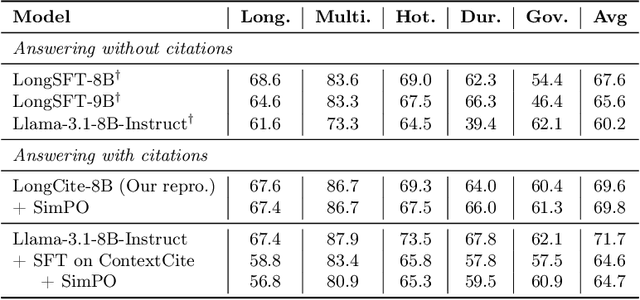

We introduce SelfCite, a novel self-supervised approach that aligns LLMs to generate high-quality, fine-grained, sentence-level citations for the statements in their generated responses. Instead of only relying on costly and labor-intensive annotations, SelfCite leverages a reward signal provided by the LLM itself through context ablation: If a citation is necessary, removing the cited text from the context should prevent the same response; if sufficient, retaining the cited text alone should preserve the same response. This reward can guide the inference-time best-of-N sampling strategy to improve citation quality significantly, as well as be used in preference optimization to directly fine-tune the models for generating better citations. The effectiveness of SelfCite is demonstrated by increasing citation F1 up to 5.3 points on the LongBench-Cite benchmark across five long-form question answering tasks.
SciRIFF: A Resource to Enhance Language Model Instruction-Following over Scientific Literature
Jun 10, 2024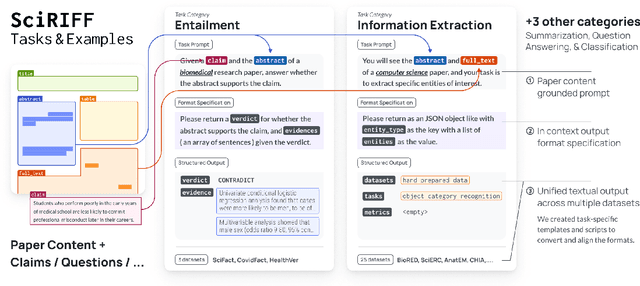

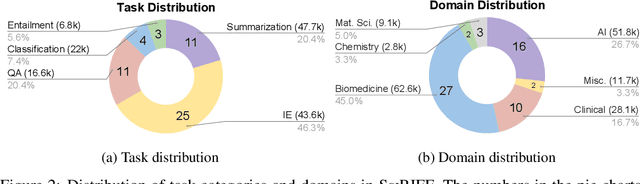
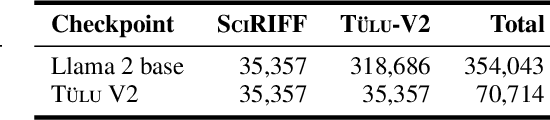
We present SciRIFF (Scientific Resource for Instruction-Following and Finetuning), a dataset of 137K instruction-following demonstrations for 54 tasks covering five essential scientific literature understanding capabilities: information extraction, summarization, question answering, claim verification, and classification. SciRIFF demonstrations are notable for their long input contexts, detailed task specifications, and complex structured outputs. While instruction-following resources are available in specific domains such as clinical medicine and chemistry, SciRIFF is the first dataset focused on extracting and synthesizing information from research literature across a wide range of scientific fields. To demonstrate the utility of SciRIFF, we develop a sample-efficient strategy to adapt a general instruction-following model for science by performing additional finetuning on a mix of general-domain and SciRIFF demonstrations. In evaluations on nine held-out scientific tasks, our model -- called SciTulu -- improves over a strong LLM baseline by 28.1% and 6.5% at the 7B and 70B scales respectively, while maintaining general instruction-following performance within 2% of the baseline. We are optimistic that SciRIFF will facilitate the development and evaluation of LLMs to help researchers navigate the ever-growing body of scientific literature. We release our dataset, model checkpoints, and data processing and evaluation code to enable further research.
A Design Space for Intelligent and Interactive Writing Assistants
Mar 26, 2024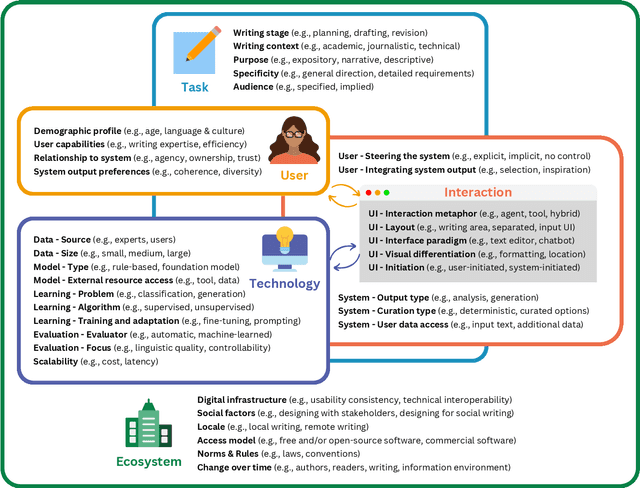
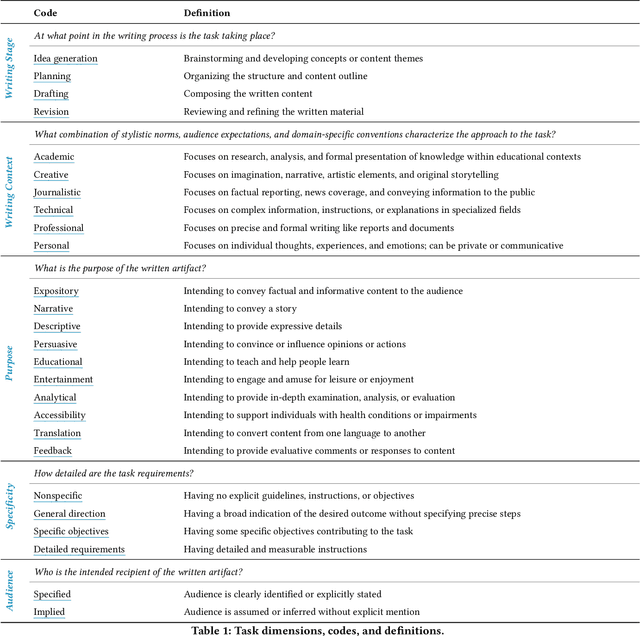
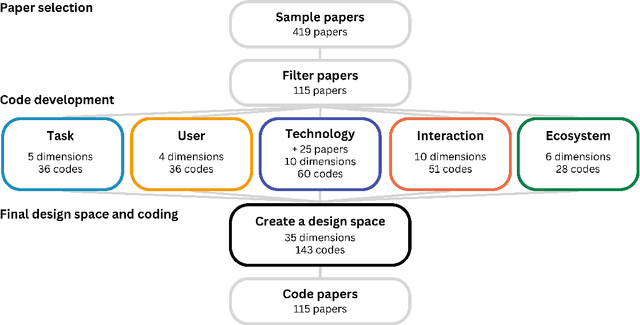

In our era of rapid technological advancement, the research landscape for writing assistants has become increasingly fragmented across various research communities. We seek to address this challenge by proposing a design space as a structured way to examine and explore the multidimensional space of intelligent and interactive writing assistants. Through a large community collaboration, we explore five aspects of writing assistants: task, user, technology, interaction, and ecosystem. Within each aspect, we define dimensions (i.e., fundamental components of an aspect) and codes (i.e., potential options for each dimension) by systematically reviewing 115 papers. Our design space aims to offer researchers and designers a practical tool to navigate, comprehend, and compare the various possibilities of writing assistants, and aid in the envisioning and design of new writing assistants.
Learning to Decode Collaboratively with Multiple Language Models
Mar 06, 2024
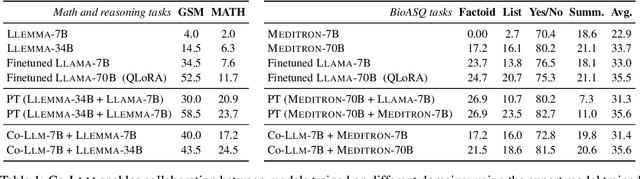
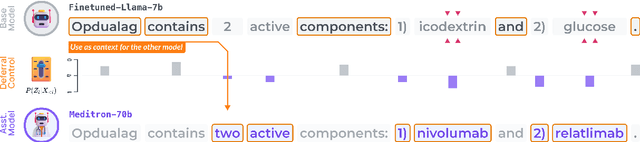

We propose a method to teach multiple large language models (LLM) to collaborate by interleaving their generations at the token level. We model the decision of which LLM generates the next token as a latent variable. By optimizing the marginal likelihood of a training set under our latent variable model, the base LLM automatically learns when to generate itself and when to call on one of the ``assistant'' language models to generate, all without direct supervision. Token-level collaboration during decoding allows for a fusion of each model's expertise in a manner tailored to the specific task at hand. Our collaborative decoding is especially useful in cross-domain settings where a generalist base LLM learns to invoke domain expert models. On instruction-following, domain-specific QA, and reasoning tasks, we show that the performance of the joint system exceeds that of the individual models. Through qualitative analysis of the learned latent decisions, we show models trained with our method exhibit several interesting collaboration patterns, e.g., template-filling. Our code is available at https://github.com/clinicalml/co-llm.
A Data-Centric Approach To Generate Faithful and High Quality Patient Summaries with Large Language Models
Feb 23, 2024


Patients often face difficulties in understanding their hospitalizations, while healthcare workers have limited resources to provide explanations. In this work, we investigate the potential of large language models to generate patient summaries based on doctors' notes and study the effect of training data on the faithfulness and quality of the generated summaries. To this end, we develop a rigorous labeling protocol for hallucinations, and have two medical experts annotate 100 real-world summaries and 100 generated summaries. We show that fine-tuning on hallucination-free data effectively reduces hallucinations from 2.60 to 1.55 per summary for Llama 2, while preserving relevant information. Although the effect is still present, it is much smaller for GPT-4 when prompted with five examples (0.70 to 0.40). We also conduct a qualitative evaluation using hallucination-free and improved training data. GPT-4 shows very good results even in the zero-shot setting. We find that common quantitative metrics do not correlate well with faithfulness and quality. Finally, we test GPT-4 for automatic hallucination detection, which yields promising results.