 Add to Chrome
 Add to Firefox
 Add to Edge
Learning from 53.6K Real-World Developer Edits of AI-Generated Code
Jul 27, 2026
Imperfections in AI-generated code require that software developers modify the generated code manually, or by re-prompting an AI programming assistant. Manual code edits provide more realistic and granular information on editing behavior than Git commits, which only contain final successful code snippets. Yet, due to a lack of high-quality, realistic code editing data, LLMs are mostly trained on publicly available Git data (e.g., commits). To address this gap, we introduce DECODE (Developer Edits of Code Dataset), a dataset of 53.6K real-world in-IDE code edits of AI-generated code in Python, TypeScript, and JavaScript, sourced from 1K+ developers. First, we demonstrate the utility of DECODE for data analysis, obtaining insights on when, why, and how AI-generated code is edited. We find that most edits occur within the first 15 minutes after accepting an AI completion, resulting in the removal of AI completions in 31% of edit trajectories. Second, we use DECODE to benchmark the ability of LLMs to predict code edits. We find that finetuning on DECODE enables open-source 3B models to perform code edit prediction tasks significantly better than frontier LLMs. We then discuss implications of this work, emphasizing the necessity of developer-centric machine learning approaches for future AI programming assistants.

Comparing Developer and LLM Biases in Code Evaluation
Mar 25, 2026As LLMs are increasingly used as judges in code applications, they should be evaluated in realistic interactive settings that capture partial context and ambiguous intent. We present TRACE (Tool for Rubric Analysis in Code Evaluation), a framework that evaluates LLM judges' ability to predict human preferences and automatically extracts rubric items to reveal systematic biases in how humans and models weigh each item. Across three modalities -- chat-based programming, IDE autocompletion, and instructed code editing -- we use TRACE to measure how well LLM judges align with developer preferences. Among 13 different models, the best judges underperform human annotators by 12-23%. TRACE identifies 35 significant sources of misalignment between humans and judges across interaction modalities, the majority of which correspond to existing software engineering code quality criteria. For example, in chat-based coding, judges are biased towards longer code explanations while humans prefer shorter ones. We find significant misalignment on the majority of existing code quality dimensions, showing alignment gaps between LLM judges and human preference in realistic coding applications.
GameDevBench: Evaluating Agentic Capabilities Through Game Development
Feb 11, 2026Despite rapid progress on coding agents, progress on their multimodal counterparts has lagged behind. A key challenge is the scarcity of evaluation testbeds that combine the complexity of software development with the need for deep multimodal understanding. Game development provides such a testbed as agents must navigate large, dense codebases while manipulating intrinsically multimodal assets such as shaders, sprites, and animations within a visual game scene. We present GameDevBench, the first benchmark for evaluating agents on game development tasks. GameDevBench consists of 132 tasks derived from web and video tutorials. Tasks require significant multimodal understanding and are complex -- the average solution requires over three times the amount of lines of code and file changes compared to prior software development benchmarks. Agents still struggle with game development, with the best agent solving only 54.5% of tasks. We find a strong correlation between perceived task difficulty and multimodal complexity, with success rates dropping from 46.9% on gameplay-oriented tasks to 31.6% on 2D graphics tasks. To improve multimodal capability, we introduce two simple image and video-based feedback mechanisms for agents. Despite their simplicity, these methods consistently improve performance, with the largest change being an increase in Claude Sonnet 4.5's performance from 33.3% to 47.7%. We release GameDevBench publicly to support further research into agentic game development.
Completion $ eq$ Collaboration: Scaling Collaborative Effort with Agents
Oct 30, 2025Current evaluations of agents remain centered around one-shot task completion, failing to account for the inherently iterative and collaborative nature of many real-world problems, where human goals are often underspecified and evolve. We argue for a shift from building and assessing task completion agents to developing collaborative agents, assessed not only by the quality of their final outputs but by how well they engage with and enhance human effort throughout the problem-solving process. To support this shift, we introduce collaborative effort scaling, a framework that captures how an agent's utility grows with increasing user involvement. Through case studies and simulated evaluations, we show that state-of-the-art agents often underperform in multi-turn, real-world scenarios, revealing a missing ingredient in agent design: the ability to sustain engagement and scaffold user understanding. Collaborative effort scaling offers a lens for diagnosing agent behavior and guiding development toward more effective interactions.
Music Arena: Live Evaluation for Text-to-Music
Jul 28, 2025We present Music Arena, an open platform for scalable human preference evaluation of text-to-music (TTM) models. Soliciting human preferences via listening studies is the gold standard for evaluation in TTM, but these studies are expensive to conduct and difficult to compare, as study protocols may differ across systems. Moreover, human preferences might help researchers align their TTM systems or improve automatic evaluation metrics, but an open and renewable source of preferences does not currently exist. We aim to fill these gaps by offering *live* evaluation for TTM. In Music Arena, real-world users input text prompts of their choosing and compare outputs from two TTM systems, and their preferences are used to compile a leaderboard. While Music Arena follows recent evaluation trends in other AI domains, we also design it with key features tailored to music: an LLM-based routing system to navigate the heterogeneous type signatures of TTM systems, and the collection of *detailed* preferences including listening data and natural language feedback. We also propose a rolling data release policy with user privacy guarantees, providing a renewable source of preference data and increasing platform transparency. Through its standardized evaluation protocol, transparent data access policies, and music-specific features, Music Arena not only addresses key challenges in the TTM ecosystem but also demonstrates how live evaluation can be thoughtfully adapted to unique characteristics of specific AI domains. Music Arena is available at: https://music-arena.org
TheAgentCompany: Benchmarking LLM Agents on Consequential Real World Tasks
Dec 18, 2024We interact with computers on an everyday basis, be it in everyday life or work, and many aspects of work can be done entirely with access to a computer and the Internet. At the same time, thanks to improvements in large language models (LLMs), there has also been a rapid development in AI agents that interact with and affect change in their surrounding environments. But how performant are AI agents at helping to accelerate or even autonomously perform work-related tasks? The answer to this question has important implications for both industry looking to adopt AI into their workflows, and for economic policy to understand the effects that adoption of AI may have on the labor market. To measure the progress of these LLM agents' performance on performing real-world professional tasks, in this paper, we introduce TheAgentCompany, an extensible benchmark for evaluating AI agents that interact with the world in similar ways to those of a digital worker: by browsing the Web, writing code, running programs, and communicating with other coworkers. We build a self-contained environment with internal web sites and data that mimics a small software company environment, and create a variety of tasks that may be performed by workers in such a company. We test baseline agents powered by both closed API-based and open-weights language models (LMs), and find that with the most competitive agent, 24% of the tasks can be completed autonomously. This paints a nuanced picture on task automation with LM agents -- in a setting simulating a real workplace, a good portion of simpler tasks could be solved autonomously, but more difficult long-horizon tasks are still beyond the reach of current systems.
The Impact of Element Ordering on LM Agent Performance
Sep 19, 2024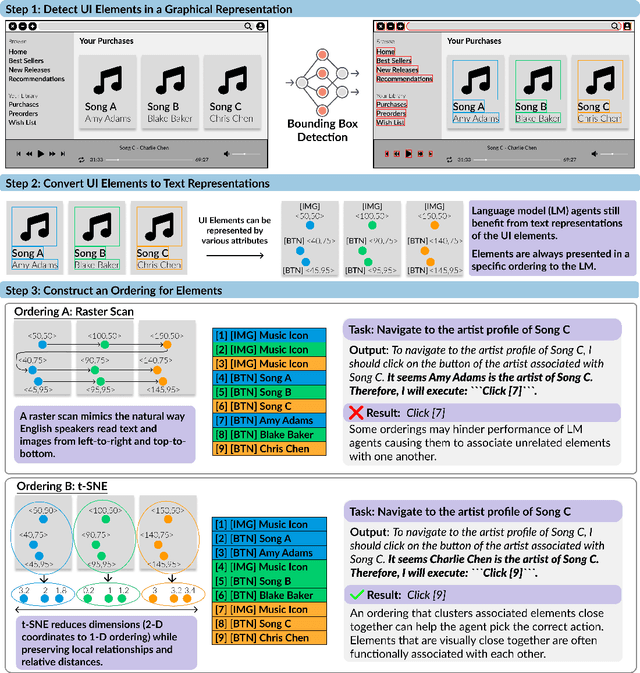
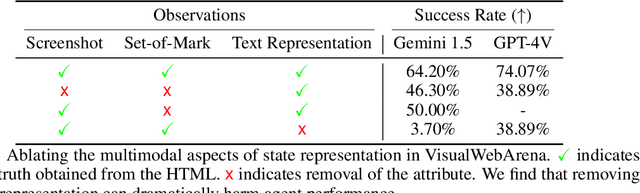
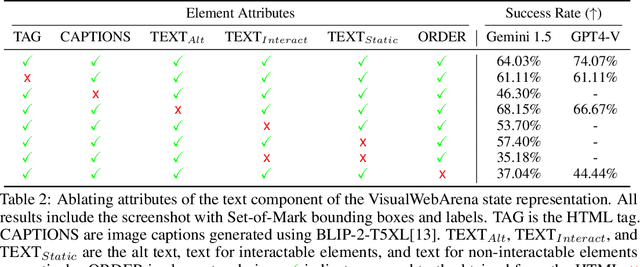
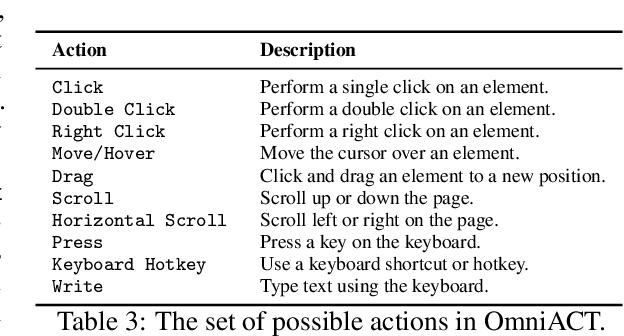
There has been a surge of interest in language model agents that can navigate virtual environments such as the web or desktop. To navigate such environments, agents benefit from information on the various elements (e.g., buttons, text, or images) present. It remains unclear which element attributes have the greatest impact on agent performance, especially in environments that only provide a graphical representation (i.e., pixels). Here we find that the ordering in which elements are presented to the language model is surprisingly impactful--randomizing element ordering in a webpage degrades agent performance comparably to removing all visible text from an agent's state representation. While a webpage provides a hierarchical ordering of elements, there is no such ordering when parsing elements directly from pixels. Moreover, as tasks become more challenging and models more sophisticated, our experiments suggest that the impact of ordering increases. Finding an effective ordering is non-trivial. We investigate the impact of various element ordering methods in web and desktop environments. We find that dimensionality reduction provides a viable ordering for pixel-only environments. We train a UI element detection model to derive elements from pixels and apply our findings to an agent benchmark--OmniACT--where we only have access to pixels. Our method completes more than two times as many tasks on average relative to the previous state-of-the-art.
Generating Music with a Self-Correcting Non-Chronological Autoregressive Model
Aug 18, 2020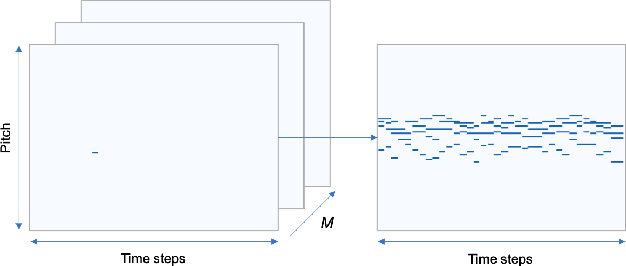
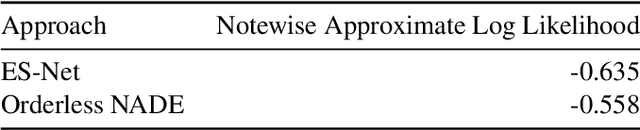
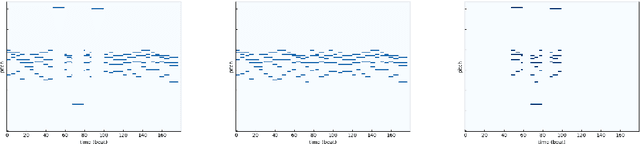
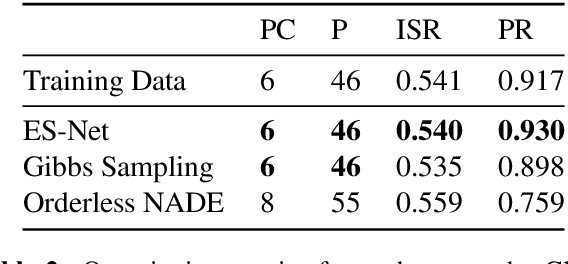
We describe a novel approach for generating music using a self-correcting, non-chronological, autoregressive model. We represent music as a sequence of edit events, each of which denotes either the addition or removal of a note---even a note previously generated by the model. During inference, we generate one edit event at a time using direct ancestral sampling. Our approach allows the model to fix previous mistakes such as incorrectly sampled notes and prevent accumulation of errors which autoregressive models are prone to have. Another benefit is a finer, note-by-note control during human and AI collaborative composition. We show through quantitative metrics and human survey evaluation that our approach generates better results than orderless NADE and Gibbs sampling approaches.