 Add to Chrome
 Add to Firefox
 Add to Edge
MARCO: Click-Intent Decomposition for Calibrated Ads Conversion Prediction
Aug 11, 2026
Not all clicks are equal. Industrial ads ranking decouples conversion probability into click-through rate (CTR) and post-click conversion rate (CVR), yet treats every click as the same event. In reality, users provide a free, self-generated signal of intent through their physical UI interactions. Different click types on the same ad exhibit a 4-fold difference in actual conversion rates. By conflating these signals, the standard CVR model under-predicts high-intent clicks and over-predicts low-intent ones, which is a bias masked by near-perfect aggregate calibration. We propose MARCO (Multi-intent Ads Ranking Composition Optimization), a framework that resolves this bias by decomposing each click by intent. Using the logged click type as a free behavioral label, MARCO trains per-intent CVR heads on homogeneous populations, and at serving time composes their per-intent CVR estimates under a predicted distribution over intents. Theoretically, we prove that decomposition never raises population risk, give the exact headroom under squared loss and non-negativity under the deployed loss, and show through a routing-efficiency dial how much of it reaches serving. Because the population-optimal score is unchanged, any gain is a finite-capacity estimation and calibration effect that we validated both offline and online. For deployment at scale, we further cast multi-impression, multi-click attribution as credit assignment with a bias-variance tradeoff analogous to RL return estimation, showing last-impression, first-click attribution is the low-bias, low-variance, deterministic choice under production constraints, and derive three consistency conditions enforced end-to-end at scale. Deployed at binary intent granularity, MARCO corrects per-intent calibration to approximately 100%, lifts conversions per click by +2.80%, and drives +0.98% cumulative improvement in topline metrics.

MISO: Model-Internal-State-Guided Optimization for Ranking Models
Aug 07, 2026Ranking models are repeatedly refined within established model families, yet the choice of which component to scale, replace, or retire is often guided by expensive trial-and-error. We present Model Internal State Optimization (MISO), a systems workflow that uses model internal states (MIS), including parameters, activations, gradients, and normalization statistics, to prioritize such local optimization decisions. MISO extracts MIS from a trained ranking model, aggregates them into ranking, alignment, and comparison signals, and converts those signals into a small set of interpretable candidate edits. Because MIS are re-extracted after each retraining cycle, MISO naturally supports an adaptive optimization workflow that tracks evolving model behavior as data distributions and system requirements shift over time. In an ads ranking case study, MISO improves normalized entropy while requiring substantially fewer validation runs than expert-driven and black-box scaling workflows, offering a practical middle ground between manual tuning and opaque automated search.
ROCS: Request-Oriented Compute Sharing for Efficient Large-Scale Recommendation
Jul 30, 2026Modern recommendation models gain prediction quality by scaling feature-interaction and sequence modules, but production cost constraints cap how far systems can scale. In this work, we propose Request-Oriented Compute Sharing (ROCS), a modeling and inference paradigm that exploits a unique property of recommendation inference: each user request is evaluated against many candidates, while request-side features are shared across candidates. ROCS defers request-candidate interactions as late as possible, isolates candidate-dependent representations, and evaluates substantial portions of the model once per request rather than once per candidate, significantly improving inference efficiency while maintaining or improving prediction quality. To realize this paradigm, we develop Generalized Layer Masking (GLM) to enforce candidate isolation in feature-interaction architectures, and Deep Cross Attention (DCA) to extend request-oriented sharing to sequence architectures. To support efficient GPU deployment, we co-design In-Kernel Broadcast Optimization (IKBO) that significantly accelerates ROCS model execution. Experiments on public benchmarks show that ROCS consistently improves the quality-efficiency tradeoff across recommendation backbones. On production-scale workloads, ROCS achieves up to a 3x QPS improvement on retrieval models without quality degradation and a 0.5% relative LogLoss improvement with a 50% QPS gain on a short-form video ranking model. ROCS has been deployed across large-scale recommendation systems spanning ads and organic surfaces, retrieval and ranking stages, and more than two orders of magnitude in inference complexity, delivering significant online gains at reduced infrastructure cost.
GR2 Technical Report
Jun 30, 2026Industrial recommendation systems serve billions of users through a multi-stage funnel -- retrieval, early-stage ranking, and re-ranking -- where the final re-ranking step disproportionately shapes user engagement and downstream performance, particularly for carousel and grid display formats. Despite growing enthusiasm for Large Language Models (LLMs) in recommendation, three gaps hinder industrial adoption: (1) most efforts target retrieval and ranking, leaving re-ranking -- the stage closest to the final user experience -- largely underexplored; (2) LLMs are typically deployed zero-shot or via supervised fine-tuning, underutilizing the reasoning capabilities unlocked by reinforcement learning (RL) on verifiable rewards; (3) deployed catalogs index billions of items with non-semantic identifiers that lie outside any base-LLM vocabulary. We present GR2 (Generative Reasoning Re-Ranker), an end-to-end framework that combines (i) mid-training on semantic IDs produced by a tokenizer with >=99% uniqueness, (ii) reasoning-trace distilled from a stronger teacher via targeted prompting and rejection sampling, and (iii) RL with verifiable rewards purpose-built for re-ranking. To make GR2 resource-viable, we further (iv) introduce a context compressor that amortizes training cost, On-Policy Distillation (OPD) as a scalable alternative to SFT -- which we find collapses at industrial scale -- and reasoning distillation for low-latency serving. GR2 delivers +18.7% R@1, +7.1% R@3, and +9.6% N@3 over legacy baselines on industrial-scale traffic. We further find that reward design is critical in re-ranking: LLMs often hack rewards by preserving the incoming order or exploiting position bias, motivating conditional verifiable rewards as essential industrial components.
LoopFM: Learning frOm HistOrical RePresentations of Foundation Model for Recommendation
May 28, 2026Knowledge distillation (KD) transfers a single scalar prediction from a large foundation model (FM) to compact vertical models (VMs), suffering from diminishing transfer ratio -- the fraction of FM improvement captured by the VM -- as a single scalar cannot convey the rich intermediate knowledge that larger FMs learn. To address this bottleneck, we propose LoopFM (Learning frOm HistOrical ReP*resentations of FM), a framework that opens a high-bandwidth transfer channel by structuring FM intermediate embeddings as input features (e.g., user history sequence) for downstream VMs, without requiring real-time FM inference at serving and architectural coupling between FM and VM. We provide a theoretical framework for LoopFM with a gain decomposition and transfer-ratio analysis. On three public benchmarks, LoopFM demonstrates strong AUC improvements (e.g., 6\%+ on TaobaoAd) and complementary knowledge transfer capability with KD. On industrial-scale systems (billions of examples, trillion-parameter FMs), LoopFM approximately doubles the knowledge transfer ratio on top of KD, delivering a +0.5\% conversion improvement in Y1H1, and a +1.03\% and +1.22\% conversion improvement from two individual launches respectively in Y1H2.
LoKA: Low-precision Kernel Applications for Recommendation Models At Scale
May 11, 2026Recent GPU generations deliver significantly higher FLOPs using lower-precision arithmetic, such as FP8. While successfully applied to large language models (LLMs), its adoption in large recommendation models (LRMs) has been limited. This is because LRMs are numerically sensitive, dominated by small matrix multiplications (GEMMs) followed by normalization, and trained in communication-intensive environments. Applying FP8 directly to LRMs often degrades model quality and prolongs training time. These challenges are inherent to LRM workloads and cannot be resolved merely by introducing better FP8 kernels. Instead, a system-model co-design approach is needed to successfully integrate FP8. We present LoKA (Low-precision Kernel Applications), a framework that makes FP8 practical for LRMs through three principles: profile under realistic distributions to know where low precision is safe, co-design model components with hardware to expand where it is safe, and orchestrate across kernel libraries to maximize the gains. Concretely, LoKA Probe is a statistically grounded, online benchmarking method that learns activation and weight statistics, and quantifies per-layer errors. This process pinpoints safe and unsafe, fast and slow sites for FP8 adoption. LoKA Mods is a set of reusable model adaptations that improve both numerical stability and execution efficiency with FP8. LoKA Dispatch is a runtime that leverages the statistical insights from LoKA Probe to select the fastest FP8 kernel that satisfies the accuracy requirements.
Kunlun: Establishing Scaling Laws for Massive-Scale Recommendation Systems through Unified Architecture Design
Feb 13, 2026Deriving predictable scaling laws that govern the relationship between model performance and computational investment is crucial for designing and allocating resources in massive-scale recommendation systems. While such laws are established for large language models, they remain challenging for recommendation systems, especially those processing both user history and context features. We identify poor scaling efficiency as the main barrier to predictable power-law scaling, stemming from inefficient modules with low Model FLOPs Utilization (MFU) and suboptimal resource allocation. We introduce Kunlun, a scalable architecture that systematically improves model efficiency and resource allocation. Our low-level optimizations include Generalized Dot-Product Attention (GDPA), Hierarchical Seed Pooling (HSP), and Sliding Window Attention. Our high-level innovations feature Computation Skip (CompSkip) and Event-level Personalization. These advances increase MFU from 17% to 37% on NVIDIA B200 GPUs and double scaling efficiency over state-of-the-art methods. Kunlun is now deployed in major Meta Ads models, delivering significant production impact.
Meta Lattice: Model Space Redesign for Cost-Effective Industry-Scale Ads Recommendations
Dec 15, 2025The rapidly evolving landscape of products, surfaces, policies, and regulations poses significant challenges for deploying state-of-the-art recommendation models at industry scale, primarily due to data fragmentation across domains and escalating infrastructure costs that hinder sustained quality improvements. To address this challenge, we propose Lattice, a recommendation framework centered around model space redesign that extends Multi-Domain, Multi-Objective (MDMO) learning beyond models and learning objectives. Lattice addresses these challenges through a comprehensive model space redesign that combines cross-domain knowledge sharing, data consolidation, model unification, distillation, and system optimizations to achieve significant improvements in both quality and cost-efficiency. Our deployment of Lattice at Meta has resulted in 10% revenue-driving top-line metrics gain, 11.5% user satisfaction improvement, 6% boost in conversion rate, with 20% capacity saving.
External Large Foundation Model: How to Efficiently Serve Trillions of Parameters for Online Ads Recommendation
Feb 26, 2025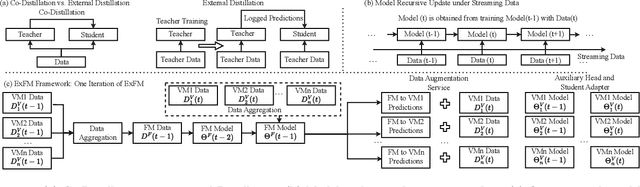
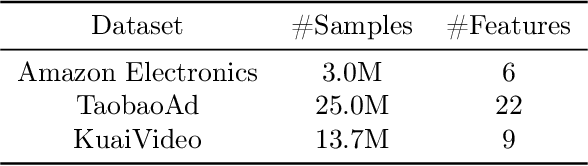
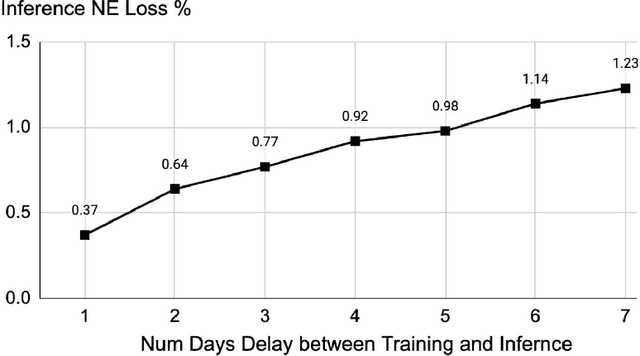
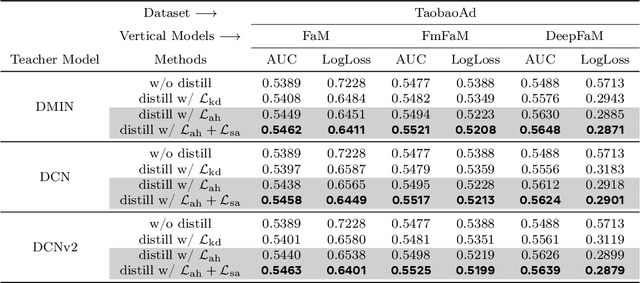
Ads recommendation is a prominent service of online advertising systems and has been actively studied. Recent studies indicate that scaling-up and advanced design of the recommendation model can bring significant performance improvement. However, with a larger model scale, such prior studies have a significantly increasing gap from industry as they often neglect two fundamental challenges in industrial-scale applications. First, training and inference budgets are restricted for the model to be served, exceeding which may incur latency and impair user experience. Second, large-volume data arrive in a streaming mode with data distributions dynamically shifting, as new users/ads join and existing users/ads leave the system. We propose the External Large Foundation Model (ExFM) framework to address the overlooked challenges. Specifically, we develop external distillation and a data augmentation system (DAS) to control the computational cost of training/inference while maintaining high performance. We design the teacher in a way like a foundation model (FM) that can serve multiple students as vertical models (VMs) to amortize its building cost. We propose Auxiliary Head and Student Adapter to mitigate the data distribution gap between FM and VMs caused by the streaming data issue. Comprehensive experiments on internal industrial-scale applications and public datasets demonstrate significant performance gain by ExFM.
Towards Data Quality Assessment in Online Advertising
Nov 30, 2017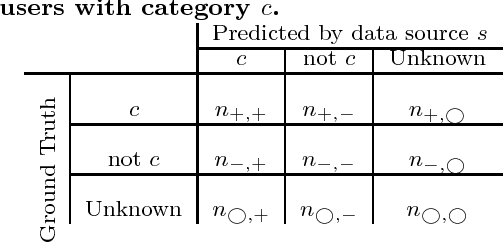
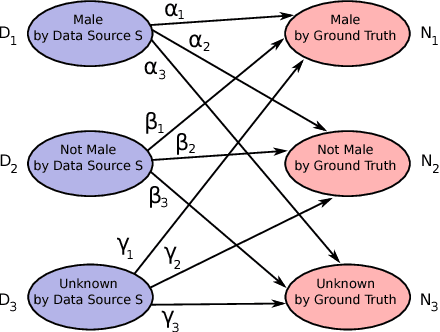
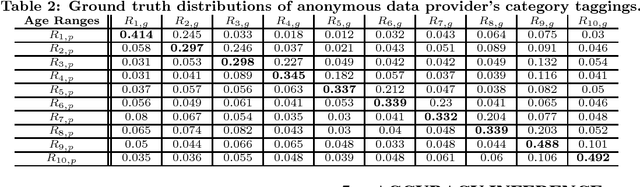
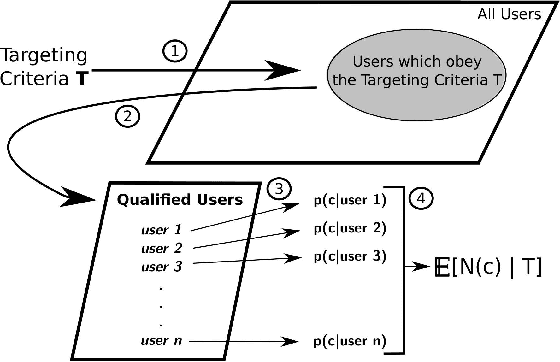
In online advertising, our aim is to match the advertisers with the most relevant users to optimize the campaign performance. In the pursuit of achieving this goal, multiple data sources provided by the advertisers or third-party data providers are utilized to choose the set of users according to the advertisers' targeting criteria. In this paper, we present a framework that can be applied to assess the quality of such data sources in large scale. This framework efficiently evaluates the similarity of a specific data source categorization to that of the ground truth, especially for those cases when the ground truth is accessible only in aggregate, and the user-level information is anonymized or unavailable due to privacy reasons. We propose multiple methodologies within this framework, present some preliminary assessment results, and evaluate how the methodologies compare to each other. We also present two use cases where we can utilize the data quality assessment results: the first use case is targeting specific user categories, and the second one is forecasting the desirable audiences we can reach for an online advertising campaign with pre-set targeting criteria.
* 10 pages, 7 Figures. This work has been presented in the KDD 2016 Workshop on Enterprise Intelligence