 Add to Chrome
 Add to Firefox
 Add to Edge
Structured Thoughts For Improved Reasoning And Context Pruning
Jul 11, 2026
Large language models (LLMs) excel at generating long chains of thought, but long reasoning traces are often verbose and memory-inefficient. In this work, we introduce Structured Thoughts, a framework that organizes reasoning into alternating <try> and <outcome> blocks: <try> captures exploratory scratch work, while <outcome> contains the distilled conclusion of that step. We construct a dataset of structured thoughts by segmenting reasoning traces into <try> blocks and prompting an LLM to summarize each step into its corresponding <outcome>. Fine-tuning pretrained foundation models on this reformatted data produces models that adopt the structured reasoning style, leading to performance gains of up to 8.08\% on reasoning benchmarks compared to standard SFT. The explicit structure also enables context pruning: after each <try>/<outcome> pair, the <try> can be pruned, allowing the model to retain conclusions without keeping the full scratch work in the context. A proof-of-concept pruning implementation achieves an average of 85\% memory / context savings with an 8.67\% performance drop across mathematical tasks.

Know When to Stop: Segment-Level Credit Assignment for Reducing Overthinking
Jul 01, 2026Reasoning language models frequently overthink: generating extended chains of behaviors such as hedging, approach abandonment, and self contradiction that consume tokens without improving answers. We show that these behaviors are not merely a consequence of length; even when controlling for response length, incorrect traces exhibit higher rates of unproductive self-reflection than correct ones. Addressing this requires identifying where self-reflection helps vs hurts, but obtaining these step-level annotations is costly. We observe that intermediate answer commitments within reasoning traces can provide a cheap proxy: by comparing each final answer candidate in the trace to the ground truth, we can determine whether subsequent reflection is productive without any additional supervision. Building on this insight, we propose DASH (Drift Aware advantage SHaping), which assigns segment-level credit based on whether each reasoning segment leads toward or away from correctness. On competition-level math benchmarks, DASH achieves the highest accuracy where overthinking is prevalent (AIME25: 50.8% vs. 45.4% GRPO) while reducing overthinking behaviors and achieving more productive self-correction than baselines.
SEAD: Competence-Aware On-Policy Distillation via Entropy-Guided Supervision
Jun 26, 2026On-policy distillation (OPD) has a property absent in offline distillation and RL: teacher supervision quality depends on student competence. Incoherent rollouts yield noisy gradients; already-mastered tokens yield redundant ones. This creates waste at three scales (tokens, training phases, and prompts) yet existing methods supervise uniformly. We introduce SEAD, which uses entropy as a unified probe of this competence-dependent degradation at three scales: (1) joint teacher-student entropy partitions tokens into zones receiving tailored divergences or zero gradient (approx. 50% skipped); (2) a cosine schedule anneals from forward to reverse KL as competence grows; (3) a competence-gated curriculum introduces prompts easy-to-hard. These components are symbiotically necessary: token selection requires coherent rollouts (curriculum), annealing requires monotonic improvement (also curriculum). On OLMo-3 (7B to 32B), SEAD achieves +4.8 avg accuracy over vanilla OPD across six math benchmarks, with ablations confirming super-additive interactions.
Your Model Diversity, Not Method, Determines Reasoning Strategy
Apr 12, 2026Compute scaling for LLM reasoning requires allocating budget between exploring solution approaches ($breadth$) and refining promising solutions ($depth$). Most methods implicitly trade off one for the other, yet why a given trade-off works remains unclear, and validation on a single model obscures the role of the model itself. We argue that $\textbf{the optimal strategy depends on the model's diversity profile, the spread of probability mass across solution approaches, and that this must be characterized before any exploration strategy is adopted.}$ We formalize this through a theoretical framework decomposing reasoning uncertainty and derive conditions under which tree-style depth refinement outperforms parallel sampling. We validate it on Qwen-3 4B and Olmo-3 7B families, showing that lightweight signals suffice for depth-based refinement on low-diversity aligned models while yielding limited utility for high-diversity base models, which we hypothesize require stronger compensation for lower exploration coverage.
Decomposing the Delta: What Do Models Actually Learn from Preference Pairs?
Apr 09, 2026Preference optimization methods such as DPO and KTO are widely used for aligning language models, yet little is understood about what properties of preference data drive downstream reasoning gains. We ask: what aspects of a preference pair improve a reasoning model's performance on general reasoning tasks? We investigate two distinct notions of quality delta in preference data: generator-level delta, arising from the differences in capability between models that generate chosen and rejected reasoning traces, and sample-level delta, arising from differences in judged quality differences within an individual preference pair. To study generator-level delta, we vary the generator's scale and model family, and to study sample-level delta, we employ an LLM-as-a-judge to rate the quality of generated traces along multiple reasoning-quality dimensions. We find that increasing generator-level delta steadily improves performance on out-of-domain reasoning tasks and filtering data by sample-level delta can enable more data-efficient training. Our results suggest a twofold recipe for improving reasoning performance through preference optimization: maximize generator-level delta when constructing preference pairs and exploit sample-level delta to select the most informative training examples.
DIAL-SUMMER: A Structured Evaluation Framework of Hierarchical Errors in Dialogue Summaries
Feb 08, 2026Dialogues are a predominant mode of communication for humans, and it is immensely helpful to have automatically generated summaries of them (e.g., to revise key points discussed in a meeting, to review conversations between customer agents and product users). Prior works on dialogue summary evaluation largely ignore the complexities specific to this task: (i) shift in structure, from multiple speakers discussing information in a scattered fashion across several turns, to a summary's sentences, and (ii) shift in narration viewpoint, from speakers' first/second-person narration, standardized third-person narration in the summary. In this work, we introduce our framework DIALSUMMER to address the above. We propose DIAL-SUMMER's taxonomy of errors to comprehensively evaluate dialogue summaries at two hierarchical levels: DIALOGUE-LEVEL that focuses on the broader speakers/turns, and WITHIN-TURN-LEVEL that focuses on the information talked about inside a turn. We then present DIAL-SUMMER's dataset composed of dialogue summaries manually annotated with our taxonomy's fine-grained errors. We conduct empirical analyses of these annotated errors, and observe interesting trends (e.g., turns occurring in middle of the dialogue are the most frequently missed in the summary, extrinsic hallucinations largely occur at the end of the summary). We also conduct experiments on LLM-Judges' capability at detecting these errors, through which we demonstrate the challenging nature of our dataset, the robustness of our taxonomy, and the need for future work in this field to enhance LLMs' performance in the same. Code and inference dataset coming soon.
Critique-Guided Distillation: Improving Supervised Fine-tuning via Better Distillation
May 16, 2025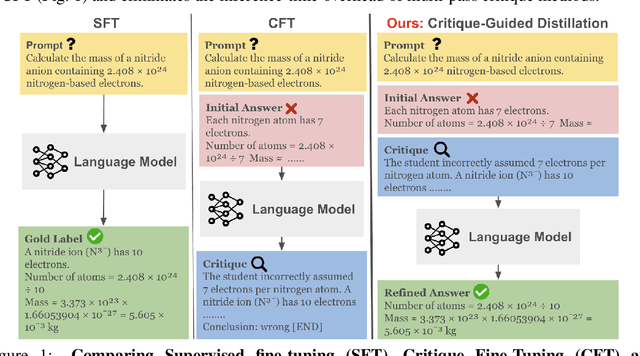
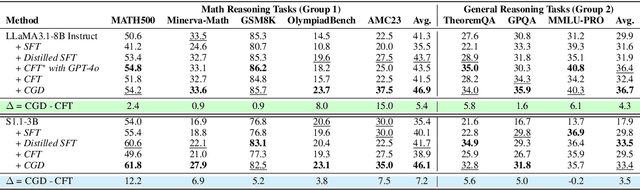
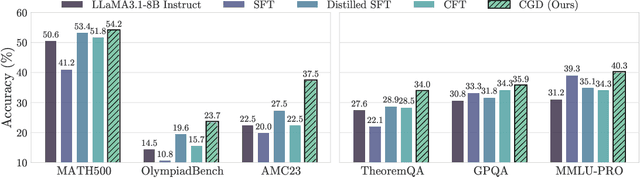
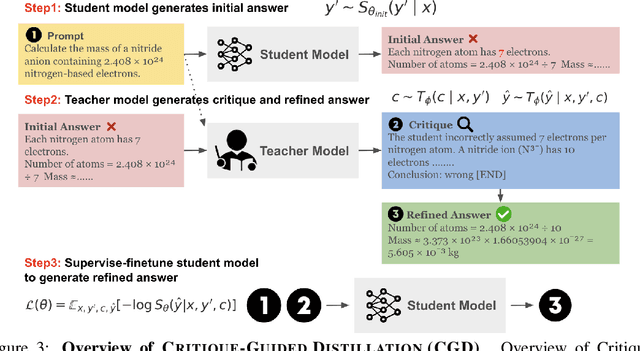
Supervised fine-tuning (SFT) using expert demonstrations often suffer from the imitation problem, where the model learns to reproduce the correct responses without \emph{understanding} the underlying rationale. To address this limitation, we propose \textsc{Critique-Guided Distillation (CGD)}, a novel multi-stage framework that integrates teacher model generated \emph{explanatory critiques} and \emph{refined responses} into the SFT process. A student model is then trained to map the triplet of prompt, teacher critique, and its own initial response to the corresponding refined teacher response, thereby learning both \emph{what} to imitate and \emph{why}. Using entropy-based analysis, we show that \textsc{CGD} reduces refinement uncertainty and can be interpreted as a Bayesian posterior update. We perform extensive empirical evaluation of \textsc{CGD}, on variety of benchmark tasks, and demonstrate significant gains on both math (AMC23 +17.5%) and language understanding tasks (MMLU-Pro +6.3%), while successfully mitigating the format drift issues observed in previous critique fine-tuning (CFT) techniques.
CorrectionLM: Self-Corrections with SLM for Dialogue State Tracking
Oct 23, 2024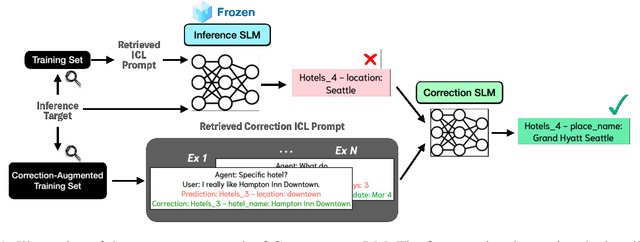
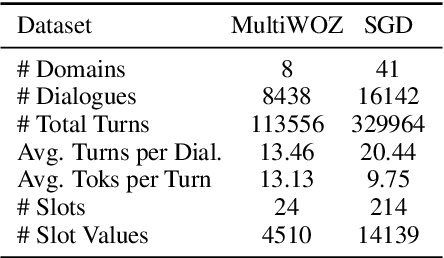


Large language models (LLMs) have demonstrated self-improvement capabilities via feedback and refinement, but current small language models (SLMs) have had limited success in this area. Existing correction approaches often rely on distilling knowledge from LLMs, which imposes significant computation demands. In this work, we introduce CORRECTIONLM, a novel correction framework that enables SLMs to self-correct using in-context exemplars without LLM involvement. Applied to two dialogue state tracking (DST) tasks in low-resource settings, CORRECTIONLM achieves results similar to a state-of-the-art LLM at a small fraction of the computation costs.
OrchestraLLM: Efficient Orchestration of Language Models for Dialogue State Tracking
Nov 16, 2023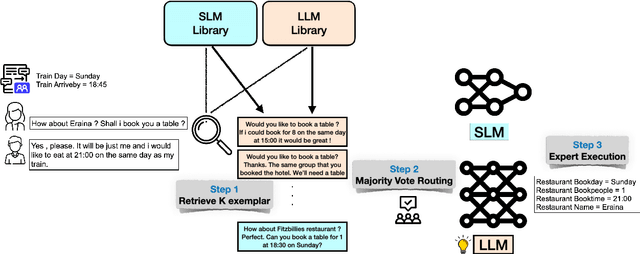


Large language models (LLMs) have revolutionized the landscape of Natural Language Processing systems, but are computationally expensive. To reduce the cost without sacrificing performance, previous studies have explored various approaches to harness the potential of Small Language Models (SLMs) as cost-effective alternatives to their larger counterparts. Driven by findings that SLMs and LLMs exhibit complementary strengths in a structured knowledge extraction task, this work presents a novel SLM/LLM routing framework designed to improve computational efficiency and enhance task performance. First, exemplar pools are created to represent the types of contexts where each LM provides a more reliable answer, leveraging a sentence embedding fine-tuned so that context similarity is close to dialogue state similarity. Then, during inference, the k-nearest exemplars to the testing instance are retrieved, and the instance is routed according to majority vote. In dialogue state tracking tasks, the proposed routing framework enhances performance substantially compared to relying solely on LLMs, while reducing the computational costs by over 50%.
DIALGEN: Collaborative Human-LM Generated Dialogues for Improved Understanding of Human-Human Conversations
Jul 13, 2023


Applications that could benefit from automatic understanding of human-human conversations often come with challenges associated with private information in real-world data such as call center or clinical conversations. Working with protected data also increases costs of annotation, which limits technology development. To address these challenges, we propose DIALGEN, a human-in-the-loop semi-automated dialogue generation framework. DIALGEN uses a language model (ChatGPT) that can follow schema and style specifications to produce fluent conversational text, generating a complex conversation through iteratively generating subdialogues and using human feedback to correct inconsistencies or redirect the flow. In experiments on structured summarization of agent-client information gathering calls, framed as dialogue state tracking, we show that DIALGEN data enables significant improvement in model performance.