 Add to Chrome
 Add to Firefox
 Add to Edge
RoboBRIDGE: A Modular Framework for Bridging Policies to Robust Real-World Robotic Agents
Jul 30, 2026
Vision-Language-Action (VLA) models have attracted growing interest as a scalable approach to robotic manipulation. While these models are effective action predictors, deploying them as robotic agents exposes critical gaps: no mechanism for failure recovery, inconsistent execution over long horizons, and limited robustness to shifts in observations, tasks, or embodiments. Existing solutions address these limitations individually through model retraining or environment-specific modules, yet what is needed is a general framework that systematically transforms a pretrained VLA into a robotic agent. We present RoboBRIDGE, a modular framework that provides an orchestration layer over five coordinated modules, namely Monitor, Perceptor, Planner, Controller, and Robot Interface, to compose robust robotic agents from off-the-shelf components, including pretrained VLAs. The Monitor pairs rapid failure detection with hierarchical recovery to correct errors before they cascade. When the environment diverges from the current plan, the Planner triggers replanning while the Perceptor updates scene understanding asynchronously, avoiding execution stalls. Within the Controller, primitive skill fine-tuning factors manipulation into domain-invariant primitives with dedicated LoRA adapters, reducing sensitivity to domain shifts when a VLA is used. Across LIBERO, RoboCasa, and real-world case studies spanning multiple robot platforms and VLA backbones, RoboBRIDGE consistently outperforms both standalone policies and prior augmented VLA deployments. These results suggest that reliable robotic agency does not arise from scaling action predictors alone, but from structured orchestration around them.

Multi-scale Mixture of World Models for Embodied Agents in Evolving Environments
Jul 01, 2026Embodied agents operating in the real world require multi-scale reasoning and knowledge adaptation as conditions change. We identify two challenges in applying Mixture of Experts (MoE) to this setting: routing lacks an explicit notion of scale, preventing targeted updates at specific scales, and a uniform update policy cannot accommodate the different rates at which knowledge at each scale becomes outdated. We present MuSix, a framework that addresses both challenges through scale-aware world model mixture and evolution. A two-stage routing mechanism grounds scale selection in experiential distance, a measure of situational novelty inspired by Construal Level Theory: a meta-router first maps this quantity to a weight over continuous scale space, then per-scale base routers select world models within the identified scale. For adaptation, scale-dependent forgetting rates allow low-scale knowledge to refresh rapidly while high-scale abstractions persist, and gated inter-scale transfer maintains coherence across the hierarchy. Experiments on EmbodiedBench and HAZARD show that MuSix improves over state-of-the-art baselines on multi-scale reasoning and dynamic adaptation.
Functional Cache Grafting: Robust and Rapid Code-Policy Synthesis for Embodied Agents
Jun 11, 2026Code-writing large language models (CodeLLMs) generate executable code policies for embodied agents by translating natural language goals and environmental constraints into structured control programs. However, policy generation in open-domain embodied environments suffers from two fundamental limitations: (i) delayed decoding caused by repetitive prefill computation over long prompts, and (ii) limited robustness due to fully generative decoding, which often produces API mismatches, missing safety guards, and unstable control logic. To address these limitations, we present FCGraft, a Functional Cache Grafting framework. FCGraft maintains a library of function-level validated code skeletons and their associated prompt-level Transformer key-value (KV) caches, and synthesizes new policies by retrieving relevant functions and grafting their KV caches when a new task is provided. Given retrieved function caches, FCGraft performs cache grafting via stitching, which composes cached function segments into a composite policy, and patching, which locally adapts only the necessary code regions to satisfy task-specific parameters and constraints with minimal additional decoding. By eliminating redundant prefill computation, this approach reduces generation latency, while reusing validated control structures improves robustness over prompt-level caching methods RAGCache, achieving 18.31% higher task success rate and 2.3x faster policy synthesis.
Efficient Skill Grounding via Code Refactoring with Small Language Models
Jun 06, 2026Effective skill grounding is essential for deploying reusable skills in embodied agents, as even minor embodiment or environmental differences can render an entire skill incompatible. This challenge is particularly pronounced in embodied settings, where agents must operate in dynamic, partially observable environments without access to large language models (LLMs). In this setting, reliance on LLMs is impractical, while small language models (sLMs) remain insufficient for the effective skill grounding required for reliable long-horizon control. We present RECENT, a refactoring-centric agent framework that enables efficient skill grounding with sLMs by decoupling skill semantics from embodiment- and environment-specific execution binding. By representing skills as executable code, RECENT preserves the semantic intent encoded in a skill's control structure while grounding it by modifying only execution bindings through localized refactoring, rather than regenerating code from scratch. We evaluate RECENT across diverse skill grounding scenarios spanning multiple robot embodiments in dynamic environments, demonstrating robust long-horizon performance when deployed with an sLM. Across all scenarios, RECENT achieves the best performance among sLM-based Code-as-Policies (CaP) methods and matches the task performance of LLM-based CaP.
Cross-Domain Demo-to-Code via Neurosymbolic Counterfactual Reasoning
Mar 19, 2026Recent advances in Vision-Language Models (VLMs) have enabled video-instructed robotic programming, allowing agents to interpret video demonstrations and generate executable control code. We formulate video-instructed robotic programming as a cross-domain adaptation problem, where perceptual and physical differences between demonstration and deployment induce procedural mismatches. However, current VLMs lack the procedural understanding needed to reformulate causal dependencies and achieve task-compatible behavior under such domain shifts. We introduce NeSyCR, a neurosymbolic counterfactual reasoning framework that enables verifiable adaptation of task procedures, providing a reliable synthesis of code policies. NeSyCR abstracts video demonstrations into symbolic trajectories that capture the underlying task procedure. Given deployment observations, it derives counterfactual states that reveal cross-domain incompatibilities. By exploring the symbolic state space with verifiable checks, NeSyCR proposes procedural revisions that restore compatibility with the demonstrated procedure. NeSyCR achieves a 31.14% improvement in task success over the strongest baseline Statler, showing robust cross-domain adaptation across both simulated and real-world manipulation tasks.
Test-Time Mixture of World Models for Embodied Agents in Dynamic Environments
Jan 30, 2026Language model (LM)-based embodied agents are increasingly deployed in real-world settings. Yet, their adaptability remains limited in dynamic environments, where constructing accurate and flexible world models is crucial for effective reasoning and decision-making. To address this challenge, we extend the Mixture-of-Experts (MoE) paradigm to embodied agents. While conventional MoE architectures modularize knowledge into expert components with pre-trained routing, they remain rigid once deployed, making them less effective for adapting to unseen domains in dynamic environments. We therefore propose Test-time Mixture of World Models (TMoW), a framework that enhances adaptability to unseen and evolving domains. TMoW updates its routing function over world models at test time, unlike conventional MoE where the function remains fixed, enabling agents to recombine existing models and integrate new ones for continual adaptation. It achieves this through (i) multi-granular prototype-based routing, which adapts mixtures across object- to scene-level similarities, (ii) test-time refinement that aligns unseen domain features with prototypes during inference, and (iii) distilled mixture-based augmentation, which efficiently constructs new models from few-shot data and existing prototypes. We evaluate TMoW on VirtualHome, ALFWorld, and RLBench benchmarks, demonstrating strong performance in both zero-shot adaptation and few-shot expansion scenarios, and showing that it enables embodied agents to operate effectively in dynamic environments.
Exploratory Retrieval-Augmented Planning For Continual Embodied Instruction Following
Sep 10, 2025This study presents an Exploratory Retrieval-Augmented Planning (ExRAP) framework, designed to tackle continual instruction following tasks of embodied agents in dynamic, non-stationary environments. The framework enhances Large Language Models' (LLMs) embodied reasoning capabilities by efficiently exploring the physical environment and establishing the environmental context memory, thereby effectively grounding the task planning process in time-varying environment contexts. In ExRAP, given multiple continual instruction following tasks, each instruction is decomposed into queries on the environmental context memory and task executions conditioned on the query results. To efficiently handle these multiple tasks that are performed continuously and simultaneously, we implement an exploration-integrated task planning scheme by incorporating the {information-based exploration} into the LLM-based planning process. Combined with memory-augmented query evaluation, this integrated scheme not only allows for a better balance between the validity of the environmental context memory and the load of environment exploration, but also improves overall task performance. Furthermore, we devise a {temporal consistency refinement} scheme for query evaluation to address the inherent decay of knowledge in the memory. Through experiments with VirtualHome, ALFRED, and CARLA, our approach demonstrates robustness against a variety of embodied instruction following scenarios involving different instruction scales and types, and non-stationarity degrees, and it consistently outperforms other state-of-the-art LLM-based task planning approaches in terms of both goal success rate and execution efficiency.
* 21 pages. NeurIPS 2024
World Model Implanting for Test-time Adaptation of Embodied Agents
Sep 04, 2025In embodied AI, a persistent challenge is enabling agents to robustly adapt to novel domains without requiring extensive data collection or retraining. To address this, we present a world model implanting framework (WorMI) that combines the reasoning capabilities of large language models (LLMs) with independently learned, domain-specific world models through test-time composition. By allowing seamless implantation and removal of the world models, the embodied agent's policy achieves and maintains cross-domain adaptability. In the WorMI framework, we employ a prototype-based world model retrieval approach, utilizing efficient trajectory-based abstract representation matching, to incorporate relevant models into test-time composition. We also develop a world-wise compound attention method that not only integrates the knowledge from the retrieved world models but also aligns their intermediate representations with the reasoning model's representation within the agent's policy. This framework design effectively fuses domain-specific knowledge from multiple world models, ensuring robust adaptation to unseen domains. We evaluate our WorMI on the VirtualHome and ALFWorld benchmarks, demonstrating superior zero-shot and few-shot performance compared to several LLM-based approaches across a range of unseen domains. These results highlight the frameworks potential for scalable, real-world deployment in embodied agent scenarios where adaptability and data efficiency are essential.
Efficient Policy Adaptation with Contrastive Prompt Ensemble for Embodied Agents
Dec 16, 2024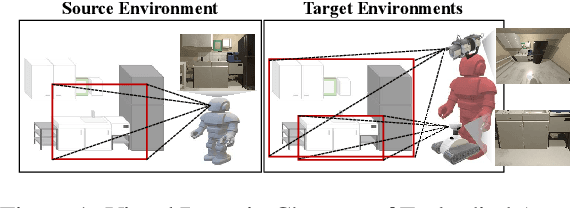
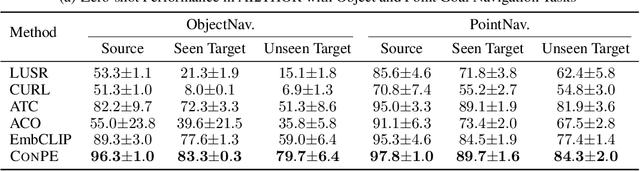
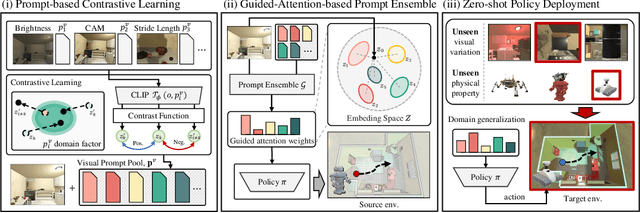
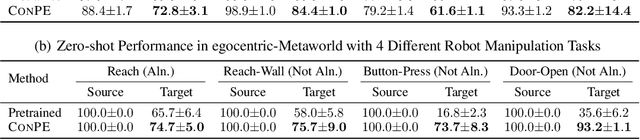
For embodied reinforcement learning (RL) agents interacting with the environment, it is desirable to have rapid policy adaptation to unseen visual observations, but achieving zero-shot adaptation capability is considered as a challenging problem in the RL context. To address the problem, we present a novel contrastive prompt ensemble (ConPE) framework which utilizes a pretrained vision-language model and a set of visual prompts, thus enabling efficient policy learning and adaptation upon a wide range of environmental and physical changes encountered by embodied agents. Specifically, we devise a guided-attention-based ensemble approach with multiple visual prompts on the vision-language model to construct robust state representations. Each prompt is contrastively learned in terms of an individual domain factor that significantly affects the agent's egocentric perception and observation. For a given task, the attention-based ensemble and policy are jointly learned so that the resulting state representations not only generalize to various domains but are also optimized for learning the task. Through experiments, we show that ConPE outperforms other state-of-the-art algorithms for several embodied agent tasks including navigation in AI2THOR, manipulation in egocentric-Metaworld, and autonomous driving in CARLA, while also improving the sample efficiency of policy learning and adaptation.
Embodied CoT Distillation From LLM To Off-the-shelf Agents
Dec 16, 2024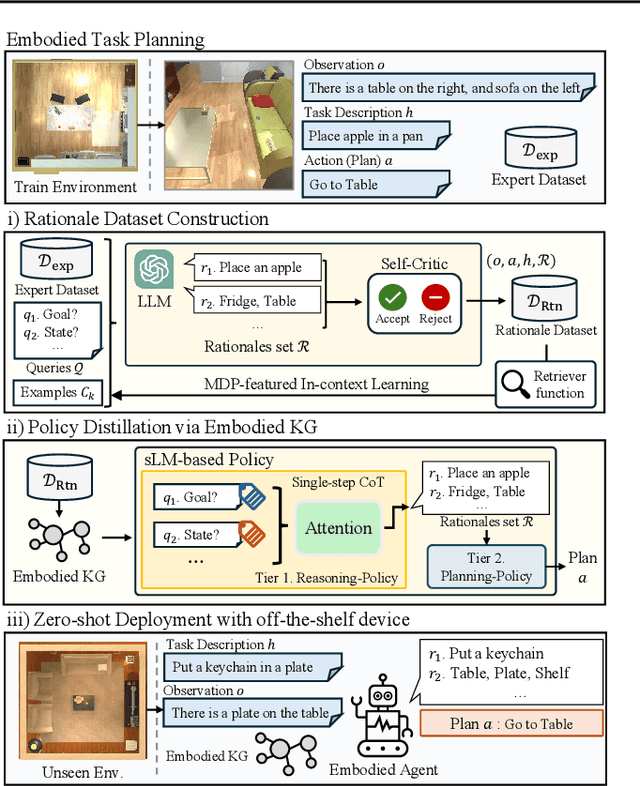
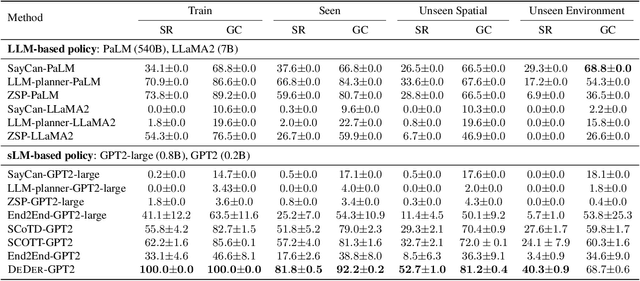
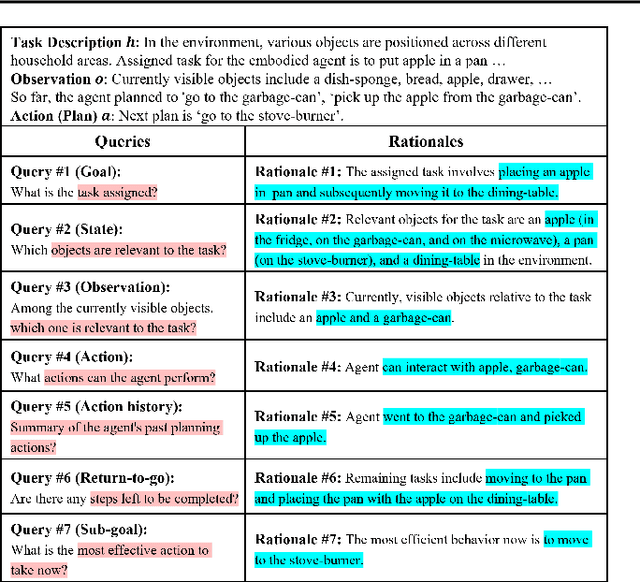
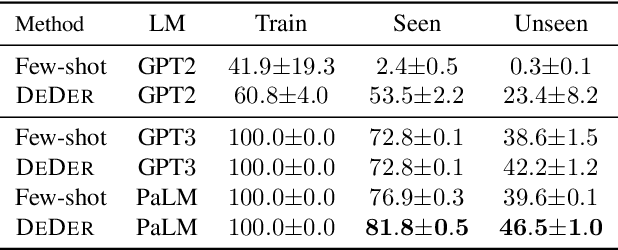
We address the challenge of utilizing large language models (LLMs) for complex embodied tasks, in the environment where decision-making systems operate timely on capacity-limited, off-the-shelf devices. We present DeDer, a framework for decomposing and distilling the embodied reasoning capabilities from LLMs to efficient, small language model (sLM)-based policies. In DeDer, the decision-making process of LLM-based strategies is restructured into a hierarchy with a reasoning-policy and planning-policy. The reasoning-policy is distilled from the data that is generated through the embodied in-context learning and self-verification of an LLM, so it can produce effective rationales. The planning-policy, guided by the rationales, can render optimized plans efficiently. In turn, DeDer allows for adopting sLMs for both policies, deployed on off-the-shelf devices. Furthermore, to enhance the quality of intermediate rationales, specific to embodied tasks, we devise the embodied knowledge graph, and to generate multiple rationales timely through a single inference, we also use the contrastively prompted attention model. Our experiments with the ALFRED benchmark demonstrate that DeDer surpasses leading language planning and distillation approaches, indicating the applicability and efficiency of sLM-based embodied policies derived through DeDer.