 Add to Chrome
 Add to Firefox
 Add to Edge
SCOUT: Per-Context Reset Curricula for Sparse-Reward Reinforcement Learning
Jul 29, 2026
Sparse-reward reinforcement learning often fails because rollouts from the unassisted evaluation start rarely reach later task stages. Reset curricula address this by starting some training rollouts from easier intermediate states, called scaffolds. Such a curriculum faces two decisions: scaffold access, obtaining informative starts, and scaffold allocation, deciding how quickly that assistance is removed. Most prior curricula pace removal on one shared schedule, which can fail when task instances, or contexts, learn at different rates. We introduce SCOUT, an online, learner-agnostic reset controller that gives every context its own curriculum. Using only binary rollout success, SCOUT removes assistance after sustained success, restores it after failure, and cautiously tests a harder start when progress stalls, without changing the reward, optimizer, or learner. A counting construction shows that synchronized global pacing can be insufficient when contexts need conflicting amounts of assisted practice. Across six navigation and manipulation settings, scaffold access improves learning and enables success in three where unassisted training fails within the reported budget. In a constructed pacing conflict, each tested global schedule leaves one group unsolved, while SCOUT solves both. Average success can conceal this failure, so we also report the least successful group. Group-level pacing works when learning differences follow known groups but can fail when they occur within one group. SCOUT needs no group labels and remains consistently strong in both cases. A reset curriculum should remove assistance at the scale where learning progress differs.

Good Rankers, Bad Objectives: Bilinear Contrastive Critics under Expressive Policy Search
Jul 29, 2026Good action rankings do not make a contrastive critic safe to maximize. These critics increasingly act as value-like objectives for best-of-$K$ selection, planning, and critic-guided generation. Unbounded bilinear scores can let large embedding norms inflate off-support values, but cosine bounding does not remove the failure. A controlled support decomposition attributes most raw bilinear regret to norm drift. Cosine and hybrid critics nevertheless select off-support actions from most pools and incur comparable regret. Contrastive scores are weakly calibrated or inverted in the top score decile across four OGBench navigation tasks, and they fail to order fixed-query actions by value. Bellman-trained TD-Q succeeds, including in a parameter-matched function-class control. Realized costs depend on the task: simulator rollouts reveal single-step selection costs on PointMaze and the exact-$Q^*$ toy but well-powered nulls on AntMaze and HumanoidMaze, where the controller can self-correct. A training/readout decomposition traces the lost ordering to the cosine training objective; raw-trained embeddings retain weak ordering after inference-time normalization. Candidate maximization can therefore exploit false positives caused by norm drift, score saturation, or in-support misranking. Contrastive critics remain useful compatibility rankers on navigation and manipulation tasks, but action selection requires a value-calibrated scalar.
LAW & ORDER: Adaptive Spatial Weighting for Medical Diffusion and Segmentation
Mar 05, 2026Medical image analysis relies on accurate segmentation, and benefits from controllable synthesis (of new training images). Yet both tasks of the cyclical pipeline face spatial imbalance: lesions occupy small regions against vast backgrounds. In particular, diffusion models have been shown to drift from prescribed lesion layouts, while efficient segmenters struggle on spatially uncertain regions. Adaptive spatial weighting addresses this by learning where to allocate computational resources. This paper introduces a pair of network adapters: 1) Learnable Adaptive Weighter (LAW) which predicts per-pixel loss modulation from features and masks for diffusion training, stabilized via a mix of normalization, clamping, and regularization to prevent degenerate solutions; and 2) Optimal Region Detection with Efficient Resolution (ORDER) which applies selective bidirectional skip attention at late decoder stages for efficient segmentation. Experiments on polyp and kidney tumor datasets demonstrate that LAW achieves 20% FID generative improvement over a uniform baseline (52.28 vs. 65.60), with synthetic data then improving downstream segmentation by 4.9% Dice coefficient (83.2% vs. 78.3%). ORDER reaches 6.0% Dice improvement on MK-UNet (81.3% vs. 75.3%) with 0.56 GFLOPs and just 42K parameters, remaining 730x smaller than the standard nnUNet.
DISK: Dynamic Inference SKipping for World Models
Jan 31, 2026We present DISK, a training-free adaptive inference method for autoregressive world models. DISK coordinates two coupled diffusion transformers for video and ego-trajectory via dual-branch controllers with cross-modal skip decisions, preserving motion-appearance consistency without retraining. We extend higher-order latent-difference skip testing to the autoregressive chain-of-forward regime and propagate controller statistics through rollout loops for long-horizon stability. When integrated into closed-loop driving rollouts on 1500 NuPlan and NuScenes samples using an NVIDIA L40S GPU, DISK achieves 2x speedup on trajectory diffusion and 1.6x speedup on video diffusion while maintaining L2 planning error, visual quality (FID/FVD), and NAVSIM PDMS scores, demonstrating practical long-horizon video-and-trajectory prediction at substantially reduced cost.
Lessons from the Field: An Adaptable Lifecycle Approach to Applied Dialogue Summarization
Jan 13, 2026Summarization of multi-party dialogues is a critical capability in industry, enhancing knowledge transfer and operational effectiveness across many domains. However, automatically generating high-quality summaries is challenging, as the ideal summary must satisfy a set of complex, multi-faceted requirements. While summarization has received immense attention in research, prior work has primarily utilized static datasets and benchmarks, a condition rare in practical scenarios where requirements inevitably evolve. In this work, we present an industry case study on developing an agentic system to summarize multi-party interactions. We share practical insights spanning the full development lifecycle to guide practitioners in building reliable, adaptable summarization systems, as well as to inform future research, covering: 1) robust methods for evaluation despite evolving requirements and task subjectivity, 2) component-wise optimization enabled by the task decomposition inherent in an agentic architecture, 3) the impact of upstream data bottlenecks, and 4) the realities of vendor lock-in due to the poor transferability of LLM prompts.
A novel visual data-based diagnostic approach for estimation of regime transition in pool boiling
Jun 12, 2025This study introduces a novel metric, the Index of Visual Similarity (IVS), to qualitatively characterize boiling heat transfer regimes using only visual data. The IVS is constructed by combining morphological similarity, through SIFT-based feature matching, with physical similarity, via vapor area estimation using Mask R-CNN. High-speed images of pool boiling on two distinct surfaces, polished copper and porous copper foam, are employed to demonstrate the generalizability of the approach. IVS captures critical changes in bubble shape, size, and distribution that correspond to transitions in heat transfer mechanisms. The metric is validated against an equivalent metric, $\Phi$, derived from measured heat transfer coefficients (HTC), showing strong correlation and reliability in detecting boiling regime transitions, including the onset of nucleate boiling and proximity to critical heat flux (CHF). Given experimental limitations in precisely measuring changes in HTC, the sensitivity of IVS to surface superheat is also examined to reinforce the credibility of IVS. IVS thus emerges as a powerful, rapid, and non-intrusive tool for real-time, image-based boiling diagnostics, with promising applications in phase change heat transfer.
Crowdsource, Crawl, or Generate? Creating SEA-VL, a Multicultural Vision-Language Dataset for Southeast Asia
Mar 10, 2025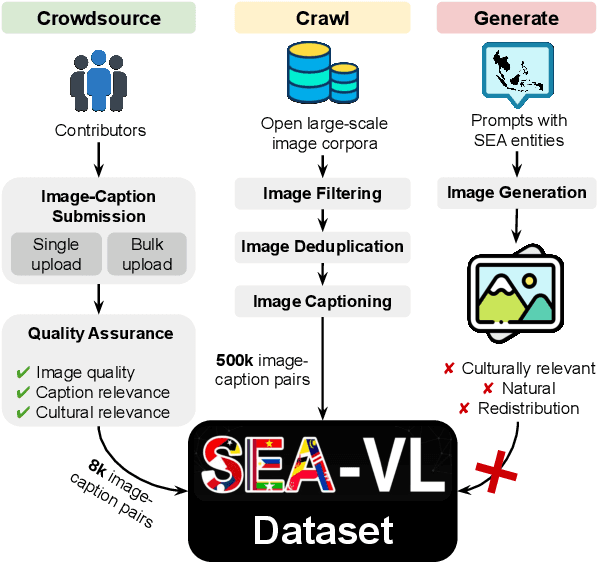
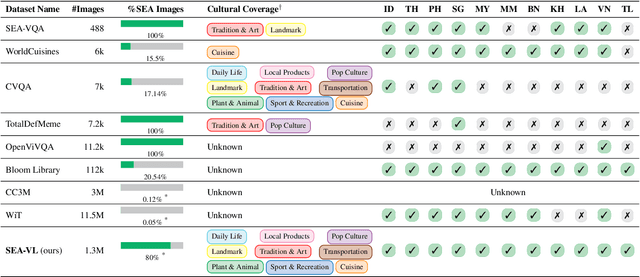
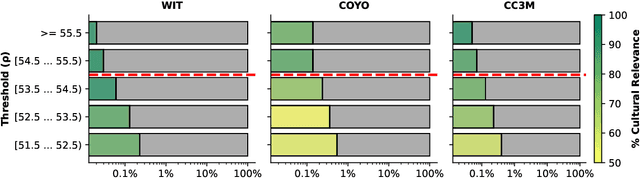
Southeast Asia (SEA) is a region of extraordinary linguistic and cultural diversity, yet it remains significantly underrepresented in vision-language (VL) research. This often results in artificial intelligence (AI) models that fail to capture SEA cultural nuances. To fill this gap, we present SEA-VL, an open-source initiative dedicated to developing high-quality, culturally relevant data for SEA languages. By involving contributors from SEA countries, SEA-VL aims to ensure better cultural relevance and diversity, fostering greater inclusivity of underrepresented languages in VL research. Beyond crowdsourcing, our initiative goes one step further in the exploration of the automatic collection of culturally relevant images through crawling and image generation. First, we find that image crawling achieves approximately ~85% cultural relevance while being more cost- and time-efficient than crowdsourcing. Second, despite the substantial progress in generative vision models, synthetic images remain unreliable in accurately reflecting SEA cultures. The generated images often fail to reflect the nuanced traditions and cultural contexts of the region. Collectively, we gather 1.28M SEA culturally-relevant images, more than 50 times larger than other existing datasets. Through SEA-VL, we aim to bridge the representation gap in SEA, fostering the development of more inclusive AI systems that authentically represent diverse cultures across SEA.
ColonNet: A Hybrid Of DenseNet121 And U-NET Model For Detection And Segmentation Of GI Bleeding
Dec 06, 2024This study presents an integrated deep learning model for automatic detection and classification of Gastrointestinal bleeding in the frames extracted from Wireless Capsule Endoscopy (WCE) videos. The dataset has been released as part of Auto-WCBleedGen Challenge Version V2 hosted by the MISAHUB team. Our model attained the highest performance among 75 teams that took part in this competition. It aims to efficiently utilizes CNN based model i.e. DenseNet and UNet to detect and segment bleeding and non-bleeding areas in the real-world complex dataset. The model achieves an impressive overall accuracy of 80% which would surely help a skilled doctor to carry out further diagnostics.
CapsuleNet: A Deep Learning Model To Classify GI Diseases Using EfficientNet-b7
Oct 24, 2024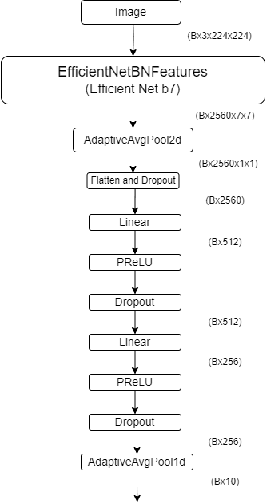
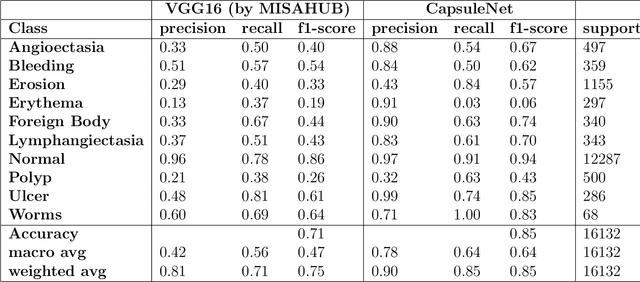
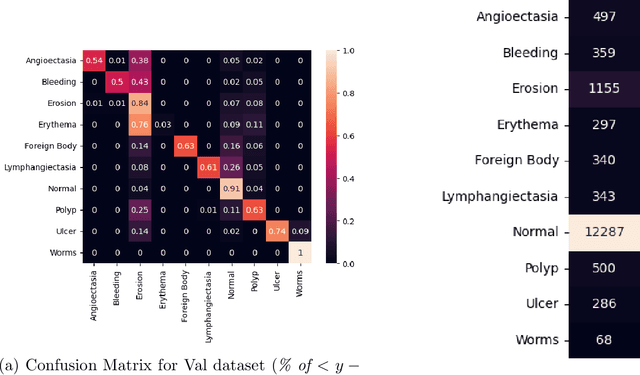

Gastrointestinal (GI) diseases represent a significant global health concern, with Capsule Endoscopy (CE) offering a non-invasive method for diagnosis by capturing a large number of GI tract images. However, the sheer volume of video frames necessitates automated analysis to reduce the workload on doctors and increase the diagnostic accuracy. In this paper, we present CapsuleNet, a deep learning model developed for the Capsule Vision 2024 Challenge, aimed at classifying 10 distinct GI abnormalities. Using a highly imbalanced dataset, we implemented various data augmentation strategies, reducing the data imbalance to a manageable level. Our model leverages a pretrained EfficientNet-b7 backbone, tuned with additional layers for classification and optimized with PReLU activation functions. The model demonstrated superior performance on validation data, achieving a micro accuracy of 84.5% and outperforming the VGG16 baseline across most classes. Despite these advances, challenges remain in classifying certain abnormalities, such as Erythema. Our findings suggest that CNN-based models like CapsuleNet can provide an efficient solution for GI tract disease classification, particularly when inference time is a critical factor.
Deep Learning based Person Re-identification
May 07, 2020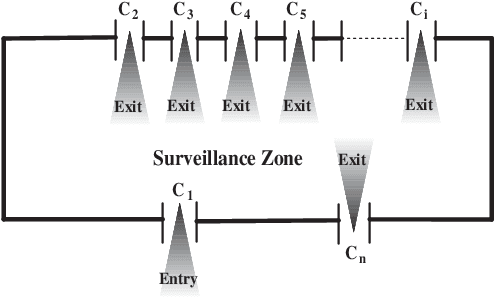
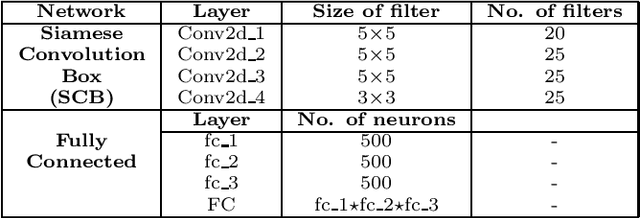
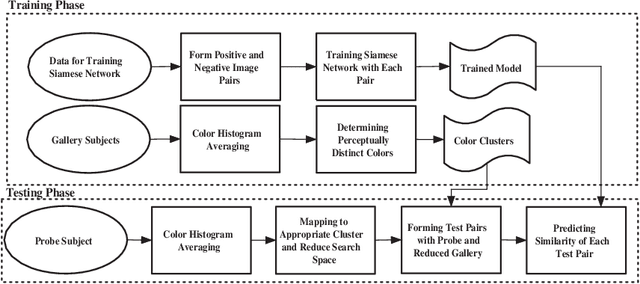
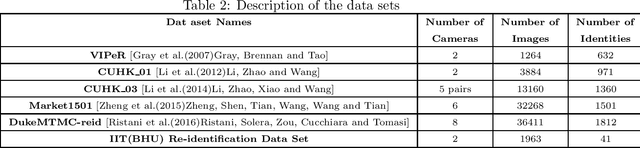
Automated person re-identification in a multi-camera surveillance setup is very important for effective tracking and monitoring crowd movement. In the recent years, few deep learning based re-identification approaches have been developed which are quite accurate but time-intensive, and hence not very suitable for practical purposes. In this paper, we propose an efficient hierarchical re-identification approach in which color histogram based comparison is first employed to find the closest matches in the gallery set, and next deep feature based comparison is carried out using Siamese network. Reduction in search space after the first level of matching helps in achieving a fast response time as well as improving the accuracy of prediction by the Siamese network by eliminating vastly dissimilar elements. A silhouette part-based feature extraction scheme is adopted in each level of hierarchy to preserve the relative locations of the different body structures and make the appearance descriptors more discriminating in nature. The proposed approach has been evaluated on five public data sets and also a new data set captured by our team in our laboratory. Results reveal that it outperforms most state-of-the-art approaches in terms of overall accuracy.