 Add to Chrome
 Add to Firefox
 Add to Edge
ASTELD: A Six-Axis Classification Framework for Autonomous AI Agents - Design, Evaluation, and an OpenClaw Case Study
Aug 05, 2026
Autonomous AI agent platforms differ substantially in architecture, security, tool integration, execution, autonomy, and deployment, yet the field lacks a common classification scheme for comparing these design choices. We propose ASTELD, an operational six-axis classification framework for autonomous AI agents: Architecture pattern, Security posture, Tool integration model, Execution paradigm, Level of autonomy and human control, and Deployment topology. ASTELD is constructed by synthesizing prior agent taxonomies with observable platform properties and explicit category-assignment rules. We evaluate its discriminative and explanatory utility by mapping eight representative frameworks and by using OpenClaw as an in-depth case study. The resulting profiles separate all eight platforms under their dominant configurations and reveal three cross-platform patterns: a security-accessibility diagonal, strong execution-architecture coupling, and capability convergence with persistent architectural differentiation. We further classify 50+ OpenClaw derivatives and find that innovation concentrates on the Security, Execution, and Deployment axes, indicating that ASTELD can explain where ecosystem fragmentation occurs. The OpenClaw case study also supplies a six-category vulnerability taxonomy, evidence from five institutional assessments, and adoption and governance analyses that connect platform coordinates to observed risks. These results position ASTELD as a reproducible method for comparing agent platforms, identifying unoccupied design regions, guiding framework selection, and organizing future empirical research. The analysis also exposes a consequential empty region: none of the evaluated systems combines local-first deployment with enterprise-grade security.

SoniSpeech: A Large-Scale Open-Vocabulary Tri-Modal Dataset for Wearable Silent Speech Interfaces
Aug 01, 2026Wearable silent speech interfaces (SSIs) are limited to small, closed vocabularies. Approaches achieving larger vocabularies require obtrusive hardware such as facial electrodes. We present SoniSpeech, the first large-scale, open-vocabulary, trimodal dataset for wearable SSI using acoustic-sensing eyewear. It contains 34 hours across 18,000 utterances with three synchronized modalities: ultrasound echo profiles, voiced audio, and frontal video, in both voiced and silent modes. The corpus draws from the SODA dialogue dataset, providing contemporary conversational English with 5,356 unique words and full phoneme coverage. A CTC-based ResNet-34 baseline achieves 26.3% word error rate (WER) on open-vocabulary silent speech recognition, the first benchmark for this task. Dataset is available at https://doi.org/10.7298/xjjr-9m85
SYNAPSE: Empowering LLM Agents with Episodic-Semantic Memory via Spreading Activation
Jan 06, 2026While Large Language Models (LLMs) excel at generalized reasoning, standard retrieval-augmented approaches fail to address the disconnected nature of long-term agentic memory. To bridge this gap, we introduce Synapse (Synergistic Associative Processing Semantic Encoding), a unified memory architecture that transcends static vector similarity. Drawing from cognitive science, Synapse models memory as a dynamic graph where relevance emerges from spreading activation rather than pre-computed links. By integrating lateral inhibition and temporal decay, the system dynamically highlights relevant sub-graphs while filtering interference. We implement a Triple Hybrid Retrieval strategy that fuses geometric embeddings with activation-based graph traversal. Comprehensive evaluations on the LoCoMo benchmark show that Synapse significantly outperforms state-of-the-art methods in complex temporal and multi-hop reasoning tasks, offering a robust solution to the "Contextual Tunneling" problem. Our code and data will be made publicly available upon acceptance.
Opportunities and Challenges of Large Language Models for Low-Resource Languages in Humanities Research
Dec 09, 2024Low-resource languages serve as invaluable repositories of human history, embodying cultural evolution and intellectual diversity. Despite their significance, these languages face critical challenges, including data scarcity and technological limitations, which hinder their comprehensive study and preservation. Recent advancements in large language models (LLMs) offer transformative opportunities for addressing these challenges, enabling innovative methodologies in linguistic, historical, and cultural research. This study systematically evaluates the applications of LLMs in low-resource language research, encompassing linguistic variation, historical documentation, cultural expressions, and literary analysis. By analyzing technical frameworks, current methodologies, and ethical considerations, this paper identifies key challenges such as data accessibility, model adaptability, and cultural sensitivity. Given the cultural, historical, and linguistic richness inherent in low-resource languages, this work emphasizes interdisciplinary collaboration and the development of customized models as promising avenues for advancing research in this domain. By underscoring the potential of integrating artificial intelligence with the humanities to preserve and study humanity's linguistic and cultural heritage, this study fosters global efforts towards safeguarding intellectual diversity.
Evaluation of OpenAI o1: Opportunities and Challenges of AGI
Sep 27, 2024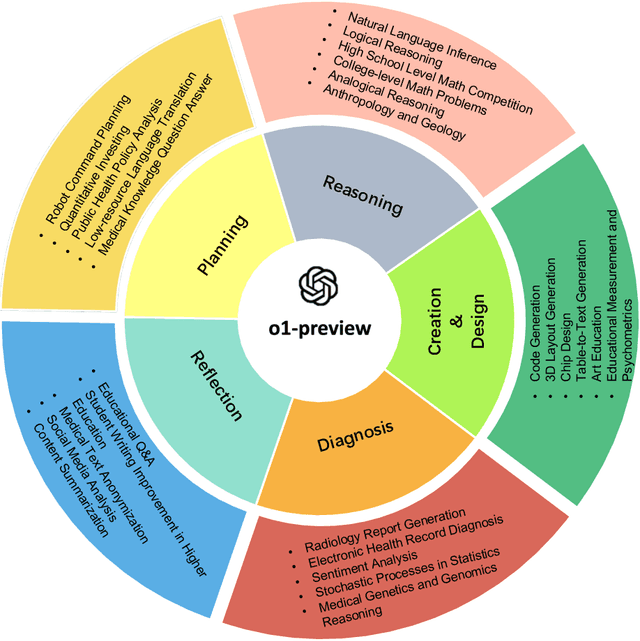
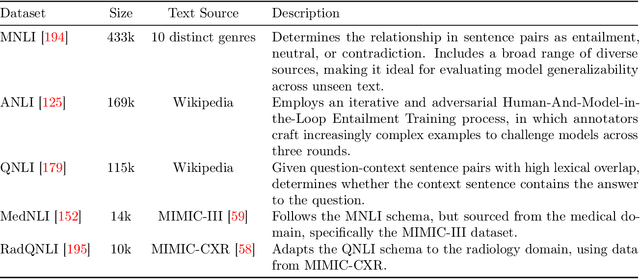


This comprehensive study evaluates the performance of OpenAI's o1-preview large language model across a diverse array of complex reasoning tasks, spanning multiple domains, including computer science, mathematics, natural sciences, medicine, linguistics, and social sciences. Through rigorous testing, o1-preview demonstrated remarkable capabilities, often achieving human-level or superior performance in areas ranging from coding challenges to scientific reasoning and from language processing to creative problem-solving. Key findings include: -83.3% success rate in solving complex competitive programming problems, surpassing many human experts. -Superior ability in generating coherent and accurate radiology reports, outperforming other evaluated models. -100% accuracy in high school-level mathematical reasoning tasks, providing detailed step-by-step solutions. -Advanced natural language inference capabilities across general and specialized domains like medicine. -Impressive performance in chip design tasks, outperforming specialized models in areas such as EDA script generation and bug analysis. -Remarkable proficiency in anthropology and geology, demonstrating deep understanding and reasoning in these specialized fields. -Strong capabilities in quantitative investing. O1 has comprehensive financial knowledge and statistical modeling skills. -Effective performance in social media analysis, including sentiment analysis and emotion recognition. The model excelled particularly in tasks requiring intricate reasoning and knowledge integration across various fields. While some limitations were observed, including occasional errors on simpler problems and challenges with certain highly specialized concepts, the overall results indicate significant progress towards artificial general intelligence.
SeamPose: Repurposing Seams as Capacitive Sensors in a Shirt for Upper-Body Pose Tracking
Jun 17, 2024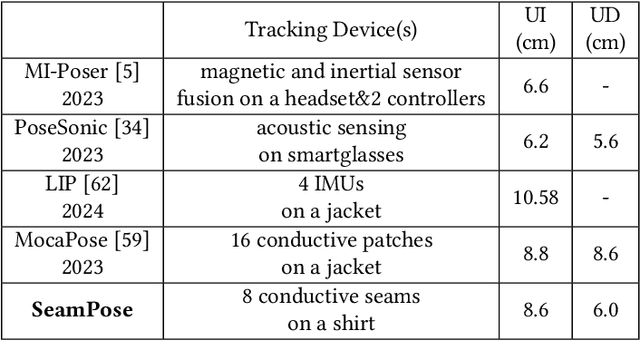
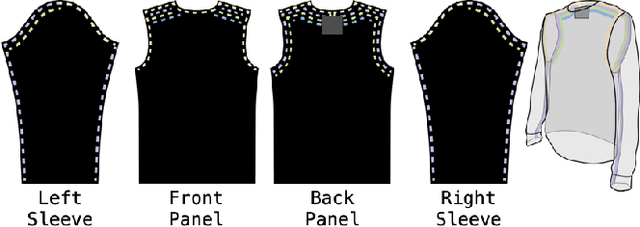
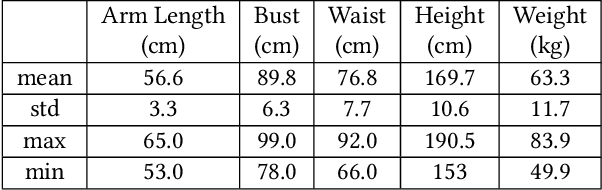
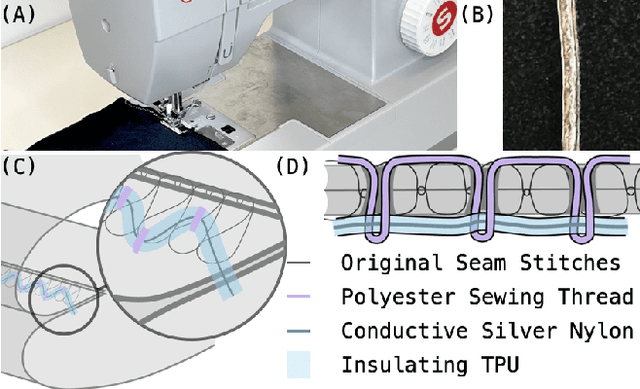
Seams are areas of overlapping fabric formed by stitching two or more pieces of fabric together in the cut-and-sew apparel manufacturing process. In SeamPose, we repurposed seams as capacitive sensors in a shirt for continuous upper-body pose estimation. Compared to previous all-textile motion-capturing garments that place the electrodes on the surface of clothing, our solution leverages existing seams inside of a shirt by machine-sewing insulated conductive threads over the seams. The unique invisibilities and placements of the seams afford the sensing shirt to look and wear the same as a conventional shirt while providing exciting pose-tracking capabilities. To validate this approach, we implemented a proof-of-concept untethered shirt. With eight capacitive sensing seams, our customized deep-learning pipeline accurately estimates the upper-body 3D joint positions relative to the pelvis. With a 12-participant user study, we demonstrated promising cross-user and cross-session tracking performance. SeamPose represents a step towards unobtrusive integration of smart clothing for everyday pose estimation.