 Add to Chrome
 Add to Firefox
 Add to Edge
Pose-Aware Modeling to Mitigate Pose-Related Artifacts in Tactile Gloves
Jul 25, 2026
Tactile gloves digitize contact and force during hand-object interactions, enabling robotics applications in dexterous manipulation, teleoperation, and learning from demonstration. To preserve hand dexterity and capture the nuances of natural interactions, these gloves and the integrated tactile sensors are designed to be soft, flexible, and comfortable. However, such flexible sensors are sensitive not only to contact forces but also unavoidably to hand pose changes, resulting in pose-related artifacts (PRAs). PRAs are especially problematic in the low-force range, resulting in misdetections or late-onset detections of contact, which raises the minimum detectable force (MDF) of the glove. In this work, we characterize the PRAs in relation to pose and force. Building on these insights, we introduce a glove-agnostic algorithmic framework that leverages hand pose information, which is increasingly available, to mitigate PRAs without glove modifications. Our pose-aware force estimation model augments tactile-to-force pipelines with a residual prediction branch that explicitly accounts for pose-induced sensor deformations. We validate our approach across 3 glove designs and 15 users, reducing MDF by 10.4%, 12.2%, and 18.3%, with consistent improvements across all evaluated metrics. This method provides a practical path to improving the usability of tactile gloves in data collection and diverse robotic applications.

SeamPose: Repurposing Seams as Capacitive Sensors in a Shirt for Upper-Body Pose Tracking
Jun 17, 2024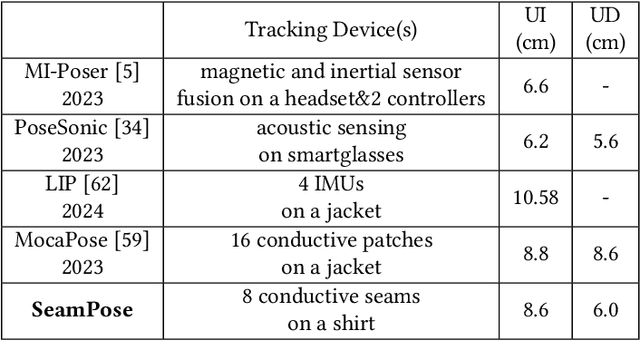
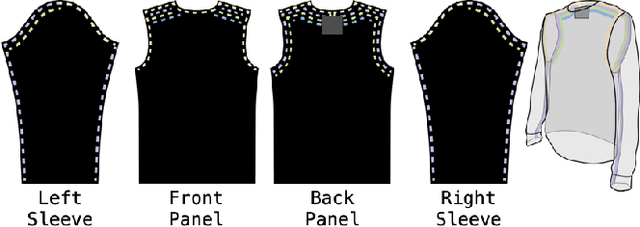
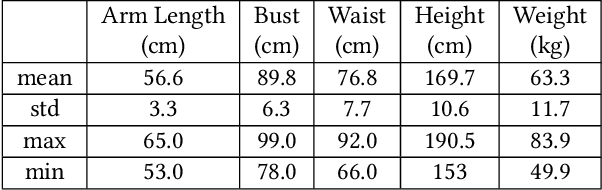
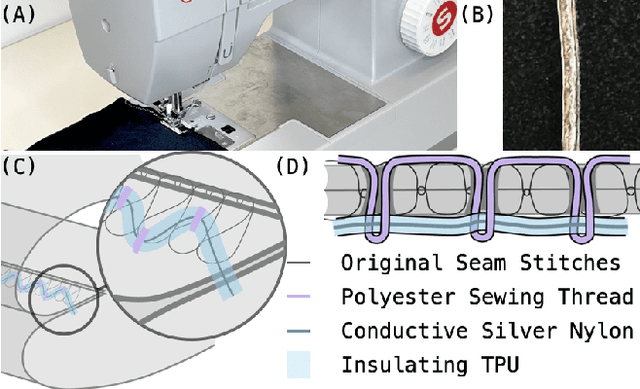
Seams are areas of overlapping fabric formed by stitching two or more pieces of fabric together in the cut-and-sew apparel manufacturing process. In SeamPose, we repurposed seams as capacitive sensors in a shirt for continuous upper-body pose estimation. Compared to previous all-textile motion-capturing garments that place the electrodes on the surface of clothing, our solution leverages existing seams inside of a shirt by machine-sewing insulated conductive threads over the seams. The unique invisibilities and placements of the seams afford the sensing shirt to look and wear the same as a conventional shirt while providing exciting pose-tracking capabilities. To validate this approach, we implemented a proof-of-concept untethered shirt. With eight capacitive sensing seams, our customized deep-learning pipeline accurately estimates the upper-body 3D joint positions relative to the pelvis. With a 12-participant user study, we demonstrated promising cross-user and cross-session tracking performance. SeamPose represents a step towards unobtrusive integration of smart clothing for everyday pose estimation.
RobotSweater: Scalable, Generalizable, and Customizable Machine-Knitted Tactile Skins for Robots
Mar 06, 2023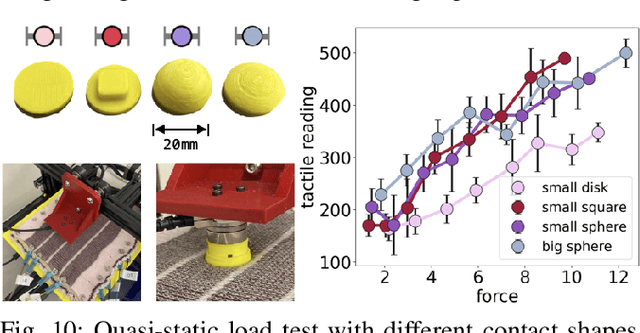
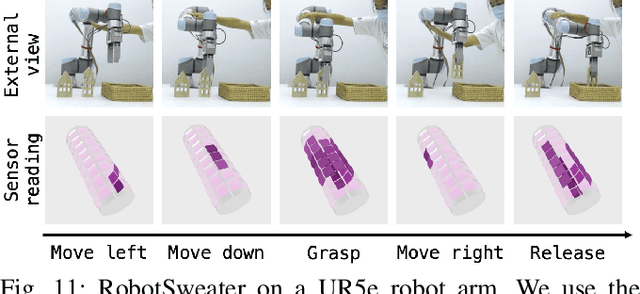

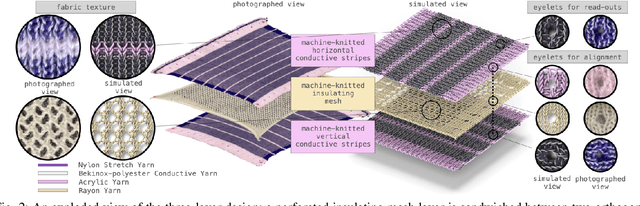
Tactile sensing is essential for robots to perceive and react to the environment. However, it remains a challenge to make large-scale and flexible tactile skins on robots. Industrial machine knitting provides solutions to manufacture customizable fabrics. Along with functional yarns, it can produce highly customizable circuits that can be made into tactile skins for robots. In this work, we present RobotSweater, a machine-knitted pressure-sensitive tactile skin that can be easily applied on robots. We design and fabricate a parameterized multi-layer tactile skin using off-the-shelf yarns, and characterize our sensor on both a flat testbed and a curved surface to show its robust contact detection, multi-contact localization, and pressure sensing capabilities. The sensor is fabricated using a well-established textile manufacturing process with a programmable industrial knitting machine, which makes it highly customizable and low-cost. The textile nature of the sensor also makes it easily fit curved surfaces of different robots and have a friendly appearance. Using our tactile skins, we conduct closed-loop control with tactile feedback for two applications: (1) human lead-through control of a robot arm, and (2) human-robot interaction with a mobile robot.